


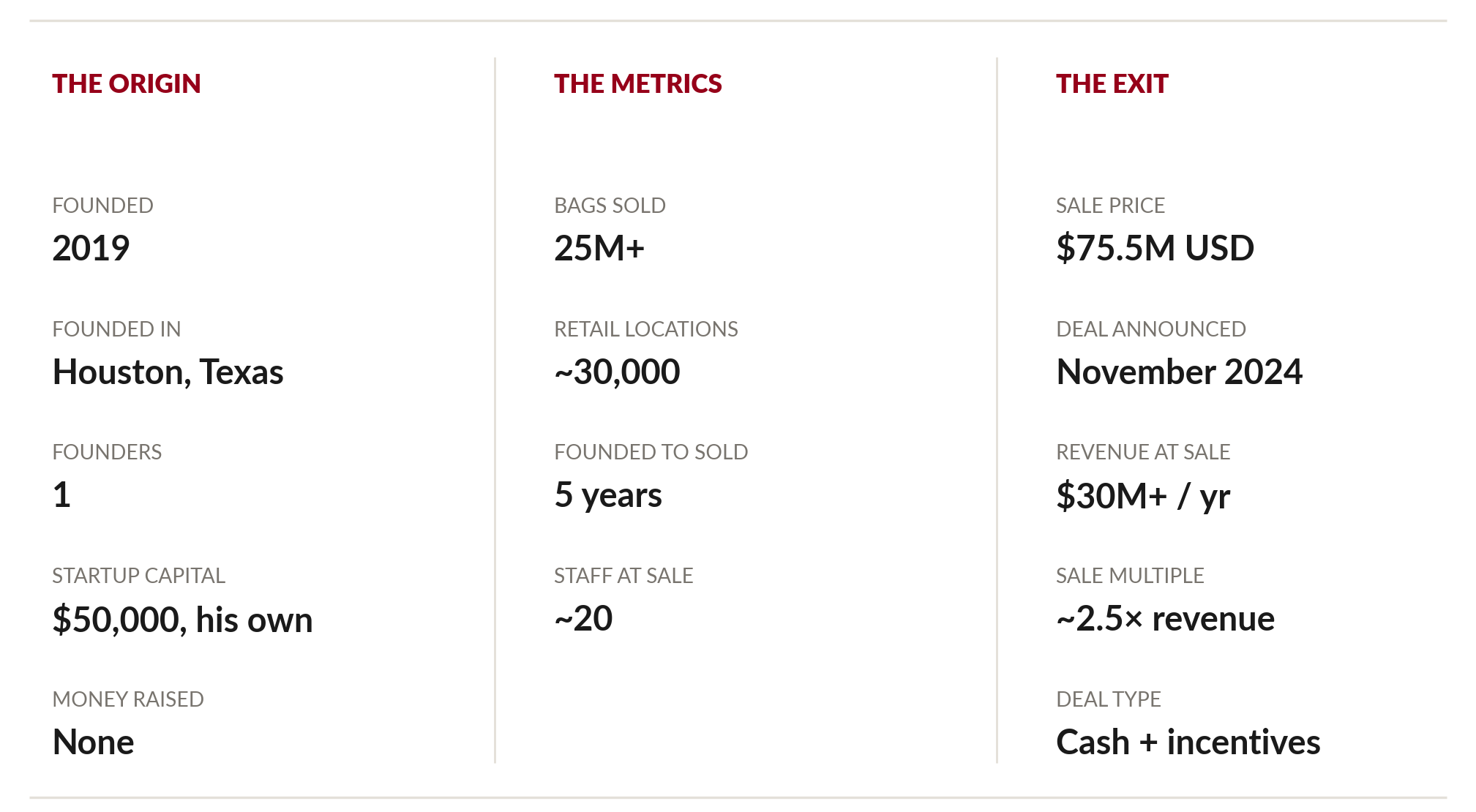
TL;DR: A fitness YouTuber spent seven years building an audience, then spent $50,000 of his own money to create the sour candy he always craved. Five years later, he sold it to Hershey for $75.5M USD, having never raised a dollar and retaining 100% equity. Here’s the full story.
Biggest lessons:
Build the audience before you build the business. Not only is it the most organic form of marketing, it’s trust.
A clean cap table sells quickly — no investors, no debt, and no contracts to unwind took this deal from a conversation to a bank balance in just two months.
01: the $75.5 million guessing game
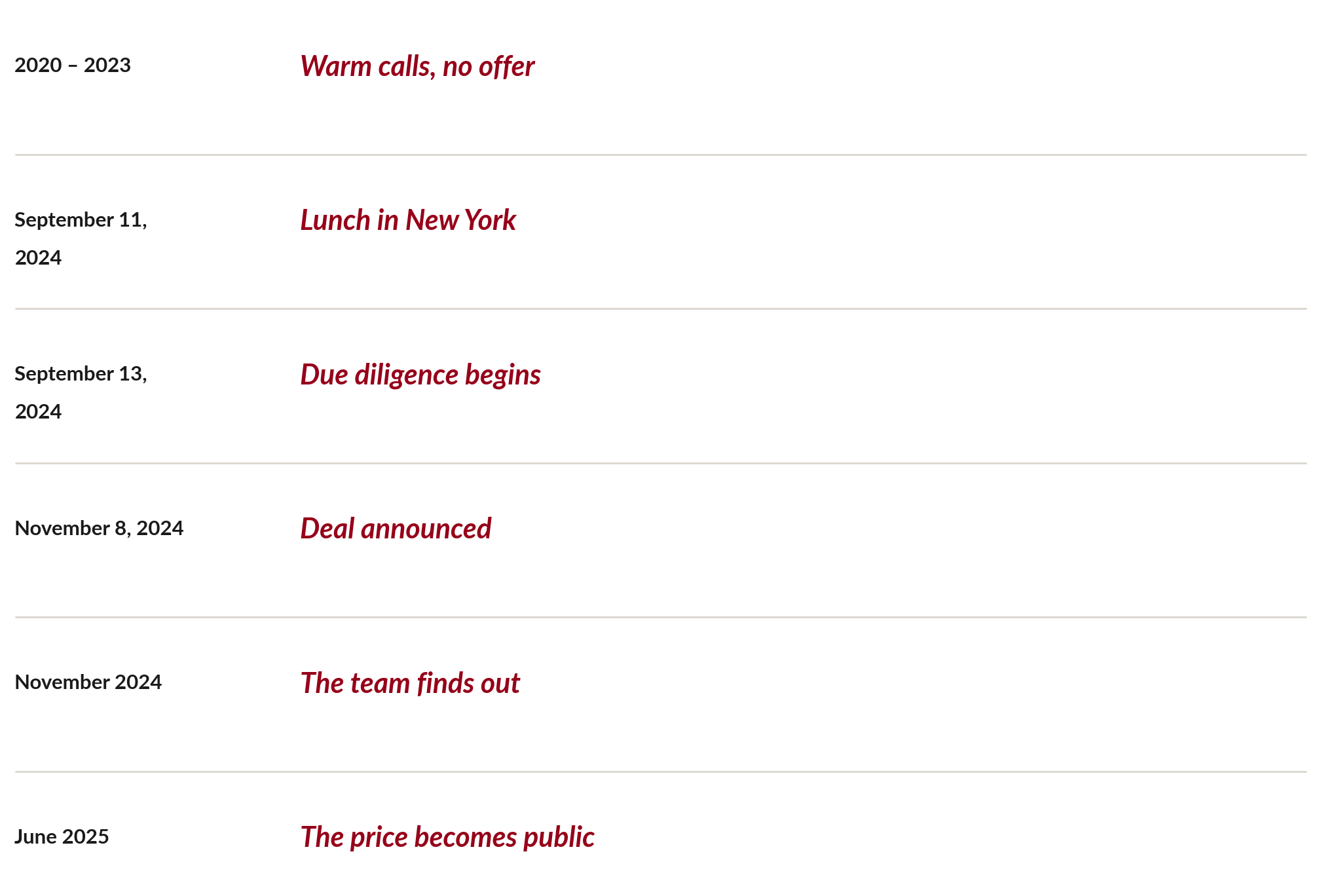
On November 8, 2024, The Hershey Company announced the acquisition of Sour Strips. The press release was very formal: a few hundred words about expanding its candy portfolio and a quote from an executive. It mentioned everything, except the acquisition price.
Maxx had amassed a YouTube following of several hundred thousand by 2024, and, as you might imagine, the guessing began. People from all corners of the internet cast their vote, pegging the Sour Strips acquisition price anywhere from $75 million to half a billion, which is reasonable for knowing next to nothing about the buyer or the situation. The actual number arrived in a June 2025 podcast episode, broadcast by Maxx himself.
$75.5 million.
It went to sole owner Maxx Chewning who had started the company five years earlier with just $50,000 of his own money – an impressive feat for a physical product business by any stretch. He never raised capital, didn’t take on any debt, and never sold as much as a fraction of a percent to anyone.
“So the company got sold for $75.5 million. And that was a number that… was right in line of what I expected the company to honestly get sold for.”
— Maxx Chewning
Here is how a man whose first warehouse was a ten-by-ten foot office got to an exit of that scale.
02: how it started
Maxx Chewning grew up in Virginia and started posting fitness videos on YouTube in 2013 — workouts, food challenges, and, eventually, the business ventures themselves. When he first started, he was working an IT job. He was ultimately fired for doing YouTube on company time.
Like many fitness YouTubers in the early 2010s, Maxx started a clothing brand to sell to his dedicated audience, primarily gym goers. This brand was Ever Forward Apparel, named after his father, who died of ALS years earlier; the phrase “Ever Forward” had been his. Maxx learned business skills that would later jumpstart his success at Sour Strips — textiles, manufacturing, import processes and the ‘in the weeds’ mentality that included packing orders every night and dropping them off at the post office the following morning.
He later moved to Houston, Texas, mostly because that was where several close friends including Christian Guzman (also a fitness YouTuber who started the clothing brand Alphalete) lived at the time. He made the trip down there so often, he figured why not just move there instead.
By that time, Ever Forward had peaked at $1.6 million in annual revenue. By creator merch standards, it was a sizeable business. It was also, according to Maxx, a business that existed because of him rather than beyond him. Legacy was important to him.
The idea that would outlast him had been sitting in his videos for years.
Original fans knew that Maxx was a sour candy fiend. He would buy it at gas stations and convenience stores and then publicly complain about how it wasn’t sour enough. It was a running joke that the big candy companies should hire him to approve new products before they shipped them.
The joke was also a spark, with a full market analysis conducted over the span of two decades trying ‘sour’ candy.
In 2017, Christian Guzman launched an energy drink brand called 3D Energy. The shift from apparel to consumables inspired Maxx, knowing it could be done as a fitness YouTuber. The journey officially began in 2018.
“I never overanalyzed the market. It wasn’t a big master plan. As a candy fanatic, I was always analyzing what’s available in stores, and I was not as impressed as I felt like I could be.”
— Maxx Chewning
It took approximately eighteen months mostly because of several roadblocks - Manufacturers wanted order minimums he didn’t want to commit to while the samples he received were not sour enough to put his name behind the product. The project kept being put aside, but something kept pulling him back.
Investors were interested early on. The idea was to bring someone onboard who had industry experience, and to let Maxx be the face of the brand as a public creator. With the dragging timeline for actually getting started, they eventually lost interest.
Maxx was ultimately left with one option: Fund the $50,000 to get the thing off the ground himself.
Please take a moment to share this article of founded. if you are enjoying it so far. It helps me grow and provide ever-more interesting case studies!
03: the twenty-thousand-unit hour
Sour Strips launched online on September 9, 2019, with the tagline “sour candy that doesn’t suck.” It sold more than 20,000 units in the first hour, the very real benefit of an engaged and dedicated audience he had spent years building.
People who followed his business ventures onscreen had two reasons to buy: the first was that they genuinely wanted to support Maxx; the second was those loyal fans who watched him complain about sour candy for years, eager to find out if he had finally cracked the sour-candy code. Whatever the reason, it worked.
“I’d built a social media audience for seven years. When I launched it, they not only wanted to support me, but also trusted that, hey, if I’m really into candy, I probably know what a good product is.”
— Maxx Chewning
The first warehouse was a ten-by-ten-foot office space. In December 2019 he added Tropical Mango, the first new flavor, because of a nudge received by members of his audience. By the brand’s first birthday in September 2020, it had sold more than one million bags or roughly $3 million in revenue.
The perfect positioning and the timing of it all became much clearer in hindsight. Six months after the brand launched, the world had its first COVID-19 shutdown. People were forced to stay home, were bored, and watched YouTube. The other thing they did was scroll and shop online. A YouTuber with a candy brand that fulfilled online orders was near perfect positioning for the brand to slingshot to the big leagues.
04: navigating margins
Before launch, Maxx called a friend who had built several large drinks brands. He was told what an optimal distributor margin, cost per unit, and sale price were. His cost was much higher than the friend suggested; by all measures, the business wasn’t operating efficiently and his costs were too high.
The tradeoff was the final price at which he sold to consumers. He rationalized that he would pay an extra dollar if the candy was actually sour and tasted good. It was either that or selling cheap candy that meant no team, no retail opportunities, and in the end, no brand. The choice to sell at a higher price point than direct competitors signaled to buyers that it wasn’t a competitor at all. He had created a premium category in one that wasn’t supposed to be premium at all. The decision paid off and ended up funding his team, providing retail opportunities and built the Sour Strips brand.
The second unique component of Sour Strips was the option to forego a sales team entirely. This came down, once again, to positioning.
When brick-and-mortar stores reopened post-pandemic, they needed every reason to get customers back into their stores. A candy brand that had a cult online following filled the gap perfectly. Many retail buyers had also seen the brand grow online over the last two years and were ready to make an offer.
In January 2023 Sour Strips went nationwide — all fifty states in more than 16,000 stores — which was the moment it stopped being an online brand. Over the five-year timeline, revenue skyrocketed from $3 million in year one, to $8.5 million, $16.5 million, $25 million, and then over $30 million in the final year before it was sold.
The rapid growth pattern emerged in every new retail venture: Sour Strips got into five H-E-B stores in the first week with the chain. Managers at other H-E-B stores saw the sales data and five to fifteen store requests started flooding in each day.
05: the tools
the product
The Sour Strips product consists of flat belt-like candy strips covered by a tooth-enamel-destroying layer of sour. They are sold in a resealable bag with a clear frontside so buyers can see the strips in all of their glory — a detail Maxx adopted from the candy he liked as a kid. By the time of the sale there were thirteen flavors in addition to bite-sized and party-size strips. There were also plenty of collaborations with other candy brands and even one with his friend’s energy drink.
founder skillsets
Maxx had developed a rather diverse skillset from building Ever Forward, and continued to build on them while Sour Strips grew. His skills as a YouTuber also helped with marketing, brand, and distribution. Of particular interest was the obsession to curate the brand, product SKUs, packaging and flavor of each new addition to the lineup himself rather than outsourcing it. His taste needed to be the final signoff – something Maxx understood well having built a personal brand on social media.
The operational side was mostly handled by a long-term friend and employee who handled vendor interactions, photoshoot setups, insurance, and documentation for distribution. Near the end of Maxx’s run at Sour Strips, the team had grown to around 20.
the warehouses
The ten-by-ten office space did not last long. The first real move was to a 1,000 square feet backroom inside of Christian Guzman’s Alphalete headquarters, a space Maxx renovated himself. It could hold 250,000 bags when full, which sounded like plenty until Sour Strips outgrew it in under a year.
Christian was the one who pushed him to make the big jump to 13,000 square feet, which seemed way too big at the time. Sour Strips outgrew it in under two years. The next step was a split 58,000 square foot warehouse of which Sour Strips occupied approximately half. Even those 28,000 square feet were reaching capacity before the sale went through. In a June 2026 YouTube video, Maxx explains how the lease was up and the brand was moving to a bigger space still.
monetization
Sour Strips was monetized through three primary channels, in chronological order of when they were first established:
Direct-to-consumer. The channel that first launched the brand and, for the first few years, was the whole business. The benefits included keeping the entire margin to reinvest in the business and a list of customers that followed and respected the founder. The limitation was volume.
Wholesale retail. This channel lowered the margin per bag but significantly increased volume. This is what took annual revenue from low seven figures to over $30 million, and it is what built the brand into something worth selling.
New products. Smaller sized bites, party packs and collaborations were sold within the already existing network of customers, ensuring repeat business.
unique branding
The primary aim of most candy brands is to attract children. Soft, swirly text, primary colors and cartoons invite children to try them, and is perhaps also why most candy isn’t sour enough. This is where Sour Strips created a category of its own. Maxx was thirty when he launched Sour Strips, so he created it for candy fiends like himself. Packaging strategically had angry fruit characters, was mostly black and white and had a tagline that would not pass other candy brand’s legal review.
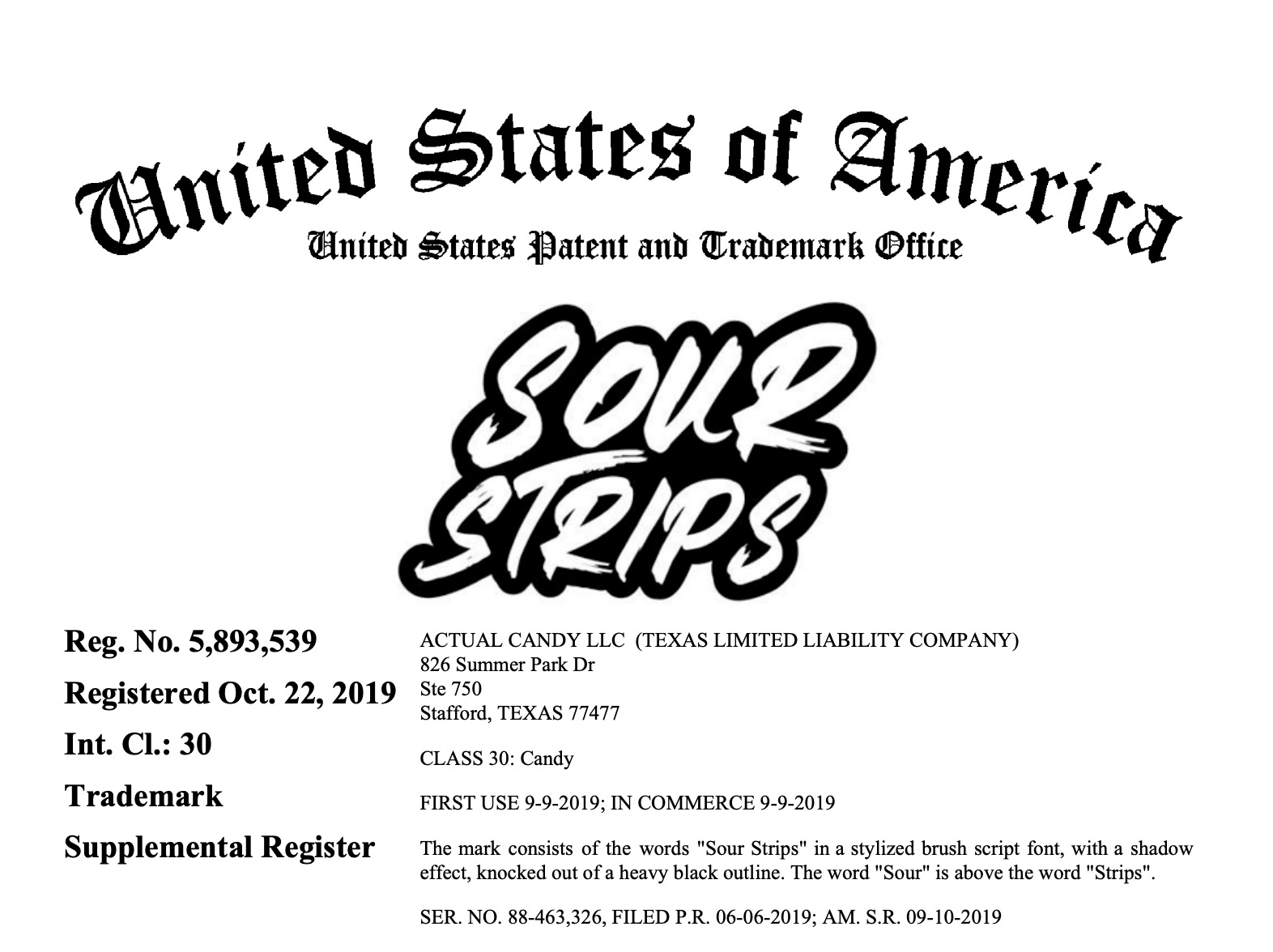
The part of the business that was hard to replicate wasn’t the candy or even the packaging, it was the founder’s love for candy, a loyal audience that had seen him try thousands of brands, and the fact that he was still personally making the videos and branding even after the company was worth eight figures.
“Our core value is to be a cool brand, and that’s not hard if you don’t overanalyze it.”
— Maxx Chewning
06: by the numbers
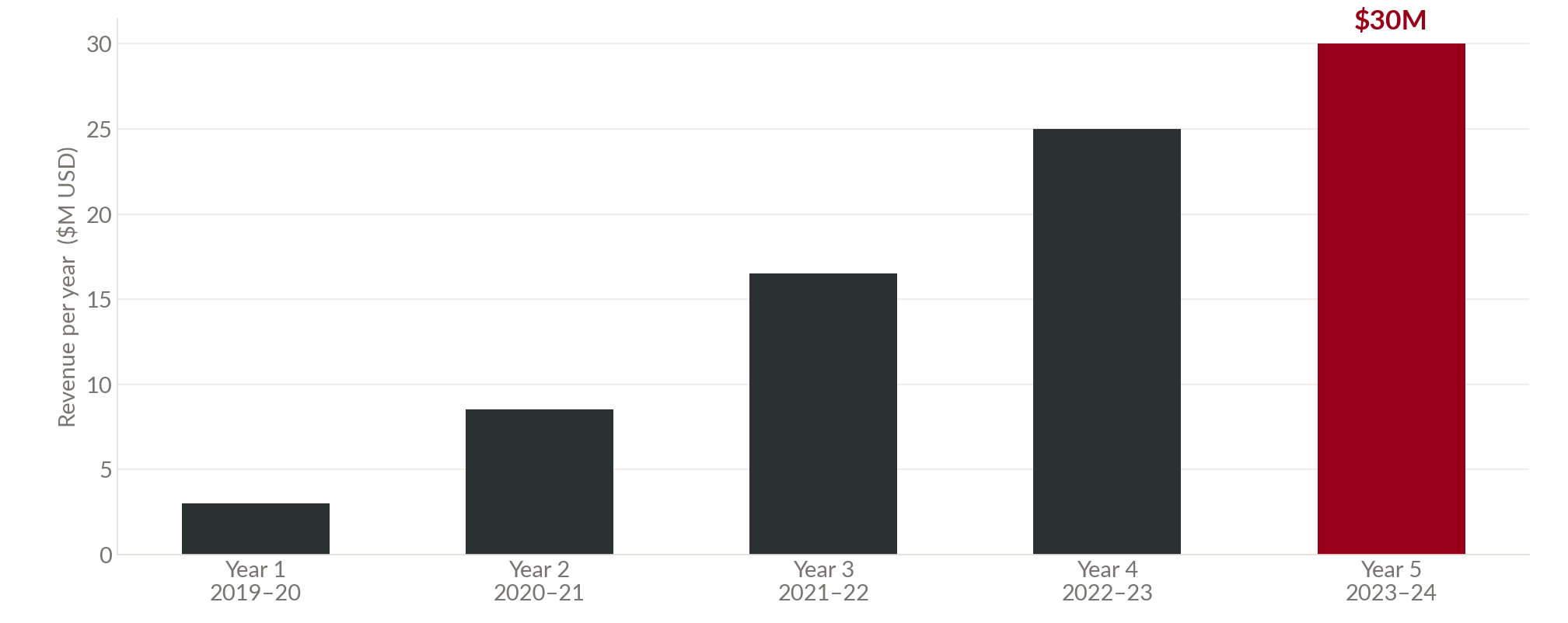
Years run from the September 9 launch anniversary. The four later figures are as Maxx has publicly stated; the first-year figure is from a 2023 profile of the business. Year five is plotted at $30M against a stated “over $30 million”.
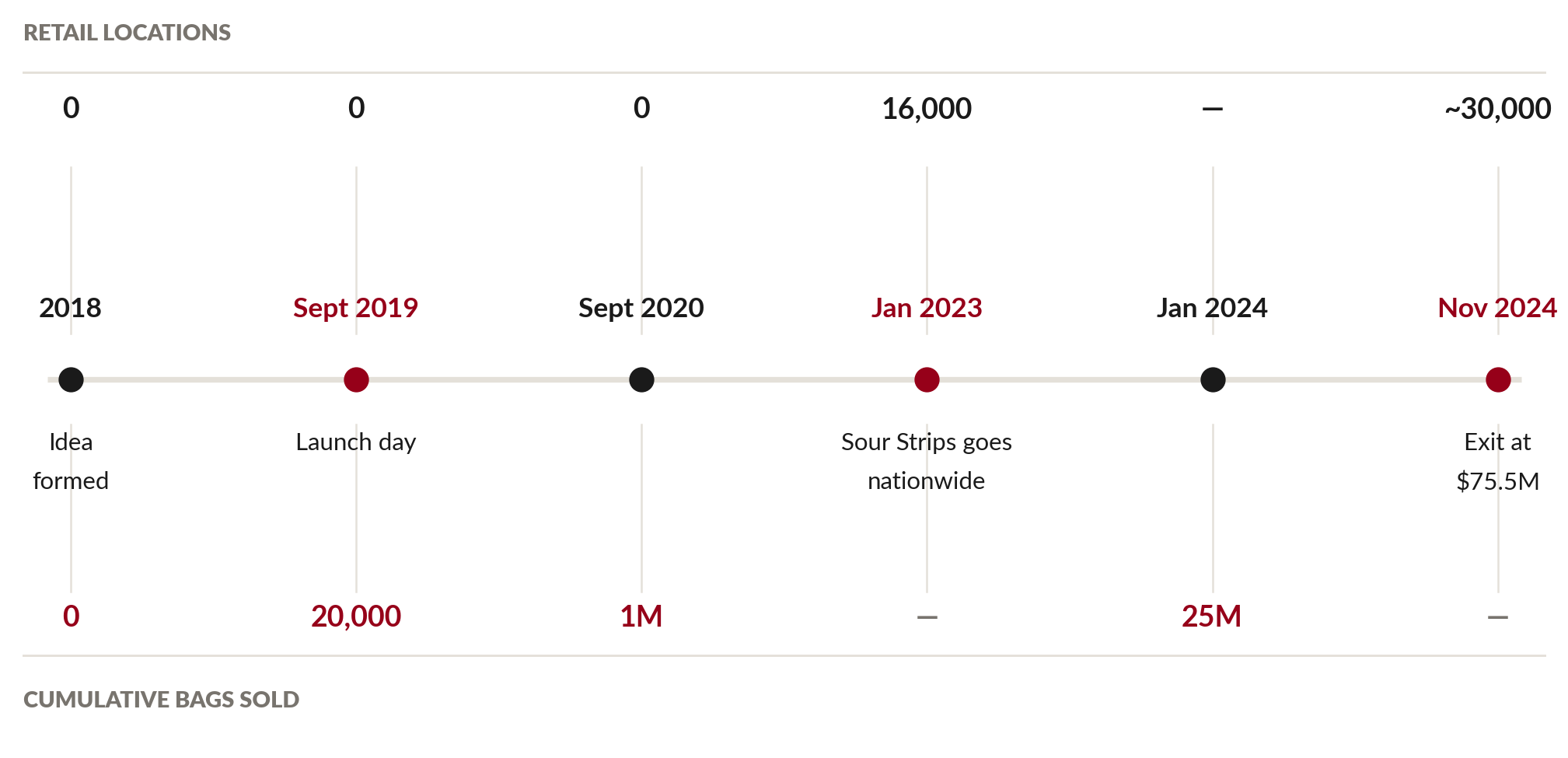
The business took a grand total of five years and two months from public launch to the announcement of the sale.
07: the decision to sell
Hershey had been calling for years. Not to negotiate, but just to check in. Roughly once a year somebody would call Maxx, say they liked what he was doing, ask whether he needed anything, and hang up. Maxx was intrigued by the interruption, but never thought much of it.
Private equity firms emailed regularly as well. He ignored them, both because he didn’t feel the need for outside capital, and because if he ever did sell, he wanted it to be to a candy company.
In September 2024, the annual call from Hershey came with a request to meet in person in New York. Maxx was heading to New York anyways — his wife was attending fashion week, there was a Sour Strips event, and it was his birthday. The lunch took place on Wednesday, September 11. He recounts coming back to the hotel and telling his wife he had no idea what had just happened.
Two days later, a file with several hundred questions about the business landed in Maxx’s inbox. This was their due diligence.
Sour Strips had just turned five years old earlier that week.
“It wasn’t this desire. It wasn’t like I need to sell because of cash flow or I need to sell because I’m hating doing this. It was like I’m in, I’m doing candy, man. This is my dream.”
— Maxx Chewning
The initial push to sell to Hershey was the unlock for the next level of growth: Hershey had the access and network to get Sour Strips into more than 300,000 retail locations rather than the current 30,000 in a matter of months rather than the years it would have taken Maxx. It was also an easy way to avoid dealing with the staffing nightmare of a fast-growing candy company, and, of course, the copycats stealing Sour Strips’ spotlight.
08: the sale process
“It felt like I was back in school almost, because they give you this Excel spreadsheet with hundreds of questions that you should know the answer to, but I’m kind of doing them out of order. I’m like, no, don’t know that one. Skip that one.”
— Maxx Chewning, on due diligence
09: what went wrong
01: Eighteen months of stalling before launch
The delay in launching Sour Strips was doubt. Maxx knew what his vision was for a candy brand, but was unsure he could make a candy that was good enough to market to hundreds of thousands of subscribers. That’s why he kept putting the project aside and picking it up again. In the end, the timing worked out and positioned the brand to scale quickly, so the delay was actually a benefit in hindsight.
02: Profitable and nearly out of cash
Without outside investment, Sour Strips needed to be profitable from day one. For the first three years, all profits went right back into inventory. There were times the accounts ran dangerously low, and the difference between profitability and liquidity became inherently clear to Maxx. Although these lessons were primarily learned from Ever Forward, the scale and growth rate required significant levels of inventory, something not even Maxx was fully prepared for.
03: Running two companies at once
Up until Sour Strips was pulling in $20 million per year in revenue, Maxx was also running Ever Forward. It took until late 2023 to officially shutter the doors on the clothing brand. It took five years of brute force for Ever Forward to reach $1.6 million in annual revenue, but just one year of being in the candy business produced more than $25 million. The writing was on the wall; it was a hard decision for Maxx, particularly because the brand was tied to his father’s legacy.
04: One person wearing fifty hats
Maxx has stated publicly that Sour Strips was never built to be traded hands. He would rather give a task his all in the 30 minutes to an hour it took him to do it than hire for a new position. Although this kept the business lean with more profit to reinvest, it also created key person risk.
05: The team found out at the end
The only employee that knew of the deal was the long-standing friend he employed. He needed her for producing the correct documents during the due diligence process. The other employees found out once the deal had closed. It was clear that if talk of the sale leaked, it could put pressure on the deal. The real reaction came when the sale was announced: not excitement but worry about job security.
10: what went right
01: The audience came before the product
Seven years of videos meant launch day did not require a marketing budget. 20,000 units in the first hour was not because the candy was spectacular. It was the belief that Maxx had created something worth buying. Every creator-led brand stands by this significant advantage when launching a new product.
02: He kept every penny
Founders are traditionally told that outside money is how you scale a physical product; Sour Strips scaled to $30 million on reinvested profits. The wonderful benefit of this was that the $75.5 million was not divided up, it belonged solely to Maxx. It also notably sped up the sale process since the only permission needed was his own.
03: He ignored pricing advice
One of the best decisions Maxx made was to ignore pricing advice from peers. By charging a higher price and imagining it as a premium product, it became exactly that. Without this thinking, there would have been little profit margin and stifled growth as a result.
04: He let retail come to him
This was a unique advantage as a creator. Maxx leveraged his audience to generate awareness for the product until retailers came knocking instead of the other way around. He waited for the big brands like Walmart, Target, and H-E-B to come to him. Once other retailers saw the sales figures, they came quickly. It was a domino-effect.
05: He chose the buyer before there was an offer
Maxx always wanted to sell to a candy brand. More specifically, he wanted one that didn’t have a prominent line of sour candy so that the buyer would have to make it succeed. In other words, he wanted the legacy of Sour Strips to live on beyond his control. The relationship with Hershey that was built up over the years was more subconscious than it was deliberate, something Maxx only realized when he had an offer in-hand.
So far, the bet on the brand has paid off. At the time of the sale, Sour Strips was shipping about one million bags per month. By June 2026, that number had passed two million per month in over 70,000 retail locations. In recent months, they had a record week: 600,000 bags through retail checkouts in a single week.
Just a few years prior, a retailer had asked for 600,000 bags over three months that stretched the small team to their limits. A testament to the immense growth of the business in a short timeframe.
11: founded lessons
In his words:
“You should take advice from a lot of places, maybe from a lot of people who know the space… but you shouldn’t take every piece of advice as: this is concrete and what you have to do.”
— Maxx Chewning
“It’s a good thing, if you’re ever looking for an acquisition, that your team is really small and you don’t have any debt… in my case, owned 100%, no debt, profitable company, super small team.”
— Maxx Chewning
“I built a candy brand for candy lovers, but it was built by a candy lover. And I think that’s this cheat code that a lot of people don’t have.”
— Maxx Chewning
“I know that we are at the extreme of pushing the team, but this retailer wants 600,000 bags in three months. It was never ‘I don’t know if I can do this.’ It was always, ‘Say yes and figure out how you get there.’”
— Maxx Chewning
12: what still isn’t clear from the research
The size and terms of the performance incentives alongside the $75.5 million, and how much of the total amount Maxx has actually received.
What the employees received as a payout. He has confirmed publicly that he paid staff well from the proceeds.
Tax treatment on the final payout.
Whether competition for an offer would have raised the sale price. He never spoke to another buyer, so there is no way to know what Mars, Mondelez or Ferrero would have paid for Sour Strips.
Exact revenue by calendar year. The figures are as Maxx stated them, in company years, in a podcast.
FOUNDED FACT
Hershey sold his first successful company too.
Milton Hershey’s first candy business failed. So did his second. The one that finally worked was his third venture, the Lancaster Caramel Company, founded in 1886. The company performed well enough that the American Caramel Company agreed a price of $1 million in the spring of 1900 and completed the purchase on August 10, 1900, paying cash for the factory, machinery, recipes and the “Crystal A” trademark.
He sold because he was under the impression that caramel was a fad. He kept one thing out of the deal — a small chocolate subsidiary and its equipment — and bet the million dollars on it. In 1909 he and his wife founded a school for orphaned boys, and in 1918 he signed nearly his entire fortune over to it. The trust that runs that school still controls roughly 80% of the voting shares of The Hershey Company today. This means the $75.5 million paid to Maxx was signed off, ultimately, by a boarding school in Pennsylvania.
LEARN MORE
Chew on This — Chewning on the two-month acquisition, the due diligence and telling the team.
I Sold Sour Strips to Hershey’s (let me explain) — his own explanation, on his own channel.
SOURCES
1. The Hershey Company — “Hershey Expands Sweets Portfolio with Acquisition of Sour Strips”, press release, November 8, 2024
2. The Hershey Company — Form 10-K for fiscal 2024, filed February 18, 2025 (confirms the November 8, 2024 completion date and the sale of the brand by Actual Candy, LLC; no purchase price is disclosed)
3. Chew on This podcast — “How Maxx Chewning Sold Sour Strips to Hershey’s for $75.5M”, June 2025 (source of the $75.5 million figure)
4. The Hershey Company — “How Sour Strips Went from Startup to Standout: A Q&A with Maxx Chewning”, May 26, 2026
5. Sour Strips official brand timeline, hersheyland.com
6. Shelf Life Story — “Maxx Chewning’s Multi-Million Dollar Candy Brand: Sour Strips”, December 6, 2023
7. Tubefilter — “Maxx Chewning has a smart strategy for his creator product”, November 12, 2024
8. Hershey Community Archives and LancasterHistory — Lancaster Caramel Company and Milton S. Hershey
9. Maxx Chewning, YouTube — “Saying goodbye to Sour Strips…”, June 2026
Built entirely from public interviews, podcasts, press releases and SEC filings. No interview was conducted with the founder. All figures are as the founder or the acquirer stated them and have not been independently audited. Amounts are US dollars unless noted.