

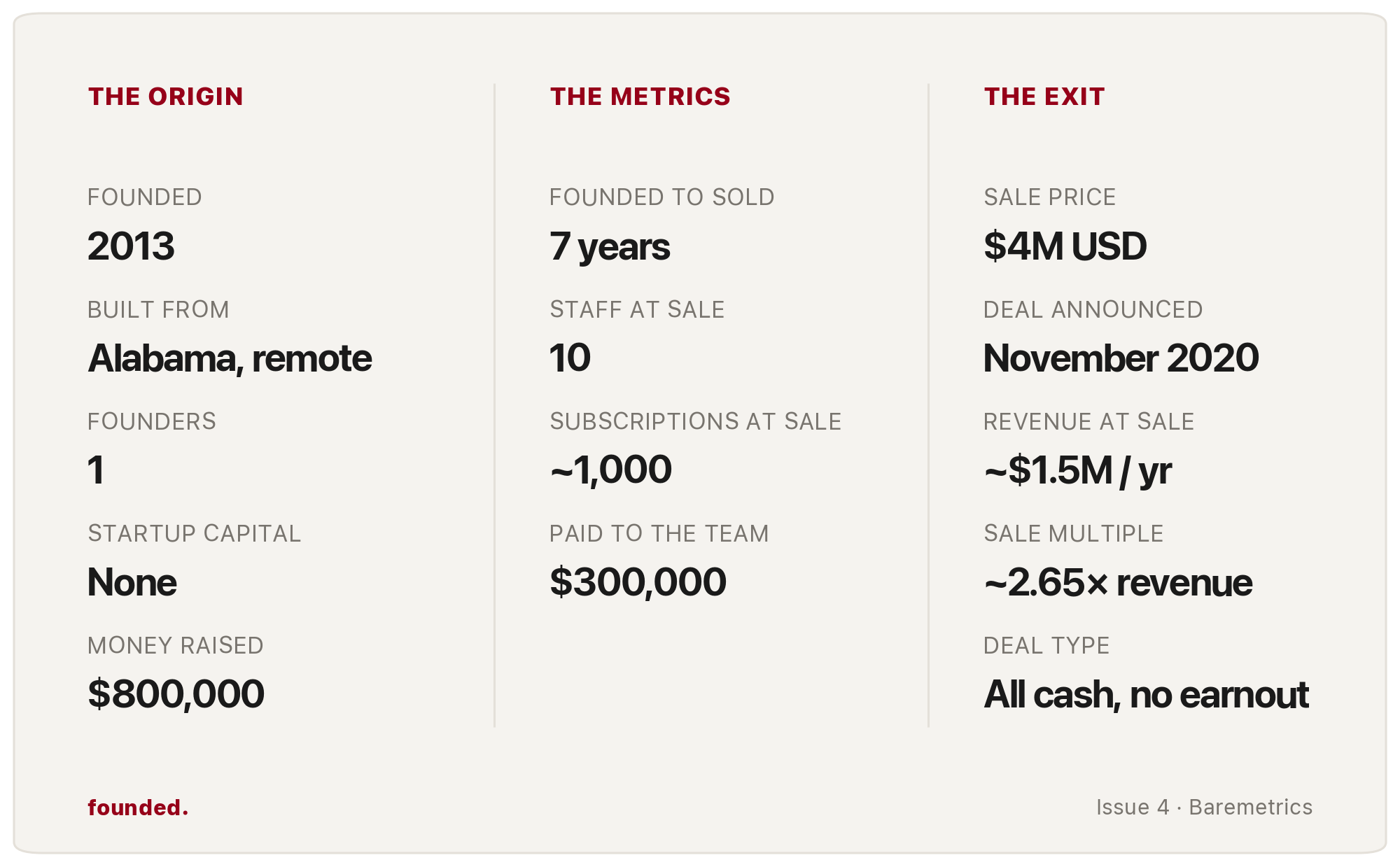
TL;DR: Josh Pigford built a revenue dashboard in one month for his own products, charged for it from day one and was making $20,000 MRR within the first year. He went on to raise $800,000 of outside capital, spent it all, and the business suffered. Seven years after launch, it was sold for $4 million. The caveat: the only way the buyer would agree to a deal was if his investors took a full loss on their investment.
Biggest lessons:
Outside capital changes a business and how it operates. Baremetrics was profitable until the day Josh raised capital.
The price of a product is an important decision. Nobody changed prices for eight years. The revenue plateau that followed was ultimately the reason the company sold for 2.65× revenue multiple rather than five.
01: the write-off
In the weeks before Baremetrics was sold in November 2020, Josh had to make two phone calls that most founders never have to make.
He had an offer on the table — $4 million, all cash, from a buyer he had known for fifteen years. The offer was good for a company of its size, and after a failed sale the prior year, he was not about to let another one go. There was, however, a small problem.
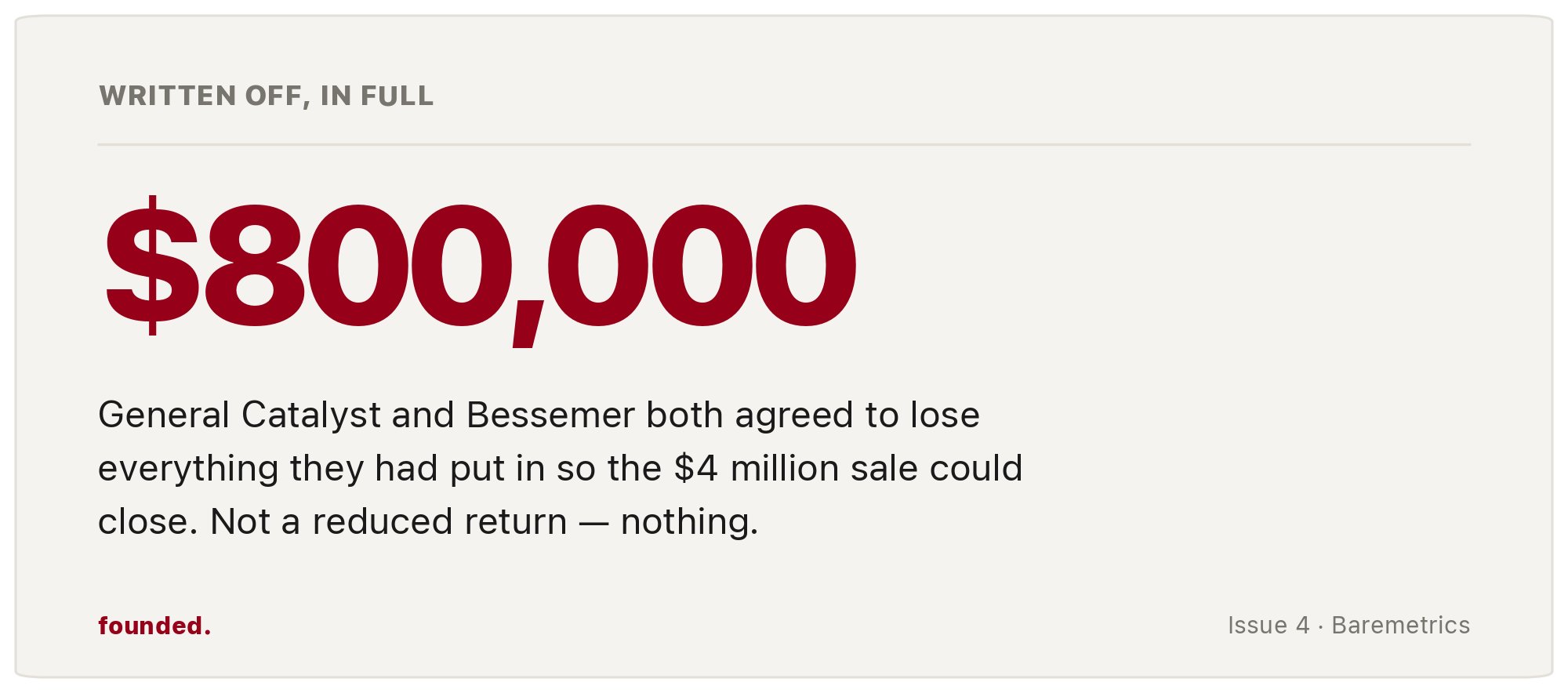
In 2014 and 2015, Josh had raised $800,000 from two investors: General Catalyst and Bessemer Venture Partners. In order to sell the business, both had to agree to never see their investment again.
To Josh’s surprise, both said yes. General Catalyst’s reply was something that a founder never hears.
“We recognize the work that’s gone into the past 7 years and it sounds like this is a great landing spot for the team.”
— General Catalyst, to Josh Pigford
It does stir up confusion. Why would an investor be so calm about losing 100% of an investment? What happened over those seven years? Why was the business unprofitable as soon as outside investment was arranged? The answer is in the detailed story, so let’s dive in.
02: how it started
Josh Pigford grew up in Alabama and was the kid on the block always trying to sell the neighbors something. From homemade birthday cakes to lawn mowing services, he would make a poster, staple it to a stick and plant it in the front yard.
He studied design in college and turned it into freelance web work, which became a consulting company called Automatik Studios. Between 2003 and 2013 he shipped more than forty projects: link directories that he sold later for a profit, a package-tracking tool for online stores that he sold, bought back and eventually shut down, music blogs, tutorials, and a long list of experiments that never earned a dime (his extensive list of projects, past and present, can be found here: https://joshpigford.com/projects).
Most of them failed for the same reason:
“I thought it was a good idea but it was a solution looking for a problem.”
— Josh Pigford
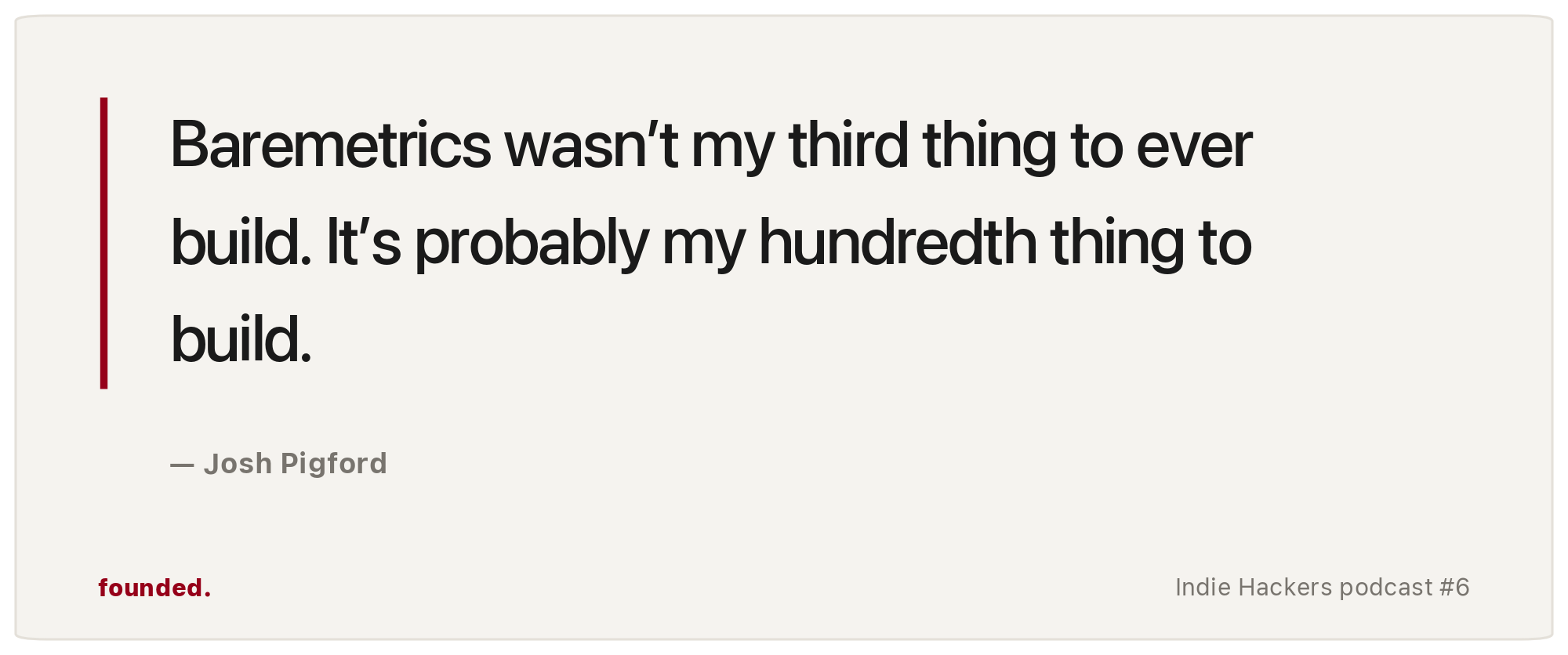
By 2013, two ideas were finally working. PopSurvey and Temper were survey and feedback tools built to work with Stripe were generating roughly $5,000 MRR combined. Not life-changing money, but proof that a decade of shipping had taught him something. Every skill Baremetrics would eventually need — the speed, the design eye, the confidence to charge on day one — had been paid for by products almost nobody used.
What looks like an overnight success was a decade of practice paying off.
Josh was a young entrepreneur, running two small software products businesses in 2013 — a survey tool and a feedback tool — and found himself exporting Stripe data to an Excel sheet once a month to collect data. The issue he consistently ran into was the lack of useful metrics captured. Stripe told you when money had been sent and who sent it. It didn’t, however, tell you pertinent metrics to grow a business: customer churn, revenue per customer, or month over month growth.
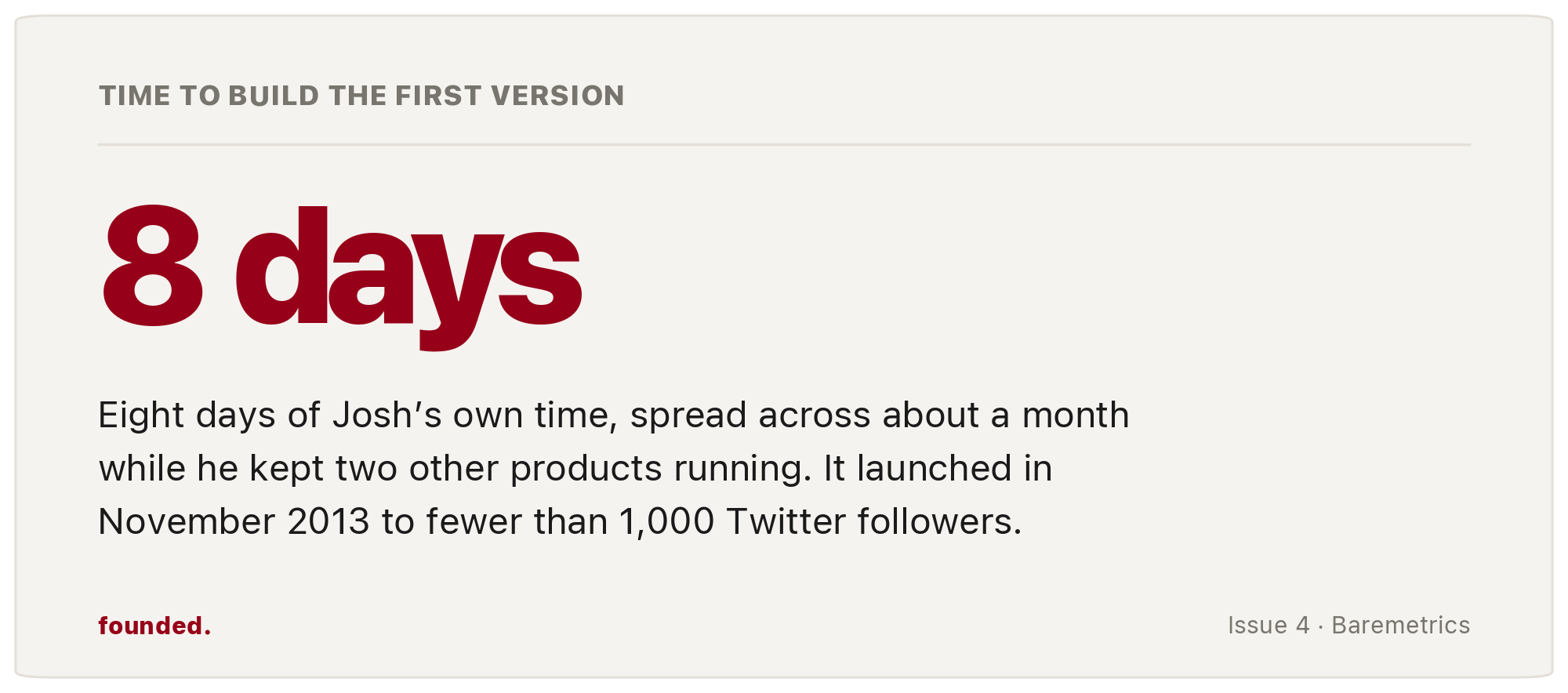
He did what a logical entrepreneur would do and built the dashboard for himself first. So, in less than a month, he built it — eight days of actual work, spread out because he kept the other two products going at the same time — and launched it on Twitter where he had less than 1,000 followers.
Launch day brought five or six paying customers. One of them was a complete stranger who signed up on the most expensive plan at $250 per month — a tier Josh had put on the pricing page without expecting anybody to pay for it.
His distribution was terrible, but that didn’t matter. He knew something others didn’t that was rooted in a problem he had already encountered himself. If he had this frustration, he knew that others did too. It’s how he validated an idea within one week that would have taken another entrepreneur an entire year while testing.
The first year was a founder’s wet dream. Month two was the $1,000 monthly recurring revenue (MRR) milestone. This became $1,650 in month three. Then $3,200 and $5,300. By month six he was at $8,300, beating every estimate and goal he had.
Two catalysts brought the business to the next level. In April 2014, Buffer — then the most conspicuously transparent startup on the internet — made their Baremetrics dashboard public. Users that were curious about Buffer’s revenue landed on a live page that featured Baremetrics’ name. Josh later described it as the single biggest consistent source of referral traffic the company ever had, stating it permanently changed the shape of the growth curve. Visitors who saw the dashboard working in real time converted at 5.5 times the rate of an ordinary buyer.
The second was strategic writing, though not the kind most companies think of when hearing ‘content marketing’.
“Just generic content marketing is not the stuff that worked well for us. What did work well was when I laid out very specific things I did and gave tips.”
— Josh Pigford
The posts that worked were the ones with numbers in the titles: “How Hacker News generated $1,500 in monthly revenue”, “idea to $5,000 a month in five months”, “how we got our first hundred customers”. The triangulation of the idea was a thing of beauty. He wrote the articles for his customers, using his own company as a case study to drive leads, and then sold the product that was producing all of the numbers he wrote about.
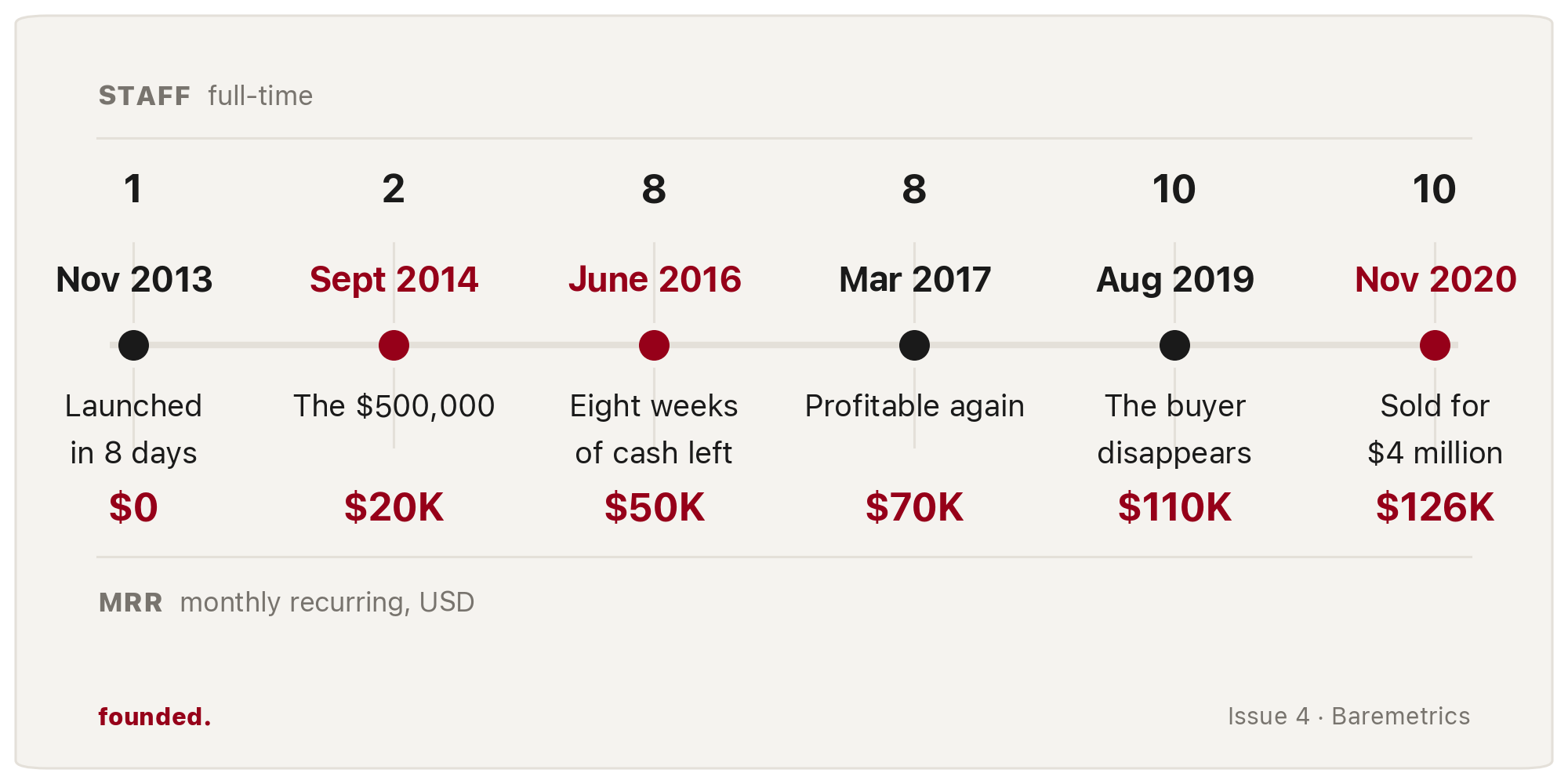
By September 2014, Baremetrics was generating $20,000 MRR, with 250 paying customers by October and five employees.
It was also the month Josh decided to raise money.
If you’re enjoying this issue of founded., consider subscribing for a weekly issue right to your mailbox.
03: the $500,000 investment
General Catalyst had just launched a $10 million fund specifically for companies built on or for Stripe, and Baremetrics fit the bill. The final number was a $500,000 investment on a Simple Agreement for Future Equity (SAFE) at a $10 million valuation. The stated plan was to make three strategic hires: an engineer, a data scientist, and support staff.
Over $250,000 was depleted by month four. In that time, the team had expanded from two full-time employees to six and the company had stopped growing; a side effect of the key marketer (Josh) spending his time getting funding and making hiring decisions.
In December 2015, the decision was made to raise another $300,000 to hire two additional staff. Total headcount was now at eight, while the company had not been profitable since there were only two full-time employees.
By June of 2016, Josh came to the realization that the business was burning cash at a rate of $40,000 per month and there was about eight weeks of runway left.
“We’re running out of money and I need all of you to take a pay cut.”
— Josh Pigford, to the team
The team took the news rather well. They agreed to take a 15% pay cut. Josh took a 30% cut. One employee even volunteered to take a 50% hit to their salary for several months to get the business to profitability sooner. It had worked quite quickly; expenses came down by $20,000 in the first month and by almost $30,000 the month after. By December 2016, Baremetrics was profitable again, allowing employees to receive their full paychecks two months later.
This marked the end of a 27-month no-profit spell, which Josh bluntly blames on his vision and optimism:
“I was playing ‘visionary’ and just assuming things would work out because…of course they would!”
— Josh Pigford
“Eternal optimism is a tough beast to overcome.”
— Josh Pigford
There is a skill in that meeting that rarely gets credited. Josh had to walk into a room full of people he had personally put at risk and ask them to accept less money because of decisions he made. He said it plainly and honestly, stated he took the biggest cut of all, and nobody left.
Hiring had felt like progress at the time. What was not considered was that once hired, he was responsible for their livelihood. He couldn’t just let them go.
04: the tools
the product
The software was simple but impactful. It was, at its core, a dashboard connected to the payment processor Stripe. The dashboard showed the number of active subscriptions, MRR, churn, revenue per customer, lifetime value, and growth rates among other key metrics.
There was no spreadsheet, analyst, or setup which made adoption quick and meaningful for small businesses.
Two additional features were eventually rolled out: Recover, which chased customers who had declined transactions due to a failed card payment, and Cancellation Insights that aimed to collect information from customers that were cancelling their service and provided insights as to the most common reasons. Users were more likely to stay once these features were introduced, primarily because it increased retention and saved more money than it cost to subscribe.
founder skillsets
Josh is a designer by trade, but the difference is that he actually shipped his ideas. Baremetrics existed one month after the idea surfaced; his speed is what allowed him to beat competition to an underserved market. He has noted that he was not a particularly good manager for either the business or his employees and is what ultimately caused the blip in profitability.
The skill he leaned on hardest, though, was not design. It was listening. For years, Josh got on the phone with every single customer, and kept doing it long after most founders would have handed the job to somebody else. He booked follow-up calls at three, six, twelve and eighteen months, not to sell anything, but to understand how each business actually ran. He also refused to automate cancellations, routing them through a live chat instead so that a leaving customer had to tell an actual person.
“I hopped on the phone with every customer, every one of them, and regularly.”
— Josh Pigford
It is the same instinct that produced Cancellation Insights. If a customer was considering walking away, the most valuable thing left to do was find out why.
The failed deal and the anxiety around cutting everyone’s payroll left Josh thinking. And writing. Publicly:
“Seriously, almost nothing is actually a big deal, but man do we founders love to make things a big deal.”
— Josh Pigford, March 2018
monetization
The monetization of Baremetrics was simple: The product was sold as a recurring monthly subscription, priced to the amount of revenue a customer was tracking. This was genius, because it allowed the bill to grow as the customer’s business did, aligning incentives.
“A $9/mo customer is an entirely different customer than a $99/mo customer.”
— Josh Pigford
unique branding
Baremetrics sold transparency by practicing it. The company published its own revenue on a live dashboard, and then built Open Startups so other companies could publish theirs. This started as a marketing gimmick that turned into public validation. Other companies could not easily copy the idea without it looking like a knockoff. It gave the appearance of a much larger and more established company rather than one run by two employees at that time.
05: the revenue story
Almost no small software company leaves behind a public record of revenue figures. Baremetrics was unique in that sense – the numbers tell quite a story.
rapid growth
The fastest growth of the business happened when there was no money, no marketing budget, no staff, and most importantly, no pressure. Leverage and a lack of competition in the space allowed for quick scaling without much effort. Even on the marketing front, the large public dashboard of one of his customers did a lot of the advertising along with his strategically written articles.
Growth also came from larger companies. Revenue per customer grew by almost 70% in the first year with the average MRR growing from $55 to $93. This signaled two potential catalysts: either larger businesses were subscribing, or the ones already subscribed were growing and paying more each month.
Founded. is still small. I’d really appreciate if you could spread the word if you enjoy my work! Thanks!
outside capital
The interesting metric to observe over the next few years wasn’t necessarily revenue, it was the change in revenue. The one person responsible for generating leads spent his time hiring and raising capital. It highlights the key person risk Josh made clear in that the success of the business ultimately came down to his ability to steer it. The risk wasn’t dilution; it was the lack of attention.
What makes this stretch remarkable is that there is no gap in the revenue numbers at all. In April 2016, two months before he worked out how little runway was left, Josh published a post that put Baremetrics at roughly $50,000 MRR — the highest it had ever been — and admitted in the same sentence that the company still was not profitable.
“Yes, Baremetrics is ‘only’ making ~$50k MRR and no we aren’t profitable yet.”
— Josh Pigford, April 2016
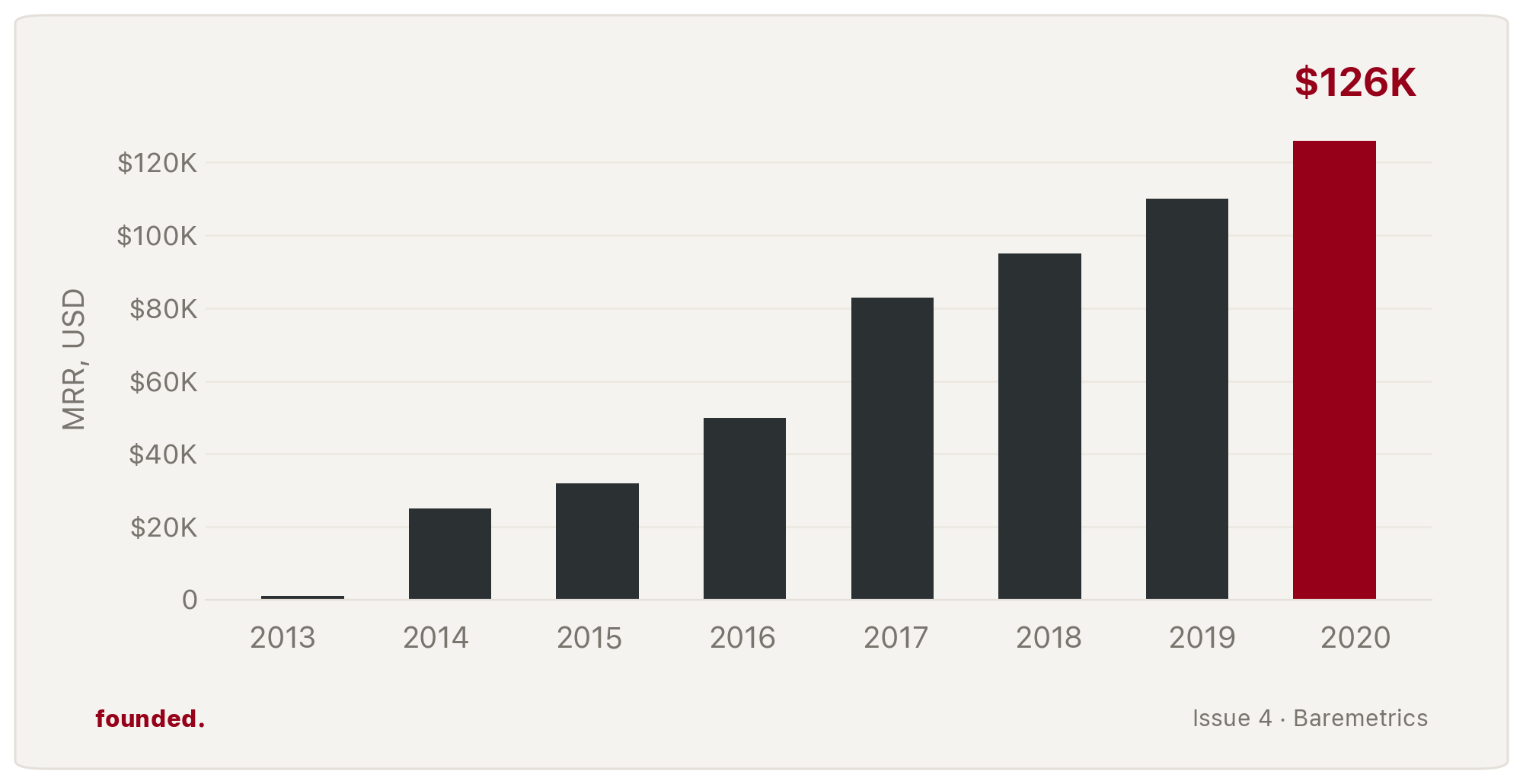
Revenue never stopped climbing. It went from $25,000 MRR at the end of 2014, to roughly $32,000 by mid-2015, to $50,000 by the spring of 2016, all while the company quietly headed toward insolvency. That was the entire lesson of outside funding in one line: the business was growing the whole time it was dying. Nothing was wrong with the product, the market, or demand. The money was simply going out faster than it was coming in.
profitability returns
Profitability returned through subtraction, not growth: pay cuts, cancelled tools, cost cutting at its finest. By March 2017, Baremetrics was producing roughly $70,000 MRR with no burn rate. Three years and four months in, the company was finally the profitable business it had been in month one. The lesson took time and $800,000 but it is one Josh will never forget.
the plateau
Then came the dry spell. For 16 months, the company sat at a plateau of $90,000-$100,000 MRR while working hard to acquire new customers.
Attempts to increase revenue included:
A rebuild of infrastructure so that dashboard numbers updated in real time instead of once per day.
The launch of the Recover and Cancellation Insights add-on.
The launch of an entirely new product, Intros, to match startups with investors.
The latter venture lasted just three months before being shut down, and was eventually sold for $100,000.
What they didn’t do was change the price. With approximately 1,000 active customers, even a small monthly price increase could have meaningfully increased revenue.
The real culprit for the growth slowdown was the founder’s written marketing. After hiring several employees and managing existing clients, Josh struggled to write the articles that once pulled in hundreds of new leads. He didn’t have the time and nobody was able to meaningfully recreate it.
the growth returns
In January 2020 Josh hired a content specialist. Two months later, the pandemic hit. Revenue fell significantly for a few months. By the latter half of 2020, however, the company experienced growth that had not been witnessed before. The market for subscription software was expanding quickly; having a tool that monitored subscription revenue was in high demand.
The full-year 2020 revenue figure of $1.5 million came as a welcomed surprise. The company now looked lean with ten employees and just about 1,000 active subscriptions.
06: the phantom sale
In early 2019, Josh was dealing with family problems that were consuming a lot of his time and was not in a good place mentally. When there was interest to acquire the business in April 2019, he took it seriously.
By mid-May, he had four letters of intent to buy ranging from $3 million to $5 million. He signed an enticing offer at $4.95 million with a closing date in August of that year.
The trouble started when the buyer missed deadlines. There was no lawyer to contact and days before closing there was no response at all to Josh’s messages. After it all fell apart, Josh learned that the buyer had misrepresented themselves and did not have the cash to commit. Their play was to have outside investors sign off on the deal and have them fund it instead.
The painful process cost Josh almost $20,000 in legal fees and lost attention. The deal was also structured as an asset sale, meaning that if the deal had gone through it would have been taxed as ordinary income (and he would keep roughly half of the proceeds).
The part worth paying attention to is what he did next. Most founders describe a collapsed sale years afterward when they’ve had a chance to reset. Josh wrote the whole thing up on the company blog while it was still raw, including the state he had been in when he agreed to it.
“Depressed, anxious and the most stressed I’ve ever been.”
— Josh Pigford, on 2019
That is a difficult thing for any founder to publish. It also cost him nothing. The transparency that sold the software worked just as well when the news was bad. The other habit that year developed was speed: once he knew the answer, he stopped deliberating.
07: the (actual) sale
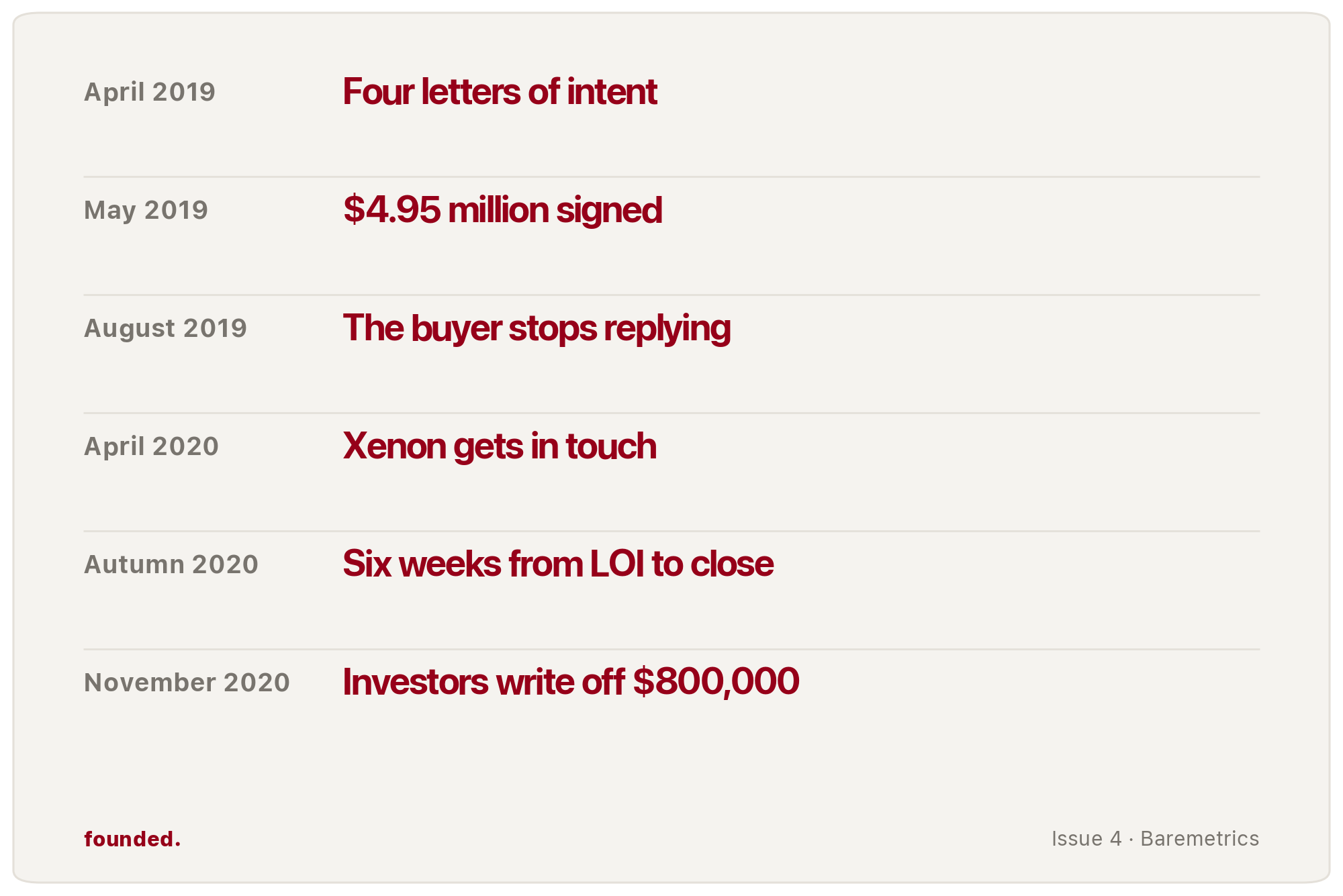
Jonathan Siegel ran the private equity firm Xenon Partners and had worked with Josh on some design work early in his career. Josh had known Jonathan for almost 15 years by the time he reached out in April 2020. It was the second time the two discussed a possible sale of the business; this time, the numbers made sense.
The structure was the unique part of the sale: $4 million, paid all cash in three instalments: at closing, 12 months after close, and 18 months after close. The important piece for Josh: No earnout. Xenon guaranteed $3.7 million for Josh regardless of what the due diligence process turned up. To Josh’s surprise, the sale was fast with just six short weeks from offer to close. Jonathan had structured the deal as a stock sale instead of an asset sale. The difference saved Josh hundreds of thousands of dollars in taxes. The sale ultimately qualified for a small business tax exemption, meaning Josh paid just 5% in state taxes. Score!
“Most acquisitions require the founder to stay on board for 2-4 years for an ‘earnout’…The prospect of sticking around for years to actually get the payout was soul-crushing.”
— Josh Pigford
The refusal of an earnout ultimately cost him. A founder willing to stay and help transition the business would be worth more in the end. To Josh, however, this was the best-case scenario. He had no intention of sticking around and received a handsome payout as a result.
Everyone on the team was kept on payroll and nobody was required to stay. People with options had them paid out in full; people without them got bonuses. The team was paid around $300,000 as a result.
Why a growing, seven-year-old company was for sale at all had nothing to do with the economics and everything to do with fulfillment.
“The majority of my time working on Baremetrics has been spent as a ‘manager’ and not a ‘maker’…I’m at my most fulfilled when I’m creating and am generally indifferent on growing or scaling things.”
— Josh Pigford
The pandemic made everything clearer for Josh. Managing 10 staff members, 1,000 customers and acquiring new ones wasn’t exactly what he had envisioned as an entrepreneur. Not only was it draining and time-consuming, he missed the ability to build.
It took him seven years to come to the conclusion that he was a starter: a person who is enormously content and useful in the first eighteen months but gets progressively less so as time goes on. Although it came later in the journey, Josh’s realization was the single most valuable piece of information he had telling him to sell.
“The same people who are good at starting companies aren’t always the same people who are good at growing or managing them.”
— Josh Pigford
“I’ve thought about Baremetrics literally every single day for seven years. That’s over 2,500 days thinking about this thing…”
— Josh Pigford
08: what went wrong
01: The price never changed
Prices never changed over the entire eight-year life of the business. The new owners increased prices in early 2022 that led to an immediate spike in revenue, followed by some churn given that prices had never changed before. Over time, revenue wasn’t just eaten by higher overhead, it was eaten by inflation and the ability to charge more but never trying to.
02: The investment that almost led to collapse
The $800,000 investment funded an increase in headcount, a fixed cost that did not fare well when revenue became stagnant. It took more than two years to recoup lost revenue, even with employees voluntarily taking pay cuts.
03: The one-man marketing team
The business was built on the founder’s transparency and niche online writing — two things that suffered when his time was spent managing. The revenue plateau started almost exactly when his marketing efforts were superseded with management duties.
09: what went right
01: He charged from the start
No free tier, no waitlist, no beta. The first customer paid $250 per month before the product was completed, which not only validated the idea but provided meaningful inputs on how to improve the overall experience.
02: The numbers that advertised
Publishing revenue was an entire distribution channel. Every company that publicly revealed revenue numbers was using what was essentially a Baremetrics billboard. As it turned out, the people looking at these dashboards were also those who wanted one for themselves.
03: Structure mattered more than the amount
The $4.95 million deal in 2019 fell through partly because half of the proceeds would have been paid in taxes. The 5% tax rate paid on the $4 million sale price, along with the lack of an earnout was worth much more than a higher offer ever could be for Josh.
10: the takeaways
01: Charge before it is ready
Josh put a $250 tier on the pricing page assuming nobody would take it, and a stranger subscribed to it on launch day. If there is something half-built sitting on your computer, who’s to say someone wouldn’t pay for it?
02: Niche writing works
Generic content marketing did nothing for Baremetrics. The posts with the number in the title built the company. Publish the version you are slightly nervous to share.
03: The cost of hiring
The $800,000 went entirely to staff and almost caused the company to go under. Before your next hire, work out what happens to the business if revenue stays flat for eighteen months.
04: Change prices. Often.
Baremetrics never increased prices. It wasn’t until the business was under new ownership in 2022 that a price hike was implemented and revenue spiked the same month. A price left unchanged is a silent decision to lose respect and value each year. It’s time to increase your prices.
05: Structure > number
$4 million as a stock sale with no earnout was worth more to Josh than $4.95 million as an asset sale. If selling is anywhere on your horizon, knowing the difference could save you.
11: what still isn’t clear from the research
The terms of the second $300,000 investment and why it was raised.
Who the buyer was when the 2019 sale failed. The ones that walked away days before closing.
Whether the three instalments were ultimately paid in full to bring Josh to the $4 million total.
Whether either of the investors could have blocked the sale to get their money and whether either of them received anything at all.
What the reasons were behind the investors not clawing back their money at the time of sale.
FOUNDED FACT
A competitor sold for 50x.
ProfitWell’s product did roughly the same that Baremetrics’ did — subscription and revenue metrics for software companies — with one key difference: ProfitWell offered it for free. Although the dashboard was free and led to many more customers, the recovered failed payments add-on, among others, was a paid feature. Customers would use the dashboard for free and subscribe to add-ons either to support the founders or to get more from the dashboard. The same add-on Baremetrics also charged for.
On May 25, 2022, about eighteen months after Josh sold Baremetrics, Paddle acquired ProfitWell for more than $200 million. Was it company structure or customer acquisition? This might just be a thread for a future issue of founded.
LEARN MORE
Baremetrics — “Selling a $4M SaaS: Inside the Baremetrics Acquisition”, Josh’s own account of the deal.https://baremetrics.com/blog/i-sold-baremetrics
Baremetrics — “I almost sold Baremetrics for $5m”, the deal that collapsed.https://baremetrics.com/blog/i-almost-sold-baremetrics-for-5m
Startups for the Rest of Us, Episode 534 — “A $4M Exit with Josh Pigford of Baremetrics”.https://www.startupsfortherestofus.com/episodes/episode-534-a-4m-exit-with-josh-pigford-of-baremetrics
SOURCES
1. Baremetrics — “Selling a $4M SaaS: Inside the Baremetrics Acquisition”, November 2020 (the $4M price, the 2.65× multiple, the three instalments, the absence of an earnout, the $3.7M guarantee, the $300,000 to the team, and the investor write-off including the General Catalyst quote)
2. Baremetrics — “I almost sold Baremetrics for $5m” (the four LOIs, the $4.95M signed at ~3.75× revenue, the buyer’s disappearance, the ~$20,000 in legal fees)
3. Baremetrics / Medium — “How we went from weeks of cash left in the bank to profitable in 8 months” (the $500,000 SAFE, $250,000 in 120 days, the $300,000 second round, the $40,000 monthly burn, eight weeks of runway, the pay cuts, December 2016)
4. Baremetrics — “Stripe Fund Invests $500,000 in Baremetrics”, September 2014 (the $10M cap, the SAFE, $20,000 MRR and profitable at the time, the hiring plan)
5. Baremetrics — “One Year Later: $20k/mo, 250 customers, 5 people and a $500k investment”, and “How we grew from $0 to $25,000/month in 12 months” (the first-year curve, Buffer, the 5.5× conversion figure, ARPU $55 to $93, the content that worked)
6. Baremetrics — “Idea to $5,000/mo in Recurring Revenue in 5 Months” (the month-by-month figures and the pricing philosophy)
7. Indie Hackers podcast #6 — Josh Pigford (the $250 first customer, the Twitter launch, ~$70,000/mo in March 2017, and “probably my hundredth thing to build”)
8. Startups for the Rest of Us, Episode 534, November 2020 (the $90,000–$100,000 plateau across sixteen to seventeen months, the 15% and 30% pay cuts, the asset-sale tax problem in 2019, the QSBS treatment and Alabama state tax, the content hire in January 2020)
9. Baremetrics — “How We Sold a Failed SaaS Product for $100,000”, January 2020 (Intros, its three-month life, and the sale to Tiny)
10. They Got Acquired — “SaaS analytics startup Baremetrics sells to private equity firm Xenon Partners” (team of ten, ~1,000 customers, the misrepresented funding on the failed deal)
11. Indie Hackers — Luke Marshall of Xenon Partners on running Baremetrics after the acquisition (the eight years of unchanged pricing, the 2022 repricing, the churn work)
12. General Catalyst / Stripe Platform Fund coverage, September 30, 2014, and Paddle — “Paddle acquires ProfitWell”, May 25, 2022 (the FOUNDED FACT)
13. Baremetrics Founder Chats — Josh Pigford (the childhood ventures, Automatik Studios and Sabotage Media, the forty-plus projects between 2003 and 2013, and “a solution looking for a problem”)
14. Intercom — “How Baremetrics went from $0 to $14,000 per month”, June 3, 2014 (the eight-day build spread across a month)
15. Startups for the Rest of Us, Episode 244, July 7, 2015 (~$32,000–$33,000 MRR in July 2015, the regret over the valuation cap, and the growth stall inside 60 days of the raise)
16. Baremetrics — “Is your company really only doing $45,000 per month?”, April 28, 2016 (~$50,000 MRR and not yet profitable, two months before the runway calculation)
17. Indie Hackers — “Growing a Revenue Analytics Platform to $83,000/mo”, June 5, 2017 (the June 2017 figure and the account of the near-death year)
18. Baremetrics — “Stop Stressing: Most Startup Decisions Aren’t Big Deals”, March 14, 2018 (the decision-making passage)
19. Starting & Sustaining — interview with Josh Pigford (calling every customer, the three, six, twelve and eighteen-month calls, the chat-based cancellation, and “payroll is a water hose that you can’t just turn off”)
Built entirely from public posts, podcasts and interviews, most of them written by the founder himself. No interview was conducted for this issue. All figures are as the founder, the buyer or the acquirer stated them and have not been independently audited. Amounts are US dollars.