


11:29pm.
I had just finished writing my master’s thesis. It was a very rough draft and I’d need to go over it again once more. The entire 70 pages.
I knew this was the home stretch, but my mind was fried and my eyes struggled to stay open. Not even caffeine could save me now.
The draft was due at midnight. I slumped over my desk while the silence taunted me.
The next feeling was one of dread.
I had completely forgotten to do my references. There were more than 40 links I had thrown into OneNote over the last two months.
Dammit.
This would cost me another three hours. Then I remembered a classmate using a website that formats citations.
I opened EasyBib and got it done in 10 minutes.
I now often run into the same issue with founded. There are a ton of sources to cite and only so much time in a week.
The business saves students and professionals hours, highly valuable if you’re ever in the same situation I was in.
Let’s look at how something so simple became such a big deal.
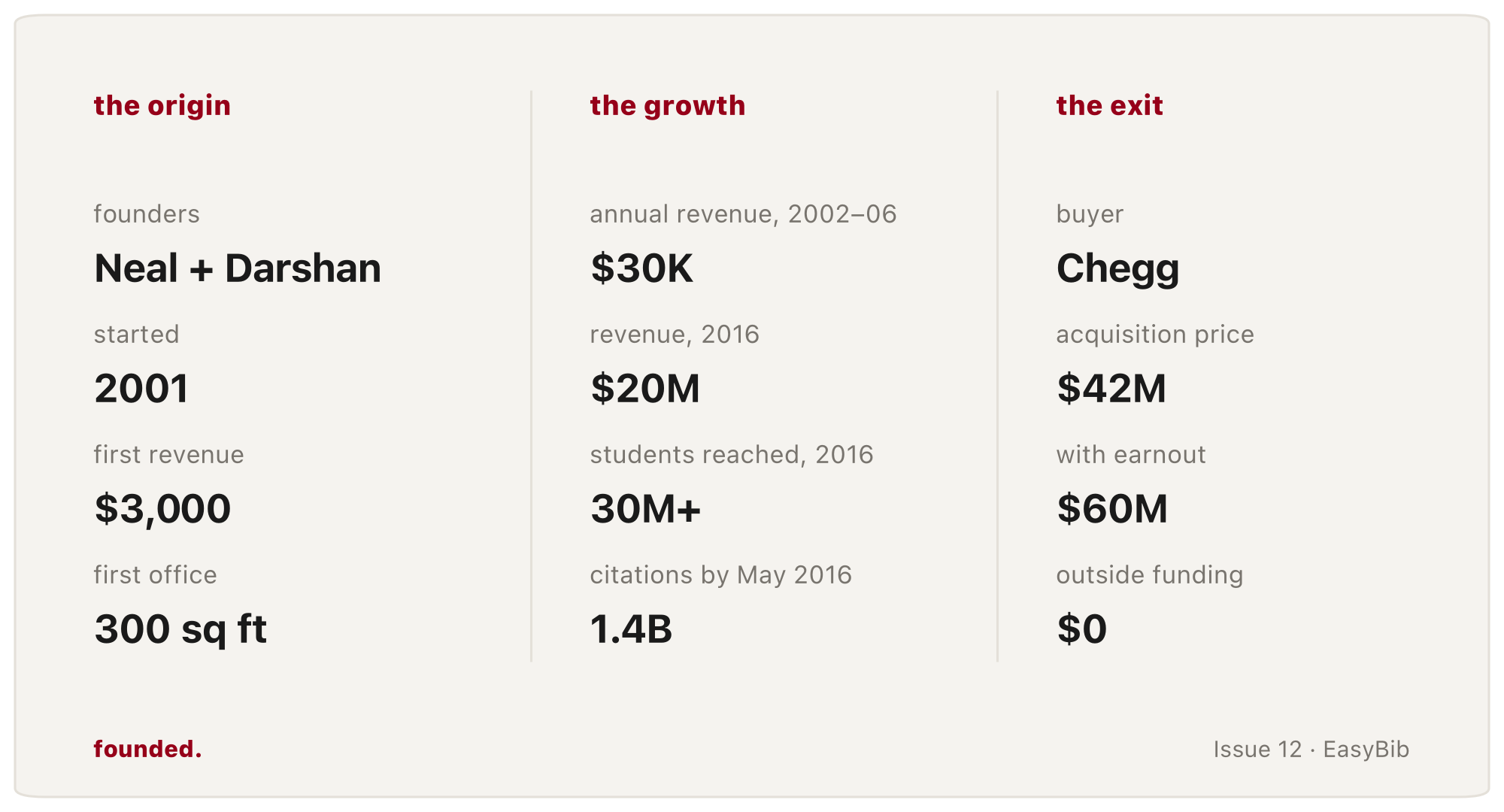
What we found out:
Buying competitors can scale a business quickly if the customers overlap. EasyBib paid $500,000 for BibMe and earned it back within a year.
Make advertisers compete for your space. EasyBib put several advertising networks head to head and tracked revenue per user.
Check whether your “serious” customers actually make you money. EasyBib’s institutional sales were a net negative to the bottom line.
Keep your job until the side hustle has proven itself. EasyBib was making more than $100,000 per year before the founder left his job at Lehman Brothers.
Move to accrual-based accounting before you sell. Buyers expect reviewed, accrual-based numbers, and EasyBib kept cash-based records.
01: flyers in a bathroom
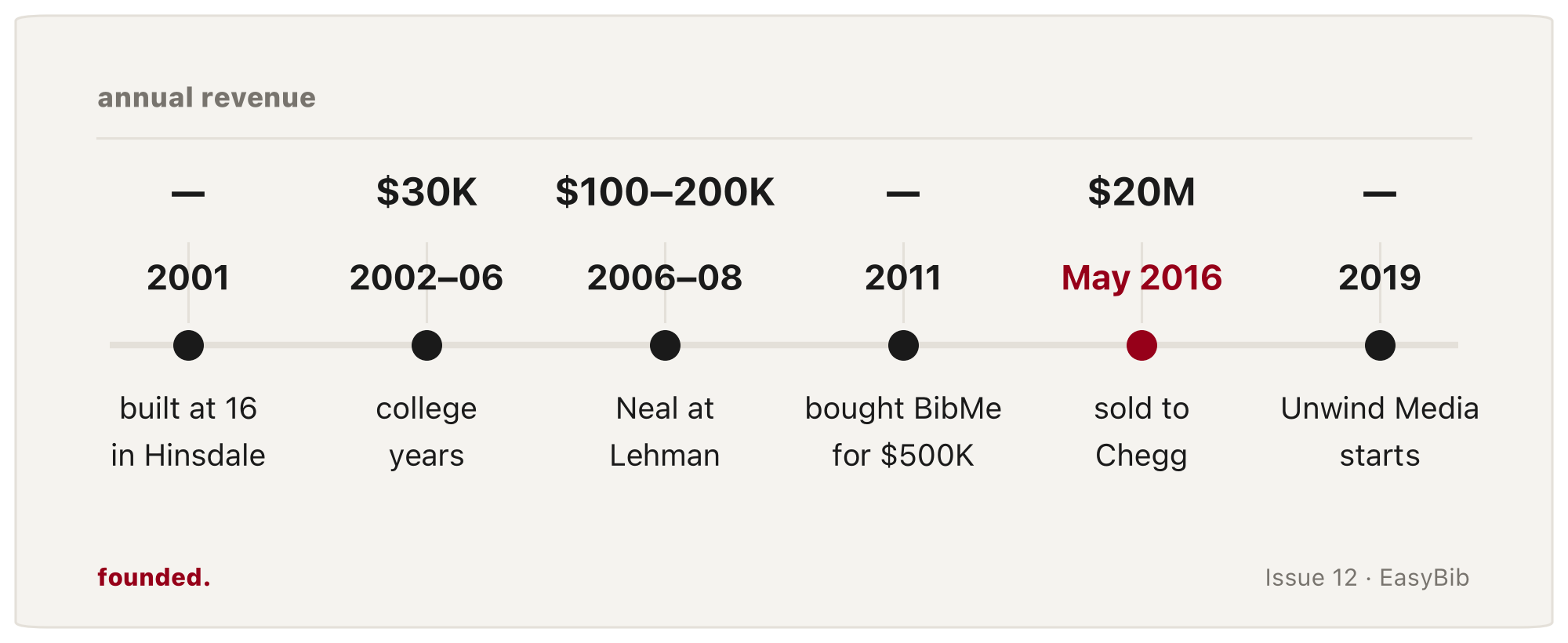
The idea for EasyBib came to Neal Taparia at the age of 16 in an English class at Hinsdale Central High School, just outside of Chicago. His parents immigrated from India, and his dad pushed him to take an introductory computer science class:
My dad nudged me to take the class because he saw me tinkering around.
— Neal Taparia, to Sramana Mitra
In that English class, he found the formatting rules for citations tedious. Neal partnered up with a friend who was good with computers and together they found a shortcut:
We realized there was a much better way to go about these bibliographies and reference management.
— Neal Taparia
That friend was Darshan Somashekar, and the two stayed business partners for the two decades that followed. It took about two months to build the prototype. A student would type a book or website into a search field, and the site would pull the details and format the citation.
In December 2001, a teachers’ magazine described it: “Students simply provide the site with information about sources, and with a couple of clicks, the site automatically creates a bibliography in the correct format.”
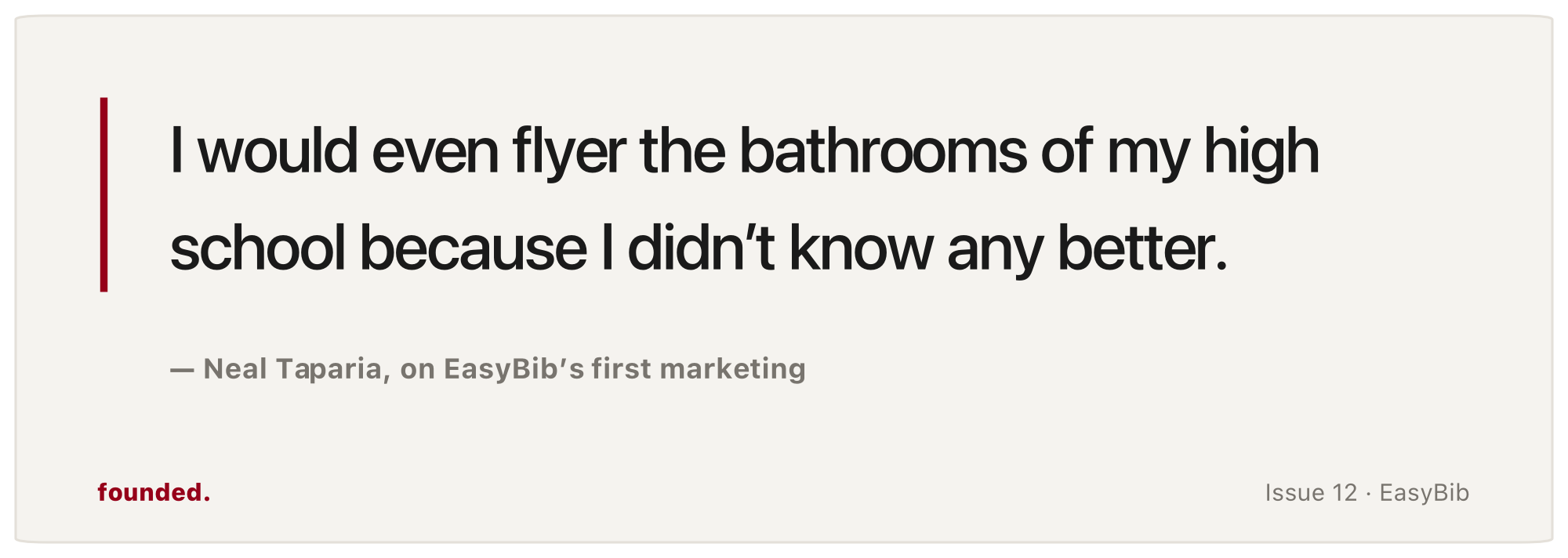
To get users, Neal didn’t overthink it, being 16 and all:
I would even flyer the bathrooms of my high school because I didn’t know any better.
— Neal Taparia
He also emailed the Chicago Tribune with a four-word pitch that should be used more often: “We’re students helping students.” A reporter called back within days, came to his house and took a photo of the founders. EasyBib made the front page of the business section.
Besides the flyers and the Tribune, the founders describe the growth in those years as organic.
If you are building a business beside your full-time job like I am, EasyBib is a good case study. Neal ran EasyBib on the side for seven years through high school, college and then a job at an investment bank before going full time.
The real question is how a free citation tool run by two high school students became valuable enough for a public company to pay $42 million with no outside investors.
02: the principal
About a year after the official launch, a high school principal became EasyBib’s first paying customer. He offered $3,000 for both classroom and school management features. Neal called it “a ton of money” at that age and admitted the two of them “were not too business-minded.”
EasyBib moved with him to Northwestern University, where he studied economics. Between lectures, he answered calls from teachers and fixed bugs. By then the business was making real money for a college student:
In college, we were probably making around $30,000 a year.
— Neal Taparia
Two new revenue streams allowed for this growth. The first was a freemium model: APA formatting (from 2004, through a PayPal subscription) and later the ability to save work sat behind a paywall. The second was institutional software, built after demand from schools.
When I first heard about these revenue streams, I assumed the schools were going to be the main driver. A principal paid the first dollar and got the ball rolling for other schools, while the basic tool was free for students.
leaving Lehman
Neal graduated in 2006 and started his career at Lehman Brothers in New York. The choice of city was strategic; he had chosen jobs and internships close to Darshan so they could keep building after work. Around the same time, Darshan co-founded a file-sharing startup, drop.io. EasyBib stayed a side project and kept growing:
It was probably making between $100,000 and $200,000 in revenue.
— Neal Taparia, on the business during his Lehman years
After about a year at Lehman, EasyBib had grown enough to sell advertising, so the founders hired their first employee to build it out. In Neal’s words: “we knew we can monetize with ads.”
About six months later, Neal left Lehman to work on EasyBib full-time with Darshan. Lehman collapsed amid the financial crisis just eight months after he left. Neal credits the bank with teaching him accounting, valuation, and finance.
Neal’s journey sounds a lot like my own: a finance day job and a project I build mornings, nights and weekends. I write founded. before work from a coffee shop between 7 and 9am. The real takeaway here is when he left.
Most ambitious builders have a corporate job they aren’t fully satisfied with and want to leave as soon as revenue starts flowing. EasyBib shows the more cautious alternative: waiting until the business earns revenue into the six figures before making the leap.
If you’re interested in getting a weekly deep-dive to adopt founder mindsets, skills, and lessons please subscribe. It’s great to have you in the family!
03: $20,000 salaries and a 300-square-foot office
In 2008, the year Neal left Lehman, the site had “millions and millions of users.” The founders paid themselves $20,000 each, putting the rest of the revenue into employees:
We couldn’t pay ourselves too much.
— Neal Taparia
To get by, Neal consulted for his cousin’s company, Tasty Bite, and was paid in food. The founders worked from home until they leased a 300-square-foot shared office 18 months later.
Neither founder has said on record that they came close to quitting, and the numbers suggest why. The first version cost less than $50 to host. When friends said that students would keep writing citations by hand, the founders ignored them and launched anyway.
Students first paid for the service in 2004, while both founders were still in college. When they went full time in 2008, they set a goal of selling the business. Neal later called the sale to Chegg “the goal we had set when we plunged into the business full time in 2008.”
ten minutes per citation
The focus on advertising revenue uncovered something rather unique:
We were seeing people interact with our site between 5 to 15 minutes.
— Neal Taparia
The average visit lasted between one and two minutes. That much attention made EasyBib’s ad space valuable. EasyBib sold that space through ad networks: companies that collect ads from advertisers, place them on websites and pay each site a share for every thousand shown.
The one metric the founders swore by was revenue per user, which kept climbing as the systems improved. Direct sales to brands didn’t work as well because students came to finish a citation, not to shop. The networks still paid for every thousand ads shown, whether users bought or not. They filled most of the space, and the rest of the revenue came from premium subscriptions, with a smaller share from schools.
the rule they broke
EasyBib operated and made money differently from how education businesses typically did in two ways:
Schools requested licenses, but the company survived on the free student tier and the advertisers that paid for students’ attention.
The founders considered venture capital early on and decided against it. Every competitor they later acquired was paid for from revenue the business earned.
04: buying the competition
Investment banks spend much of their time advising companies that buy their competitors, and Neal credits his years at Lehman for the goal he set for EasyBib:
Our goal was to consolidate the space.
— Neal Taparia
For EasyBib, this meant buying other citation sites until the company owned most of the places students went to create a bibliography online. It always started with getting to know the people who ran them. The aim was to “build strong relationships” because they “could turn into something.”
BibMe was the first conversation that paid off in 2011. It was a citation site started by students at Carnegie Mellon University. Neal admits it had better technology than EasyBib and early traction of its own. EasyBib acquired it for $500,000 with about $600,000 on its balance sheet. In another interview, Neal said the deal used all the money the company had:
We were nervous that we might not make payroll.
— Neal Taparia, to AllTopStartups
As a financial analyst, I see two interesting takeaways here:
The company put more than 80% of its capital into one asset, with no backup plan. Either this was reckless or a carefully calculated Hail Mary.
Within one year, the money had been recouped so I am leaning toward the second option.
I’m willing to bet Darshan and Neal did careful analysis of growth potential after the deal. I reached out to the founders and will update this section should they get back to me.
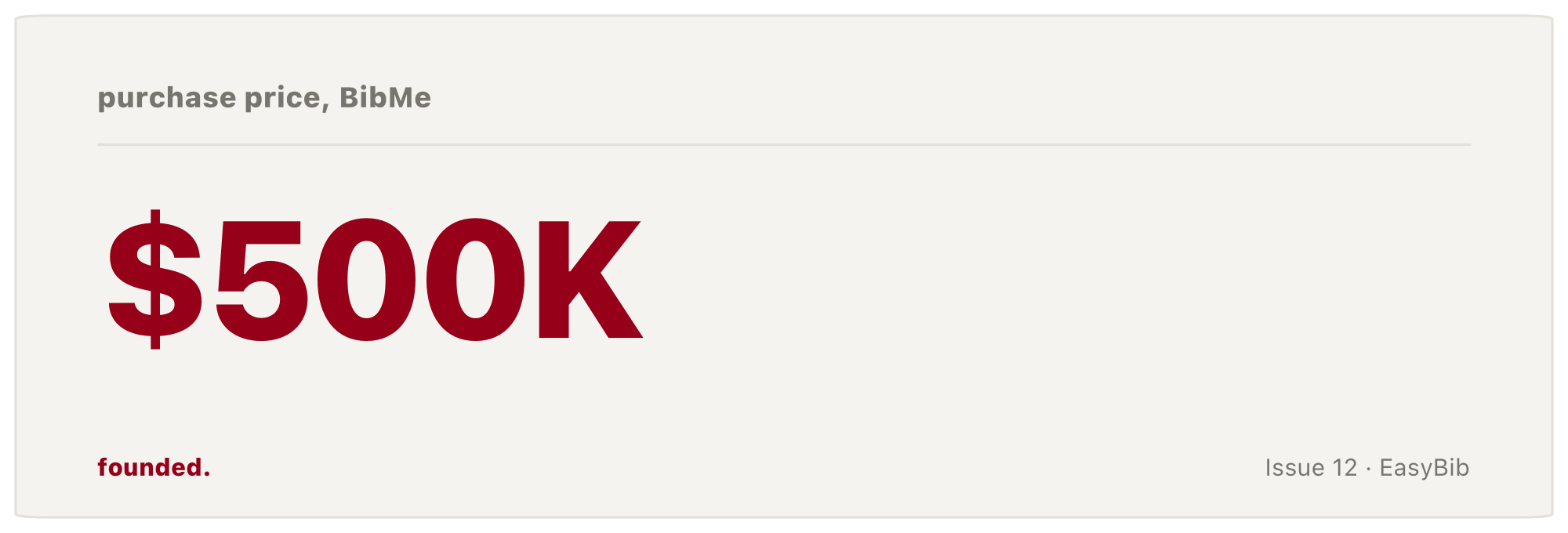
Let’s break down how they earned that $500,000 so quickly. BibMe earned less per visit than EasyBib did, so the logical move was to put EasyBib’s advertising and premium subscription on BibMe’s traffic.
The same playbook was used for Citation Machine, “the next biggest site in the space” according to Neal, and the biggest citation site in the UK and Australia (most likely Cite This For Me, although the founders never confirmed this). The prices were never disclosed.
By early 2012, EasyBib had passed half a billion citations with more than 100 colleges, universities and high schools enrolled. Four years later the number reached 1.4 billion citations, with about 240 million sessions in the 12 months before the sale.
the promising customer takes a loss
I mentioned earlier that I thought the institutional licenses would be the revenue driver. Although institutional sales kept growing, so did the cost of supporting them.
Profits from the free tier and the premium subscription were funneled into the institutional side, where a 30-person team was built to support it. By 2016, the line contributed just “a few million in revenue” but was “losing a lot of money.”
We didn’t have the operational discipline back then to look at metrics of the business to realize that it was failing.
— Neal Taparia, to AllTopStartups
The founders shut it down before the sale. Neal said it cost them money, time and focus along the way.
05: the sale
Imagine Easy Solutions (the parent company behind the citation sites) had revenue of approximately $20 million in 2016, more than 60 employees across offices in New York and Berlin, and reached 30 million students a year.
This was without taking outside investment.
— Neal Taparia
The founders already knew the team at Chegg (the textbook rental and homework help company), but still hired bankers to run the sale and get the best price.
Neal calls the sale process a “total whirlwind” because of the emotional toll of buyers picking the business apart. He also learned that buyers expected financials on an accrual basis, while EasyBib had kept its books on a cash basis.
Cash accounting records when cash comes in or goes out; accrual accounting logs revenue when it’s earned. A customer paying for an annual membership shows up as a lump sum in cash accounting and is spread across 12 months in accrual accounting. Buyers want to see what the business actually earns every month to gauge future cash flow and revenue.
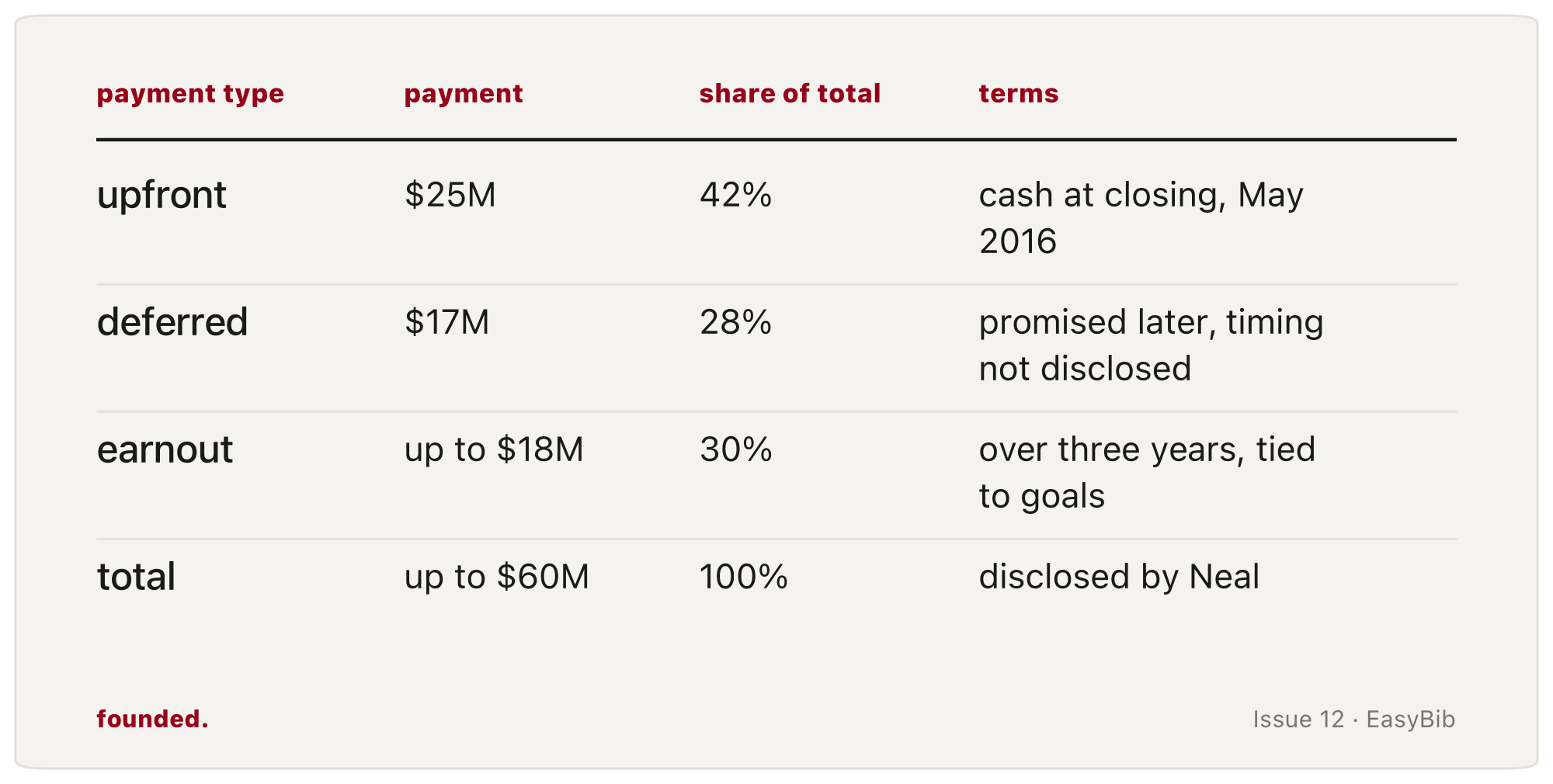
In May 2016, Chegg proposed the terms for the acquisition of Imagine Easy Solutions:
$42 million was the agreed price
This included $25 million cash at closing and a $17 million deferred cash payment
In addition, up to $18 million was structured as an earnout over three years, tied to revenue targets
Total possible acquisition price: $60 million
Chegg CEO Dan Rosensweig explained the decision:
We know that writing is one of the biggest pain points for students today.
— Dan Rosensweig, in Chegg’s announcement of the deal
Here it gets hazy. Neal has stated the sale price as the maximum ($60 million), which suggests the earnout was paid. Chegg’s filings don’t break it out, so I couldn’t confirm it.
Either way, the guaranteed price of $42 million is a 2.1x revenue multiple, and the full price with the earnout is 3x annual revenue. Neal has also given a rough profit figure: by 2016, the core business “was doing well over $10M in revenue, with margins north of 50%.”
This is where my day job in finance comes in handy. A lot of my work involves the risk that a promised payment isn’t made and what that means for both parties. Just 42% of the total possible price was paid in cash at closing; 28% was to be paid later, while 30% was the earnout. The cash in hand on closing day was less than half of the price Neal later quoted.
Neal’s takeaway from the process: a company is worth what a buyer will pay for it.
post-sale
There was no outside capital raised, so there were no investors to share the proceeds with. The only other party with a share was Uncle Sam.
For the three years after the sale, both founders stayed on as executives at Chegg. In 2019, they started another business, Unwind Media, and built Solitaired, a site of classic card games built for brain training. The team grew to five people by 2022. Darshan explained how they fund it:
Being ad-supported allows us to grow our business and stay true to our goals.
— Darshan Somashekar, to Google
They clearly learned a valuable lesson from EasyBib: a free website with ads allows for a lean team and high margins.
From an idea in a high school English class to Chegg’s offer took 15 years. The value Chegg bought was the structure of the site: the tool stayed free for students, advertisers competed for student attention, and the founders bought the competing sites to grow the user base further.
06: the growth channels
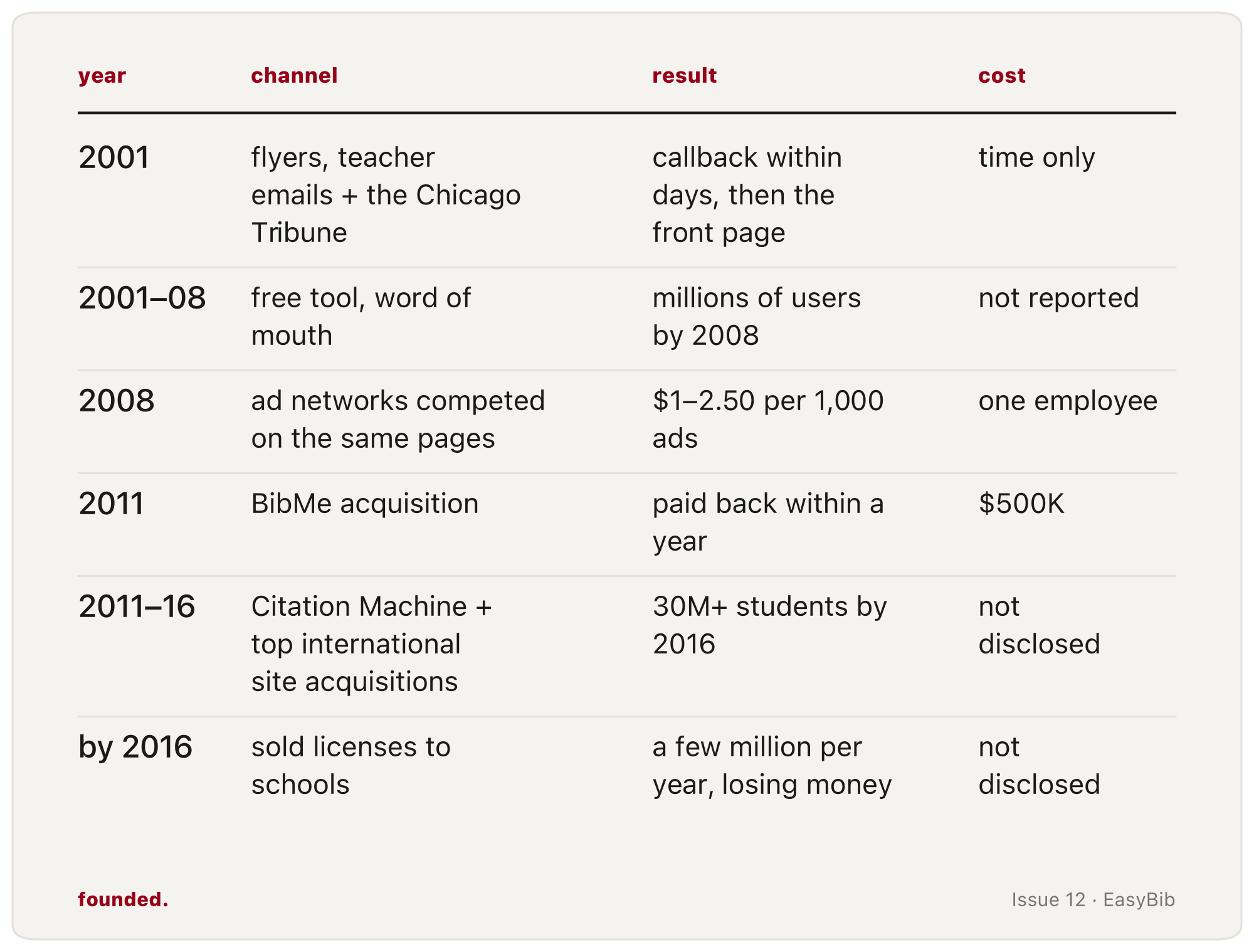
The table below sums up the distribution channels EasyBib used to reach students and earn from them, along with the result and cost of each.
flyers, emails and the Tribune
The first channel was manual. The founders posted flyers, posted in online chat rooms and emailed local teachers. Neal then emailed thousands of teachers and pitched Chicago newspapers. The Tribune story is when it took off:
Our usage exploded and snowballed from there.
— Neal Taparia, to AllTopStartups
word of mouth
While the Tribune kickstarted the site, later growth was mostly word of mouth. Students shared the site because it saved them time on every paper. Teachers shared it because it got their students to cite sources. Some teachers pushed back, calling it a shortcut. The answer was hiring educators and working with influencers in education to win them over.
Neal also spent years emailing research database companies until they agreed to connect their products to EasyBib, which added credibility. Over these years, revenue grew from about $30,000 to over $100,000 a year. The drivers included the principal who turned into the first institutional deal, students paying for premium features, and traffic growing to the point where ads could be sold.
Have you learned something new that’s worth applying to your business? Please let me know what you liked or didn’t like as much. I’d also appreciate it if you would share this post or restack if you found value here!
the advertising auction
When the founders went full time, their livelihood depended on ads, so that’s where the focus went. Instead of signing with one network, EasyBib connected several, including ones targeting students (such as HotChalk). The team built technology that fed the networks a stream of data about EasyBib’s traffic, so the networks could compete for each placement:
We would have ad networks compete against each other to place their ads in front of our users.
— Neal Taparia, to AllTopStartups
The result was $1–$2.50 per 1,000 ads shown, which Neal called “way beyond industry averages.” Two things drove it: the time spent on the site, 5–15 minutes per visit (compared with a few minutes elsewhere), and an obsession with revenue per user that let them fine-tune the system.
buying competitors
This is the part I find most interesting because I haven’t seen it in my other case studies. In 2011, EasyBib bought BibMe because it had better technology. The two later acquisitions helped EasyBib grow its user base.
Students often used the first website they could find for their citations, so owning more of them meant that the business captured more of the market.
Neal’s knowledge from Lehman regarding ‘consolidating the space’ also carried to Chegg and is ultimately what made him wealthy.
for you: if your side business earns revenue, the fastest way to grow it may be buying an audience from someone else, provided you have the budget. EasyBib paid $500,000 for BibMe, close to everything it had in the bank and earned it back within a year.
The economics need to work, and you need to understand the risk and reward. If your monetization isn’t working well yet, it’ll be hard to scale even with a larger audience.
The math is simple if you know your numbers (conversions, revenue per customer, and your customer acquisition cost, or CAC). Divide the purchase price by the expected annual profit the new customers would add. Discount it by 20% to account for hiccups or differences between their audience and your own. If it takes less than one year to pay back, that’s ideal. If it’s more, the decision is more nuanced.
The options can be anything from a small newsletter to a niche website or customer list from someone looking to sell.
07: the tools
the product
An easy way to cite sources. Students used EasyBib to finish their bibliographies “with a couple of clicks” instead of searching for each source and formatting it by hand. Knowing what it’s like being a student, I often left it to the last minute, and tools like EasyBib saved me.
The product was simple: a student searched for a book or website, and the site filled in the details in the right citation style. By 2012, it had added tools such as a credible source indicator and a plagiarism checker, along with mobile apps.
founder skillsets
Neal was the finance guy. His degree in economics and his years at Lehman Brothers, where he learned accounting, valuation and finance, helped him make critical business decisions. Darshan was the computer guy and set up the site, having co-founded drop.io while also building EasyBib.
08: the founder’s decision: going full time
the signs
About a year and a half into his job at Lehman, Neal had a side project making six figures, enough for him to consider leaving. There was enough traffic to sell ads and the founders had already hired their first full-time employee to build that business while Neal kept his job.
the options
Stay at Lehman and keep EasyBib as a side project with the new hire running ads.
Raise money from investors to fund the jump. The founders considered venture capital early on but never took it.
Leave Lehman and run EasyBib full time on its current revenue stream.
the decision
Neal left Lehman at the beginning of 2008 and went full time with Darshan, with the goal of selling the business.
the cost
A massive pay cut. Neal went from an investment banking salary to around $20,000 with far more uncertainty.
the evidence
Full time, the founders pushed advertising rates to $1–$2.50 per thousand ads shown, and three years later they had enough capital to buy the first competitor. By 2016, the business earned $20 million in revenue and sold to Chegg that same year.
How sure can we be that they made the right choice? The timing makes it hard to argue: Lehman collapsed eight or nine months after Neal left, and online ad networks were growing. That also makes it hard to pinpoint the growth that came from the decision.
There is also survivorship bias. Plenty of founders made a similar leap and had to start over or go back to a corporate job. You’re only reading this because these founders succeeded.
the application
Several decisions make leaving your job for a side business difficult. This case study shows that patience is rewarded. If you rush to leave and go too early, you’ll be stressed and more likely to make rash decisions.
It also depends on the margins. Neal and Darshan had to hire someone to run the ads, which cost them a chunk of revenue. With two founders, the $100,000 in revenue had to cover three salaries. If it’s just you, with an 80% margin on what you’re selling and a business making $60,000–$100,000 a year, it’s easier to make that jump.
Another consideration is adapting to a lower income once you’ve gotten used to making more. If you work in corporate, you are likely earning in the low six figures or slightly below. That pay cut was likely a big shock for Neal.
To plan for it, I worked out my monthly fixed costs (everything I can’t do without) and figured out my ‘exit salary’. If it’s $3,000 a month, you’d need your business to pay you $36,000 a year in profit before you can comfortably quit.
Two things to keep in mind. First, this needs to be profit, meaning all expenses are subtracted and taxes are paid. Second, consider personal taxes (depending on your sole proprietorship or corporate structure). This likely means you need closer to $70,000 in revenue before you can quit.
Another option is to build up a generous savings account. If you have 24 months of expenses saved, you can quit with less revenue.
All of this comes down to personal preference and your risk tolerance.
09: what still isn’t clear from the research
Whether Chegg paid the $17 million deferred payment and the $18 million earnout in full. Chegg still had the deferred payment on its books in early 2017.
The split of revenue attributed to ads, subscriptions and school licenses.
When EasyBib bought Citation Machine and the international site, what it paid and what each returned.
How the founders split the sale proceeds.
What the 30-person school team cost and the total loss from the institutional revenue segment.
10: the brand today
EasyBib is listed as “a Chegg service” to this day. The site’s homepage reads “Get your paper hand-in ready” and features an AI-powered writing assistant. Chegg has been shrinking, however. In October 2025, the company cut 388 jobs, about 45% of its staff, and brought Dan Rosensweig back as CEO after a drop in Google traffic as more people turned to AI for answers. Chegg has never reported EasyBib’s numbers on their own, so the record doesn’t show whether the acquisition paid off.
As for the founders, Neal runs growth, operations and finance at Solitaired, which had more than 500,000 regular visitors by 2020. The founders also started SOTA Partners, which invests in and starts companies in the future of work and food, including an investment in Impossible Foods. Neal also mentors student founders at Northwestern’s startup incubator, The Garage.
FOUNDED FACT
The most-cited scientific paper ever published is about measuring protein. Oliver Lowry and three colleagues published “Protein measurement with the Folin phenol reagent” in the Journal of Biological Chemistry in 1951, and it has been cited more than 300,000 times, more than any other paper in the scientific literature. For comparison, EasyBib’s sites had formatted 1.4 billion citations by May 2016, more than 4,000 times as many as the Lowry paper.
NEXT ISSUE
Next week’s case study: Tweet Hunter. Tibo Louis-Lucas built about 15 products, watched a startup go bankrupt and took a CTO job to get back on his feet. Then one partnership took the business from $3,000 to $20,000 in monthly revenue overnight, and about a year and a half later it was acquired. Don’t miss it.
LEARN MORE
Sramana Mitra — “Bootstrapping to Exit,” Neal Taparia, Parts 1–6, April 2020. The whole story in his words, from the bathroom flyers to the sale process.
TechCrunch — May 2, 2016. The deal terms and the scale of the sites at the sale.
SOURCES
Sramana Mitra — Neal Taparia, Part 1, April 20, 2020. Hinsdale, his parents, the computer science class, the English class, the two-month build, the flyers, the Chicago Tribune pitch and front page.
Sramana Mitra — Part 2, April 21, 2020. The $3,000 principal, freemium, schools asking to pay, Northwestern, the internships, customer support between lectures, Lehman Brothers and leaving in early 2008.
Sramana Mitra — Part 3, April 22, 2020. About $30,000 a year in college, $100,000 to $200,000 during Lehman, the first hire for ads, $20,000 salaries, Tasty Bite, the 300-square-foot office, about $20 million in revenue, 60+ employees, New York and Berlin, no outside investment.
Sramana Mitra — Part 4, April 23, 2020. Millions of users by 2008, 5 to 15 minutes per visit, competing ad networks, ad rates above industry standards, revenue per user.
Sramana Mitra — Part 5, April 24, 2020. $1 to $2.50 ad rates, direct brand sales, consolidation, relationships with competitors, BibMe for $500,000 against about $600,000, payback within a year, ad revenue nearing $20 million.
Sramana Mitra — Part 6, April 25, 2020. Citation Machine, the international site, 30 million students, the school business losing money, the bank process, accrual accounting, the $60 million figure, considering VC.
TechCrunch — May 2, 2016. $42 million, $25 million upfront, $17 million deferred, up to $18 million over three years, 240 million sessions, 1.4 billion citations and Dan Rosensweig’s quote from Chegg’s announcement.
EdSurge — May 3, 2016. The $42 million price.
THE Journal — December 1, 2001. The first published description of EasyBib.
The Next Web — April 3, 2012. Half a billion citations, 100+ institutions, drop.io, the credibility and plagiarism tools and the apps.
Wikipedia — Neal Taparia. Hinsdale, Northwestern 2006 and Unwind Media in 2019.
Google AdSense publisher story — Unwind Media, 2022. The team of two to five and Darshan Somashekar’s quote.
AllTopStartups — Neal Taparia, June 3, 2020. Emails to thousands of teachers, the Tribune business-section front page, teachers and influencers, the database integrations, the ad technology and competing networks, the payroll quote, monetizing acquired sites, the 30-person school team and its shutdown.
Indie Hackers — Neal Taparia, “Growing to $10m and Selling the Business We Launched in High School.” Under $50 to host, the naysayers, APA formatting behind a PayPal subscription in 2004, the 2008 goal, and well over $10 million in core revenue at margins above 50%.
The Daily Northwestern — October 20, 2020. Chat rooms and local teachers, three years as Chegg executives, SOTA Partners, Solitaired’s half a million regular visitors and The Garage.
LA Business Podcast, episode 44 — Neal Taparia. SOTA Partners and its investments.
Solitaired — About Neal Taparia. His role at Solitaired.
Chegg — Form 10-Q for the quarter ended March 31, 2017. The deferred cash consideration for Imagine Easy still being accreted.
EasyBib.com — home page, October 19, 2026. The headline, the AI writing assistant and the copyright line.
Fortune — October 28, 2025. Chegg’s 388 job cuts, Dan Rosensweig’s return and falling Google traffic.
Wikipedia — Lowry protein assay. The FOUNDED FACT.
YesPress — Tibo Louis-Lucas profile, and Indie Hackers — January 19, 2023. The next issue.
Every figure in this issue is drawn from public statements, interviews and press coverage, and each one is listed with its source above. No interview was conducted with the founders. Imagine Easy Solutions was a private company and published no financial statements, so revenue, user and deal figures are as the founders and the press reported them and have not been independently audited.
Waiting until EasyBib reached six figures before leaving Lehman Brothers is a great lesson in patience. Most founders want to leap at the very first sign of traction, but holding out for that financial stability clearly paid off. Great breakdown, Jay!
It's always so cool to learn the story behind a tool I've used but never really thought about.
The more I read about successful businesses, the more I realize just how much work, persistence, and experimentation happens behind the scenes. It's easy to admire the finished product without appreciating the years of effort it took to get there.
What I find especially inspiring about this story is how young the founders were when they started. From putting up flyers in school bathrooms to building a business over the next 15 years, that kind of scrappiness and dedication is incredible.
Stories like these remind me that great things often start with someone who's simply curious enough to build something and persistent enough to keep going.
Thanks for sharing this one!