


Writing a newsletter seemed like a gimmick to me for the longest time. I thought it was just another internet fad to extend reach and sell products and services. I also thought it wasn’t for me because I got a C in university English class. Boy, was I wrong.
Since starting Founded just two short months ago, my whole mindset has shifted. Not only have I found the joy and fulfillment that comes from writing long-form content, I’ve also realized it’s becoming the most valuable community I’ve ever built.
All of this led me to looking at some of the biggest names in the game. Since I am personally subscribed to Morning Brew, it was the obvious candidate. Better yet? The founders sold just a few years back and left a trail of good information.
This story gripped me because I am in the thick of growing an engaged audience and actively learning marketing. A good week brings in 5-10 subscribers, not bad by any means, but it stood out to me that Morning Brew grew by thousands of subscribers every college semester using nothing more than word of mouth and simple referrals.
What you’re about to read is the full story of Morning Brew, with a special focus on its distribution; something I am deeply interested in. Let me know your thoughts on this direction in the comments.
What we found out:
Find your first customers where they already gather in person.
A product that people love needs a referral program with incentives.
Advertise where your product is already being used.
Judge a distribution channel by how engaged its customers are, not by the cost per click.
Test new advertising opportunities early; prices will go up. Jake Kassan from MVMT experienced this as well (Case Study #8)
Charge way before you’re ready.
01: preparing for Morgan Stanley
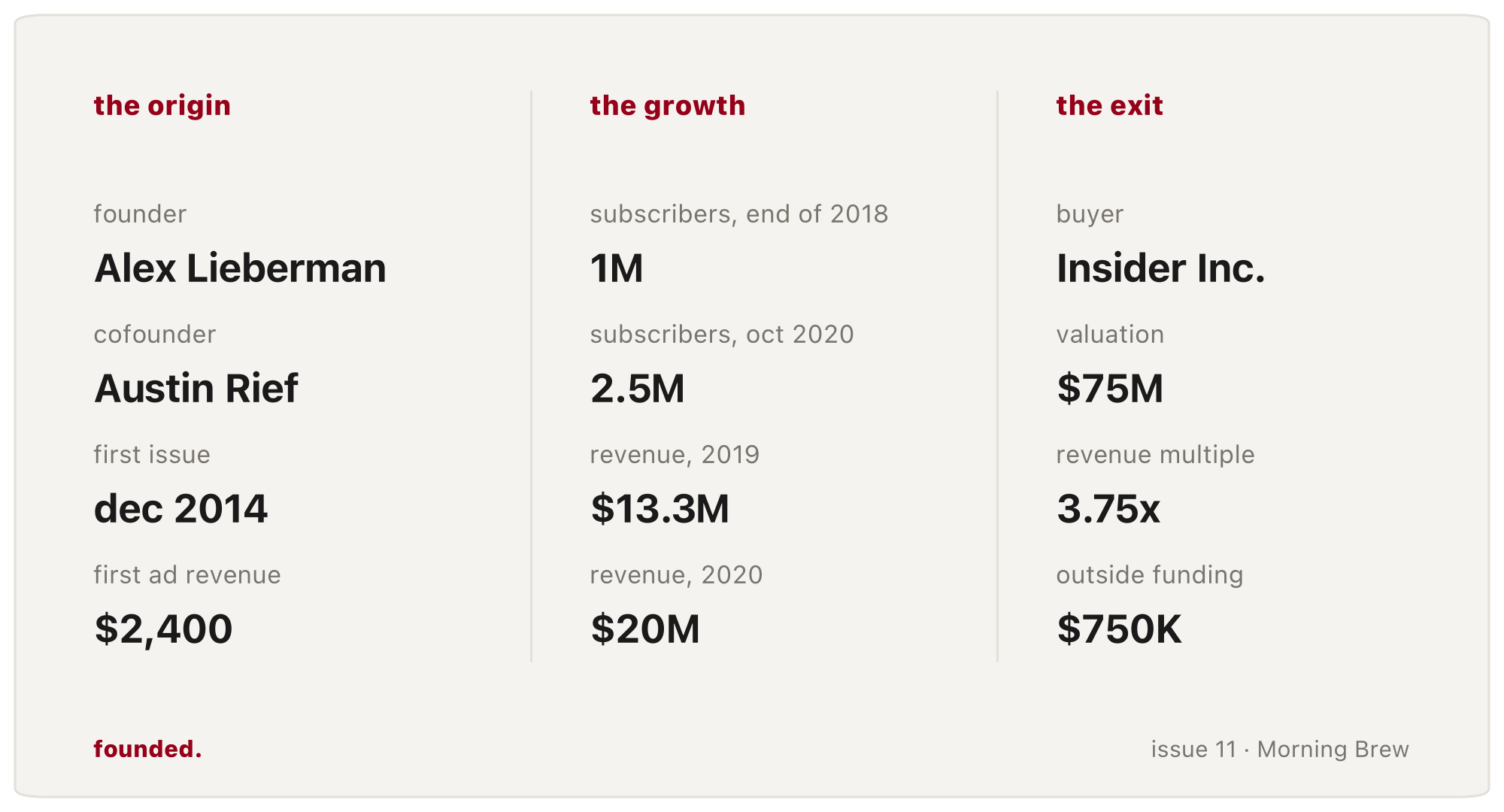
Alex Lieberman started Morning Brew to prepare for his first real job.
In his senior year at the University of Michigan, he had been offered and accepted a job offer from Morgan Stanley and was finishing up his last two classes.
His spare time was spent helping classmates prepare for their own job interviews. Many of them were unprepared because they didn’t read business news. This gap, along with his eagerness to stand out at his first job led him to Morning Brew:
When I got to Morgan Stanley, I wanted to be in a position to contribute immediately.
— Alex Lieberman
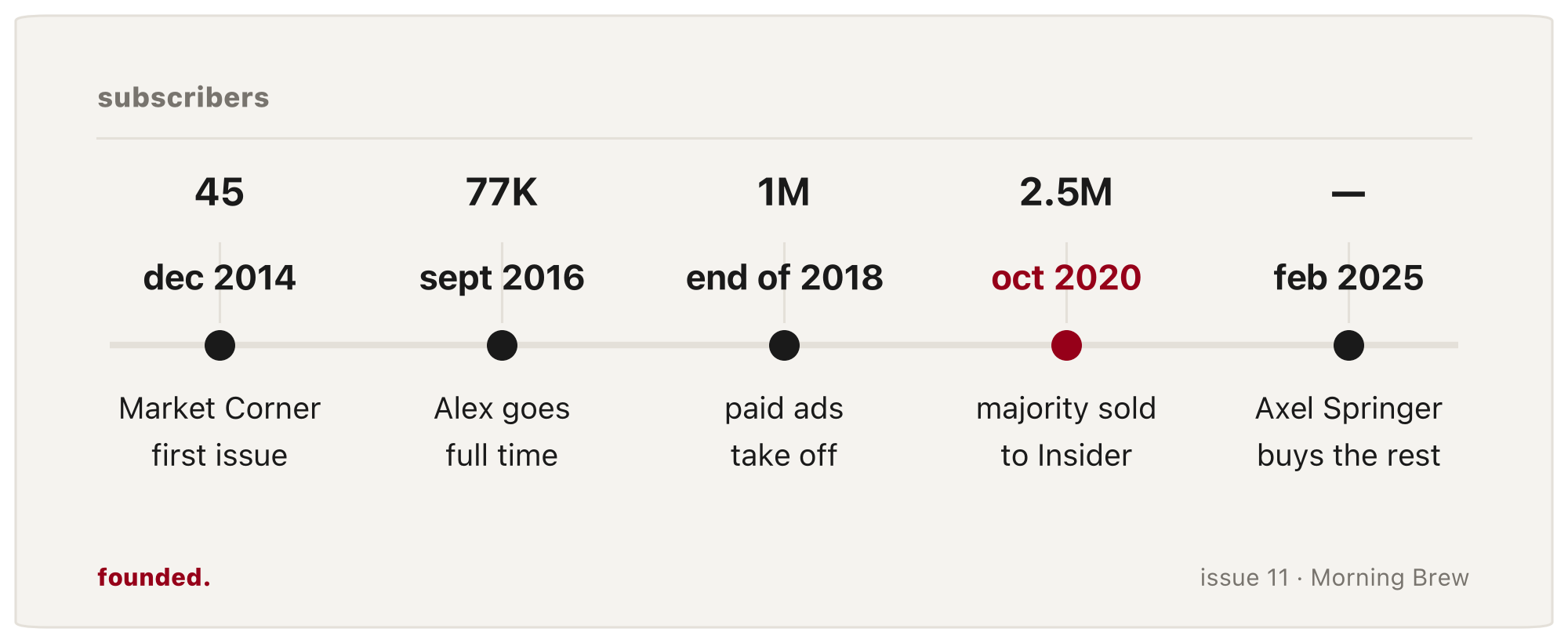
Except it didn’t start with that name: On December 6, 2014, Alex sent the first edition of Market Corner. It was unglamorous; a PDF attached to an email that was sent to 45 friends and classmates.
That small batch of readers enjoyed the daily briefs and quickly spread the word. By the end of the semester, more than 1,000 students had signed up. One of those early readers was Austin Rief, a sophomore, who emailed Alex looking to help out:
If I didn’t send Alex that first email, then I wouldn’t be here today.
— Austin Rief
Less than four months later the business was renamed Morning Brew.
If growth has been an obstacle for you, like it has for me, this is a story you’ll resonate with. The founders have openly shared what each distribution channel cost them and how it translated to readership.
02: three weeks of business classes
In the early days, there was no marketing budget. Austin explained:
We had 0 money to spend on marketing, so we had to get creative.
— Austin Rief, on X
This meant speaking to classes of business students.
We spent, I don’t know, probably three or four weeks going to every single business class and every single business club on campus.
— Alex Lieberman, on the Nathan Barry podcast
For every class they visited, they gave “the Brew spiel” that lasted 2-3 minutes and asked students to write down their email addresses.
When readers offered to sign up their friends, Alex typed the emails down. Austin said readership went from 0 to 2,000 within six months.
campus ambassadors
Word of mouth only got them so far. They ran out of classes to speak in front of so they had to visit the next college campus to expand their reach. It was time for the next level.
They turned to an ambassador framework: they recruited students at other schools to give the Brew spiel on their own campuses. At its peak, more than 700 students had signed up for the program.
Alex has said that this alone brought in 5,000-10,000 new subscribers each semester while Austin confirmed that it allowed them to grow to around 70,000 subscribers.
After graduating in May of 2015, Alex started his finance job and ran Morning Brew as a side hustle. It didn’t last long. By September 2016, he quit to work on Morning Brew full time. At the time, 77,000 subscribers didn’t earn them a single dollar.
We hadn’t made a dollar yet.
— Alex Lieberman
A key metric that kept the founders humble was actual readership: although 77,000 email addresses had been collected, open rates varied. TechCrunch reported a daily open rate of around 50% in 2018, in line with Morning Brew’s 10th Anniversary Issue that stated readership was 30,000 in 2017.
Austin graduated two years after Alex in 2017 and joined full-time that summer as a writer for the daily emails. The work far outpaced what the founders could handle. Neal Freyman, a writer that they hired that same year, recalls Alex being overworked: “I’m literally working ’til 3am, I’m sleeping on this sofa in New York City.”
the first ad revenue
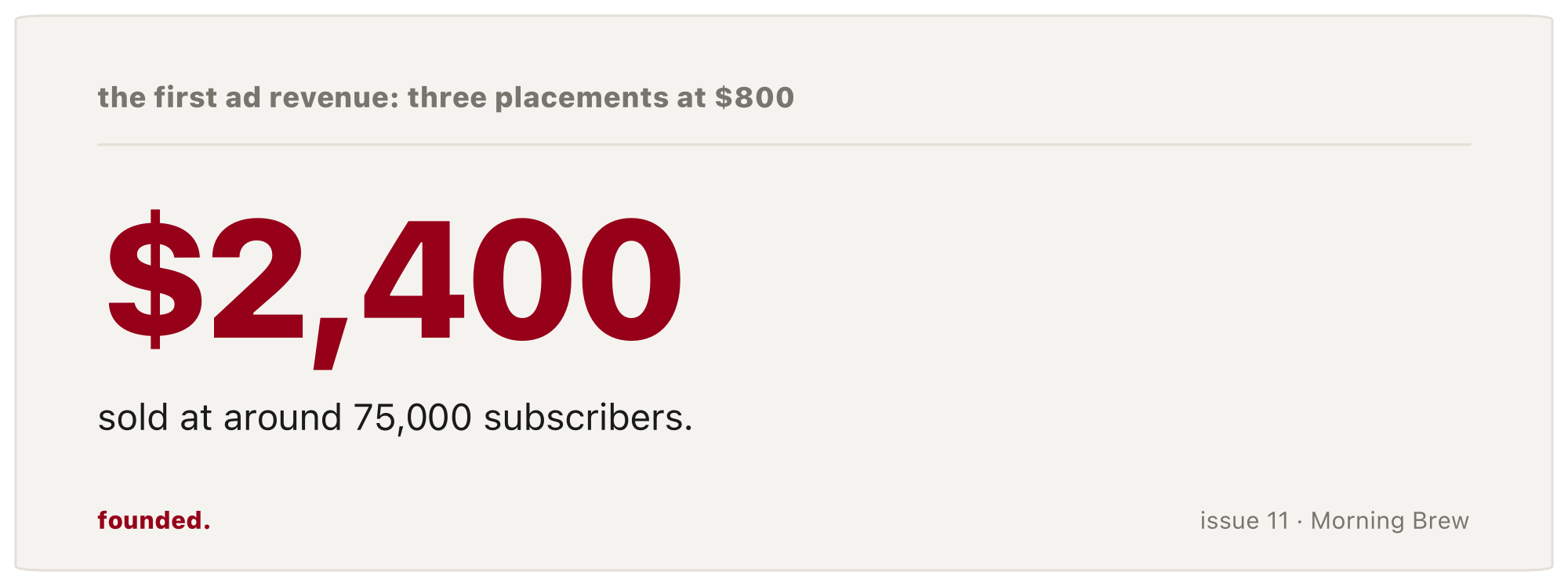
To solve their revenue problem, the founders turned to advertising. The first one was three placements of $800 for a total of $2,400 with around 75,000 subscribers. They could have charged much earlier but wanted to protect the brand, according to Alex.
Bigger advertisers including Discover, Casper, and Duke University soon wanted placements in the daily emails. Discover became their first big ad deal. Its CMO read Morning Brew and referred the founders to Discover’s ad agency that asked the team to pitch a campaign of about $250,000. Austin said Discover went on to give them “six figures, frequently.”
Morning Brew’s 2017 revenue was $300,000. That same year, the founders decided to raise $750,000 from a seed round funded by media executives including Brian Kelly, the founder of The Points Guy.
a $500 referral page
After going full-time, it was full steam ahead. The next implementation was one that did a lot of leg work in the years that followed. A referral program. It was a natural extension of the ambassador program; readers who weren’t ambassadors were sharing the newsletter too, and Alex and Austin asked themselves “how do we make everyone an ambassador?” They tried an off-the-shelf tool, KickoffLabs first but it gave them no flexibility for their own website.
The two then found a post on Tim Ferriss’s blog that walked through the referral program that Harry’s (the razor brand) had built.
An Upwork developer in Ohio was paid $500 to build a simple landing page modeled on Harry’s, where readers could earn rewards with the number of referrals they provided. At its peak, Austin reported that they were sending out two or three thousand sticker packs each week by hand. The referral tiers are covered in more detail below.
If you’re interested in getting a weekly deep-dive to adopt founder mindsets, skills, and lessons please subscribe. It’s great to have you in the family!
03: paying for readers
The final distribution channel came in 2018 through paid advertising. Once the budget had been established, it became a significant cost but also increased total subscribers tenfold from around 100,000 to one million by the end of that year. Austin recalled two key insights (read his full X thread here):
When @morningbrew began spending money on paid acquisition in 2018, 2 small insights exploded our growth ~10x in a year.
— Austin Rief, on X
the first insight: newsletter placements
The first insight was that the best way to grow a specific medium was to get promoted on that medium.
— Austin Rief, on X
For a newsletter, that meant paying for an ad spot in similar newsletters. In 2018 that market was underutilized. Austin said they paid 50-75% less than the same ads cost one year later.
Every newsletter that sold ad space was contacted by Morning Brew and when that channel was exhausted the team was hired by other companies with large mailing lists to set up their advertising. Instead of money, Morning Brew received the first ad spot as payment in the client’s newsletter (I think this was pretty genius).
the second insight: Instagram Stories
The second growth catalyst was Instagram. A post that was written as a fake group chat conversation promoting Morning Brew got more likes than the page had followers. Instagram Stories were new at the time and Instagram was just starting to allow advertisers to use them. That same post was repurposed for a story ad:
We couldn’t spend money fast enough.
— Austin Rief, on X
The $10,000 daily ad spend was often hit by noon. It cost just 10 cents per subscriber for a short while and 150,000 subscribers were added in those 2-3 weeks.
This took me by surprise. I thought the referral program would explain the extent of the growth. Instead, referrals made up about 1/3 of new subscribers in 2019 while buying ad space in other newsletters and being early to Instagram Stories increased subscriber count tenfold.
the rule they broke
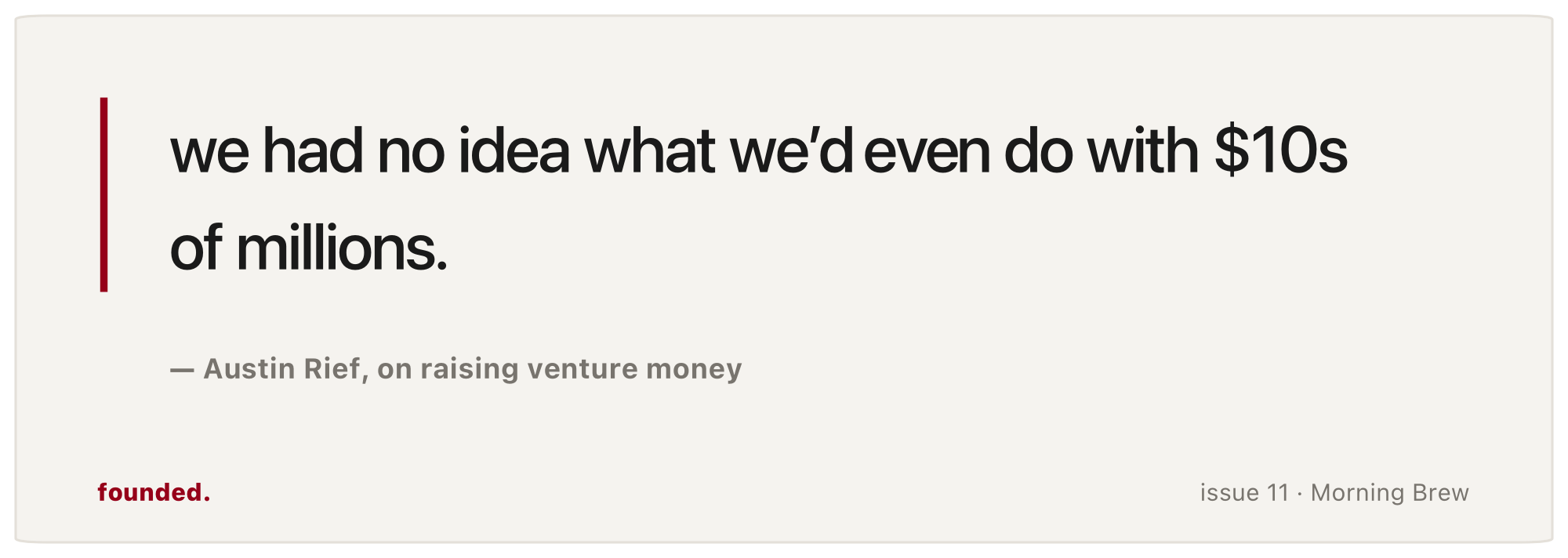
The founders had an important decision to make: digital media companies at this point were raising capital and pivoting to video format. Austin reflects on what others were pressuring them into:
They insist we raised $10s of millions of dollars to ‘pivot to video’.
— Austin Rief, on X
Morning Brew stood out from other digital media companies in two distinct ways:
Several companies raised tens of millions in outside capital; Morning Brew raised $750,000 to kickstart the brand and then never raised again.
The category pivoted to web traffic and video; Morning Brew stood its ground as a written email to reader inboxes and didn’t post on social media until year four.
04: the odd match
The revenue side is just as remarkable: $3.1 million in 2018 turned into $13.3 million just one year later to $20 million by 2020. When the business was sold, the main Morning Brew newsletter had more than 2.5 million subscribers and had been profitable since its first year.
Although advertising was difficult from a cashflow perspective (Austin has said this explicitly, stating that some advertisers took 120 days to pay), the founders established an advertisement sales team to manage growth.
On October 29, 2020, Morning Brew was sold to Insider Inc. in an all-cash deal for a majority stake. The Wall Street Journal put the valuation at over $75 million including performance incentives, and Axios reported ‘about $75 million’: approximately 3.75x 2020 revenue. The exact percentage of the business that was sold wasn’t publicly disclosed.
What the public record does show, however, is that Alex and Austin kept a substantial minority stake and that the deal was structured with a performance-based earnout component so the founders would continue to run the show. They also joined a new Morning Brew board with Henry Blodget.
an unusual buyer
When the deal closed, Insider’s CEO, Henry Blodget, said something rather unusual:
Email is not a business we are really focused on.
— Henry Blodget, to Axios
What interested me about this was why they would buy an email newsletter for 8+ figures if that wasn’t their focus.
It all came down to the assets the founders owned and the reach they had as a platform.
Blodget said as much in the same interview:
There’s a lot of growth left in the ad business for them.
— Henry Blodget, to Axios
So what did Insider actually buy? 2.5 million email addresses and about 1 million daily readers at the 42% open rate Digiday reported in early 2020, an advertising business that grew 6x over the previous two years, and a portfolio brand known for delivering relevant business news each morning.
Blodget had sold Business Insider to Axel Springer in 2015 and stayed at the helm allowing him to compare the sales side by side.
I think for Alex and Austin, the decision was the same.
— Henry Blodget, to Axios
Alex to Axios:
We are incentivized to be profitable and to grow quickly.
— Alex Lieberman, to Axios
what it bought them
Selling a majority stake also meant answering to a board. In April of 2021, approximately six months after the deal closed, Austin replaced Alex as CEO. Alex pivoted to executive chairman and turned his focus to culture, content, and being a formal representative for the business. The change was hard on him:
I would say the last 3 months have been probably the most anxious months of the last 6 years for me.
— Alex Lieberman, on Every’s Talk Therapy
That same conversation included some meaningful insights on Alex’s mindset including the loss of his identity and purpose after leaving the CEO role. He left Morning Brew to start his own businesses: StoryArb, then Distro, GrowthPair and Tenex, which helps large companies move fast with AI.
By February 2025, Axel Springer purchased the remaining share of Morning Brew, moving Austin to executive chairman.
From the email with a PDF attachment sent to 45 classmates to the sale to Insider Inc. took just under six years.
05: the growth breakdown
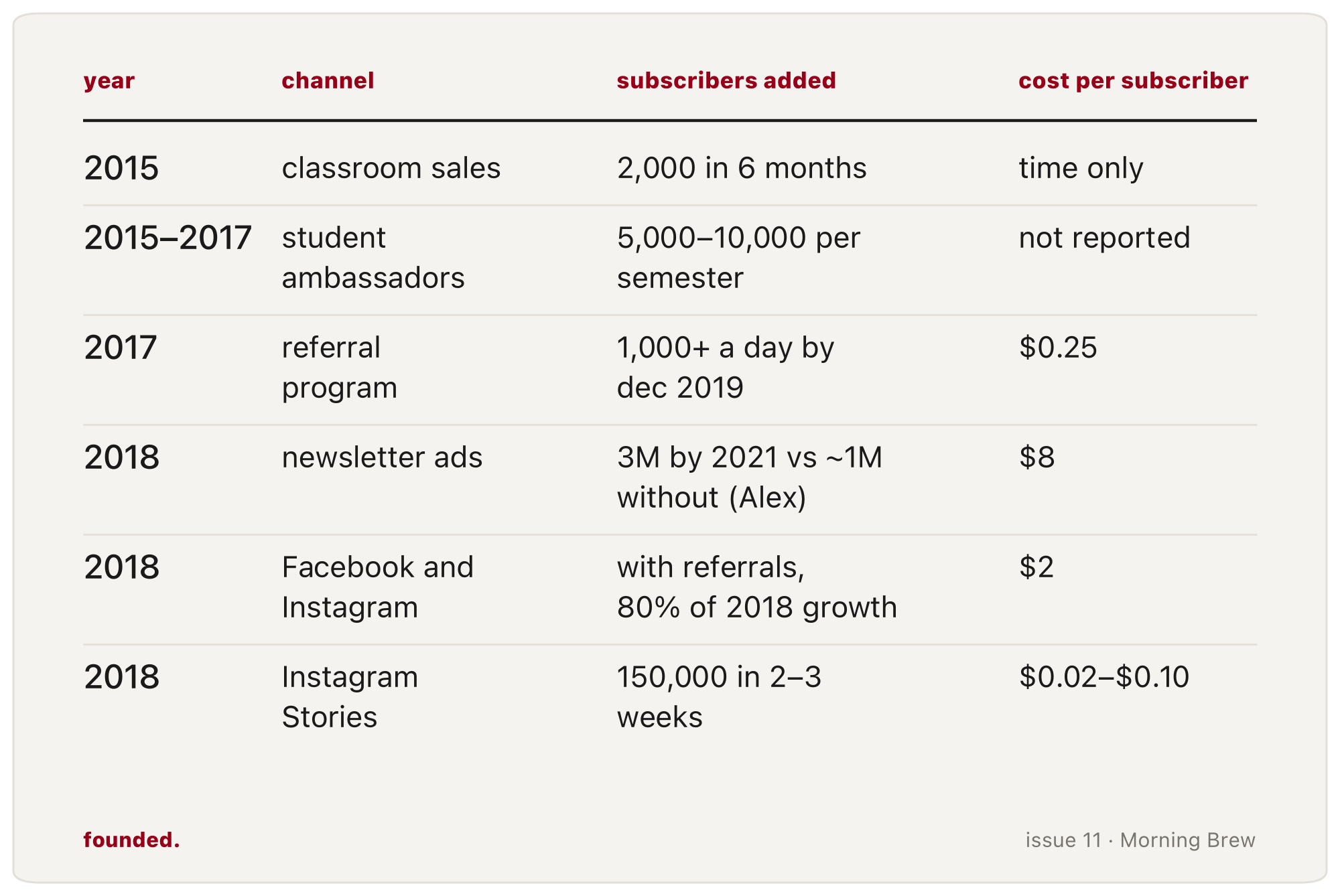
The table below shows each of Morning Brew’s distribution channels what it cost to acquire a customer on those channels and how many subscribers came from each source. This is the juicy stuff that gets me excited.
classroom sales
The founders pitched every business class and related club at the University of Michigan to collect email addresses. It cost them time but not capital, meaningfully growing subscriber count to around 2,000 by month six.
This tactic worked well because their readers were concentrated in a single room with a relatively low-friction call to action. The primary shift to another distribution channel was considered when all of the relevant classes and clubs had exhausted.
The approach is something to steal and adapt: Find a place (physical or online) where a group of buyers already congregates and ask for just two minutes to explain your proposition. Make it a small ask and see if you can convert. If you can’t it’s a value proposition or positioning issue. If you can, recreate the same experiment with another group.
student ambassadors
That next step was student ambassadors that agreed to give the Brew spiel at other schools. It was the main channel until the founders went full time, adding 5,000-10,000 new subscribers every semester. The ambassador program was still running in 2021.
the referral program
The ambassador program expanded to the referral program. It cost an Upwork developer $500 to build and by October 2019 this channel made up 35% of new subscribers with more than 225,000 readers having referred at least one person. By December 2019, Tyler Denk, a senior product lead, said it was bringing in more than 1,000 net new subscribers a day.
Morning Brew estimated the cost per referred reader at about $0.25, an efficient CAC compared with the $2-$5 average across all channels. Referred readers had to confirm their email address before it counted as a referral. Here is the reward structure for referrers:
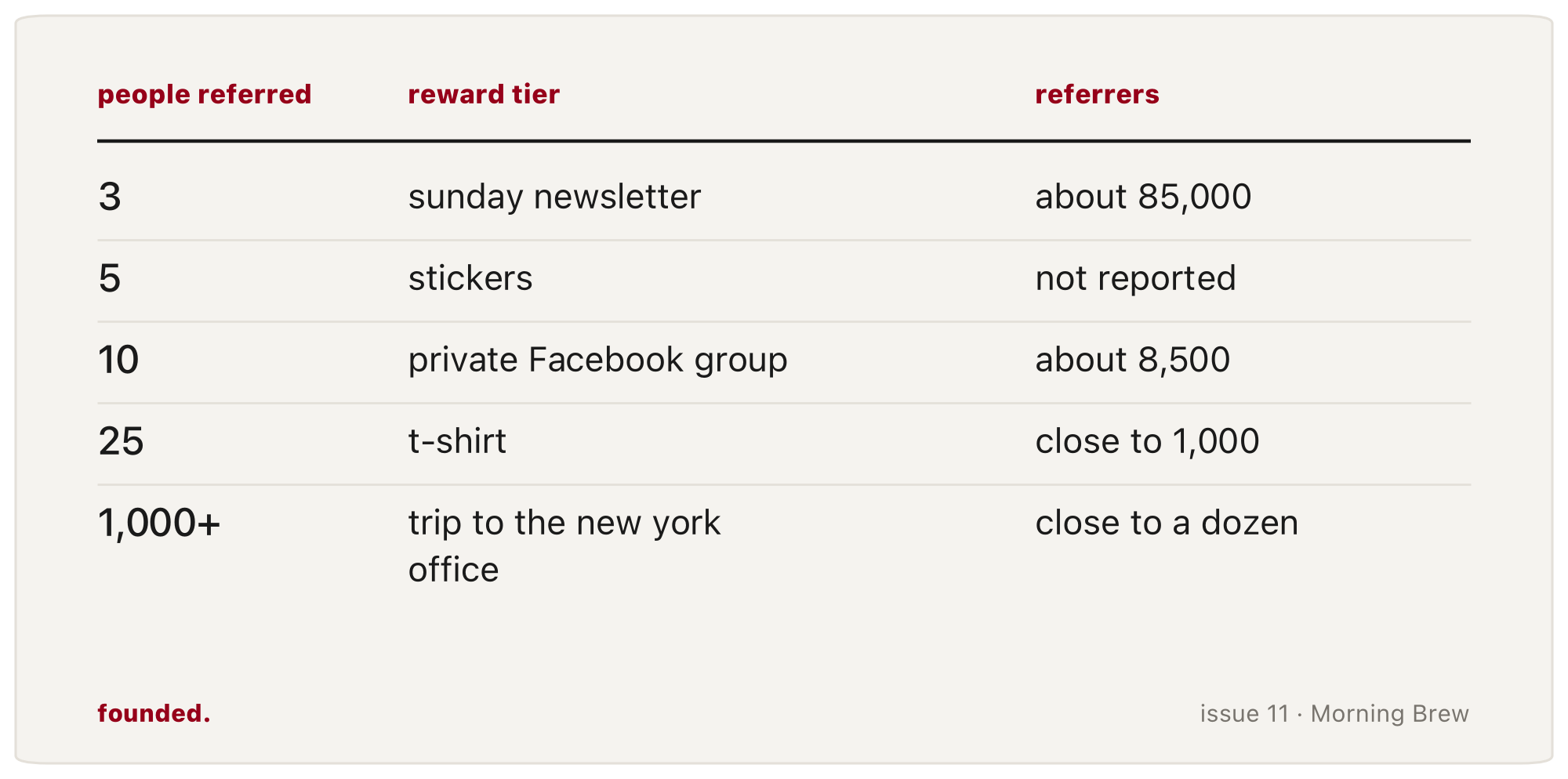
The numbers here are something that belongs in a museum. 85,000 readers referred at least three people. 10% of them (8,500) referred at least 10 readers, while close to 1,000 referred at least 25 and about a dozen people referred more than 1,000.
That means that just 12 people contributed at least 12,000 subscribers. Insane. Even the entry tier with three referrals means that at least 255,000 subscribers came from referrals.
In 2019, a back-to-school campaign gave $1 to DonorsChoose.org for each referral that admittedly grew the list substantially but “wasn’t the most lucrative,” according to Morning Brew’s former head of growth, Jenny Rothenberg.
paid advertising
Paid advertising through other newsletters was the most expensive channel at around $8 per subscriber. Readers that were acquired through this form of paid advertising were more than twice as engaged as those that came through Facebook or referrals.
Morning Brew had a restrictive definition of ‘acquired’, counting a new subscriber only if they opened at least five of their first 10 newsletters. Without the newsletter advertisements, Alex has stated that Morning Brew “would maybe be sniffing a million” readers instead of the three million they had in 2021.
In 2018, Austin reported that the referral program and paid ads (primarily Facebook) brought in 80% of new subscribers. Instagram Story ads were the cheapest at 2 to 10 cents per subscriber. This lasted about a week before the cost increased.
Paying for eyeballs also had its limitations. Audiences quickly wore out and grew tired of repeated ads and ‘advertorials’ stopped working effectively after Facebook cracked down on them.
By 2020, the business was spending “low- to mid six figures” each month on paid marketing, one of the biggest operating expenses. Interestingly, after the marketing budget was cut during the pandemic, growth stayed roughly the same.
06: the tools
the product
The sign-up page promises readers they would “Become Smarter in Just 5 Minutes.” A testimonial I read summed it up perfectly: “For the first time, I read news about business and didn’t fall into an unconscious daydream.” Working in finance, I, like other readers bought into the idea that understanding the day’s business headlines in less than five minutes without our eyes glossing over is useful.
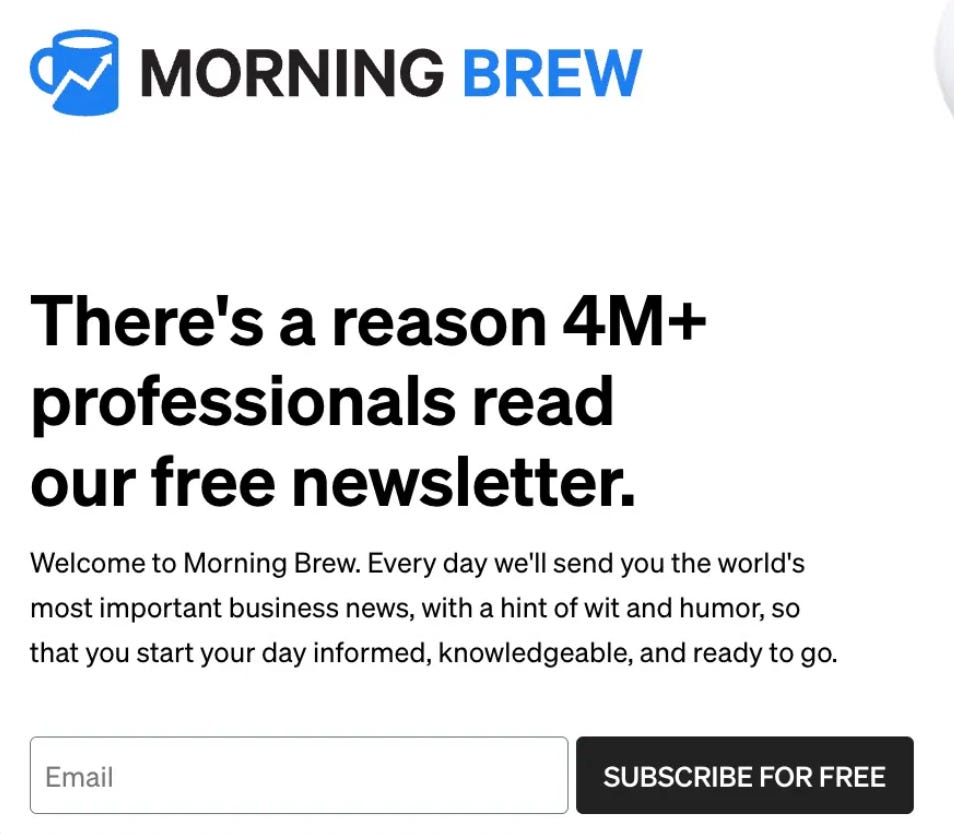
Morning Brew covers the most impactful stories and headlines in the sector. These days, each email includes stock market data, puzzles, and quizzes. By 2020 there were four newsletters and a podcast under the Morning Brew umbrella.
founder skillsets
Alex was the salesman of the two: the classes of students early on, the clubs, early advertisers. He later became the public face of the company. Austin wrote the daily email when he joined and became a master at distribution and paid ads, carefully tracking data and customer acquisition costs. His online threads are one of the most detailed records on how paid ads worked for the business. He became Morning Brew’s CEO from 2021 to 2025 after the acquisition.
monetization
Advertising within the daily newsletter. Morning Brew sold sponsorships at flat rates that increased as the brand grew from 97 advertisers in 2018 to 180 one year later. By 2020, approximately 75% of advertising revenue was directly with brands rather than through agencies with about 90% being performance-based. Morning Brew wrote its advertisers’ ads in the brand’s voice and marked them as sponsored. The advertiser was featured at the top of each email with a single small logo.
unique branding
The Brew name is what stuck and was tagged onto every product after Morning Brew. The Sunday edition aimed at referral program members was called Light Roast. The sender icon in a reader’s inbox was a coffee mug with a transparent background, so it stood out among round profile photos.
Have you learned something new that’s worth applying to your business? Please let me know what you liked or didn’t like as much. I’d also appreciate it if you would share this post or restack if you found value here!
07: the founder’s decision: paying four times more for a reader
the signal
Morning Brew was paying for readers on Facebook and in other newsletters in 2018 and tracked open rates. Readers from other newsletters were often more than twice as engaged as readers from Facebook or referrals. Alex also found that for Facebook ads, “you just burn through audiences faster.”
the options
Use the marketing budget for Facebook and Instagram, costing ~$2 per subscriber.
Invest in the referral program, costing ~$0.25 per subscriber.
Pay ~$8 per subscriber for ads in other newsletters which offered higher engagement.
the decision
Ultimately, the decision was made to not cut the legs out from channels that worked. They kept all three running but gave priority to newsletter ads, paying four times more for each subscriber in exchange for higher engagement.
This was also Austin’s own insight: the best way to grow a medium is to get promoted on that same medium.
the cost
Each newsletter subscriber cost four times more than one acquired through Facebook ads. By 2020, the cost became apparent when paid marketing was one of the company’s biggest operating expenses.
the evidence
Revenue went from $3.1 million in 2018 to $13.3 million in 2019. Alex stated that without newsletter ads, Morning Brew would have had about one million readers in 2021 instead of three million.
As a rough calculation, Morning Brew’s 2019 revenue comes out to $9 per subscriber with 1.5 million subscribers (averaged from 1 million subscribers at the start of the year and 2 million near the end), meaning a subscriber acquired through other newsletters took approximately one year to pay for itself. Clearly, at $2 per subscriber, readers acquired from Facebook paid for themselves within about three months, making it the more cost-effective option. The founders still chose the more expensive channel, seeing it as an investment because of the level of engagement.
The only problem with the analysis is the noise. Instagram Story ads, Facebook and referrals were all running at the same time, and Austin also gives credit to Instagram for the jump in subscriber count in 2018.
the application
How can you apply this to your business?
The most fruitful way to test all of this is to survey what your buyers are already consuming, watching, or reading. Does that space sell advertising opportunities? Is there a cheap way to run a pilot?
Then question engagement. Can you track the loyalty of customers acquired through that source? Do they buy more than once? Do they refer you to others? How well does your product or service suit their needs?
When should you decide against this approach, you might be asking? If you have a small niche or close-knit community you rely on. Not only will it not scale, it will cost you trust. These situations require more care and a word of mouth or door-to-door style approach.
Let’s take an example of a bookkeeping firm that wants to sponsor a local business newspaper or buy Facebook ads to reach ideal customers.
The first question is: where do business owners that require bookkeeping ‘hangout’? They read business news. Check. Next comes the question of cost. Can you do a pilot advertisement for $200? Do this for both the newspaper advertisement and for Facebook ads. Measure the number of leads and whether they are buying from you right away or if they are merely interested but click away.
Which of the two converts better for the sample? Weigh the cost and the conversion and do another test. If the results repeat, you’re found your answer. As we mentioned already, however, the local business newspaper likely has a limited number of readers and won’t continue to convert for months. This is likely where Facebook advertising has a long-term advantage.
The key is to try every channel in a vacuum, collect as much data as you can and then make an informed decision. If a new channel becomes a prospect, test before switching or diverting resources.
Although leads can be cheap, they can be the most expensive customer.
08: what still isn’t clear from the research
How the proceeds from the cash portion of the majority stake was split between the founders.
The size of the stake Insider bought. Reports use words like “majority” and “controlling” but no actual number has been confirmed.
The size of the earnout component and whether it was paid in full.
What Axel Springer paid for the remaining equity piece.
The real reason the founders sold in their own words.
Profit numbers throughout the journey.
09: the brand today
Morning Brew Inc. has been wholly owned by Axel Springer since February 2025. The flagship newsletter had more than 4 million subscribers in October 2024. Austin has stated that revenue grew to $70 million by the end of 2024 with an EBITDA margin of approximately 20%. The brand continues to grow, however, the 2022/2023 layoffs signal that costs are still an obstacle.
FOUNDED FACT
The Kiplinger Letter, a weekly business newsletter, was first mailed on September 29, 1923 to 500 prospects sold at a price of $10 for 52 issues. In November 1928, less than a year before the 1929 crash, it read: “We would give you bullish reports if we could find any, but we can’t.” The newsletter is still alive and well owned by Future plc since 2021.
LEARN MORE
The Peel — Turner Novak with Austin Rief, December 2024. Revenue year by year, the Instagram ads, the stickers and what Austin would do differently.
Nathan Barry podcast, episode 40 — Alex Lieberman, June 2021. The first issues, the class pitches, the first ad sale and what paid acquisition cost, in his own words.
Austin Rief — thread on X, December 28, 2020. The two insights behind the 2018 growth.
SOURCES
Axios — Sara Fischer, October 29, 2020. The majority stake, the valuation of about $75 million, the all-cash deal, 2.5 million subscribers, the minority stake and earn-out, the board and the quotes from Henry Blodget and Alex Lieberman.
The Wall Street Journal, via Talking Biz News — October 14, 2020. A valuation of over $75 million, including performance incentives, for a controlling stake.
Axios — April 20, 2021. Austin Rief as CEO and Alex Lieberman as executive chairman.
CNBC — March 28, 2022. 2020 revenue of $20 million, profitable from the start and more than 230 employees.
Axios — October 22, 2024. Morning Brew Inc., more than 4 million free subscribers and the 2022 and 2023 layoffs.
Talking Biz News and Adweek — February 12, 2025. Axel Springer as sole owner and Rief as executive chairman.
The Peel — Austin Rief, December 13, 2024. Zero to 2,000 subscribers, 60,000 to 70,000 through ambassadors, the Discover proposal, revenue of $300,000 (2017), $3.1 million (2018), $13.3 million (2019) and $46 million (2021), the $750,000 seed round, the stickers, no social media for three years, cash flow, 2-cent Instagram subscribers, 150,000 subscribers in two to three weeks, a million subscribers at the end of 2018, $70 million in revenue and a 20% EBITDA margin.
Austin Rief — thread on X, December 28, 2020. The two insights, newsletter ads at 50% to 75% less, building ad departments for other lists, the Instagram Story ad, the $10,000 daily cap and 10-cent subscribers.
Nathan Barry podcast, episode 40 — Alex Lieberman, June 28, 2021. Market Corner, the class pitches, leaving his job with 77,000 subscribers, the first ad sale, the ambassadors, the $500 referral page, the 23-cent mug, the cost per subscriber by channel and the limits of paid ads.
Austin Rief — threads on X, December 5, 2020, to January 6, 2021. No marketing money, the venture-money quotes and engagement by channel.
TechCrunch — Fitz Tepper, March 26, 2018. More than 700 ambassadors, a 50% open rate, the $750,000 seed round and Brian Kelly, and the Discover, Casper and Duke University sponsors.
Digiday — Kayleigh Barber, February 6, 2020. 97 advertisers in 2018 and 180 in 2019, and flat-rate sponsorships.
Michigan Today — December 19, 2019. The first issue to 45 classmates and more than 1,000 subscribers by the end of the semester.
Morning Brew — “10th Anniversary Brew,” July 6, 2025. About 30,000 readers in 2017, Neal Freyman’s memory of the sofa, answering every reader email and Light Roast.
Michigan Alumnus — “Advice to My Younger Self,” September 2019. Morgan Stanley, Rief’s first email and the five-minute format.
The Media Nut — Josh Sternberg, July 23, 2020. Lieberman going full time, paid marketing spend and channels, the pandemic cut and the revenue mix.
Digiday — October 14, 2019. The referral ladder, 35% of new subscribers, 225,000 referrers, acquisition costs and double opt-in.
Indie Hackers — Jenny Rothenberg AMA, September 27, 2021. The ambassador program in 2021 and the DonorsChoose.org campaign.
Every, Talk Therapy episode 80 — June 2021. Lieberman on the months after leaving the CEO role.
Connection Request podcast — October 11, 2024. StoryArb.
Kiplinger — “100 Years of The Kiplinger Letter.” Wikipedia — Kiplinger, for its ownership. The FOUNDED FACT.
Every figure in this issue is drawn from public statements, interviews and press coverage, and each one is listed with its source above. No interview was conducted with the founders. Morning Brew was a private company and published no financial statements, so revenue, profit and subscriber figures are as the founders and the press reported them and have not been independently audited.