


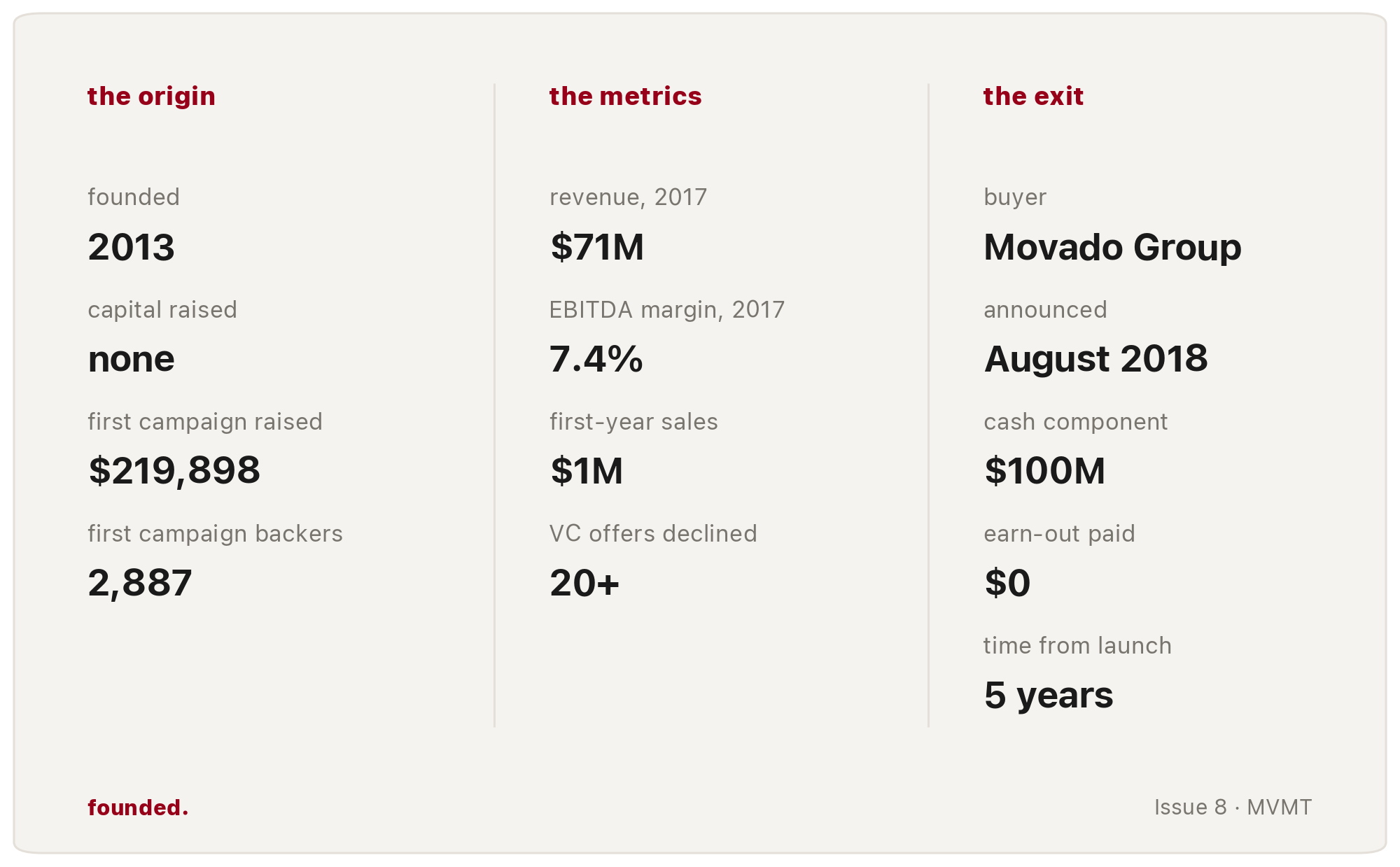
TL;DR: In 2013, roommates Jake Kassan and Kramer LaPlante, who lived in Santa Barbara, dropped out of college and crowdfunded six prototype watches on Indiegogo with the initial goal of raising $15,000. The campaign raised $219,898. Jake’s previous business failed because competitors sold online. MVMT was online-only from the get-go. In the second year of business, Jake taught himself Facebook advertising from podcasts and YouTube videos and just four years later MVMT generated $71 million in annual revenue and was profitable without a single investor. In 2018, just five years after launch, the founders sold to Movado Group for $100 million cash. Jake was 27 at the time. Years after the sale he made a YouTube video about feeling lost. Here’s the whole story (and the juicy details).
Biggest lessons:
Cash is the only security. Movado paid $100 million cash for MVMT and promised up to $100 million structured through an earnout if the brand hit certain growth targets over the four years that followed. On the day the deal closed, the earnout was already valued at just $16.5 million. In the end, no earnout was ever paid and the cash component was the only money received.
Learn from previous failures. Jake’s first company, a light-up T-shirt business, sold product through a physical store that ultimately lost to competitors who sold online. With MVMT he learned from that mistake. There were no physical stores, every sale went through the MVMT website, and customers were acquired through social media.
01: humble beginnings
At the age of 12, Jake was selling promotional lollipops and made his first few hundred dollars. By the age of 17 (2008) he started a business that sold interactive glow-in-the-dark T-shirts, which at its peak was generating $10,000 of revenue per week. The strategy worked for a while (having a physical storefront), however, when competitors offered similar products online, the business suffered and Jake was forced to shut it down.
Most of the public write-ups I’ve read about MVMT start with the inaugural Indiegogo campaign. The T-shirt business is often skipped but was foundational for the development and success of MVMT.
I had other businesses that had failed and I blamed myself. I wasn’t going to let that happen.
— Jake Kassan
Jake met Kramer in Santa Barbara. Kramer was studying at UC Santa Barbara and had experience with Kickstarter through a campaign he ran for a wallet business that ultimately raised more than $100,000 from around 3,000 backers. Jake was studying at Santa Barbara City College at the time, and after a year, he dropped out:
I just didn’t know why I was doing it. I was doing the routine, going in circles.
— Jake Kassan
Kramer left school soon after with just one semester left for his degree.
the watch niche
Neither of the founders was particularly knowledgeable when it came to watchmaking. The problem they faced was a simple one: the watches they liked cost between $500 and $1,000, too expensive for college-aged kids. On the other end of the spectrum, the cheaper ones were not particularly nice or interesting to wear. Kramer described the gap to Forbes:
It’s not that millennials don’t like watches. It’s that what was available was overpriced, marked up, and the brands weren’t things that we really felt we wanted to get behind.
— Kramer LaPlante
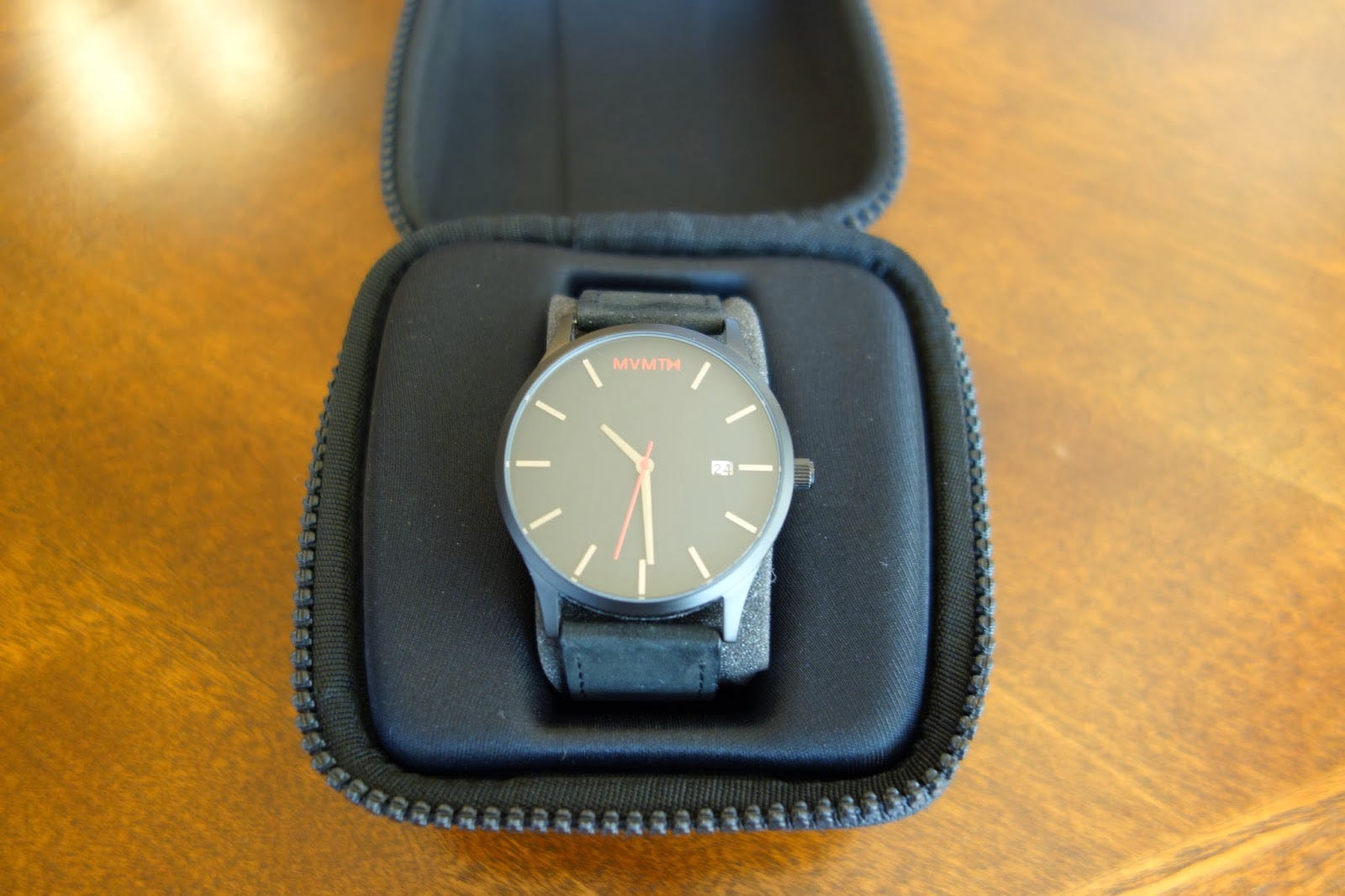
The plan was to create a minimalist watch that looked expensive but priced between $95 and $160. After vetting 20 to 30 manufacturers on Alibaba, they found one they liked. The process happened over email and Skype; they watched for red flags in how each manufacturer communicated, looked for a decent production history and asked for photos and samples before deciding. Three months later, the founders had six samples they had designed themselves and had photographed them with a camera from Costco, all with less than $5,000 invested. At this point, Jake was also $20,000 in debt and working as a valet.
02: 200 emails and the first $1 million
The first person who wanted to buy a watch was a neighbor. Jake and Kramer showed him a prototype and he asked to buy it on the spot. The first real proof of concept.
The obvious place to start was Kickstarter, where Kramer had success before. Their campaign was turned down twice so they moved to Indiegogo instead in June 2013, with a goal of $15,000. All of this without a single product shipped. The pitch was a concept alongside a promise:
We have a business, we don’t have product ... Give us six months, we’ll ship you these watches, and this is the concept.
— Jake Kassan
the campaign backers
There was no marketing budget, so Jake was forced to do it himself. His advice on crowdfunding includes starting with family and friends and setting a goal small enough to hit quickly so the campaign is ‘successful’ by platform standards. The internet glosses over the manual work that went into the success of the campaign launch. Jake describes the level of commitment he had:
I’d go and scrape 200 emails from different press people. I’d go on Reddit, and I’d post different stuff, and then I’d use VPNs to upvote my own Reddit posts to get higher ranking.
— Jake Kassan
Most of the emails went unanswered, but he felt he had to send them. Jake also believed that Indiegogo campaigns take most of their money at the end, so they extended the deadline for a total of 50 days. When it closed in August of 2013, 2,887 people had backed MVMT for a grand total of $219,898, almost fifteen times their initial goal. Forbes later reported that at the time it was the second most-funded fashion campaign in Indiegogo’s history. A second campaign ran from August 7 to 27, and the two together raised $291,307 from almost 3,900 people.
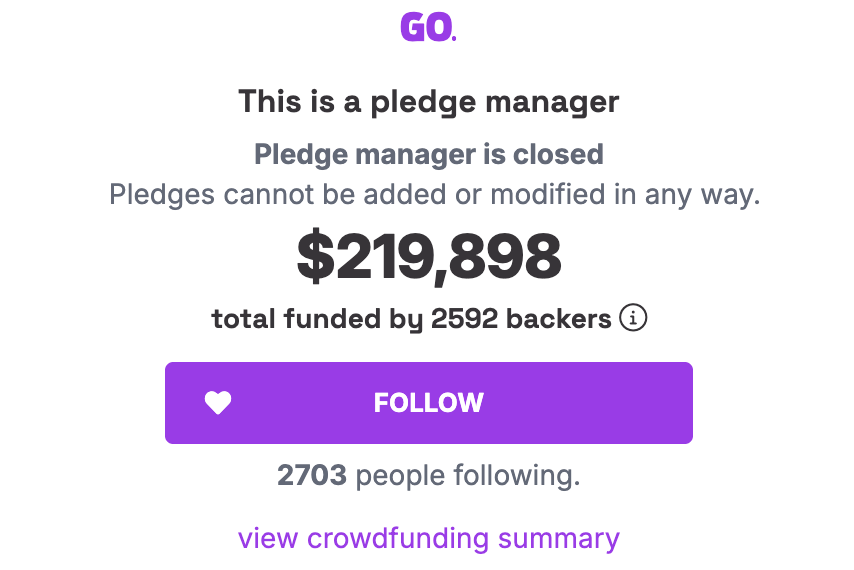
The original campaign page: https://www.indiegogo.com/projects/mvmt-watches-affordable-stylish-high-quality-watches-59
the first year
Then came the hard part: making the watches and shipping them to those who had already paid. The business was run from their Santa Barbara apartment for the first two years. Jake built a basic website during the campaign so that sales momentum could continue after it ended. It was a success; four orders were placed through the site the day after the campaign closed.
The rest of 2013 was spent working with the press. By 2016 MVMT had been featured in Complex, GQ, Hypebeast and many blogs. On Instagram, customers were prompted to post photos wearing the product with the hashtag #jointheMVMT. The best ones were reposted with credit to the photographer. It gave the business a steady supply of product photography that was essentially free.
People felt cool wearing our watches and they told their friends about it, and it all just snowballed from there.
— Kramer LaPlante
By the end of 2013, less than six months after the Indiegogo campaign had ended, MVMT had generated more than $1 million in sales.
If you’re enjoying founded. I’d love to have you join me each week in learning about another unique company taken from idea to exit. See you there!
03: $20 to sell a $100 watch
In the second year of business, growth and customer acquisition became the primary focus. Jake taught himself Facebook advertising:
Year two was when I taught myself through podcasts and YouTube videos how to run Meta ads, and that’s just when it all took off.
— Jake Kassan
Every MVMT sale went through their website which allowed for the measurement of ad spend, customer acquisition costs and how much product had been sold. Unfortunately, MVMT never published these figures publicly. The only hint came from the founder himself.
Once I learned I can go and spend 20 bucks and sell a $100 watch, I’ll do that all day.
— Jake Kassan
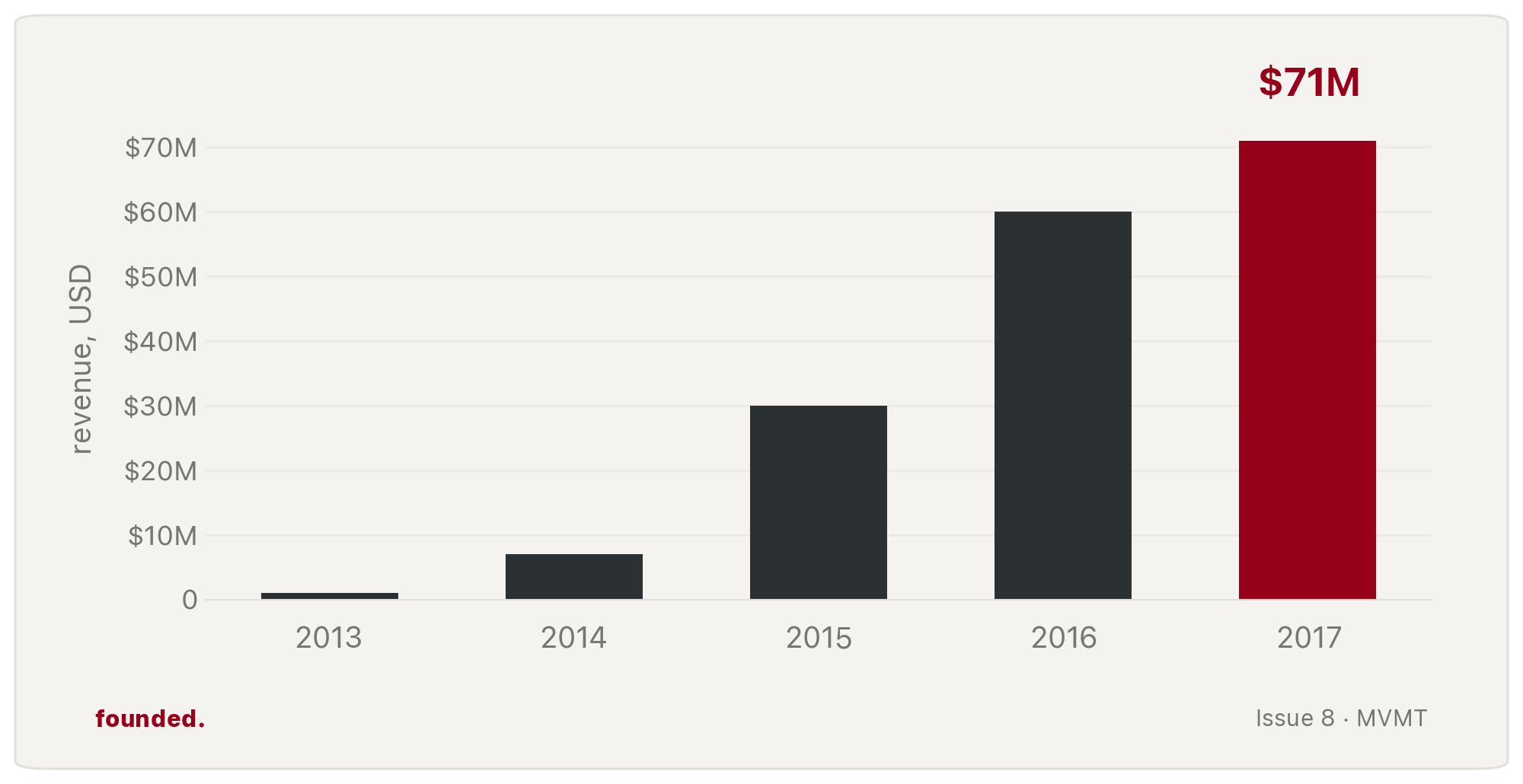
When Facebook became a proven channel for customer acquisition, the same approach was taken to podcasts, Google ads and YouTube. Jake later called Facebook and Instagram “the secret formula for scaling the brand online.” By the end of 2014, sales climbed from $1 million the year prior to $7 million. By 2017, the number had increased tenfold to $71 million.
Alongside advertisements, MVMT also leveraged influencer marketing on Instagram back when it was rare. From smaller travel creators to A-list celebrities such as Kylie Jenner, MVMT paid to have them wear the product and show it off to their respective audiences. Not every post was worth the investment. One of Kylie Jenner’s posts, for example, went up during an Instagram outage.
We made our money back, I think, but it should’ve done much better.
— Jake Kassan
The range ultimately grew from just watches to sunglasses, a women’s collection, blue-light glasses and then jewelry. By 2017, MVMT moved into department stores, including Nordstrom and Bloomingdale’s, though it remained a small part of overall revenue.
no investors
More than 20 venture capital firms wanted in, and one by one the founders turned them down. When money was short, they borrowed small amounts from friends or the bank but no share of the business was ever given up.
the margin
Profit figures weren’t made public by MVMT, but I was very curious and eventually stumbled upon a transcript of an earnings call two weeks after the deal was announced. This came directly from Movado’s CEO, Efraim Grinberg:
Since its founding, MVMT has been profitable on an operating basis every year. Last year, MVMT generated EBITDA of 7.4% of sales.
— Efraim Grinberg, chief executive, Movado Group
Based on the revenue figure of $71 million, that equates to approximately $5.3 million, a thin margin for a product with a significant markup. Movado’s CFO was able to provide some additional context on that same call stating that MVMT’s biggest operating cost was customer acquisition and marketing. MVMT also made most of its profit around the holidays after running at or slightly below breakeven in the first half of the year.
the warning
In January 2018, seven months before the deal was announced, Jake noticed a changing landscape for social media advertising:
[Using Facebook and Instagram ads now is] much more difficult without a doubt. It’s still possible, but it would be very difficult to scale as fast as we did. We used channels that just aren’t as efficient or easy to use anymore.
— Jake Kassan
In the same interview, he stressed that brands not investing in other acquisition channels “are going to hit a ceiling.” That year, for the first time, he and Kramer started looking to raise money.
04: $100 million up front, and a $100 million promise
Soon after the search started, the founders started conversations with Movado Group. Movado is the public company behind Movado, Concord and Ebel, producing watches for brands such as Coach, Tommy Hilfiger and Hugo Boss. Its offerings missed a key segment of the market at the time: young people who shopped primarily online. What started as an effort to raise capital quickly turned into a conversation around a potential sale of the business. The two sides moved quickly to an exclusivity agreement:
I think it was a 75-day exclusivity where we shared information, we talked to them, we met with them, they met with our team.
— Jake Kassan
Over the next 75 days, the founders could not entertain other offers or speak to other buyers. This gave Movado time to go through the business with a fine-tooth comb and left the founders without a backup. This was almost the opposite of the Pura Vida case study from last week where seven formal offers were registered through an auction process.
Jake says that Movado “wanted to know a lot about [the] business, if not everything,” and his finance and marketing staff spent a significant chunk of their time producing reports, a large ask on top of regular workloads. Bankers managed the process and lawyers handled the negotiation. All in, it took six months to get from the first fundraising conversations to a signed deal.
The founders were in agreement on the reason to sell:
We wanted the financial freedom to figure out what we wanted to do next.
— Jake Kassan
the terms
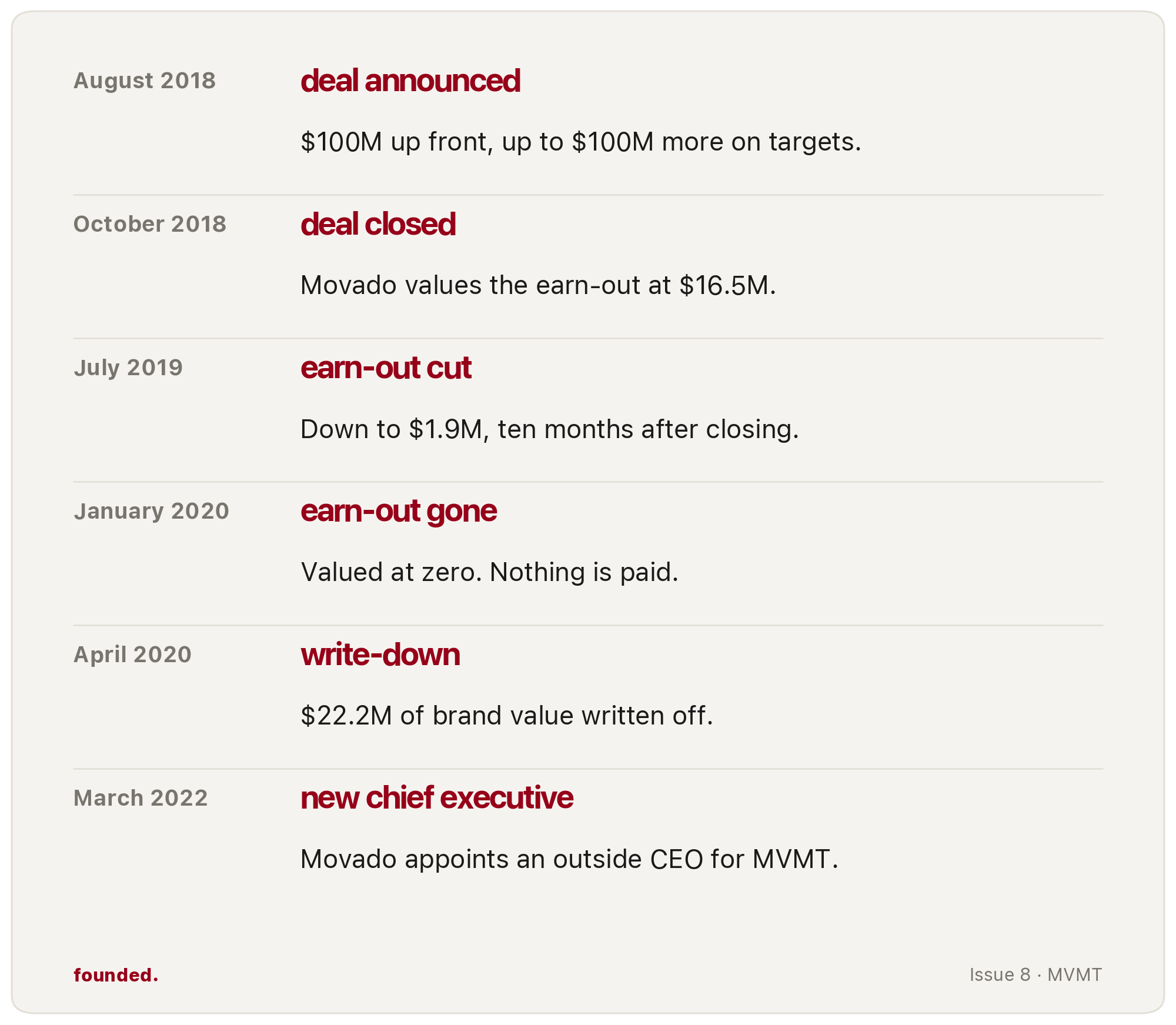
The deal was announced on August 15, 2018, and closed on October 1. It was structured with three primary components:
$100 million cash at closing, adjusted for cash, debt and working capital.
Up to $100 million more across two additional payments, tied to future performance. The catch? There was “no minimum required future payment”.
Jake was to stay on as CEO of MVMT and Kramer as COO.
The cash component valued MVMT at 1.4x 2017 revenue and 19x EBITDA. If the $100 million earnout had been paid in full, the resulting value of $200 million would have been 2.8x revenue and 38x EBITDA.
Movado’s CEO made a public statement after the announcement of the deal speaking to the gap it filled in the existing customer base at Movado:
While others believe that young consumers will not be interested in the watch category, Jake and Kramer proved them wrong.
— Efraim Grinberg, chief executive, Movado Group
The filings show how Movado logged the purchase. It valued MVMT’s inventory at $14.6 million. Most of the remainder was entered as goodwill, the MVMT name and its customer relationships, essentially how accounting shows the acquisition of a brand and its customer base (in this case, largely built on social media followers).
the second $100 million
The second $100 million was structured as an earnout. It was expected to be paid in two parts: the first was to be based on MVMT’s average performance over the first two years after the sale, and the second on performance over the two years after that. Both parts depended on MVMT hitting revenue and EBITDA targets that were never shared publicly.
Accounting rules require a buyer to estimate the expected payout of an earnout component on the day a deal closes. That estimate is then updated every quarter afterward. Movado built its estimate from a simulation of MVMT’s possible sales and profit over the next four years and arrived at an expected value of $16.5 million at closing.
$100 million is what Movado would have paid if MVMT grew fast enough to hit every growth target but when the probability of actually hitting those targets was simulated, the estimate came in less than one sixth of the maximum.
I assumed the further decline in the expected payout was because of the COVID pandemic strictly based on the timing of it all. Upon closer investigation, however, it became clear that in July 2019, 10 months after closing and six months before the pandemic started, Movado cut its estimate down to just $1.9 million. On the earnings call the reasoning was questioned, to which Movado’s CEO responded that MVMT was growing but just not fast enough.
This is a transaction that was staged over [a] three to four-year period of time in terms of an earn-out, and it will not achieve that level of growth.
— Efraim Grinberg, chief executive, Movado Group
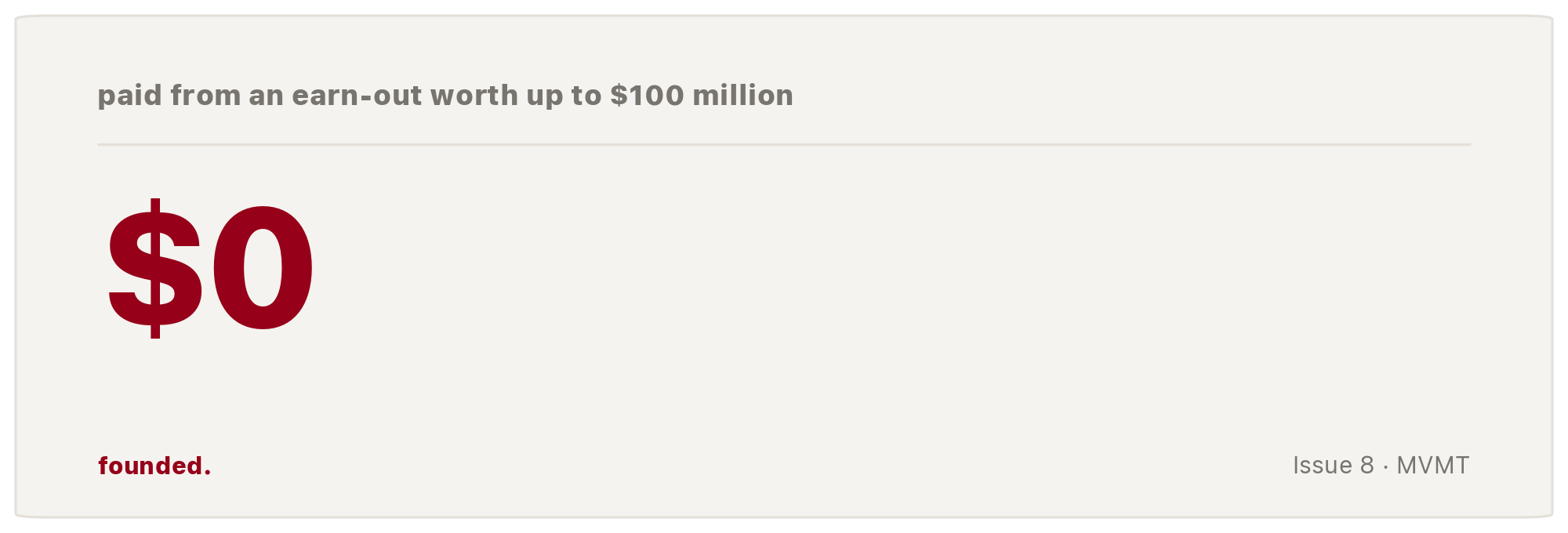
By January 31, 2020, Movado valued the earnout at $0 on lagging performance. Jake stayed on as CEO for about two years after the acquisition, and the founders ended up earning nothing after the initial cash payment at closing. In a 2025 interview, Jake said that he was happy to stay on as a courtesy to Movado since they essentially changed the trajectory of his life by acquiring the brand.
That is why the price of this deal is quoted four different ways:
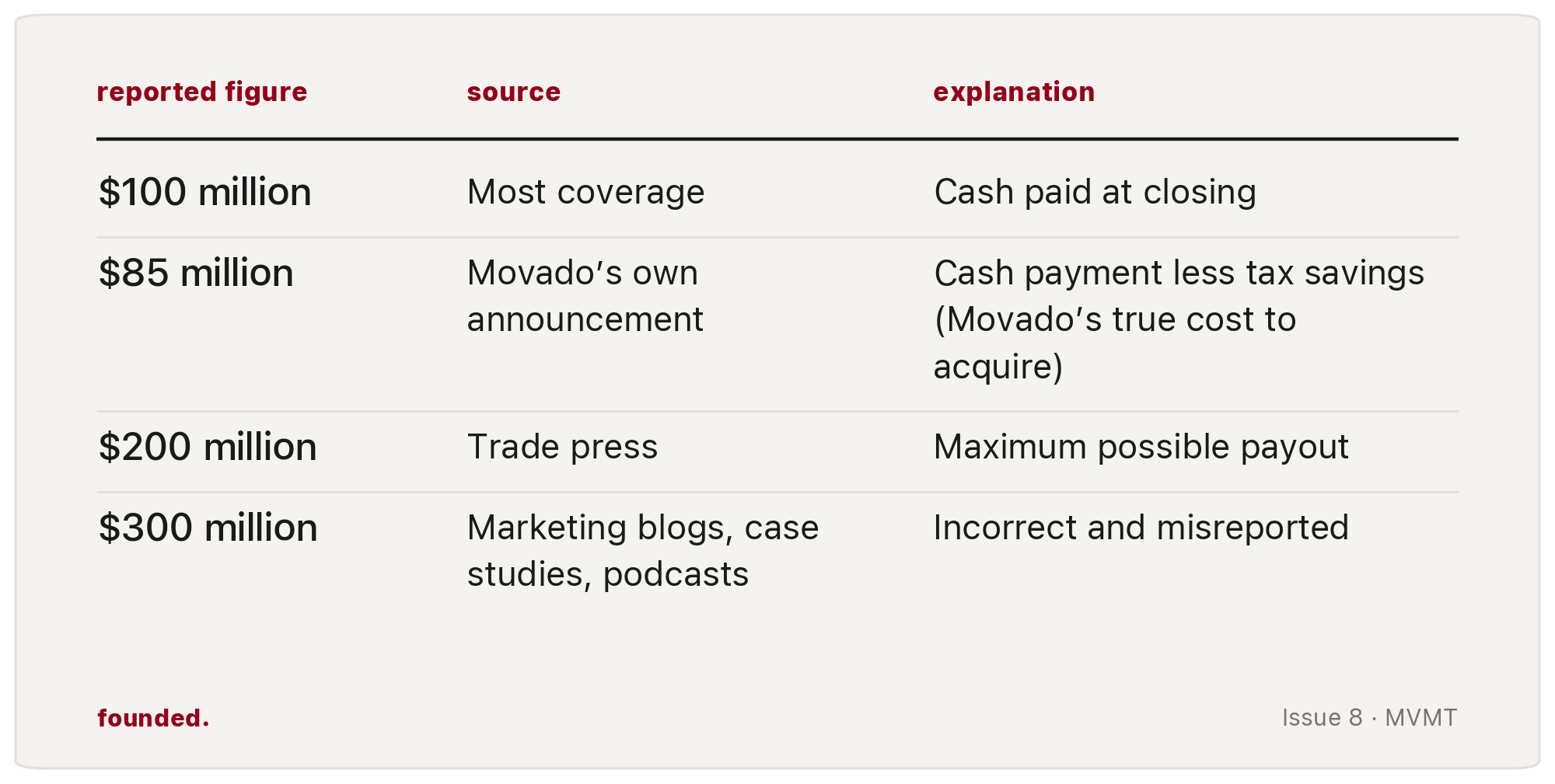
The $300 million figure appears to trace back to a 2018 Forbes writeup: “an initial $100 million payment, and two additional payments of $100 million in total.” This is incorrect but has since spread from one blog to another. Setting the record straight here! Funny enough, even one of the podcasts I listened to listed the sale price at $300 million, from which Jake made $100 million. The filings clearly state that Movado paid $100 million cash and no further payments were ever made.
Learned something new worth applying to your business? Please reach out! I’d also appreciate it if you would share this post or restack if you would be so kind :)
05: after the sale
the brick and mortar bust
Movado’s plan was to bring the MVMT brand into brick-and-mortar stores. In March of 2019, Movado’s CEO explained to shareholders that the business had been built as a digital brand and needed access to physical stores to reach the next level of growth. In May he said that Movado would launch MVMT in stores in the second half of the year alongside a bigger TV budget. By that fall, MVMT had its first national campaign.
Then COVID came along and stores closed six months later. In April 2020, Movado cut the book value for MVMT’s name and its customer relationships by $22.2 million. A write-down like this means the buyer no longer expects those assets to perform as expected at acquisition. Movado’s reasoning was twofold: universal store closures and the decline in Movado’s own market value.
leaving MVMT
Jake stayed on for two years, and the money was part of the reason why.
I stayed on for two years total, and I think it was partially because of the money.
— Jake Kassan
In 2020, he decided he “wasn’t adding a ton of value” and stepped down. Movado appointed a CEO in March 2022 to run MVMT’s day-to-day operations. The brand still exists to this day and is listed among Movado’s own brands in its most recent annual report. Kramer has since co-founded HygieneLab, a men’s personal-care brand.
now i’m lost
Jake has been unusually open about his experience after the life-changing payout at the age of 27. Growing up, he had one goal.
The North Star when I was younger was always financial freedom. So my purpose, I always felt, was: I wanted to make money.
— Jake Kassan
Then you sell [your company] and then ... for the first time in years, I don’t want to talk about MVMT anymore, but I also didn’t know what to talk about.
— Jake Kassan
The first few years were good but then every day started to feel the same, “like Groundhog Day.” In a CNBC interview, he discusses turning 30, going through a breakup, and struggling to find anyone who understood how lonely he felt. He speaks openly about depression and has mentioned a panic attack that happened in Australia in 2024 that came “completely out of left field.”
How do you empathize with someone who is rich and depressed?
— Jake Kassan
After the panic attack, he decided to start working again but to worry less about the outcome. He chose filmmaking, something he had always loved, and began posting his films on YouTube. One of his best-performing videos, “At 30, I Sold My Company for $100 Million, Now I’m Lost,” is about his struggle with depression and a real take on the life of a founder post-exit.
The next mountain I want to climb was trying to tell meaningful stories through YouTube.
— Jake Kassan
He also started investing in startups, including the soda company Olipop and the sauce brand Truff. He says the money has stopped making a difference in how he feels:
I can’t buy more peace of mind. That’s my relationship with money. I’m grateful for it. I appreciate it. I’d rather have it than not have it ... but there’s nothing that it can do that is going to make me a happier person.
— Jake Kassan
06: the tools
the product
For the first several years, the primary product offering was a line of minimalist watches designed by the founders and manufactured in Asia. They were sold exclusively online and cost between $95 and $160. Several years later, sunglasses, blue-light glasses and jewelry were added to the product line and sold to the same consumer.
founder skillsets
The two founders had different skillsets but were both business-minded from an early age. Kramer brought crowdfunding experience and went on to run the operations side of the business. He has said they were “the first ones to go to market totally online” in the watch business. Jake learned from several failed businesses as a teenager and taught himself advertising that ultimately scaled the brand. He has been open about his shortcomings, admitting he was “probably just a little below average” at school but “very good at being hyper focused.” Jake was also forced to be a master delegator in later years. By 2018, the business had a CMO and CFO who took over roles he had carried years earlier.
If you don’t hand off responsibility and hire people to have ownership of things, then you will always be limited.
— Jake Kassan
monetization
Monetization for a brand of its size had relatively few channels. The business was originally funded from preorders and then moved to direct-to-consumer (DTC) sales through the brand website and social media, ultimately moving to department stores once the brand had grown sufficiently. The crowdfunding rounds paid for the first production run and selling DTC preserved a markup that would otherwise be paid to a retailer. MVMT was strategic with reinvestment into the business; most of the markup from DTC sales went back into advertising and the production of the next batch of product.
unique branding
MVMT is pronounced ‘movement’. The founders were the same age as the people they were selling to: people in school or just graduating who didn’t have an arm and a leg to donate for a nice watch. They aimed to start a MVMT for affordable and stylish timepieces that everyone could enjoy.
07: what went wrong
01: one channel
Similar to the Pura Vida case study from last week, MVMT relied heavily on Facebook and Instagram ads. By 2018 those channels had become harder and less efficient, a significant headwind for a business whose biggest cost was marketing. Even at the peak of social media advertising and efficiency, the CAC meant that although the product markup was good, the company’s EBITDA margin was under 10%. In April 2021, two and a half years after the sale, Apple released iOS 14.5, which let iPhone users stop apps from tracking them across other apps and websites. That made ads on Facebook and Instagram harder to target and measure, and Meta told investors the change would cost about $10 billion in 2022.
02: one buyer
MVMT went into exclusive talks with Movado, the only buyer recorded, while the founders were still deciding whether to sell or raise money. It is unclear whether competing offers through an auction mechanism (like for Pura Vida) would have changed the terms they would be willing to accept or if the final price would have been higher.
03: the promised earnout
Although Jake has openly stated he was happy to stay on after the sale to thank Movado for changing his life, the promise of the $100 million earnout component was also a factor. He stayed on expecting a payout that was later reduced to $0.
08: lessons to apply today
01: treat the earnout as a bonus
Cash is the only thing that has certainty in an acquisition. As they say, “cash is king”. An earnout should be seen as a performance bonus that is by no means guaranteed. Even better? Go into a deal assuming there won’t be an earnout because then everything that is paid after the cash component is in your favor. Even at closing, Movado’s estimate for MVMT’s earnout was about 1/6 of the maximum. If you need more certainty, negotiate for more cash up front or take an all-cash deal and walk away. If you choose to stay on, make sure the reason is greater than just the money.
02: business failures
Jake’s T-shirt business was his real-life MBA. He lost to competitors that sold online so he started a brand that sold exclusively through a website. Most founders treat a failed business as something to put behind them. Instead, use it as a growth opportunity. The failure might not have been huge, but something didn’t work. Write down what actually caused the failure, being as specific as you can, and then start the next business doing exactly the opposite. If you felt no creative control, make sure you build with creativity as a core pillar. If you underpriced and had no margin, aim for an upscale or luxury product.
03: pre-sell the first orders
MVMT’s first production run was paid for by almost 3,900 backers before a single watch was made. Crowdfunding is the most obvious version of presales, but the principle works anywhere: take deposits, create a waitlist structured with a deposit for the product and sell the first batch before you manufacture. It’s also a great strategy for understanding demand. If nobody is interested, you didn’t waste time or money building up an inventory just to scrap it. I think it’s an underutilized market research tool that more founders should be using.
04: be a master of many skills
Early on, Jake understood that every aspect of the business was up to him and Kramer. After making the decision to sell exclusively online, he forced himself to learn social media ads and stuck with them until he understood what differentiated a good ad from a bad one, eventually allowing just $20 of ads to sell a $100 watch. The efficiency that was reached meant that there could be a big budget allocated to advertising spend until the efficiency of the method changed somewhere around 2018. The key here is to understand the deepest parts of the business yourself before delegating. Understand who your client is, what they care about, how advertising and marketing work and be able to explain the whole process end-to-end to somebody who doesn’t know what you offer. Pre-revenue and early on, you can’t just hire someone. It has to be in your hands so you might as well start learning early!
05: prepare for the unexpected
Movado spent the majority of the exclusivity period combing through MVMT’s business documents which required a lot of manpower and involved producing reports in order to satisfy due diligence requirements. The main value was in the brand and its social media following, not the inventory. Anticipate what a buyer may want to know ahead of time and prepare some reports that can easily verify customers, acquisition channels, and inventory levels if applicable to your business. The more organized you are, the easier the process becomes.
06: the trough after the peak
Jake’s ultimate goal growing up was to make enough money to have financial freedom, which he had checked off by 27. He eventually realized it wasn’t enough. The few years after he left MVMT, he said on a podcast, were when he enjoyed life, traveled and embraced having no responsibilities. Then it haunted him. He lost a sense of purpose. Struggling with depression and a loss of meaning, he also found it difficult to relate to anyone else given his unique situation. If you are planning an exit that has the potential to change your financial situation permanently, make sure you have something to fall back on that can keep you from losing your sense of purpose.
A great example of this is Maxx Chewning from Founded’s second case study on Sour Strips. He made videos for YouTube years before an exit and continued doing so afterward. He now makes videos about exciting projects he’s working on, designing a house, and funny skits. The perfect post-exit strategy.
09: what still isn’t clear from the research
How the sale proceeds were split between Jake and Kramer.
The earnout targets and whether they were met. Movado explained why it cut its estimate but never published the numbers.
If there were any other potential buyers considered.
The true annual spend on advertising and the raw CAC.
MVMT’s revenue after the sale (since it isn’t broken out from Movado’s portfolio).
FOUNDED FACT
MVMT’s first Indiegogo campaign was titled “Affordable, Stylish, High Quality Watches – $59.” As of this writing, MVMT men’s watches cost between $148 and $498. The brand that launched as the cheap option has now clearly moved to premium pricing.
LEARN MORE
CNBC Make It — Jake Kassan, January 2025. The most complete account of what happened after the sale, in his own words.
The 505 Podcast — episode 147, February 19, 2025. Jake on the campaign, learning ads, the Movado exclusivity and why he left.
Movado Group — Form 8-K of August 15, 2018, the quarterly reports for fiscal 2019 through fiscal 2021, and the second quarter fiscal 2020 earnings call. The terms, the earnout valuation quarter by quarter and why it was cut, and the 2020 write-down.
SOURCES
Movado Group, Inc. — Form 8-K exhibit 99.1, August 15, 2018. The initial payment of about $100 million, about $85 million net of tax benefits, up to $100 million more in two contingent payments with no minimum, and 2017 revenue of about $71 million.
Movado Group, Inc. — Form 8-K, August 15, 2018, merger agreement summary. The sellers: MVMT Watches Inc., Atomic NewCo Inc., and the revocable and 2017 annuity trusts of Jacob Kassan and Kramer LaPlante.
Movado Group, Inc. — Forms 10-Q for the quarters ended April 30, 2019, July 31, 2019, October 31, 2019 and April 30, 2020. The October 1, 2018 closing, the purchase price allocation, the earnout valued at $16.5 million at acquisition by Monte Carlo simulation and $1.9 million at July 31, 2019, revenue and EBITDA targets through 2023, the portion booked as deferred compensation, the liability at zero by January 31, 2020, and the $22.2 million impairment.
Movado Group — second quarter fiscal 2019 earnings call, August 30, 2018 (Motley Fool transcript). Efraim Grinberg on MVMT being profitable every year, its 7.4% EBITDA margin, the 4.5 million social followers, and young consumers.
Movado Group — first quarter fiscal 2020 earnings call, May 30, 2019 (Nasdaq transcript). Seasonality and the US wholesale launch.
Movado Group — second quarter fiscal 2020 earnings call, August 2019 (Seeking Alpha transcript). Grinberg and Sallie DeMarsilis on why the earnout was revalued and how its two payments were measured.
CNBC Make It — Jake Kassan, January 2025 (syndicated by NBC). The T-shirt company, dropping out, the sale at 27, life after the sale, and the quotes on purpose, loneliness, depression and money.
CNBC — December 1, 2016. The lollipops, the T-shirt company’s $10,000 weeks, Kramer’s Kickstarter wallets and his last semester, sunglasses in 2016, and the $95 to $160 price range.
The 505 Podcast — episode 147, February 19, 2025, and its episode description. The neighbor, the pitch, the 200 press emails and Reddit, the first year, learning ads in year two, $20 to sell a $100 watch, Kylie Jenner, never raising outside money, the 75-day exclusivity and diligence, why they sold, staying two years, and leaving.
Cool Hunting — interview with Jake Kassan, March 19, 2019. The 200 emails, and the line on businesses that failed.
Forbes — Peter Lane Taylor, February 16, 2017. Santa Barbara, the six sample watches, the Costco camera, less than $5,000 invested, the second most-funded fashion campaign on Indiegogo, Kramer on word of mouth, and more than 20 venture capital approaches.
Forbes — Amy Feldman, January 8, 2018. $1 million in the first year and $7 million in the second, #jointheMVMT, paid influencers, and Jake on Facebook and Instagram getting harder.
Yotpo — September 5, 2018. Kickstarter’s two rejections, how the manufacturer was vetted, crowdfunding advice, the extended deadline, the first website orders, and Jake’s $20,000 of debt and valet job.
eCommerce Influence podcast — interview with Jake Kassan, May 2018. The apartment years, #jointheMVMT, and handing off responsibility.
Dropbox — customer story, January 17, 2019. Jake on being broke and unable to afford the watches they liked.
Entrepreneur — March 9, 2016. Press coverage in Complex, GQ and Hypebeast.
JCK — August 2018. Kramer LaPlante on millennials and watches, and the founders’ roles after the sale.
BackerKit — archived records of MVMT’s 2013 Indiegogo campaigns: goals, totals, backers and dates, and the first campaign’s title.
LA Business Journal — August 2018. Nordstrom and Bloomingdale’s.
Business Wire — March 23, 2022. Movado’s appointment of a chief executive for MVMT.
Daily Dot — January 2025. The date of Jake’s YouTube video.
HygieneLab — Thistle & Oak brand profile, Fearrington Village, August 18, 2026, and Kramer LaPlante’s LinkedIn profile. Kramer’s company since MVMT.
Movado Group, Inc. — Form 10-K for fiscal 2026. MVMT among the owned brands, and manufacturing by independent contractors in Asia.
MVMT — men’s watches, mvmt.com, September 2026. Current list prices.
Every figure in this issue is drawn from public filings, interviews and press coverage, and each one is listed with its source above. No interview was conducted with the founders. Figures are as the founders, the buyer or the press stated them and have not been independently audited, with the exception of the purchase price, the earnout valuations and the write-down, which are taken from the buyer’s filings with the Securities and Exchange Commission. All currency figures are US dollars.