

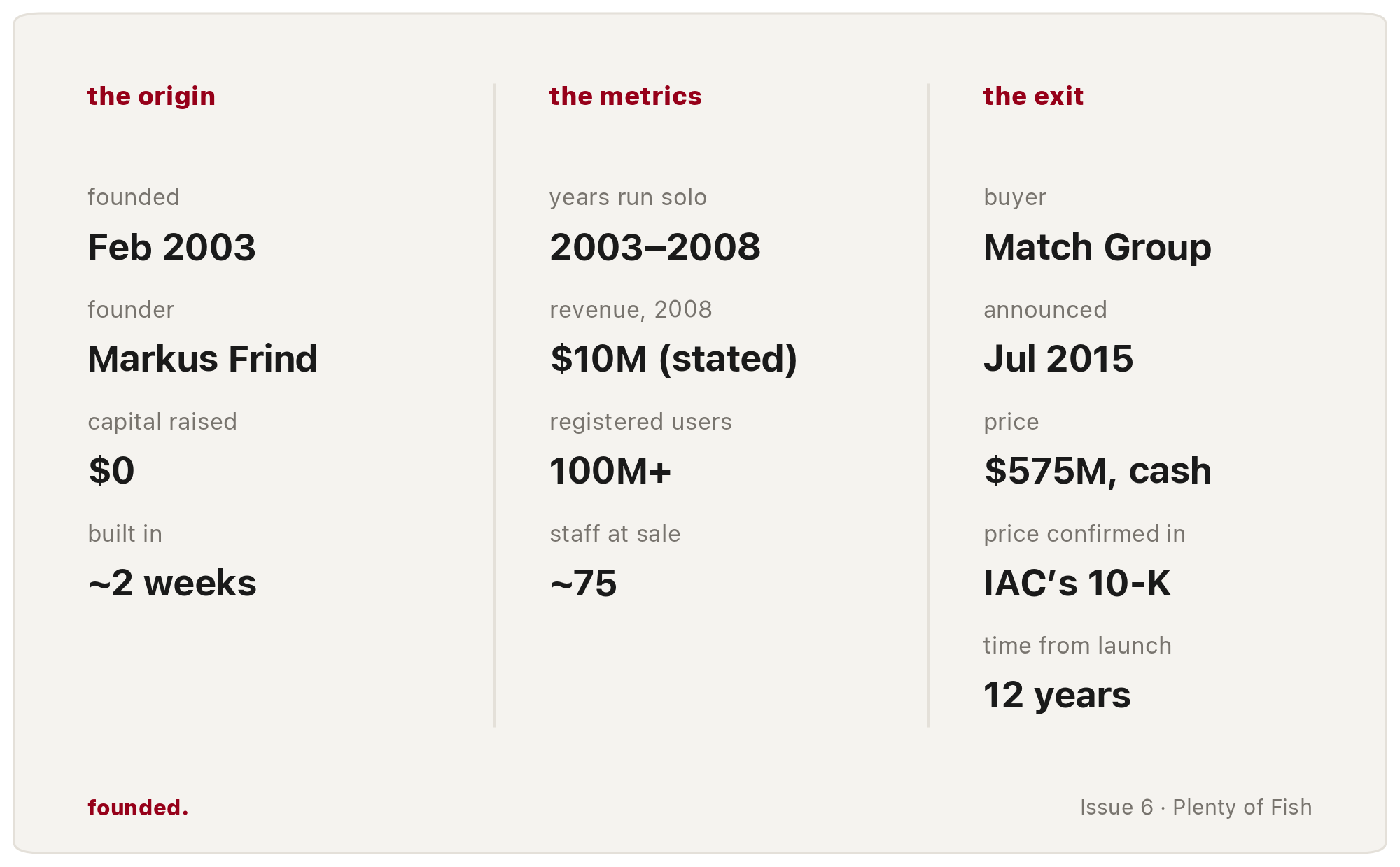
TL;DR: Markus Frind built a dating website back in 2003 in a span of just two weeks because he needed something on his resume and a reason to learn the programming tool Microsoft had just released. He built without any outside money or employees for the first five years. Twelve years later he sold it to the dating app giant Match Group, keeping every dollar. What shocked me was the decision to sell after almost ten years of saying no to the same buyer. What changed?
Biggest lessons:
A business with one owner and no investors can essentially operate however the owner wants. Markus Frind ran Plenty of Fish the way he wanted for five years which included no sign-up fees, limited working hours and no employees in early years. Funny enough, these unique characteristics are what allowed the numbers to work.
Saying no is leverage for a growing business. It is a death sentence if growth has stalled or has started to decline. Markus turned down buyers for years because the business paid him more each year through organic growth. The offer that finally registered was when a market shift was already in the works.
01: the farm, the fallback, and a two-week website
Markus Frind was born in Germany into a family of farmers that moved to Hudson’s Hope, British Columbia (an 18-hour drive from Vancouver), when he was five years old. The family lived on a 1,200-acre farm in a mobile home with no electricity or running water which provided the ideal conditions to play a lot of chess with his father. Nightly games led to clear sequenced thinking and allowed Markus to develop the ability to think five, six, or even ten moves ahead. This later translated to business foresight.
At first, I assumed the chess games were one of those things that gets attached to a founder after the fact to make the story interesting. That wasn’t the case here. He has told the story the same way for years in writing and on podcasts. In all of my research, it was the clearest explanation for his decisions; he never rushed anything and was patient in waiting for the dice to roll a six.
After high school, Markus spent two years at the British Columbia Institute of Technology (BCIT), graduating in 1999 with a diploma in computer systems technology, straight into the back half of the dot-com boom. What followed was the inception of several internet marketing companies that kept failing one after the other.
the waiting game
In 2001, out of boredom, Markus was browsing existing dating sites at the time and noticed what would become the premise of the entire business: they charged people to sign up without a clear reason. Paying to send a message seemed unnecessary to him because the sites were not necessarily trying to cover any costs. He figured that this was costing them customers.
He registered a domain and then did nothing for two years.
This is where the record surprised me. The story usually gets told as someone who spotted a gap in the market and pounced on it. In reality, though, he noticed the problem in 2001 and did not take action until 2003. What finally forced him to act was the need for a job since he had become unemployed. His resume needed an update.
Microsoft had released a new tool called ASP.NET. The fastest way to learn it, he figured, was to build something real using the technology. He already had the domain so he was off to the races. His approach was to just try things instead of learning from books:
I never learn things reading books. I learn by actually doing it.
— Markus Frind
Plenty of Fish went live in February 2003. It was built on the computer in Markus’ apartment. The first iteration had basic pages with no design and was promoted by posting in dating forums. The entire premise was to get some attention and build his portfolio as a developer. The plan was to get a job.
If you’re enjoying founded. I’d love to have you join me each week in learning about another unique company taken from idea to exit. See you there!
the summer that changed everything
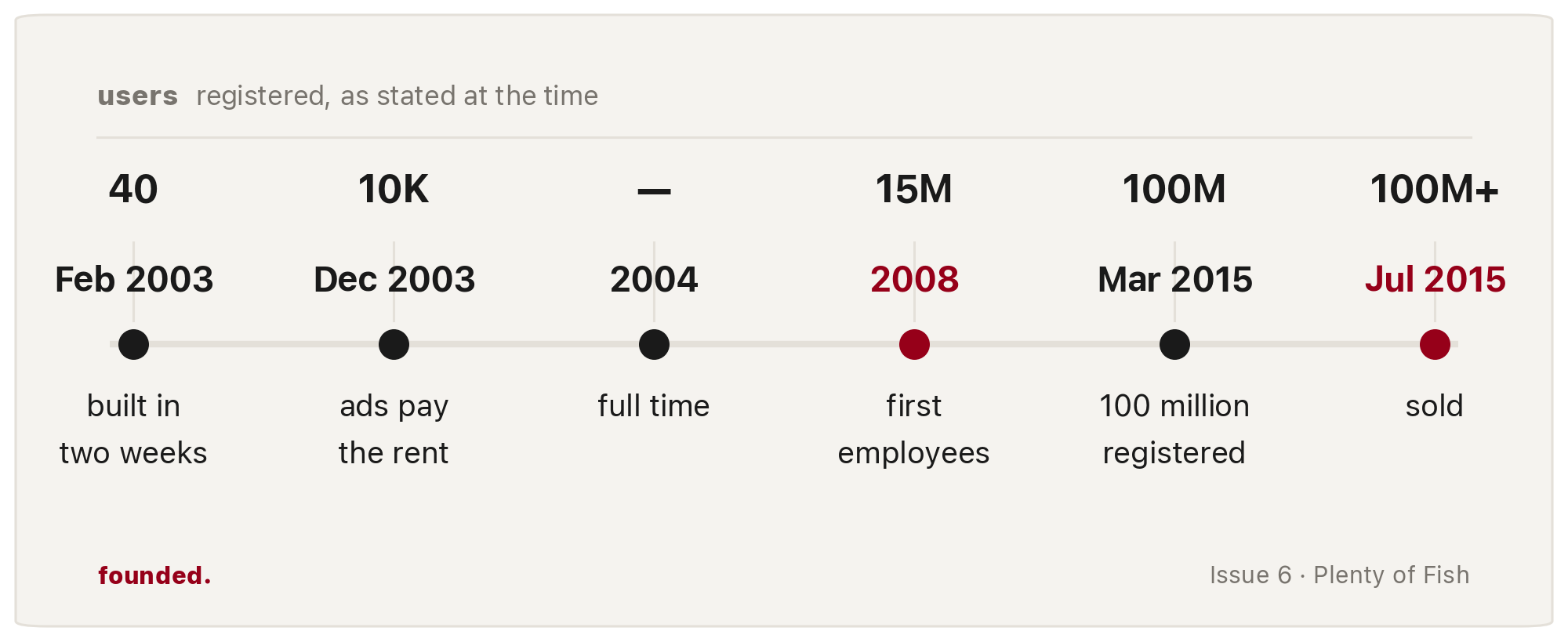
By March 2003, Plenty of Fish had 40 users. By the end of that year it had roughly 10,000. The reason it could not be a full-time job for Markus, however, was based on the entire premise the site was built on: not charging for sign-ups. There was no cashflow.
What changed the game was something not even he expected: Google launched AdSense in the summer of 2003, four months after the site went live. For the first time ever, a person with traffic and no sales team could introduce advertisements on any page and get paid automatically.
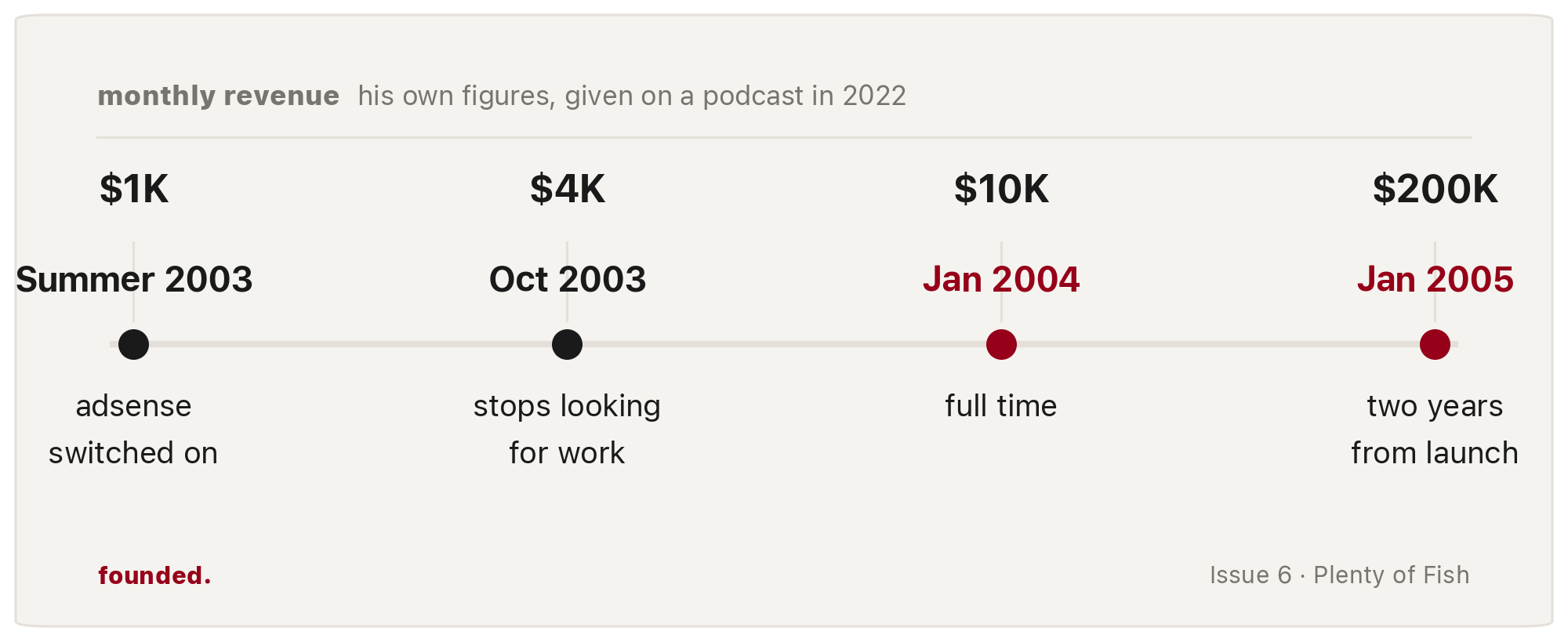
The first month grossed around $1,000. By October 2003 it was $4,000, enough to stop looking for work. By January 2004, $10,000 per month and in January 2005 revenue had inflated to almost $200,000 per month.
Those four figures were hard to find, sourced from a podcast conducted in 2022, seven years after the sale. They are his recollection rather than an actual record. The one check available is the Globe which quoted late 2003 revenue between $3,000 and $5,000 per month which matches Markus’ recollection.
Was it luck? Partly. The timing certainly was. Having a site with real traffic and almost no costs the day it launched was not. He had spent the previous nine months building the kind of website that cost nothing and had infinite upside.
02: five years as a solo builder
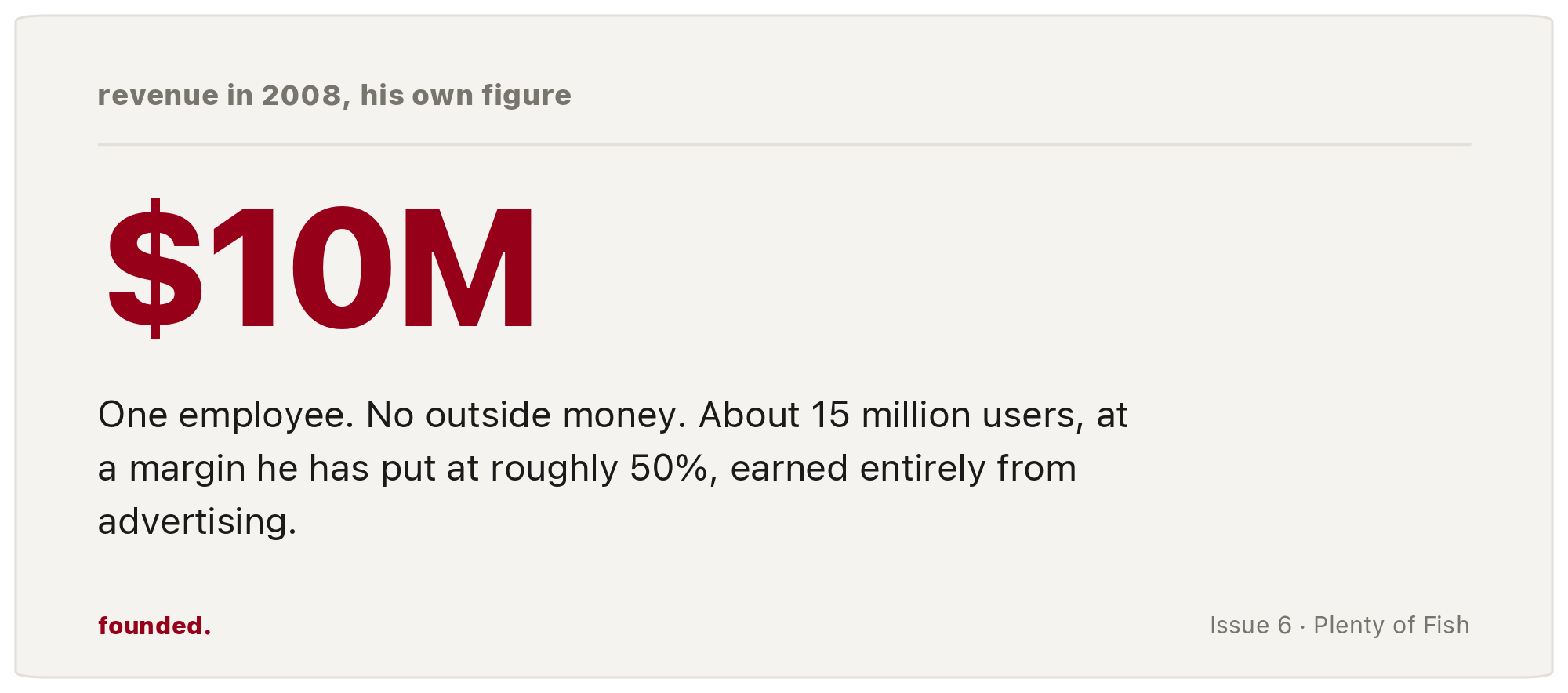
From 2003 to 2008, Plenty of Fish was run by a solo founder. He was the programmer, the moderator, the support desk and the CEO, running the whole site from a laptop in his Vancouver apartment.
The numbers make the story quite remarkable. By 2008, the site had about 15 million users and was generating roughly $10 million per year in revenue. One person and almost no overhead meant revenue was almost entirely profit for the business.
the famous payout
Nobody believed the numbers. A free dating site run by one guy making that kind of money read as obvious nonsense. Markus was often called a liar, so, in 2006, he took a photo of a Google advertising cheque totalling more than $900,000, and posted them online.

Not only did this shock the public and settle the debate, it also told every competitor in the category exactly how much money was up for grabs. He decided the attention was worth more than keeping the revenue stream quiet, and he was partly right: the copycats who turned up still lacked the traffic that Plenty of Fish had.
Nothing had changed from day one. Markus chose the free marketing channel over one that was paid.
work-life balance
The detail that made him stand out from other founders was that he claimed to work one hour per day. In later years when he had staff, he often arrived at the office at 11 a.m., sometimes noon, walked around to see what people were doing, and then went back home to play video games.
I thought about this a lot longer than I probably should have. Is that enough time to run a company with eight-figure annual revenue? The important detail here is easily missed. It’s not about the raw hours worked, which would suggest that Markus was lazy and lacked ambition. What it really reveals is an obsession with removing unnecessary tasks. There are, in Markus’ words, only ever four or five things per year that make any difference while running a business. For a business with no investors, no board meetings, no fundraising or sales calls, there simply isn’t enough work to fill the week. What was left to do did not take very long. Instead of creating random jobs to do, he simply moved on to do something else.
Over time, the needs of the business grew and were somewhat neglected by this same mindset, more on that later.
the first offer
Somewhere in the one-hour-a-day years, Noel Biderman from Avid Life Media (the company behind Ashley Madison) was interested in buying Plenty of Fish. Markus floated a price of $100 million and the conversation ended there.
At that time, the number was not defensible at roughly ten times annual revenue for a business run on advertising, one employee and with no contracts in place. Markus didn’t care that the buyer backed down; he was making enough and was not interested in selling.
hiring
In 2008, Markus finally started hiring, and Plenty of Fish became a normal company with offices. Two floors of Vancouver’s Harbour Centre housed the company’s headquarters while the staff grew into the double digits. The unique qualities of founders come out when hiring begins. In Markus’ case, he deliberately blurred the roles of each employee: programmers did some marketing and customer service representatives worked on product (they were, in his mind, closest to customer complaints to quickly fix an issue or feature).
What he screened for was narrower than a skillset. His interview questions were odd on purpose. One was simply: what is your spirit animal? Another asked the candidate to name three people they had worked with — one who liked them, one who did not, and one who was indifferent, and to say how each would describe them in a single adjective. Neither question has a right answer or can be rehearsed, which was the whole point.
By this point the company was garnering immense traction. Measured in page views, comScore stated 2.8 billion per month against Match.com’s 723 million. Markus’ public position on his competitors was that he left them in the dust long ago.
03: a decade of saying no
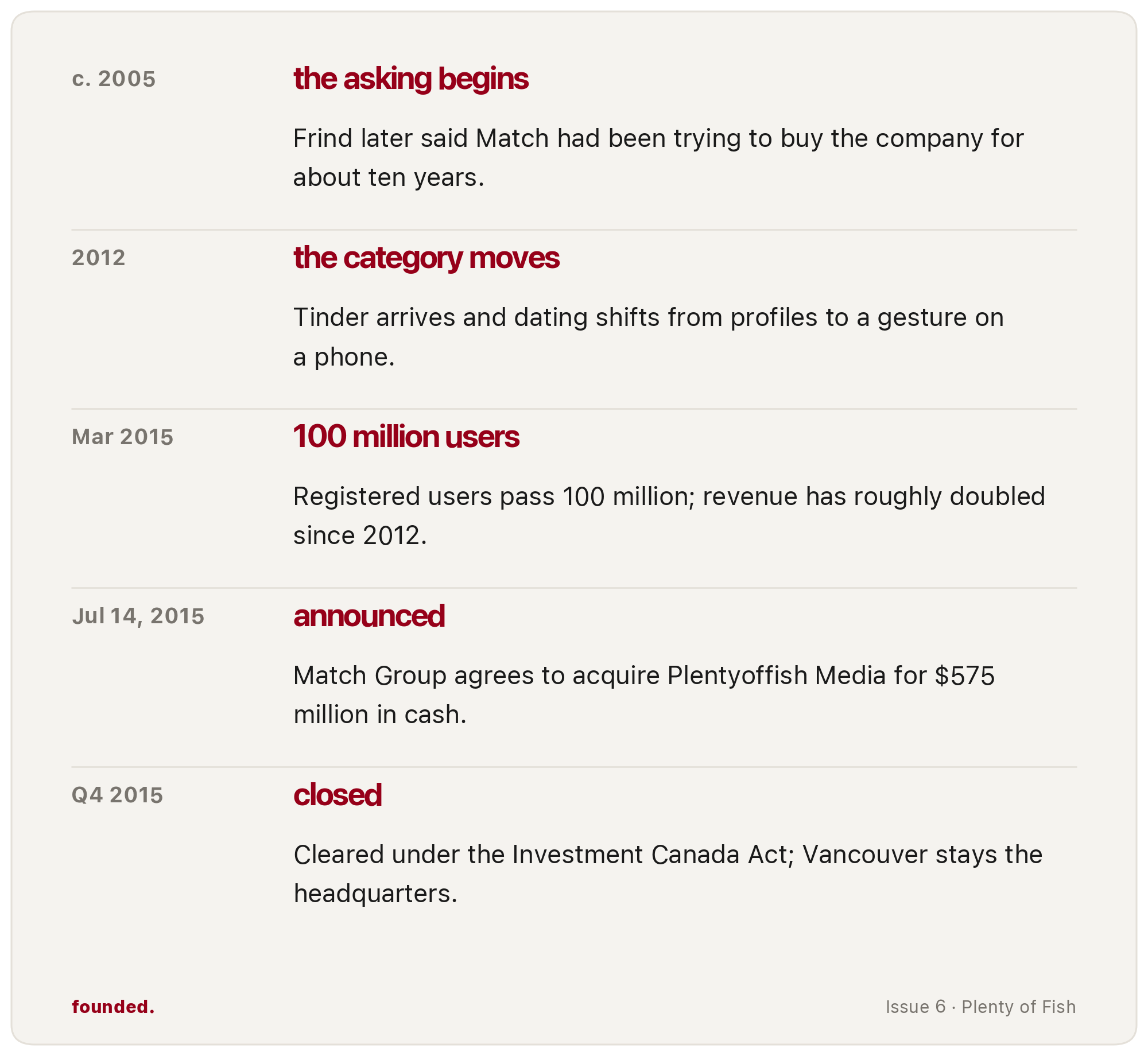
The thing that changed my understanding of the business and its founder was from an interview one month after the sale was finalized: Match Group had actually been trying to buy Plenty of Fish for about ten years prior to acquisition. It wasn’t one interaction that yielded the sale; it was years of Markus denying offers like a negotiation taking place in slow motion.
The question haunting me was: what the hell changed?
saying no was just easier
It was easy to keep denying offers primarily because every dollar of revenue was essentially profit in the beginning. That and the fact that Markus was the sole decision maker and stakeholder.
That put him in a rare position for an acquisition. When Match Group reached out, the only person he had to confer with was himself. The business was easy to run and paid him well for years without a hiccup. So why after all those years of saying no did Markus sell?
He told the BBC in earlier years that he had no other plans and that doing anything else would be like watching grass grow.
the things that changed
Three things changed between 2008 and 2015.
The first was the platform. Plenty of Fish was built as a website when that was the only option. An app version for Apple and Android launched in 2010. By 2012, Tinder had revolutionized the space again with a simple swipe gesture instead of the message-only design that Plenty of Fish was based on.
The second was revenue channels. The move from a website to a mobile app limited the ability to include advertising as standard. The industry was moving towards in-app purchases and subscription models, a shift Plenty of Fish made gradually between 2012 and 2015 rather than in one launch. The move doubled revenue from 2012 to 2015 because even a lower conversion to a subscription increased revenue more than advertisements ever could for the same number of eyeballs.
The third change was a chain of things going sideways. We’ll cover those in a little bit.
I went looking for some drama here and there isn’t anything meaningful to speak of. No other buyers to speak of and no public mentions.
the sale
On July 14, 2015, Match Group announced the acquisition of Plenty of Fish Media for $575 million USD, all cash. The announcement contained a generic line from Markus stating that his team had grown the company into one of the leaders in the category and that he was confident Match would accelerate it.
What he told a reporter the next day was better: It was “really surreal” and he was “still processing it all”. He was 36 at the time. The company had roughly 75 employees and a downtown Vancouver office that had grown the brand to have more than 100 million registered users.
The deal needed clearance from Canada’s Minister of Industry under the Investment Canada Act, a review that a foreign buyer goes through for a Canadian company of any size. The deal closed in the fourth quarter of 2015.
Learned something new worth applying to your business? Please reach out! I’d also appreciate it if you would share this post or restack if you would be so kind :)
04: the tools
the product
A free dating website with no sign-up fee, the key differentiator from competitors. The website allowed users to create a profile, search for people, message them, and in later versions, fill out a matching questionnaire. The design was famously plain. At face value this reads as a lack of care and investment into how the site looked. As a technology systems expert, Markus knew that simple meant fast which mattered more to him than design.
founder skillsets
Markus is trained in technology systems and programming, which buckets him as a technical founder. Through the five-year stint as sole operator, he learned many business skills. He built the product, but more importantly he made the decisions for what moved the needle for the product. The primary skill was not writing code. That part took two weeks. The real skill was ignoring what didn’t matter and simplifying what did.
monetization
Advertising was the revenue engine for years, through Google AdSense, driven by the volume of traffic to the website each month. Margins were strong and high traffic volume meant heaps of monthly revenue for several years. Subscriptions and paid features came later, once mobile phones enticed customers to pay for the upgrade.
unique branding
The name “Plenty of Fish” tells a lonely person that the problem isn’t them, it’s the supply. There’s plenty of people to choose from, you just have to start looking. Not only did this rank well on Google SEO, it also carried well through word of mouth.
05: by the numbers
Revenue was never audited or filed, so the whole public record is either directly from Markus or from the press. The figures include the $10 million of annual revenue in 2008 and the $100 million revenue figure reported in March 2015, which was described as having roughly doubled since 2012. The other figures are from early stages between 2003 and 2005, provided directly from Markus in a podcast. The years between 2008 and 2015 are still a mystery.
06: the sale process
The mechanics of the deal are simple in a way that is notable because almost no exit of this size is. There was one buyer, one recipient of a cash-only payment. And that was it. There was also no stock or earnout component so there were no strings attached. The slowest part of the sale was the Canadian regulatory review which is usually the fastest part of the sale process.
In Issue 4, which featured Baremetrics, the founder Josh Pigford had to get a signoff from two investors that agreed to lose every dollar they invested to facilitate the sale. The difference is not in the negotiation but in the choice to raise capital and sell a stake of the business. The sale was smooth because a cap table was never required.
07: what went wrong
01: the security mishap
In January 2011 Plenty of Fish was hacked and close to 30 million user accounts were exposed because passwords were stored in a form that was not protected. For a business whose product is privately sent messages, it posed a significant concern. The mishap was caused by years of running lean infrastructure that nobody other than the founder could see or fix.
02: bad marketing
Some of the marketing back in the early days included paid placements in music videos from 2010 that were not disclosed as advertising. In March 2015, months before the sale, the company was fined $48,000 under Canada’s anti-spam legislation. Neither of these was monumental in hindering the success of the business but turn up during the due diligence process.
03: the second product
Even with millions of registered users, Plenty of Fish remained one website for 12 years. Match Group, on the other hand, owned dozens of dating brands and could move a user from one to another as their circumstances changed. Markus could have done the same thing but was limited given the ‘four-to-five-things-per-year’ rule. Two or three dating brands under the Plenty of Fish umbrella could have competed well with Match Group.
08: lessons to apply today
01: know the value of future growth
Markus had the ability to turn down buyers many times because he was paid well and saw a clear growth trajectory for the business. If growth has stalled in your business or you foresee issues in the market, it may be time to position yourself for this shift before considering a sale. Although waiting years and saying no to buyers might sound like a good idea, there is also a risk that markets change so that there is less interest in buying your business.
02: sole ownership
One hundred percent owned by Markus Frind. From coding the website to the nine-figure wire transfer. Enough said.
Keep it as simple as possible for as long as possible. Borrow from a friend if you need to. Raising capital or diluting your ownership should be a last resort. Not only does it affect your decision-making ability, it lengthens the sale process and runs the risk of other shareholders not wanting to sell at the same time as you.
03: prioritize the true drivers
The one-hour-a-day story is unhelpful as an aspiration and useful as a filter. His actual claim is that only a handful of decisions in a year change anything, which implies the discipline is not working less but choosing earlier. Try it literally: at the start of a quarter, name the small number of changes that could plausibly move revenue or users, and put everything else on a written list titled “not this year”. That list matters as much as the choices do, because it is what stops the same rejected idea coming back every six weeks dressed up as a new one.
04: the free product model
Not only was the removal of a sign-up fee a key market differentiator, it was a distribution strategy. Free sign-up attracted the single men and women who were sick of paying for online dating. That same volume produced page views, and page views were sold to advertisers. Competitors left out a significant chunk of the market by ignoring price sensitivity. Plenty of Fish leaned into it and ended up winning.
For your business, if there is a way to widen the funnel at the top by offering a part or all of your service for free this can be a great customer acquisition strategy. Once users have discovered the value you offer, you can monetize through any channel and see increased conversion.
05: infrastructure. don’t ignore it.
Plenty of Fish’s password leak in 2011 and compliance fine in 2015 are both examples of what happens when a business runs on autopilot for too long with an underinvestment in infrastructure. Not only will flaws in the systems you run be found during a due diligence audit by a buyer, it will cause catastrophe down the line if not taken seriously. You should prioritize testing and upgrading security on the two or three most important systems you rely on most for your business.
06: measure the non-monetary driver metrics
Markus has said the thing that mattered in the early years was watching the data rather than the reports, and that for Plenty of Fish the business could be reduced to three metrics: how many people visited, how many sent a message, and how many received one. A site with visitors who never message one another is just a directory.
Find the smallest measurable metrics not tied directly to the money that can tell you if the business is thriving or starving. Measure them continuously and test them proactively rather than just reading a report of what’s already happened. The unglamorous truth is that you need to keep costs low for long enough so you can be patient and build the business on top of a working set of fundamentals.
07: action beats learning
What allowed Markus to build the business in the first place was a bias toward action. He always favored just trying something and learning from it than reading books and never applying the knowledge.
09: what still isn’t clear from the research
Audited revenue for the year of the sale. The only figure in public is a reported annual run rate, and nothing breaks it out.
Who initiated the sale in 2015. Did Match make a materially better offer than in previous years, or was Markus ready to sell?
Whether there was another buyer.
What the actual take-home amount Markus received after taxes and whether he decided to stay on after the acquisition.
The split between advertising and subscription revenue at the time of the sale.
FOUNDED FACT
Around 2007, with the site earning about $10 million a year, Markus pitched a sale price that represented roughly 10x annual revenue. Eight years later, with 10x the revenue from 2007, he accepted an offer that was about 6x annual revenue. What changed was not the price he was willing to accept, but the outlook on the market and a realistic view of what the company was worth after learning from many previous offers.
LEARN MORE
The Globe and Mail — “The Vancouverite behind Plenty of Fish”. The best account of the solo years, the farm, and the $900,000 cheque.
The Globe and Mail — “Plenty of Fish founder Markus Frind on love, steel mills and selling out”. The long profile written after the sale, and his own account of how he decides what to work on.
Match Group — the acquisition announcement, July 14, 2015, and IAC’s annual report for that year, which is where the price is confirmed.
A New Wave of Entrepreneurship — “Markus Frind: Continual Improvement”, July 2022. The podcast the monthly revenue figures, the hiring approach and the three-counts idea come from.
SOURCES
IAC/InterActiveCorp — Form 10-K for the year ended December 31, 2015. The purchase price, the cash consideration and the year of completion. The only audited statement of the price.
Match Group — acquisition announcement, July 14, 2015. The announcement date, the $575 million figure, the quotes from Markus Frind and Sam Yagan, and the Investment Canada Act review.
The Globe and Mail — “The Vancouverite behind Plenty of Fish”, ROB Magazine. The farm and the move to Hudson’s Hope, the chess games, BCIT, the failed marketing companies, the domain registered in 2001, 40 users in March 2003 and 10,000 by December, the $900,000 in cheques published in 2006, $10 million of revenue by 2008, the one-hour day, the blurred roles, Harbour Centre, the comScore page views, and Noel Biderman’s approach.
The Globe and Mail — “Plenty of Fish founder Markus Frind on love, steel mills and selling out”, ROB Magazine. February 2003 as the launch month, “I never learn things reading books”, late-2003 revenue of $4,000 to $5,000 a month, and the four or five things a year that make any difference. Its headline puts the sale at $800 million where the filing says $575 million; this issue uses the filing.
Global News — “Meet the Vancouver man getting $575M cash for PlentyofFish sale”, July 15, 2015. About 75 employees, 100 million registered users in March 2015, his age at the sale, “really surreal” and “still processing it all”, and the earlier BBC line about watching grass grow.
Global Dating Insights — “Plenty of Fish Hit 100m Users, On Course For $100m Revenue”, March 17, 2015. The annual run rate of about $100 million, revenue roughly doubled since 2012, and the shift from advertising to paid membership.
TechCrunch — “Match Group Buys PlentyOfFish For $575M To Bag More Singles”, July 14, 2015. The bootstrapped, sole-ownership framing and Match’s stated rationale.
Dating Sites Reviews — interview with Markus Frind, August 9, 2015. Match having tried to buy the company for about ten years.
A New Wave of Entrepreneurship — “Markus Frind: Continual Improvement”, Venture For Canada, July 27, 2022. The monthly revenue figures for 2003 to 2005, what he screened for when hiring, the two interview questions, and the three metrics he watched. These are his own recollection, given on audio seven years after the sale, and no other source carries them.
Wikipedia — “Plenty of Fish”. The 1999 BCIT diploma, the 2010 apps, the January 2011 breach, the undisclosed music-video placements, and the $48,000 anti-spam fine.
Every figure in this issue is drawn from public interviews, press coverage and SEC filings, and each one is listed with its source above. No interview was conducted with the founder. Figures are as the founder, the buyer or the press stated them and have not been independently audited, with the exception of the purchase price, which is taken from the buyer’s annual report. Amounts are US dollars unless stated otherwise.