


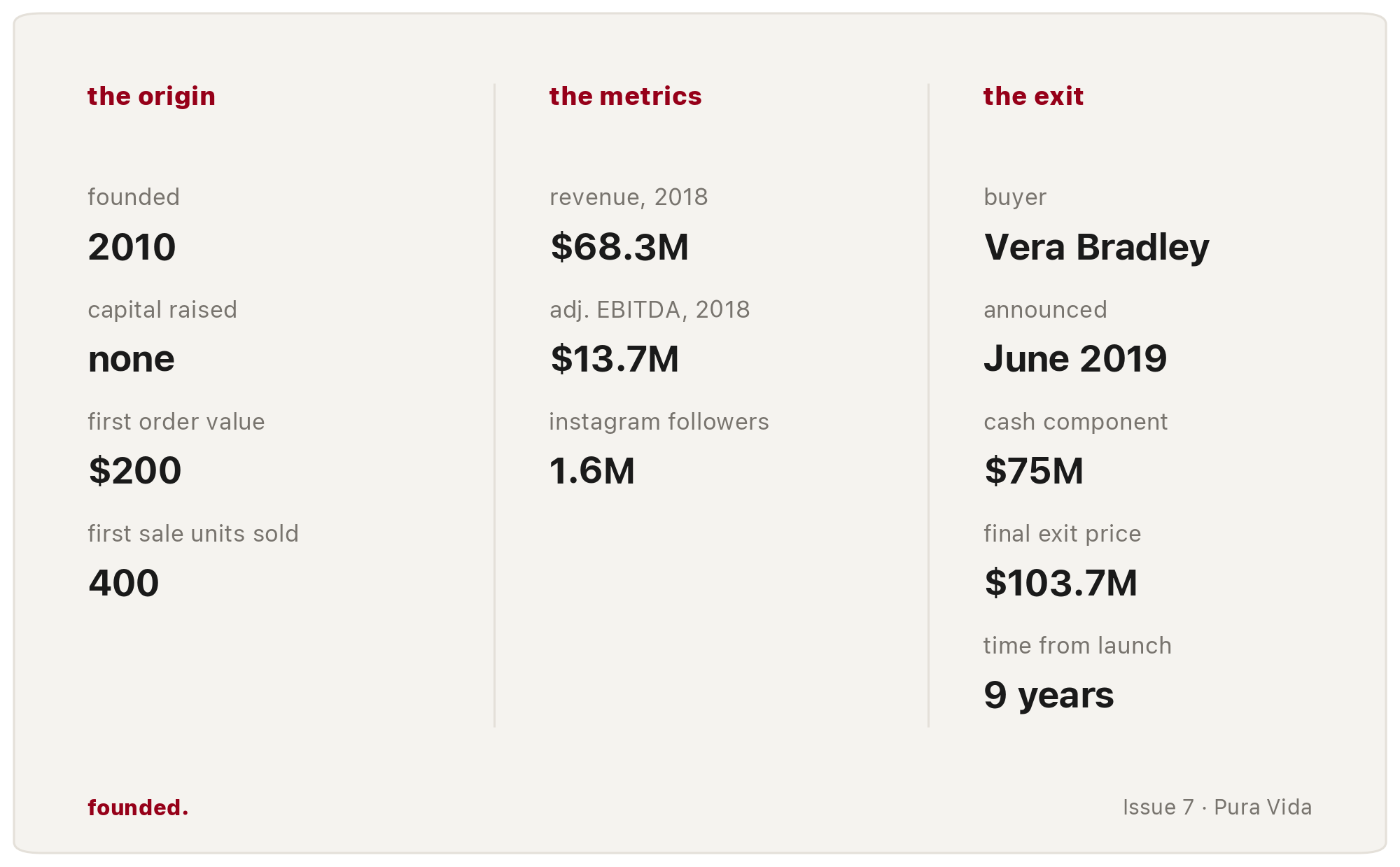
TL;DR: In 2010, two friends came home from a trip to Costa Rica with 300 handmade bracelets in a trash bag they bought from two men who were living on the beach. By 2018 the business was generating $68.3 million per year at a 20% operating margin, with 1.6 million Instagram followers, 150,000 registered ambassadors and no outside investors. They then sold a majority stake to a public company in 2019. By 2025, growth had declined and the business was sold for less than 1% of what the buyer had paid for it. What happened and why?
Biggest lessons:
The structure is more important than the payout. Griffin Thall and Paul Goodman received seven offers to sell in 2019. Six of them left more of the money tied to future performance. In the end, they took the offer with 75% of the amount paid up front. This saved them because future performance was not guaranteed.
Don’t build on rented land. Almost everything Pura Vida sold was through Instagram and Facebook with reach that could not be recreated outside of those platforms. Apple changed the rules in 2021 causing revenue to halve over three years.
01: two artisans, a trash bag, and a boutique in Malibu
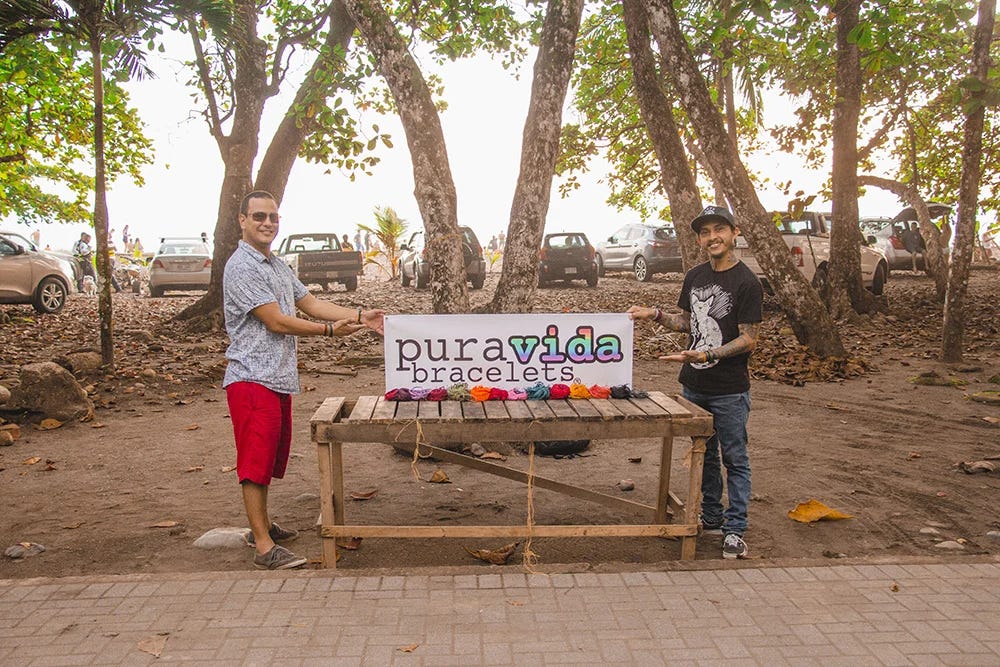
Griffin Thall and Paul Goodman met at San Diego State University. In 2010, with their degrees finished and no jobs lined up, they took a five-week surf trip to Costa Rica. On a beach on the Pacific coast, they met two local men, Joaquin and Jorge, who were making and selling woven bracelets.
The boys certainly didn’t plan on buying 300 bracelets but the situation called for it:
We met two artisans on the beach who were hand-making super colorful bracelets. They were homeless at the time and we decided we wanted to help them.
— Paul Goodman
They bought the entire stock to help them out. The crazy part was that it was the only investment they would ever make in the business and there would be no investors.
I went looking for this detail because the story is always told as two boys with some genius idea. Griffin’s own words show how little planning went into the business initially:
We just came home with a bag of bracelets in a trash bag.
— Griffin Thall
the first customer
The two recent graduates had no retail experience and no good way to market or distribute the bracelets. Griffin’s mother was a buyer at Planet Blue, a boutique in Malibu who agreed to carry them. All 300 sold in a week.
This was when Griffin and Paul knew they were onto something big. It was also the moment Griffin and Paul were faced with the problem of getting more supply.
ten days of silence
An email was sent to Joaquin and Jorge to ask for more, followed by 10 nail-biting days of radio silence. There was no plan B. Either they got a response or that would be the end.
On the eleventh day, they got an email back and the second legitimate order was placed, turning an ordinary souvenir into a supply chain.
I would say probably one of the best parts of our story is the luck of us finding each other.
— Griffin Thall
What followed was the boring middle. Griffin and Paul introduced the product to surf stores, yoga studios, nail and hair salons, boutiques, or any other store they thought fit the brand. They established their digital presence using a website around the same time, taught themselves web design and product photography from YouTube.
02: the machine
From 2010 to 2015 Pura Vida saw rapid growth primarily stemming from wholesale and online sales through their website. By 2014, the company was generating approximately $9 million in annual revenue, with 80 Costa Ricans working full-time and more than two million bracelets sold. In 2014 alone, $300,000 was donated to 166 charities, the same kindness on which the foundation of the business was built.
What made the company remarkable were three key developments that emerged between 2015 and 2019.
the ambassadors
Pura Vida recruited more than 150,000 registered brand ambassadors, about 50,000 of which were active at any one time. They were not celebrities by any stretch, Griffin and Paul took another route: People with small followings who were sent product for free, given a referral code, and were paid an affiliate commission for each sale they made.
The terms of the program weren’t easy to find but some digging revealed the company’s own ambassador pages and recruiting materials used to recruit university students. The commission on all sales through each person’s unique link was 10%, paid through PayPal, while the code also gave those who used it a 20% discount code, which could be given to friends but could not be mass-posted. For high performers, there was a reward ladder with levels called Sand, Surf, Sea and Star. The rewards were paid in bracelets, charms, t-shirts and silver cuffs as referral sales climbed. There was no penalty if an ambassador made no sales.
That structure is why the program scaled so quickly. At 10% of the bracelet sale, monetary benefits were limited so for most ambassadors the social acclaim of climbing the ladder and free gifts is what they stayed for. This cost Pura Vida next to nothing and was essentially all profit. Griffin’s reasoning for recruiting small accounts speaks to the marketing knowledge he had developed:
Customers know that businesses working with influencers having 50,000 followers are sponsored [posts] and might not be as authentic.
— Griffin Thall
One influencer with a million followers involved negotiation and headaches they didn’t want. Fifty thousand people with 1,000 followers became a system that produced a continuous stream of organic content showing off the product in real photos and locations. The focus was on creating very high-resolution content and then repurposing it across the company’s other marketing channels.
the club
The second big mover for the business was a monthly subscription that sent exclusively designed bracelets to customers each month. In 2018, this channel alone was responsible for 22% of total revenue.
The key with adding a subscription service was recurring revenue. Not only does it raise the lifetime value of a customer it also allowed for a higher budget for customer acquisition while actively smoothing out seasonality in a gift category. On the supply side, it also created stable revenue and predictability for the Costa Ricans that made the bracelets. Ultimately, this added revenue source allowed the company to grow even quicker since a large part of subscription revenue was reinvested.
the wave ring
The third mover was a product decision. After five years of selling only bracelets, Pura Vida had moved laterally into jewelry. One product in particular did the heavy lifting – rings. At one point, rings were flying off the shelf at a rate of 3,000-4,000 per day for two years straight. The real driver of revenue was the fact that there was essentially no cost to acquire customers since the audience had already been built.
the numbers
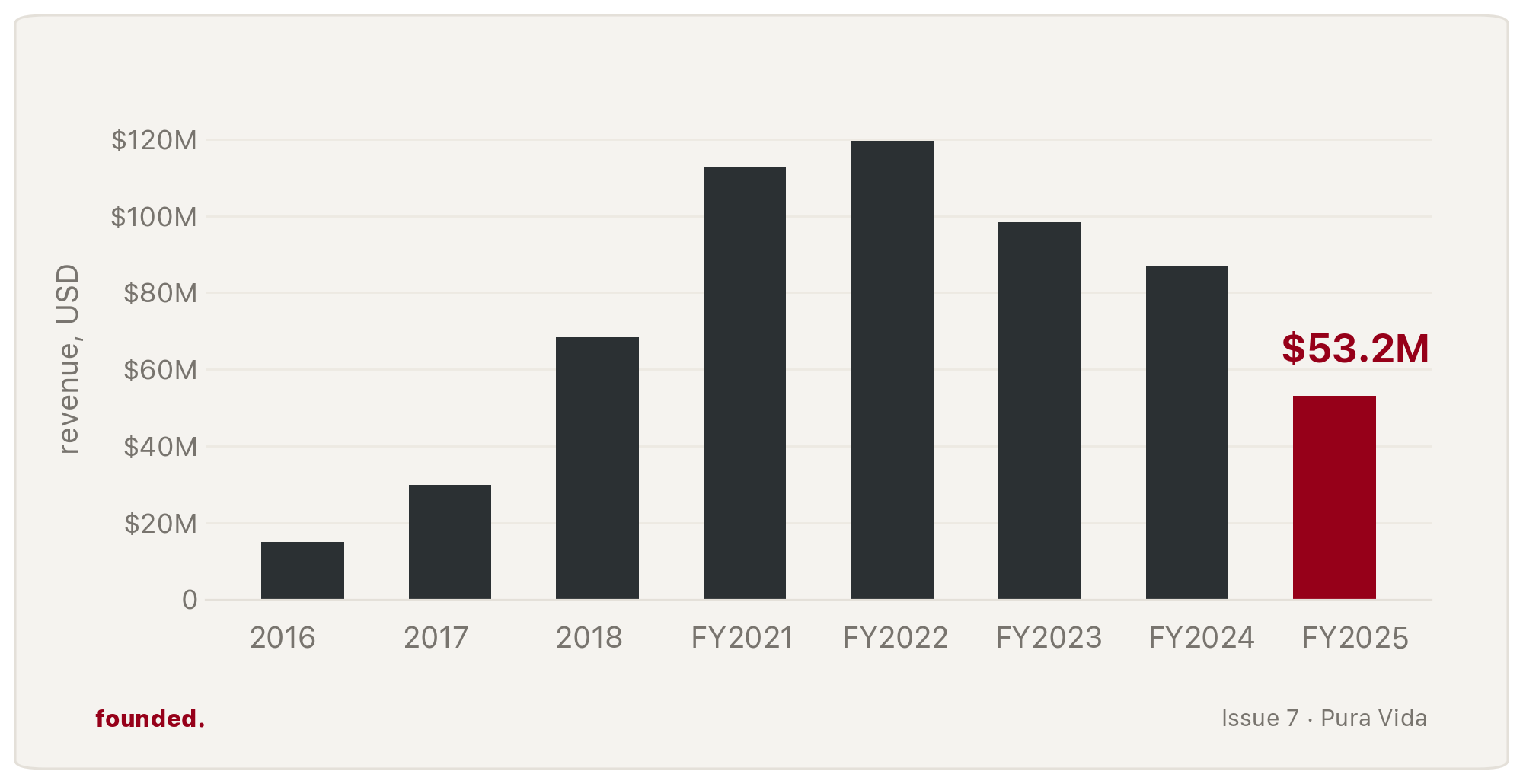
Between 2016 and 2018, revenue blew a hole in any projections. From $15 million in 2016 to $30 million in 2017 and finally to $68.3 million in 2018 from which the business made $3.8 million in net income and $13.7 million in adjusted EBITDA, at an operating margin of around 20%.
Those are not rookie numbers, especially for a two-owner company without investors or outside capital.
One thing I couldn’t quite straighten out is the sales channels. The buyer’s investor presentation has 2018 figures broken out as 52% e-commerce, 25% wholesale and 22% subscription. A trade publication reporting from that same year reported 65%, 20% and 14%, respectively. I have used the buyer’s version here but either way the breakdown is roughly the same: just over half of revenue came from e-commerce, and the rest was split almost evenly between wholesale and the subscription club.
The lion’s share being e-commerce was not a mistake. At the time of the sale Pura Vida had 1.6 million Instagram followers, more than 3 million people across all social platforms and one million email addresses. Griffin has shared that more than 800 artisans were making bracelets in Costa Rica and El Salvador at that time.
the Costa Rica problem
In August of 2017 a former director of supplies for Pura Vida, Shannon Eagle, sued the company. Among the allegations was that the bracelets were not made in Costa Rica at all and that this had been the case since 2015. In December 2017 a customer filed a class action over the same issue, stating the packaging and marketing said the bracelets were made in Costa Rica by the people who shared in the profits.
On April 26, 2018, an email was sent to all customers. The products, it said, may not have been hand-made by local artisans in Costa Rica, and the bracelets were made, assembled and distributed in several countries including Costa Rica, El Salvador and India.
The outcomes of either case were not part of the public record. The supply-side problem was clear: when millions of bracelets were being sold each year, Costa Rican artisans working from a cart on a beach can’t keep up. Production had to move elsewhere, at least in part. The issue was that the marketing materials were never changed to reflect this.
03: cash up front
In 2019 Griffin and Paul ran an auction to sell the business. Twenty-five parties looked into the company: 22 private equity firms and three strategic buyers that would own and operate it. Seven made formal offers.
We weren’t really looking to sell quite honestly, we were looking for the best partner that could help take Pura Vida to the next level.
— Griffin Thall
The strategic buyer that best suited the interests of the founders was Vera Bradley, a quilted-cotton bag and luggage brand out of Roanoke, Indiana that was listed on the Nasdaq and at that time generated about $416 million in annual revenue. On paper it was an odd pairing: a department store brand acquiring a bracelet business selling to teens on social media was a unique one.
the sale
The seven offers were not competing on price. It was the guarantee that made Vera Bradley’s deal enticing. A private equity buyer will typically pay part of the price at closing and leave the rest tied to future performance, which keeps founders working for the remaining funds. Vera Bradley was willing to pay 75% in cash on the day of closing.
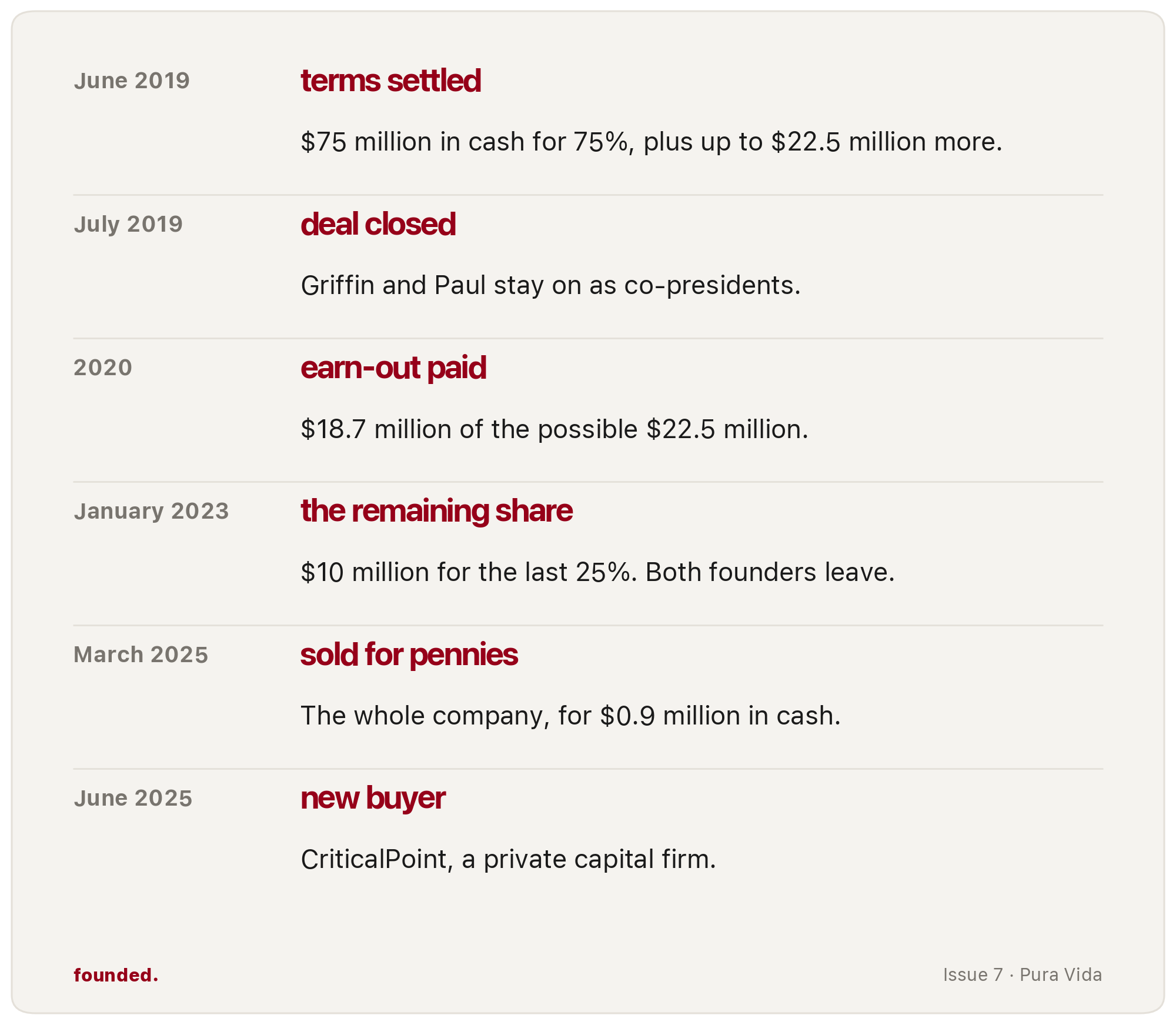
The terms were agreed on June 19, 2019 and closing was less than a month later on July 16. Here’s the juicy part you’ve been waiting for:
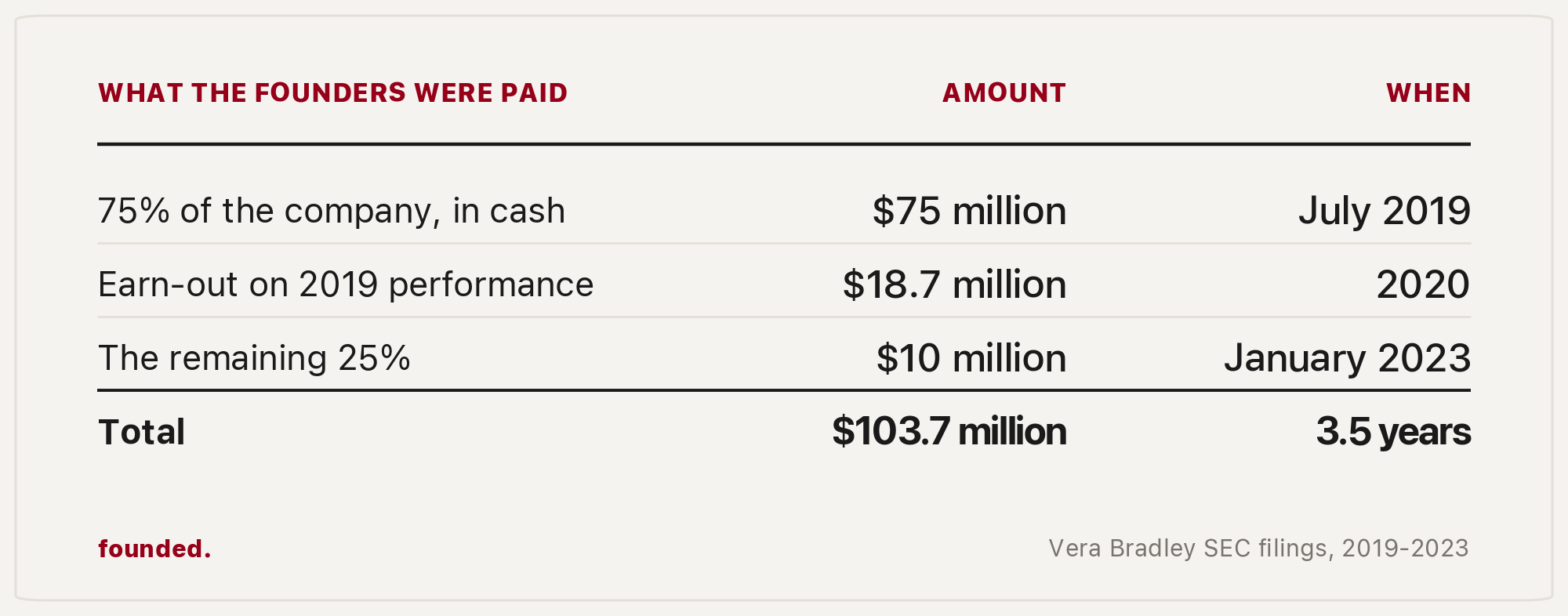
$75 million paid cash for 75% of the company on the day of closing, funded from cash and investments.
Up to $22.5 million structured as an earn-out against performance targets for 2019.
An option (not required) for Vera Bradley to buy the remaining 25% five years after closing.
Griffin and Paul staying on to run the business as co-presidents, from their homes in La Jolla.
At closing, the whole company was valued at $100 million, which was 1.5x 2018 revenue and 7.3x adjusted EBITDA. With the maximum earn-out included, the total value was $130 million, which was 1.9x revenue and 9.5x EBITDA. Griffin has publicly stated that the sale was roughly 9x EBITDA, meaning he assumed the full earnout in his quoted figures.
the real price nobody calculated
Digging through articles and press releases revealing the sale, I noticed that three different prices were circulated and none of them are what the founders were actually paid. Using the official filings, however, I was able to make sense of it. Most news coverage quoted a price of $75 million, which was only the first cash payment. One trade outlet quoted $85 million, which is the $75 million plus the later purchase of the last 25% of the business, and leaves the earnout outside the equation. Two business publications quoted $130 million which was not a payment at all: it was the highest-possible valuation the deal would have implied if the earn-out had paid in full and Vera Bradley purchased the remaining 25% at the original $100 million valuation.
The earn-out was ultimately found on the balance sheet for $20.1 million on the day the deal closed, which is what Vera Bradley expected to pay. What was actually paid by Vera Bradley turned up in the cash flow statement for the year to January 2021: $18.7 million, which was about $3.8 million short of the expected cap. Whether performance targets were missed or further negotiation happened is unclear. The final 25% was ultimately not paid with the same valuation from 2019, either. Here is the full and accurate breakdown:
From $100 each to splitting over $100 million is quite the return for nine years of work.
04: after the sale
Vera Bradley reported Pura Vida as its own business segment, meaning that operating figures were reported separately every quarter for six years after the sale. This works out because it means I had a proper revenue stream to follow after the sale.
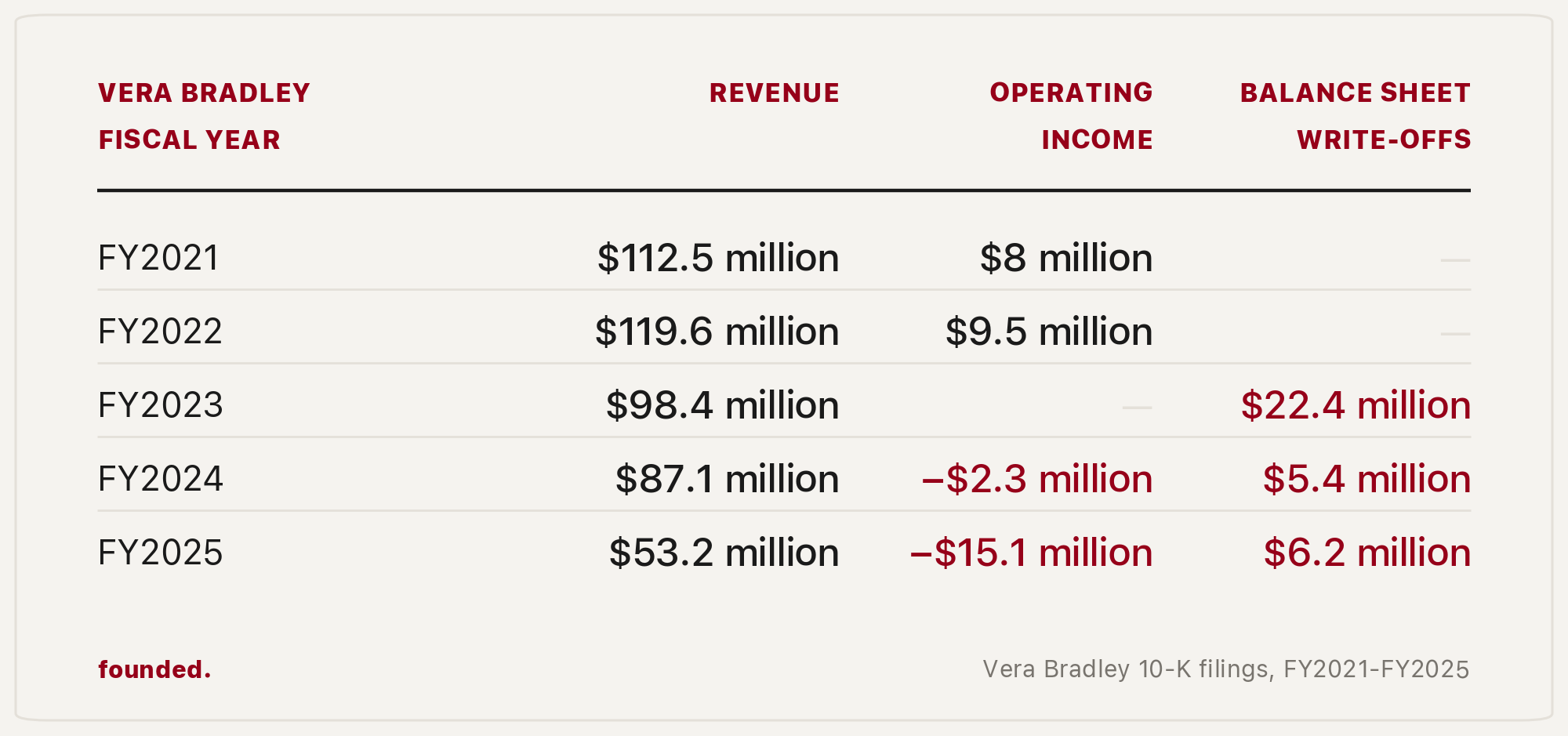
The first two years were record years and the investment was a good one for Vera Bradley; Pura Vida’s sales rose more than 50% in the first year after acquisition, surpassing $100 million. In the year to January 2021, revenue was $112.5 million with $8 million of operating income, and in the year to January 2022 it was $119.6 million and $9.5 million, respectively. Two and a half years after the sale the business was still growing and run by its founders.
If you’re enjoying founded. I’d love to have you join me each week in learning about another unique company taken from idea to exit. See you there!
the start of the end
Apple released iOS 14.5 in April of 2021, which added a system prompt that asked iPhone users whether an app was allowed to track across other apps and websites. Most users opted out.
Facebook and Instagram had been built on app tracking. It was how they knew which advertisement led to a purchase, a big driver in deciding who to show advertisements to and which ones to use. Without it, both customer targeting and measurement was unreliable, leaving advertisers scrambling to acquire customers. As was to be expected, the cost of customer acquisition skyrocketed.
For most companies that meant a bad quarter or two. For Pura Vida, it was the basis of the whole business with about three quarters of revenue coming from customers acquired through social media. In other words, it was the start of the end. Vera Bradley’s chief executive, Jackie Ardrey, commented on the change shortly afterward:
Overall challenges continued to persist in our social and digital media effectiveness coupled with rising digital media costs.
— Jackie Ardrey, chief executive, Vera Bradley
The quarter ending October 2022 is where it becomes notable. Pura Vida generated $21.7 million in revenue over those three months, down 20.3% year-over-year with an operating loss of $1.4 million compared to a $1.8 million operating profit a year earlier. The revenue chart above shows the whole story.
the founders leave
Vera Bradley bought the remaining 25% of the business for $10 million in 2023, three and a half years after the deal closed. Griffin and Paul left the company on January 28, 2023, thirteen years after the inaugural trip to Costa Rica. They gave up their roles, sold their last shares and disembarked from Pura Vida. Griffin was to stay on as a marketing and branding consultant.
The real mystery that I’d like to uncover is why the remaining 25% was sold for $10 million instead of the $25 million based on the valuation when the deal closed in 2019. I suspect it had something to do with the declines in performance already being felt by Vera Bradley and the founders wanting out.
the write-down
Vera Bradley had $44.3 million of goodwill and $61.7 million of other intangible assets on its balance sheet when it bought Pura Vida. For those unfamiliar, goodwill and intangibles are what a buyer records when it pays more for an acquisition than just the hard asset value, which have to be written off when the value of the company no longer supports the line items. Over the three years that followed, it was written down: $22.4 million after tax in the year to January 2023, $5.4 million the next year and $6.2 million the year after that.
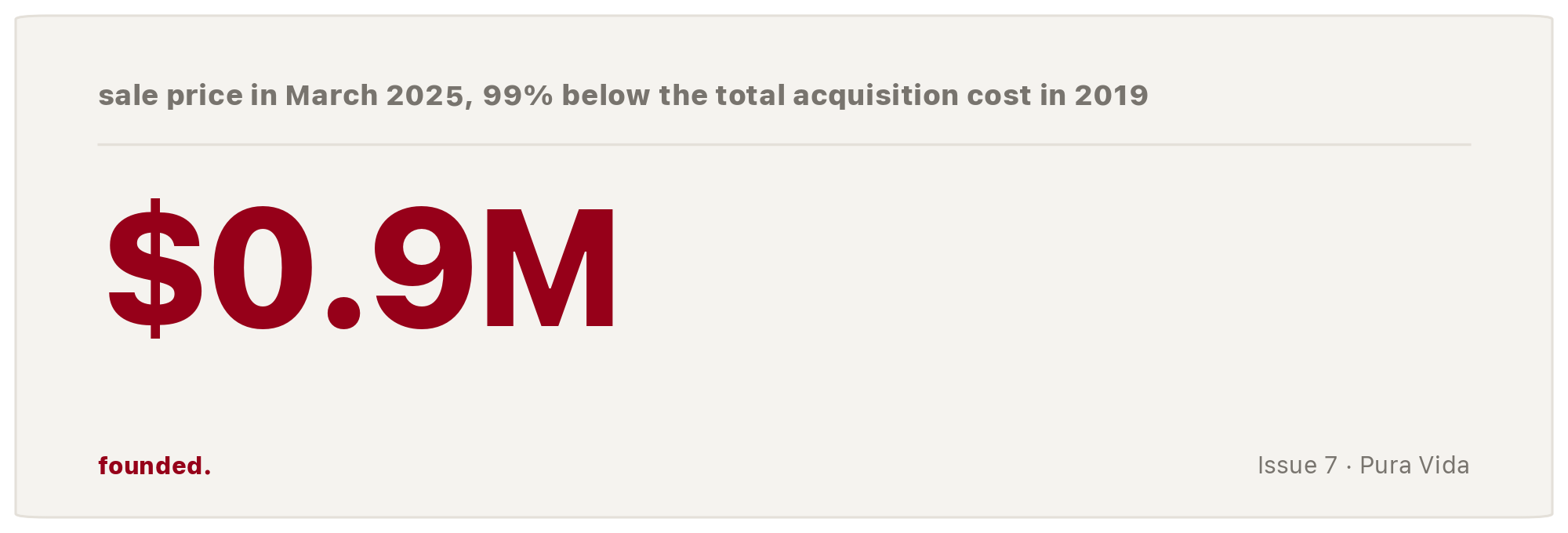
By March of 2025, Vera Bradley had signed an agreement to sell Pura Vida which closed later that month for a staggering $1 million. I triple-checked this one because a business that had cost Vera Bradley nine figures to acquire and was then sold for just 1% of that value six years later is an anomaly. The filings show a bit more detail: A cash consideration of $0.9 million, with a total of $3.5 million including $2.5 million of contingency and a net loss on disposal of $15.2 million.
The revenue numbers speak volumes in explaining the final sale price. In Vera Bradley’s last year of ownership, the business ran an operating loss of $15.1 million on $53.2 million of revenue. A buyer willing to take that on must be compensated for the heavy losses they will also assume. The reason the brand sold for any kind of value at all was Pura Vida’s 2.1 million Instagram followers at the time.
The buyer was a special purpose vehicle called Project Aster Acquisition, LLC. On June 24, 2025 the beneficial owner, CriticalPoint was named, a private capital firm in El Segundo, California that buys non-core businesses from larger companies. It appointed Ryan Heuser, who co-founded and ran Paul Frank Industries, as chief executive, with a plan to cut the existing lineup of products, move to cut-to-order production and revamp the website.
05: the tools
the product
For the better part of a decade, Pura Vida specialized in a single product: handmade woven string bracelets from Costa Rica. The price at which the bracelets were sold was especially important because it meant scalability and a vast TAM. Later on, the line extended to rings, necklaces and anklets. The founders valued donating to charities, and often; the company supported more than 300 non-profits with more than $2 million raised.
founder skillsets
Neither founder was an artisan, jeweler or marketer. Listening to podcasts and reading about the founders, it became clear what their true skillset was: The ability to hold a vision and stick to it. The idea to produce organic content was far-fetched but ultimately was possible through the ambassador program which produced a continuous supply of authentic-looking photographs of the bracelets. This meant that growth and attention were a compounding resource that was almost free. The subscription, the wholesale expansion and the move into jewelry were downstream effects of this ability to scale at low cost. Ultimately, however, this is also what caused the collapse of the revenue model when Apple changed its rules.
monetization
The strategy for monetization grew as the company did. From direct to consumer through one merchant to start, the brand then grew social media accounts and its ambassador program. From there, sales grew quickly making for better economics to support a subscription service and expand into wholesale. The entire premise of the business (and why no cash investment was needed) was the reinvestment. Every bracelet sold would then fund the next one. The combination of scaling and reinvestment is what led to a nine-figure exit just nine years after the trip to Costa Rica.
unique branding
Pura Vida is a Costa Rican expression meaning ‘the good life’. The bracelets came with a story of hope and support for those two men on the beach that was passed down to ambassadors. This human element meant the sourcing correction email sent in 2018 was especially damaging to trust and brand image.
Learned something new worth applying to your business? Please reach out! I’d also appreciate it if you would share this post or restack if you would be so kind :)
06: what went wrong
01: the origin story
Moving production from Costa Rica was a reasonable business decision for a company growing at the speed that Pura Vida did. It was the failure to communicate the change with customers that ultimately cost the trust of many customers. The two lawsuits and the apology sent out by the founders solidify the damage that was done.
02: rented land
About three quarters of the business depended on Meta’s decisions. Progress was made to produce real assets outside of the social media side (one million email addresses, over 150,000 ambassadors, wholesale growth and a subscription base) but acquisition was never taken off those platforms. The expensive part of the business was platform risk and is a lesson to anyone relying heavily on rented land.
03: the last 25%
In January 2023, when the option to purchase the remaining 25% of Pura Vida still had eighteen months remaining, revenue was declining at a rate of 20% per year and the bottom line was losing money. The purchase of the last quarter of the business, although still lucrative, was less than half of the value implied with the initial sale in 2019.
07: lessons to apply today
01: negotiate for certainty
Six of the seven offers would have left more money in the business, contingent on future growth, which turned out to be dismal. The decision to choose a lower total value and receive 75% upfront is likely something the founders are still happy with to this day. If you are ever handed competing offers to purchase your business, price them two ways before deciding: at the implied valuation and on the assumption that revenue falls by 50%. The offer that realizes the highest price and makes the process easier is always the best option.
02: plant the flag pole
Pura Vida’s product, customers, brand or team didn’t change between 2022 and 2025. It was ultimately the risk that the customer acquisition strategy would be affected by a change outside of the control of the business that caused damage. Do this today: Get out a blank document and list where your last 100 customers came from. Was it from a distribution channel you own or from a channel that can disappear or become more expensive overnight? If the cost to acquire a new customer doubles or triples, what does that do to your bottom line? If the business does not survive on paper, it’s time to eliminate the point of failure. The second and third acquisition channels are only cheap to build while the first one still works.
03: auction for buyers
Even if you’re not looking to sell, you might be interested in what kind of offers you might get if you get a bidding war going. Running an auction for a sale of your business can not only serve as price discovery, it can help drive up the final multiple if you do decide to sell. For Pura Vida, it led to 25 interested parties and seven formal offers. This allowed the founders to take their time, weigh their options and pick the offer that best suited their requirements. Go in with a strong description of the business, a list of 10 buyers you would happily sell to, and a price floor. One offer gives you no leverage.
04: recurring revenue FTW
A woven bracelet was historically seen as a one-time purchase. A monthly subscription turned it into 20% of overall revenue that was reliable. The increase in lifetime customer value allowed for a higher cost to acquire customers up front. It also flattened the seasonality for a product that was often gifted. The subscription model also created less inefficiency on the supply side since it was easier to predict. The question isn’t whether customers will subscribe, it’s seeing what they already subscribe to and making a purchase easier by removing the decision element. Lower friction for the customer means more revenue for the business.
05: minority stakes
Keeping a stake in the business might feel like keeping upside potential, but in reality it’s putting your cards in the hands of a buyer that has full control over the remaining piece. Vera Bradley had a five-year purchase option that was exercised 18 months early when the business started to decline for less than half of the implied value at acquisition. If you sell a majority stake and keep a small amount of equity, keep these questions top of mind: Who can trigger the sale of the remaining equity? When can it be triggered and how is that piece valued? If at all possible, advocate for a price floor or the right to force the sale yourself.
08: what still isn’t clear from the research
How the total was divided between Griffin and Paul, and whether either removed equity before the sale.
Why the earnout was $18.7 million rather than the full $22.5 million.
How the two 2017 lawsuits were resolved. Were they settled, dismissed or tried.
Revenue figures between 2010 and 2013.
Whether Joaquin and Jorge were still supplying the company at the sale, what the relationship looked like after the company grew, and their current quality of life after serving Pura Vida for years.
FOUNDED FACT
Vera Bradley paid $103.7 million all cash for Pura Vida between 2019 and 2023. At the end of 2025, the stock market valued Vera Bradley at about $64 million. The buyer had paid more for Pura Vida than the buyer was worth less than two years after the final piece of the business was acquired.
LEARN MORE
Built to Sell Radio — “Pura Vida’s $75 Million Acquisition by Vera Bradley”, episode 217. The only detailed account of the sale process from Griffin Thall: the 25 parties, the seven offers, and why the cash up front decided it.
Ranch & Coast Magazine — the profile that carries the trash bag, Planet Blue and the ten days of waiting for Joaquin and Jorge to reply.
Vera Bradley — the acquisition announcement of June 20, 2019 and the annual reports for fiscal 2020 through fiscal 2026. Six years of segment revenue, the earn-out payment and the disposal.
SOURCES
Vera Bradley, Inc. — Form 8-K exhibit 99.1, June 20, 2019. The $75 million cash consideration for 75%, the $22.5 million earn-out against 2019 targets, the right to buy the remaining 25% five years after closing, and 2018 revenue of $68.3 million with $3.8 million of net income and $13.7 million of adjusted EBITDA.
Vera Bradley, Inc. — Pura Vida acquisition investor presentation, June 2019. The channel mix of 52% e-commerce, 25% wholesale and 22% monthly club, the 96% bracelets and jewelry product mix, 1.6 million Instagram followers, more than 3 million social followers, a million email subscribers, the Net Promoter Score of 80, and $416 million of Vera Bradley sales.
Vera Bradley, Inc. — Form 10-K for fiscal 2020. The July 16, 2019 acquisition date and the allocation of $44.3 million to goodwill and $61.7 million to other intangible assets. The fiscal 2021 quarterly report carries the earn-out at $20.1 million at acquisition.
Vera Bradley, Inc. — fourth quarter and full year results, fiscal 2020 through fiscal 2025. The segment revenue series, the operating results, the write-downs, the “sales up more than 50%” line, the $18.7 million of contingent consideration paid in the year to January 2021, the quarter ended October 29, 2022, and Jackie Ardrey’s comments.
Vera Bradley, Inc. — Form 8-K, March 11, 2025, and Form 10-K for fiscal 2026. The sale of Creative Genius, Inc. to Project Aster Acquisition, LLC, the $1 million of cash consideration stated in the 8-K, and the 10-K figures of $0.9 million of cash consideration, $3.5 million of total consideration, $2.5 million of estimated contingent consideration and a $15.2 million net loss on disposal.
Built to Sell Radio — episode 217, Griffin Thall. The 25 interested parties, 22 private equity firms and three strategic buyers, seven formal offers, roughly nine times adjusted EBITDA, the 75% paid up front and 100% founder ownership.
Ranch & Coast Magazine — Griffin Thall and Paul Goodman. “We just came home with a bag of bracelets in a trash bag”, Griffin’s mother as a buyer at Planet Blue, 400 bracelets sold in a week, the ten-day wait for Joaquin and Jorge, and the luck quote.
GoDaddy — Q&A with Griffin Thall and Paul Goodman. “They were homeless at the time and we decided we wanted to help them”, and the wholesale push into surf stores, yoga studios and salons.
ABC7 Los Angeles — profile of the founders. “We invested $100 each”, about $9 million of revenue in 2014, $300,000 given to 166 charities that year, 80 Costa Ricans in full-time work and more than two million bracelets sold.
Pura Vida Bracelets — brand ambassador materials, and the program write-up for college students dated May 24, 2019. The 10% commission paid through PayPal, the 20% referral code and its restrictions, and the Sand, Surf, Sea and Star reward tiers.
CO— by the US Chamber of Commerce, May 2022. The ambassador program at more than 150,000 registered and about 50,000 active, the quote on 50,000-follower influencers, 2.1 million Instagram followers, and stores moving from 10% to 30% of the business.
San Diego Reader, January 5, 2018, and ABC10 News San Diego, April 26, 2018. The August 2017 suit by Shannon Eagle, the December 2017 class action, and the company’s email to customers.
Shop Eat Surf Outdoor — the 2019 sale, the founders’ exit on January 28, 2023 and the $10 million purchase of the remaining 25%, and the 2025 disposal. Also the alternative channel mix of 65%, 20% and 14%, and the roughly 20% operating margin.
PostPilot podcast and griffinthall.com — “We started with a hundred dollars each, never took on funding, doubled on every order”, three to four thousand rings a day, more than 800 artisans, and the “$130 million investment” figure in Griffin’s own biography.
CriticalPoint — announcement of June 24, 2025, and Shop Eat Surf Outdoor, August 12, 2025. The acquisition by CriticalPoint affiliates and Ryan Heuser’s appointment and plan.
companiesmarketcap.com — Vera Bradley’s stock market value at the end of 2025, used in the Founded Fact. Market value is not the same measure as a purchase price, and the comparison is offered as an oddity rather than as a valuation.
Every figure in this issue is drawn from public filings, interviews and press coverage, and each one is listed with its source above. No interview was conducted with the founders. Figures are as the founders, the buyer or the press stated them and have not been independently audited, with the exception of the purchase price, the segment revenue, the write-downs and the disposal, which are taken from the buyer’s filings with the Securities and Exchange Commission. Amounts are US dollars.