

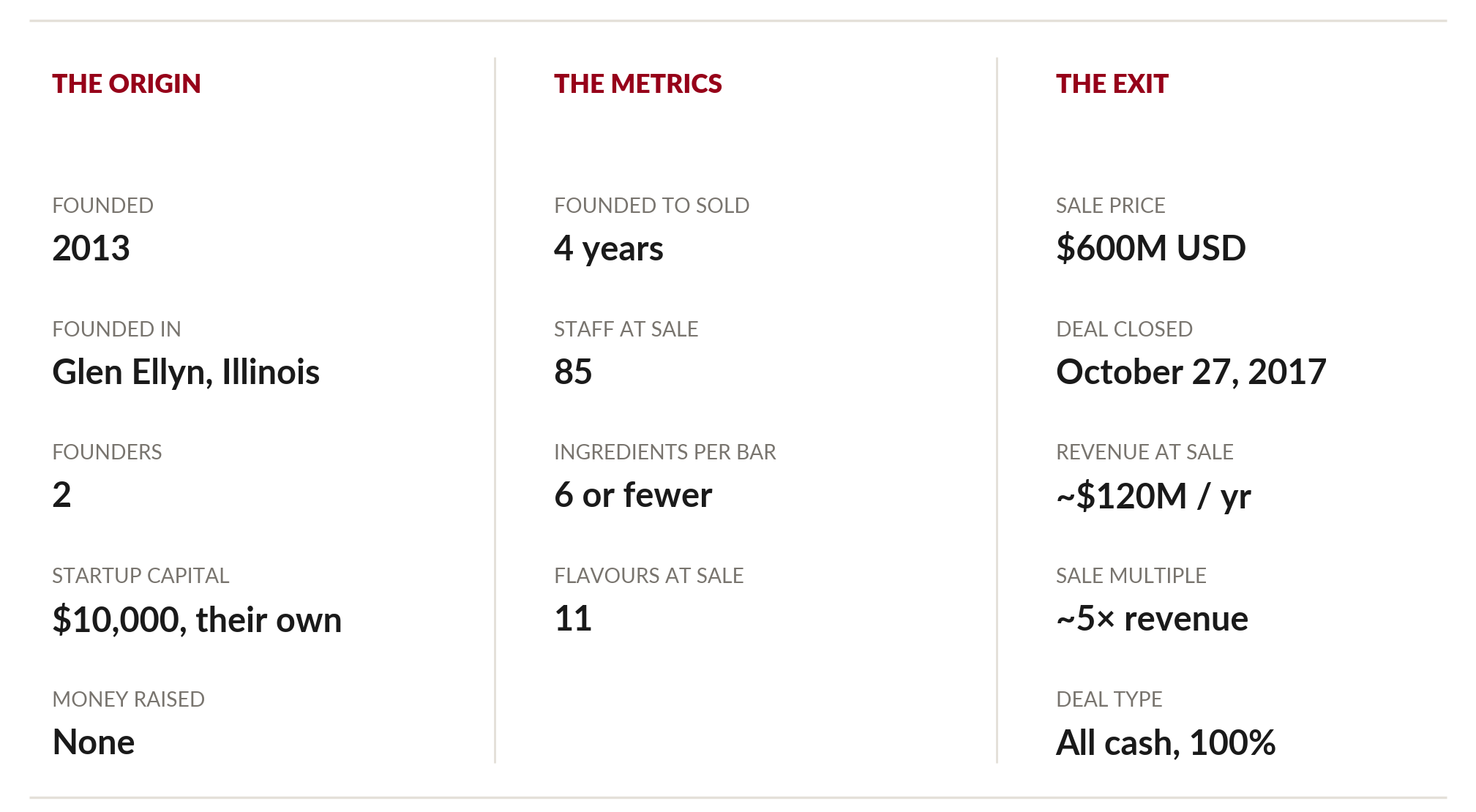
TL;DR: Two childhood friends contributed $5,000 each, made and tested protein bars in a basement outside of Chicago, and sold them to local CrossFit gyms. Four years later, Kellogg paid $600 million all-cash to acquire the business. They never raised money and the major catalyst for accelerating growth was the packaging.
Biggest lessons:
The product did not change; the packaging did. Sales went from $2 million to roughly $120 million in the two years after they put the simple ingredient list on the front of the package.
Sell where nobody else is. The protein bar section at the grocery store was cutthroat. The CrossFit gym down the road had no competition whatsoever.
01: the ugly baby
In August 2015, a small protein bar company in Chicago announced a complete packaging makeover.
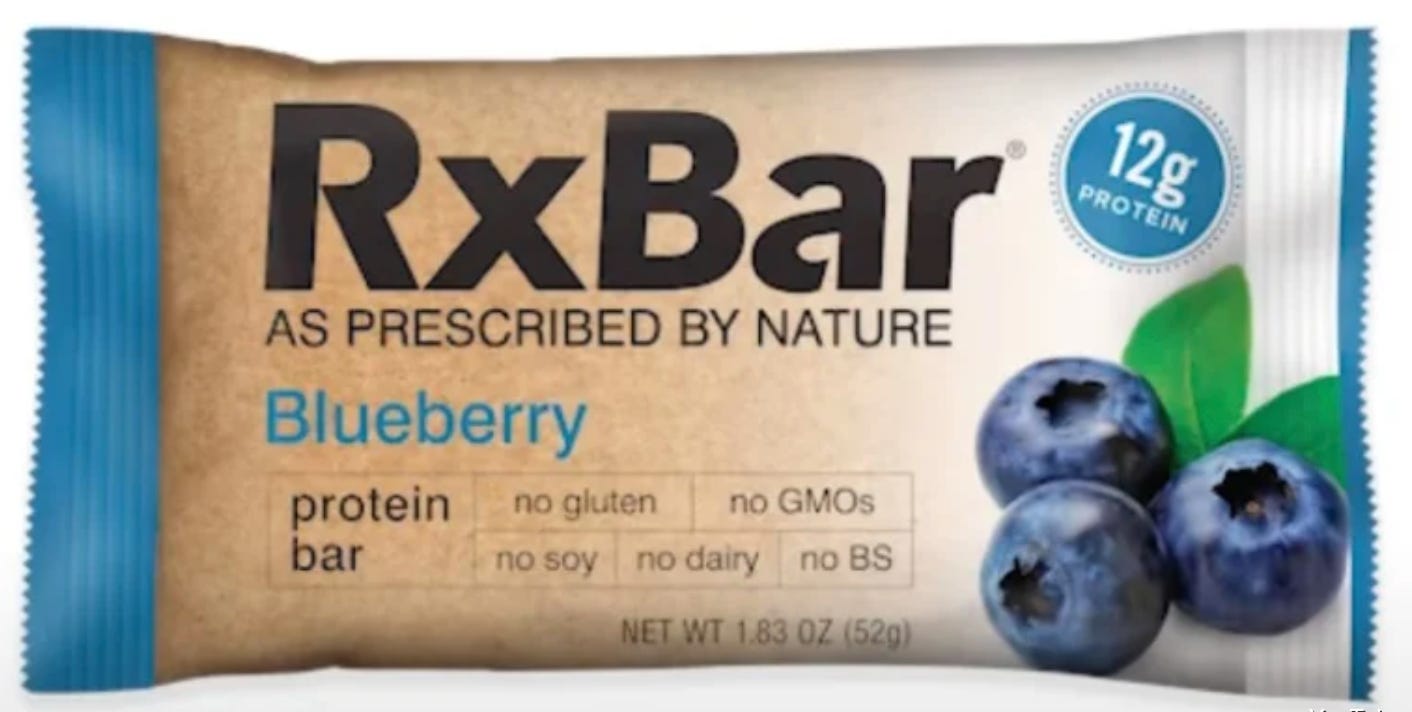
The old wrapper had everything traditional protein bars had: a large logo, a catchy tagline that read “As Prescribed By Nature”, a picture of fruit and nuts, a colored band to suggest different flavors, and a list of bad ingredients the bar did not contain.
The redesign scrapped all of it. The wrapper became a flavor-specific colored backdrop, plain white text, and the recipe: 3 egg whites, 6 almonds, 4 cashews, 2 dates. Underneath it, two words. No B.S. The RXBAR logo was made smaller and moved to the top. The thing that customers cared about, the ingredients, was made crystal clear at first glance.
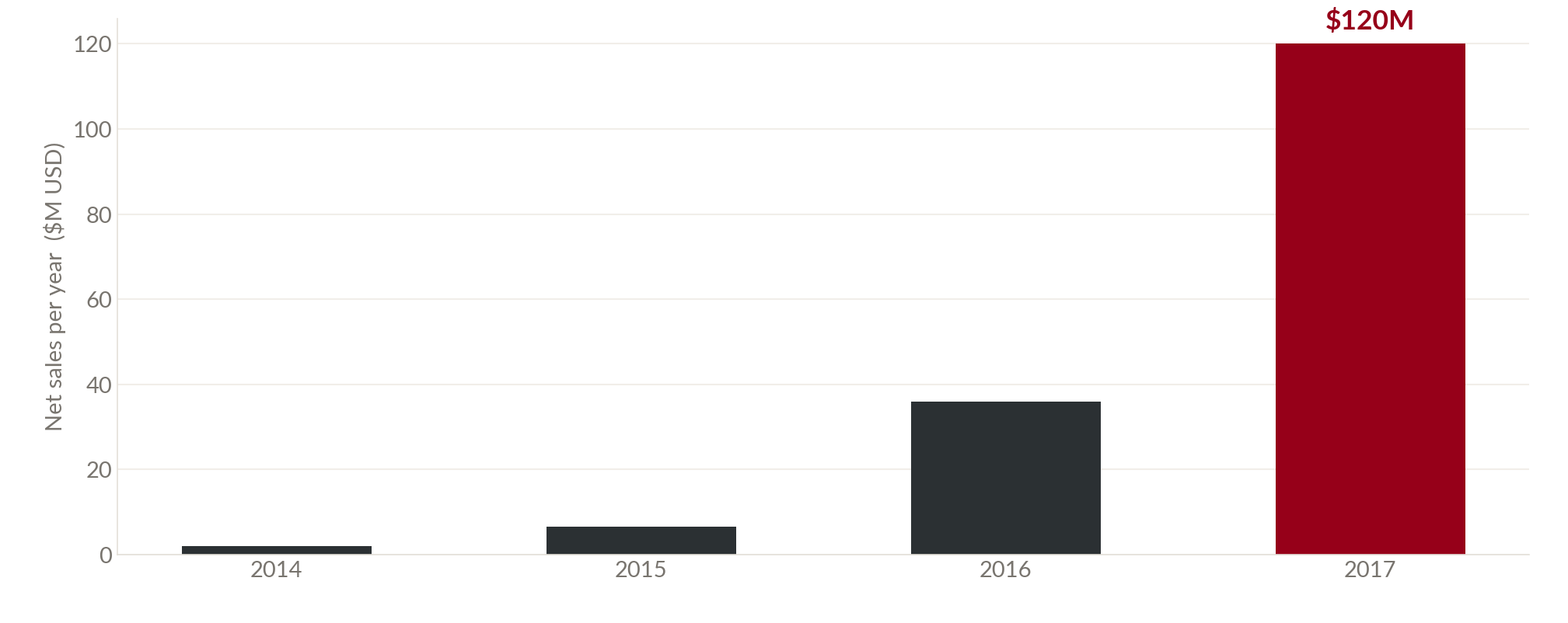
Nothing about the recipe changed. Same founders. Same strategy. The new packaging did some heavy legwork; the year before the redesign, the company did $2 million in sales. Two years after the redesign, that figure had jumped 60x to $120 million.
Peter Rahal, who had designed the original packaging himself, later described it in his own words: “Our baby’s ugly.”
02: how it started
Peter Rahal grew up in Glen Ellyn, a suburb west of Chicago, in a family that had been in the food business for two generations — his father on the ingredient supply side, and his mother specializing in juice. Peter was diagnosed with dyslexia in middle school, after years of being placed in special education classes and of teachers claiming he didn’t put in enough effort.
“I think some of my contrarian nature is rooted in that I just question and am skeptical of things. That was the way to protect myself.”
— Peter Rahal
He studied Political Science at Wittenberg University in Ohio, graduated in 2008, and went to work in marketing for a food business in Belgium. He ultimately came home to work in the family business.
Peter also ate a lot of protein bars, and thought almost all of them were bad. Not the taste, the contents. The front of the wrappers sold a healthy snack while the back revealed an ingredient list as long as his forearm, most of them harmful chemicals.
On a mission to create something healthy and delicious, Peter started making his own bars in his parents’ kitchen with Jared Smith, a childhood friend. Egg whites were used for protein, dates held them together, and nuts added texture. No added sugar, dairy, soy, or anything that required an explanation.
The two had many conversations about funding and toyed with the idea of raising money. Peter’s father told them to try to sell first. Both Peter and Jared contributed $5,000 to kickstart the business which would carry them from idea to exit.
“You need to shut up and sell a thousand bars.”
— Peter Rahal’s father, on raising capital
Production soon moved from the kitchen to the basement, where the first bars were made. Labels were designed in PowerPoint and applied to packaging by their mothers, who offered to lend a hand.
Peter wasn’t happy with the quality of work and was soon faced with having to fire his own mother.
“My mom just kept putting the front panel on the back panel, and vice versa… she wasn’t getting paid so it doesn’t really matter, but she actually was fired.”
— Peter Rahal
Peter tells the story as a lesson about quality standards rather than to berate his own mother. A crooked label could ruin the product simply because the label was the first and only part of the product the customer saw before trying it.
03: the gym phase
The obvious place to sell a protein bar in 2013 was a health food store, which is exactly why they didn’t try it first. The protein bar aisle at a traditional grocery chain was already full of brands with endless capital paying for shelf space; a two-man company with $10,000 was not going to win that fight.
CrossFit gyms, on the other hand, were the perfect place to find the exact buyer for the bars. Members were often on strict diets and picky about ingredients; not much was sold over gym counters other than T-shirts and hats. A clean slate. The shelf space was theirs if they could sell it. Members would often come for a late workout and be looking for a high-protein snack that wasn’t full of crap.
There were no departments to get past and no shelf space to pay for. There was just the owner, who usually ran the place from behind a counter. If the owner tried the bar and liked it, they bought a case. The process was manual, but it did give immediate feedback.
Peter and Jared spent the next few months driving around Chicago selling to gyms one at a time.
“We started in Chicago and just dropped by the gym, door to door essentially, calling, emailing, just like traditional sales.”
— Peter Rahal
For the first two years, Peter’s cell number was printed on the wrapper. If customers called, they reached a founder directly for support.
The other sales channel was online. RXBAR was offered on Amazon and sold direct from its own site. Both online options offered a subscription for the bars, a detail that made the company work financially: the customer paid first, and the bars were made to order.
By the end of 2014, less than two years after the first bars were made in Peter’s basement, RXBAR was pulling in $2 million per year in revenue.
04: removing the branding
The problem with the wrapper was not that it was ugly, although it was, even by protein bar standards. The bottleneck was hiding the details that made the product different from other bars — the ingredients.
The redesign went through five rounds. The final version made no promises whatsoever — no “natural”, no “clean”, no photography, no claims about what chemicals the bar avoided. Just a simple but clear list of ingredients, and “No B.S.” underneath.
“We’re not like everybody else. We don’t have secrets… it’s time we started saying that out loud.”
— Jared Smith
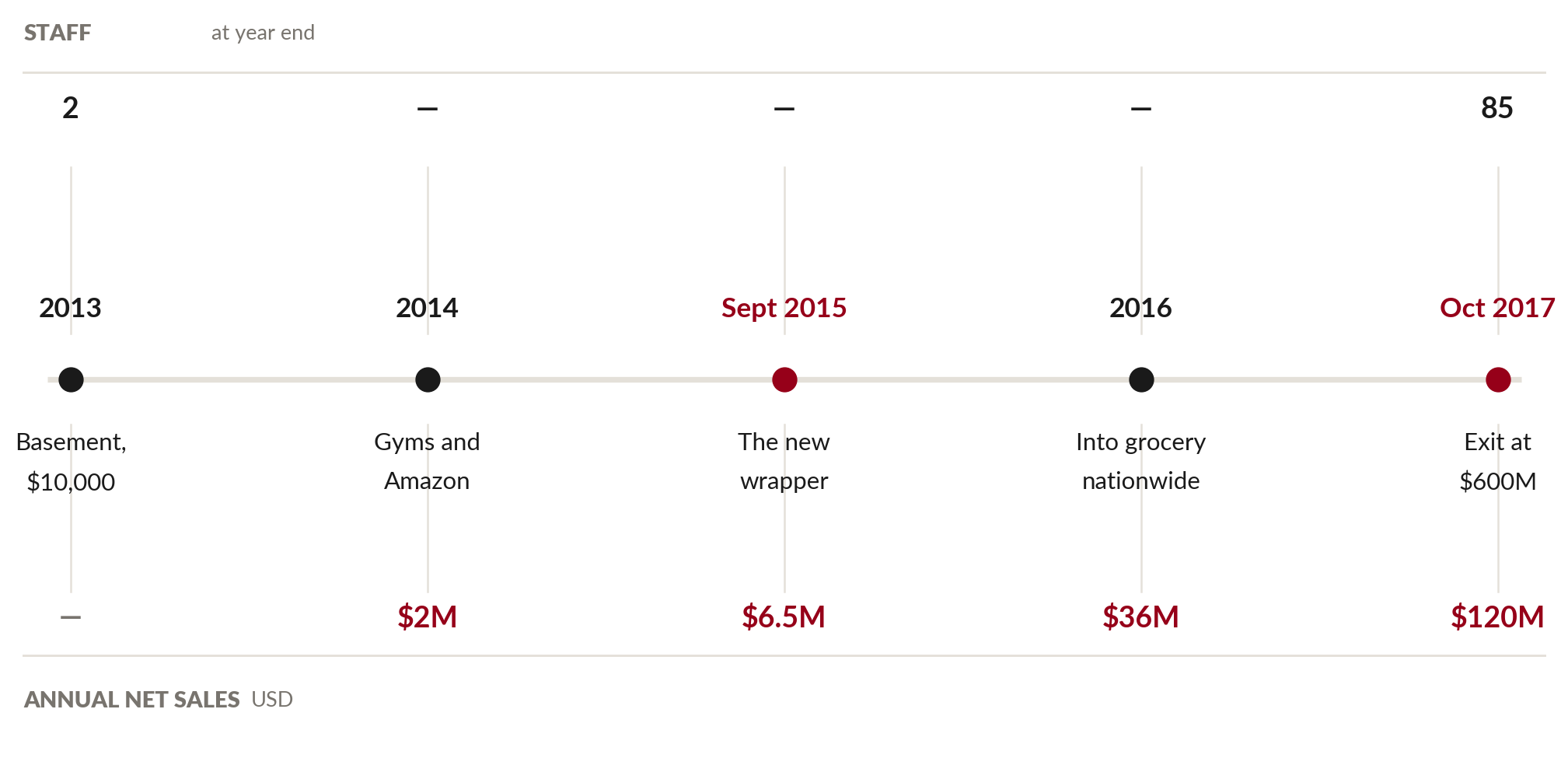
The finalized design rolled out in September 2015 and the business changed shape almost immediately. Wegmans took it first, then Whole Foods, then Trader Joe’s, which was the first time the bar went national. Sales went from $2 million in 2014 to $6.5 million in 2015, $36 million in 2016, and approximately $120 million in 2017.
This was a staggering lesson in branding — a 60x increase in revenue in three years and all that changed was the packaging.
By the summer of 2017, Nielsen had listed RXBAR as the fastest-growing bar in the country by dollar growth, in both the natural and the conventional aisles. The company had 85 employees at this time.
As it turns out, a grocery aisle full of brands making claims is the ideal place to be the brand making none.
05: the tools
the product
RXBAR is one bar, varying slightly through a selection of eleven different flavors by the time of the sale, alongside a smaller RXBAR Kids line launched in 2017. The premise has always been simple: six or fewer ingredients, 12 grams of protein, 200 to 220 calories, no gluten, dairy, soy or added sugar. The formula was mastered early on in the company’s life and it was kept that way. No new products, only new versions of the same one.
founder skillsets
Peter was in charge of product, marketing, branding, and sales and was the public face of the company. Jared worked on the operational side. Both founders have explained that the differences between them were an asset since neither of them had built a consumer brand before. A competitive advantage Peter did have was a childhood immersed in the food industry. He likely understood recipes, margins, and ingredients much better than the average person.
Founded fact: The family manufacturing business, Rahal Foods, helped to source ingredients in bulk at good prices for early RXBAR production.
monetization
RXBAR monetized through three main channels; later, this became just the latter two:
Direct sales to gyms and coffee shops. Low volume, high effort. CrossFit gyms were the niche they first tackled, which became a sales and marketing channel all in one.
E-commerce, which included Amazon and a subscription for the bars on their own website. This channel brought in a significant chunk of revenue right up until the sale of the company.
Wholesale grocery, from 2015 onwards. Lower margin per bar traded for vastly more volume. This is what took the business from seven figures to nine, and it is what made it valuable enough to sell.
unique branding
Every big protein bar brand on the shelf was selling an outcome. RXBAR sold transparency. Health-conscious consumers no longer had to read the back label and put it back down when it was too unhealthy — they saw the tiny ingredient list on the front with nothing to hide, making the purchase easy. This caught attention and became the best marketing strategy the team could have hoped for.
The idea and packaging were unique enough so that any copycats would be noticed immediately. The vastly different packaging from competitors is what set the brand apart.
06: by the numbers
07: the decision to sell
Neither founder went looking for a buyer. In January 2017, they started receiving calls, primarily because of the immense growth in a category that was running dry.
By March, the team had hired a banker to find out what the company might be worth and took their first meeting with Kellogg the same month. Ten companies expressed interest in buying the company; the team met with four.
The buyers were interested because sales across the category were down. Kellogg specifically noted a drop in cereal sales, a flat snacks business, and was in the process of cutting costs rather than inventing new products. RXBAR was the golden egg, providing a fast-growing vessel with no debt, good margins and health food credentials.
Absent a sale, the founders would be faced with a decade or more of working to get into every American grocery chain, something Kellogg already had access to.
One buyer they refused to sell to, however, was a private equity firm.
“We have an allergic reaction to private equity: They’re not operators.”
— Peter Rahal
They also refused to sell a portion of the business. A partial sale meant going through the whole process again in a few years. They wanted to focus on growth. One sale transaction meant they could get the deal done and then get back to work. At the time of the sale, Peter was 31 and had no intention to stop working. The consensus was therefore to go with a company with a track record for keeping founders as operators even after the business was sold. That company was Kellogg.
“We didn’t want to exit. I don’t want to not work… how Kellogg approaches acquiring companies, they don’t want to fire the founders.”
— Peter Rahal
08: the sale process
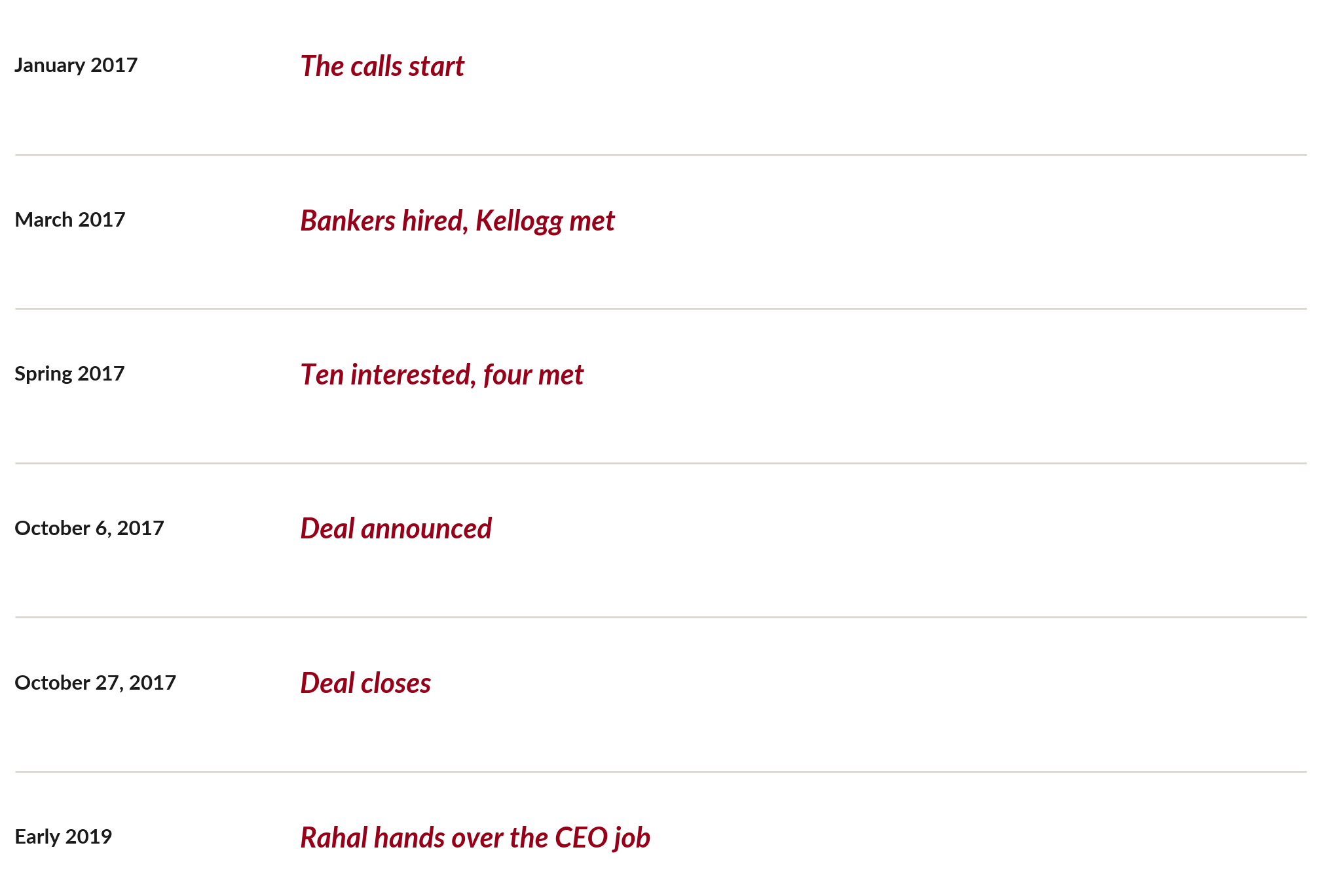
Kellogg announced the acquisition on the morning of October 6, 2017, and the deal closed on October 27, funded from Kellogg’s short-term borrowings. The sale price of $600 million was described to Kellogg’s own investors as 12 to 14 times RXBAR’s projected 2018 earnings, although it was approximately five times 2017 total sales.
Because the buyer was a public company, the sale price and details went out in a press release for all investors.
“The RXBAR team has built an incredible business with impressive growth and profitability.”
— Paul Norman, President of Kellogg North America
It took a total of seven months from first meeting to closing the deal, the result of a company not encumbered by debt or a complicated cap table.
09: what went wrong
01: The ingredient list
The ingredient list was the entire brand, and for the first two years it was out of sight. Even with this hiccup, RXBAR was a huge success in a very short timeframe.
02: They sold all of it, even future growth
This is always the risk of selling, although it is doubtful either founder regrets it. Selling 100% of the business meant there was some risk that the company would keep expanding rapidly, potentially into the billions of dollars. The founders took money off the table and created generational wealth. Could it have been more? Yes. Are they sleeping better now? Probably.
03: The reorganization
RXBAR was bought to be run as a standalone business, and for a while it was. Fourteen months after the deal closed, however, RXBAR had a headcount of 200. Forty of them were let go in a reorganization. The following March, the brand was moved under a new holding company called Insurgent Brands. The job of CEO went to the finance director, and Peter was moved into a vision and strategy position. Wanting to call the shots and operate the brand, Peter left soon afterwards.
10: what went right
01: They sold where nobody was selling
Every competitor was fighting for shelf space at grocery stores. RXBAR was sold in gyms, which had no competition or shelf space to purchase. By the time the brand reached grocery stores, recurring customers were asking for the bars by name.
02: The wrapper was the marketing
There was never a meaningful advertising spend before the acquisition. The package did the work: it explained the product, made the claim, and separated the brand from the competition. Peter learned of all customer issues early on by having his cell phone number printed on the wrapper.
03: Know what you want
Of the ten interested buyers, four meetings were set up with clear terms: no private equity and no partial sale. Not only did this expedite the closing of the deal, it also made negotiation that much easier.
11: founded lessons
In their words:
“Make sure you’re solving the right problem that exists or frustration that exists, and define it well, and spend a lot of time doing it.”
— Peter Rahal
“Our customers don’t want to buy a product with a label that’s not centered.”
— Peter Rahal
“You don’t sell your company and have less work.”
— Peter Rahal
“When things are going well, I get paranoid, you know. Celebrating doesn’t do anything to move you forward.”
— Peter Rahal
12: what still isn’t clear from the research
How the $600 million was split between the founders.
What, if anything, the 85 employees received.
What the other three buyers offered, and whether any of them offered more than Kellogg or different structures.
Where and how the bars were made once the hand-mixing wasn’t economically feasible.
Whether the company was founded in 2012 or 2013. Peter has used both, and the difference comes down to when the kitchen experiments turned into a business.
FOUNDED FACT
The brand has been sold twice.
On October 2, 2023, the Kellogg Company split in two: the North American cereal business became WK Kellogg Co, and everything else — Pringles, Cheez-It, Pop-Tarts and RXBAR — became Kellanova. Ten months later, Mars agreed to buy Kellanova in a $35.9 billion sale that closed on December 11, 2025.
The business built by two friends in a basement in Chicago is now owned by a family-owned candy company, you know, the ones notorious for the long, chemically heavy ingredient lists. Peter’s non-compete stretched five years from the sale of RXBAR to Kellogg and expired in October 2022.
In September 2024, Peter co-founded a competing protein bar called David Protein. The first year of sales brought in a whopping $100 million in revenue. A $75 million series A funding round valued the company at $725 million. Is Peter Rahal the protein bar king?
LEARN MORE
Inc. — “He Started His Company for $10,000. He Sold It for $600 Million Five Years Later”, the exit interview, April 2018. https://www.inc.com/magazine/201804/danielle-sacks/rxbar-peter-rahal-exit-interview.html
How I Built This with Guy Raz — “Live Episode! RXBAR: Peter Rahal”, NPR, August 2018, recorded in Chicago. https://www.npr.org/2018/08/10/637619434/live-episode-rxbar-peter-rahal
Forbes — “This Protein Bar Cofounder Sold His Company For $600 Million. Now He Wants Another Bite Of The Market.”, December 6, 2024. https://www.forbes.com/sites/simonemelvin/2024/12/06/peter-rahal-david-protein-bar-interview-rxbar-600-million/
SOURCES
1. Kellogg Company — “Kellogg adds RXBAR, fastest growing U.S. nutrition bar brand, to wholesome snacks portfolio”, press release, October 6, 2017 (source of the $600 million price, the ~$120 million 2017 net sales figure and the 12–14× EBITDA multiple)
2. Kellogg Company — Form 10-Q note on acquisitions, filed November 2017, SEC EDGAR (source of the October 27, 2017 closing date and the short-term borrowings)
3. Inc. — Danielle Sacks, “He Started His Company for $10,000. He Sold It for $600 Million Five Years Later”, April 2018 (the sale process, ten interested parties, four meetings, the private equity quote)
4. Entrepreneur — “The Founders of RXBar… Built the Company by ‘Having a Bias Toward Action’” (door-to-door gym sales, the phone number on the wrapper, the redesign brief)
5. Packaging World — “‘No-B.S.’ approach to protein bar extends to packaging”, 2015 (the old and new wrapper described in detail, the Jared Smith quote, the September 2015 rollout)
6. CNBC — “RXBar CEO Peter Rahal: Focus on detail is crucial to success”, March 12, 2018 (firing his mother)
7. Crain’s Chicago Business — Peter Rahal, 40 Under 40 profile (85 employees, the $130 million 2017 run rate, “our baby’s ugly”)
8. Forbes — Alejandro Cremades interview, March 26, 2019, and Megan Bruneau, May 22, 2025 (the $5,000 each, the 2014 and 2015 revenue figures, dyslexia, the quotes in section 11)
9. Food Dive — “Despite its popularity, Kellogg’s RXBAR sheds 40 employees”, December 2018, and “RXBAR’s prescription for the future”, 2019 (the reorganisation, Insurgent Brands, the leadership change and the doubling of retail sales)
10. NOSH — “Sale of RXBAR Highlights What Investors Are Missing”, October 2017 (that the company raised no outside money, and why the large food companies were buying)
11. NPR / How I Built This with Guy Raz — “Live Episode! RXBAR: Peter Rahal”, August 2018 (the Cuisinart, and the $36 million 2016 sales figure)
12. Kellanova — separation completion release, October 2, 2023, and “Mars to Acquire Kellanova”, August 14, 2024; Mars — “Mars Completes Acquisition of Kellanova”, December 11, 2025
Built entirely from public interviews, press releases and SEC filings. No interview was conducted with the founders. All figures are as the founders or the acquirer stated them and have not been independently audited. Amounts are US dollars.