


Ten case studies in, I’ve written more than 45,000 words studying founders who built a company valuable enough to be sold. Each article took approximately 6-8 hours of research: what you’re about to read are the most important discoveries from approximately 70 hours’ worth of digging, distilling, and validating.
Along the way, I referenced 132 sources and found 87 meaningful quotes from founders, buyers and the people who made their journey possible. With more than $1.7 billion in aggregate sale proceeds, this article serves to boil down the ten stories and compare them side by side. You’ll discover how founders got their first customers, what distribution channels worked, the mindsets and habits they shared, what went well, and the mistakes that were repeated. This is the best of founded., and I’m so excited to share it with you.
what we found out:
most founders scaled on one channel for years before adding a second.
the channel that worked was often the second one.
distribution can change overnight; own your audience.
half of the founders had built something before with more failures than expected.
the same mistakes show up at multiple companies at the same stage of growth.
it’s rare for a founder to publish the first $500,000 of revenue.
the price reported by the press is usually higher than the actual sale price.
01: two founders, 22 years apart
Markus Frind was out of a job in Vancouver back in 2003. He built a free dating site in two weeks on his computer to teach himself a programming language, and called it Plenty of Fish. A few months later, Google introduced AdSense, and what was free to join suddenly had a monetization channel. The first month made him $1,000.
Maor Shlomo launched Base44 from Tel Aviv in February of 2025. Product Hunt brought him 15 users, and he later admitted that the few thousand dollars he spent on ads and influencers yielded no results. What worked was LinkedIn, where he had an existing following and built in public. Base44 went from $0 to $1 million in annual recurring revenue (ARR) in just three weeks.
One founder started with no audience and the other started with a small one. Despite the differences, this journey has taught me a lot. They are more similar than they seem: both of them found a channel that was effective and doubled down. Markus had free sign-ups and search traffic at a time when other dating sites charged people to join. Maor chose LinkedIn over X (where building in public wasn’t yet as popular) and showed his followers every win and problem as it happened.
both were mechanisms for building trust.
When I started writing Founded, I assumed the product would be a large part of the story in every case study: build the best product or service and the customers automatically follow.
Looking back now, I had it all backwards. Every founder had a good product. It’s the bare minimum. What differentiated them was distribution: how they got in front of potential customers, how quickly they could reach more of them, and what happened when the channels themselves shifted.
I urge you to treat this writeup as a field guide rather than a formula to copy and paste. The ten companies are decades of experiments, failures and successes paid for by determination, effort, and eating the costs up front. The details are what’s interesting. In particular, the choice to change a distribution channel when one wasn’t effective, the habits and mindsets they relied on, and the mistakes that somehow migrated across businesses and repeated themselves are the real lessons here.
02: from idea to exit
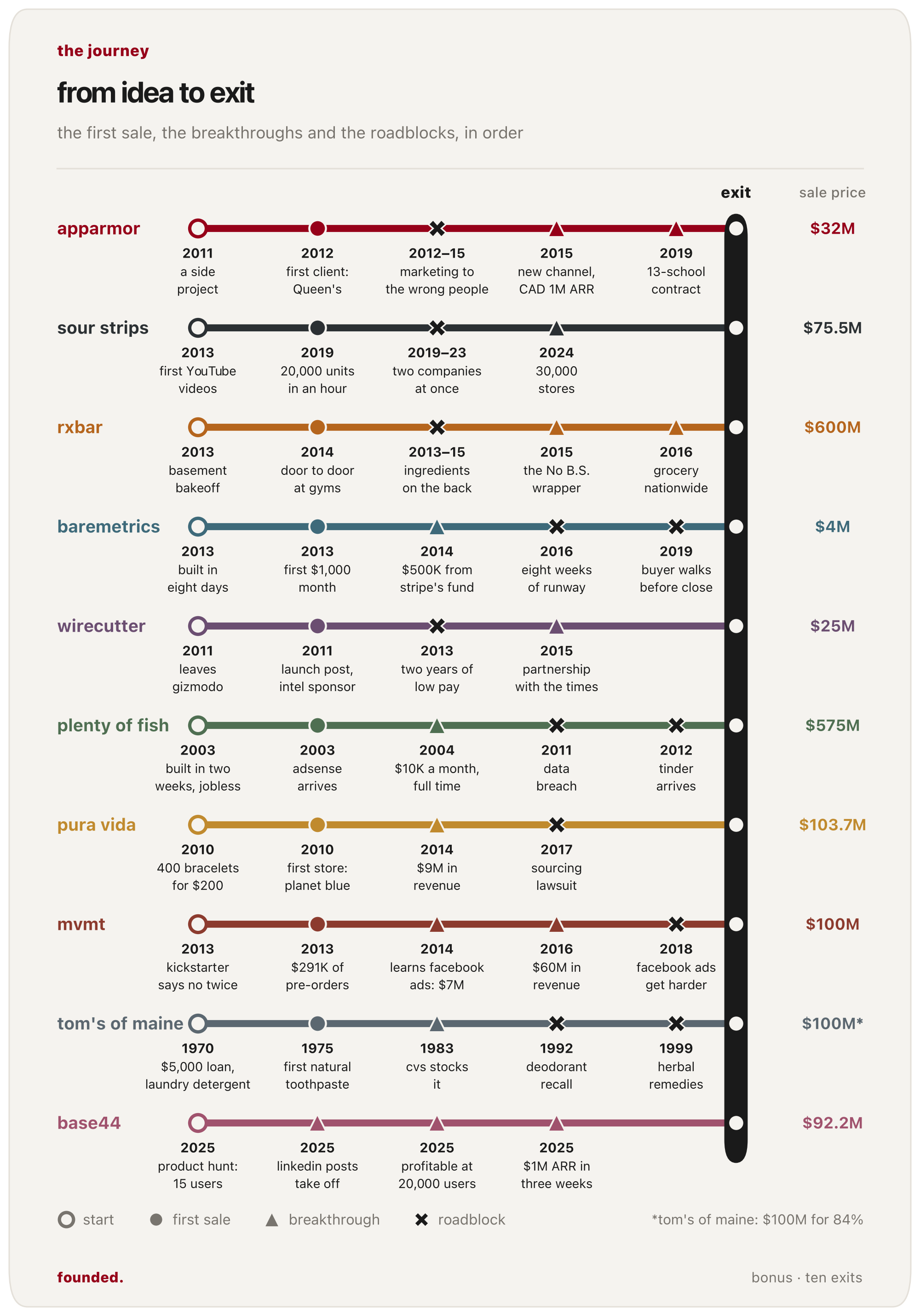
The graphic above illustrates the major milestones in each company’s journey: the day each was founded, the first sale, the breakthrough and the roadblocks.
The first sales are smaller than you might expect. AppArmor’s first client, Queen’s University, paid CAD $960 for a one-year subscription to a campus safety app. Chris Sinkinson, one of the two brothers behind it, later said:
I can’t believe how little we charged... We were just so excited to have a client.
— Chris Sinkinson, AppArmor
Pura Vida’s first store was Planet Blue in Malibu, where the mom of Griffin Thall, one of the founders, was a buyer. RXBAR went door to door selling to CrossFit gyms in Chicago. MVMT was turned down by Kickstarter twice and raised $291,307 of pre-orders on Indiegogo instead. The only big launch was Maxx Chewning’s; he sold 20,000 units of Sour Strips in the first hour of launch to an audience he had built over seven years.
The roadblocks are somewhat distributed in each founder’s journey. Some came early on before the right distribution channel had been identified. AppArmor spent years marketing to the wrong audience and RXBAR hid the ingredient list on the back of the wrapper.
Others ran into roadblocks later on when channels became overrun or expensive. Tinder entered the dating market in 2012 and changed the way people used dating apps. Markus sold Plenty of Fish three years later.
MVMT cofounder Jake Kassan told Forbes that selling on Facebook and Instagram had become much harder in January 2018. MVMT was sold that August.
The important takeaway here is that there is no one-size-fits-all in business. Founders are forced to take challenges as they come and make hard choices in the moment. For early challenges, the choice was often to switch to a better distribution channel. Challenges that showed up later often led to selling the business.
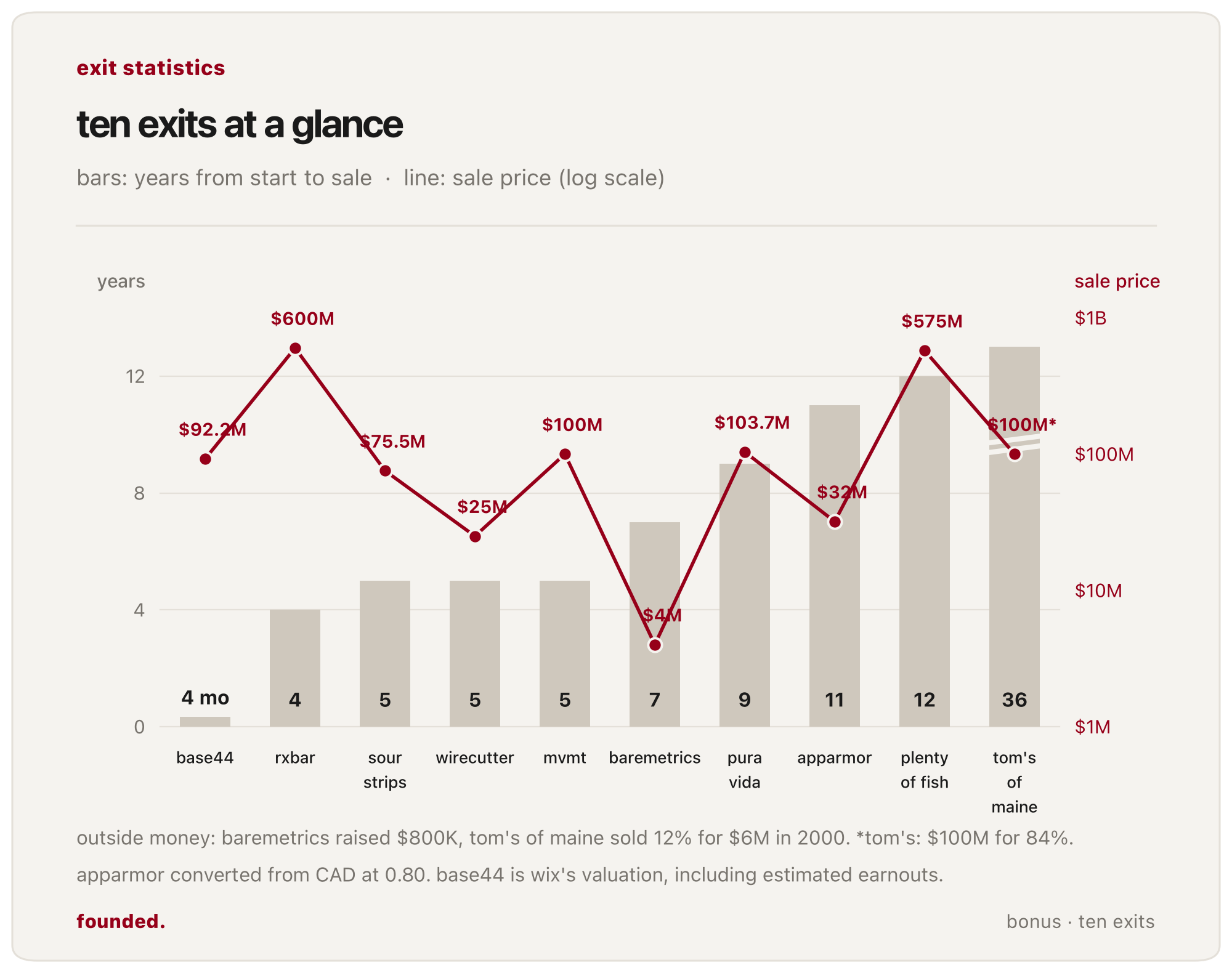
The timeline from starting a business to an eventual sale varied significantly across the board. From Base44 which sold just four months after launch, to Tom’s of Maine that sold 36 years after inception, the median was approximately six years. The line shows no clear link between how long a company took to sell and what it sold for: RXBAR sold for the most after four years, and Baremetrics for the least after seven.
Only two of the companies I studied took on outside investment: Baremetrics raised $800,000 to fund hiring (which almost led to its collapse) and Tom’s of Maine sold 12% for $6 million in 2000 after 30 years in business to fund a new product line that failed.
Every other founder’s exit was bootstrapped, starting with as little as $200 (Pura Vida).
If you’re interested in getting a weekly deep-dive to adopt founder mindsets, skills, and lessons please subscribe. It’s great to have you in the family!
03: the first $500,000
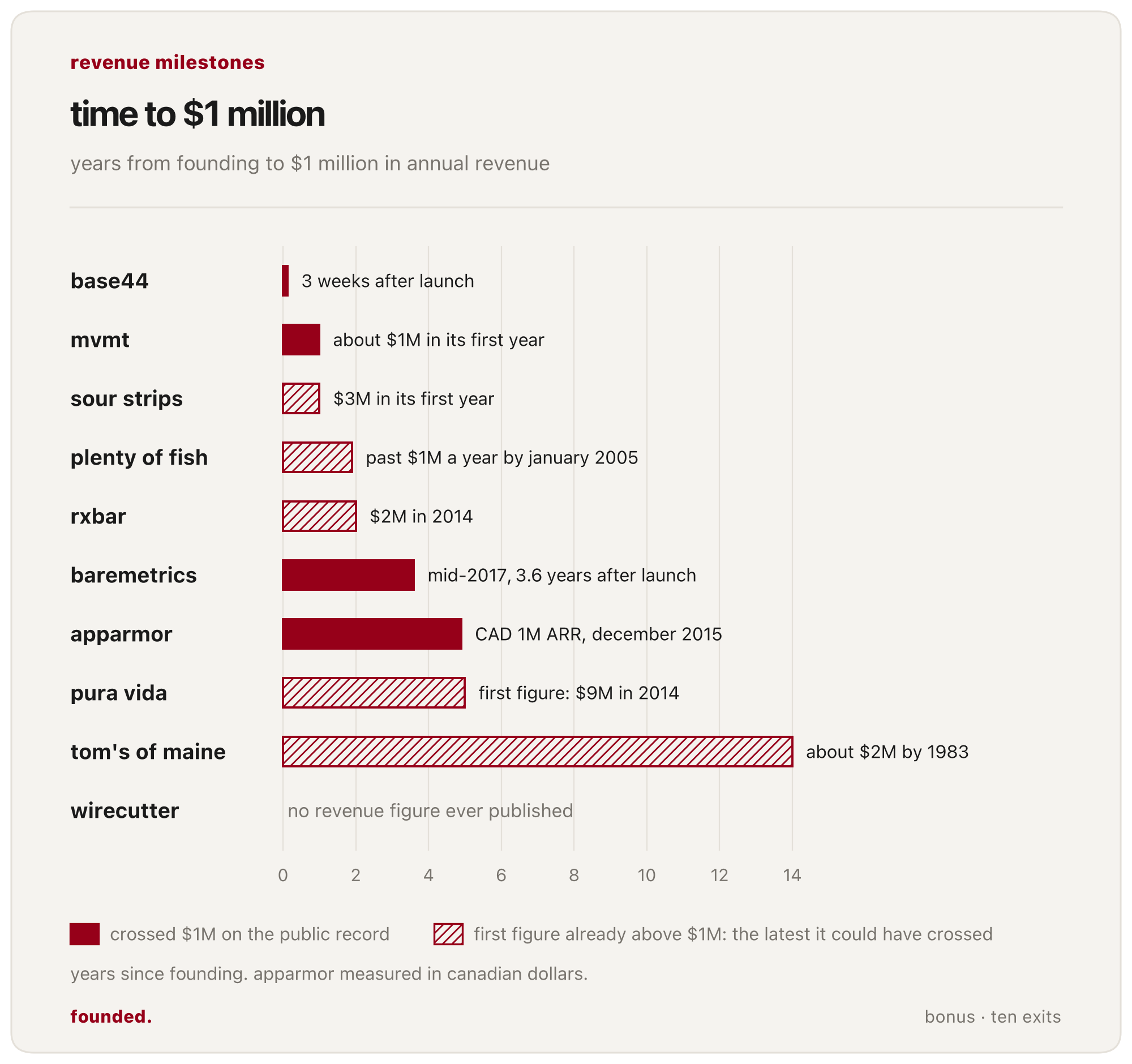
The second chart fixes revenue at $1 million a year and shows how long each company took to get there. Where a company’s first public figure was already above $1 million, the bar shows the latest it could have crossed the threshold.
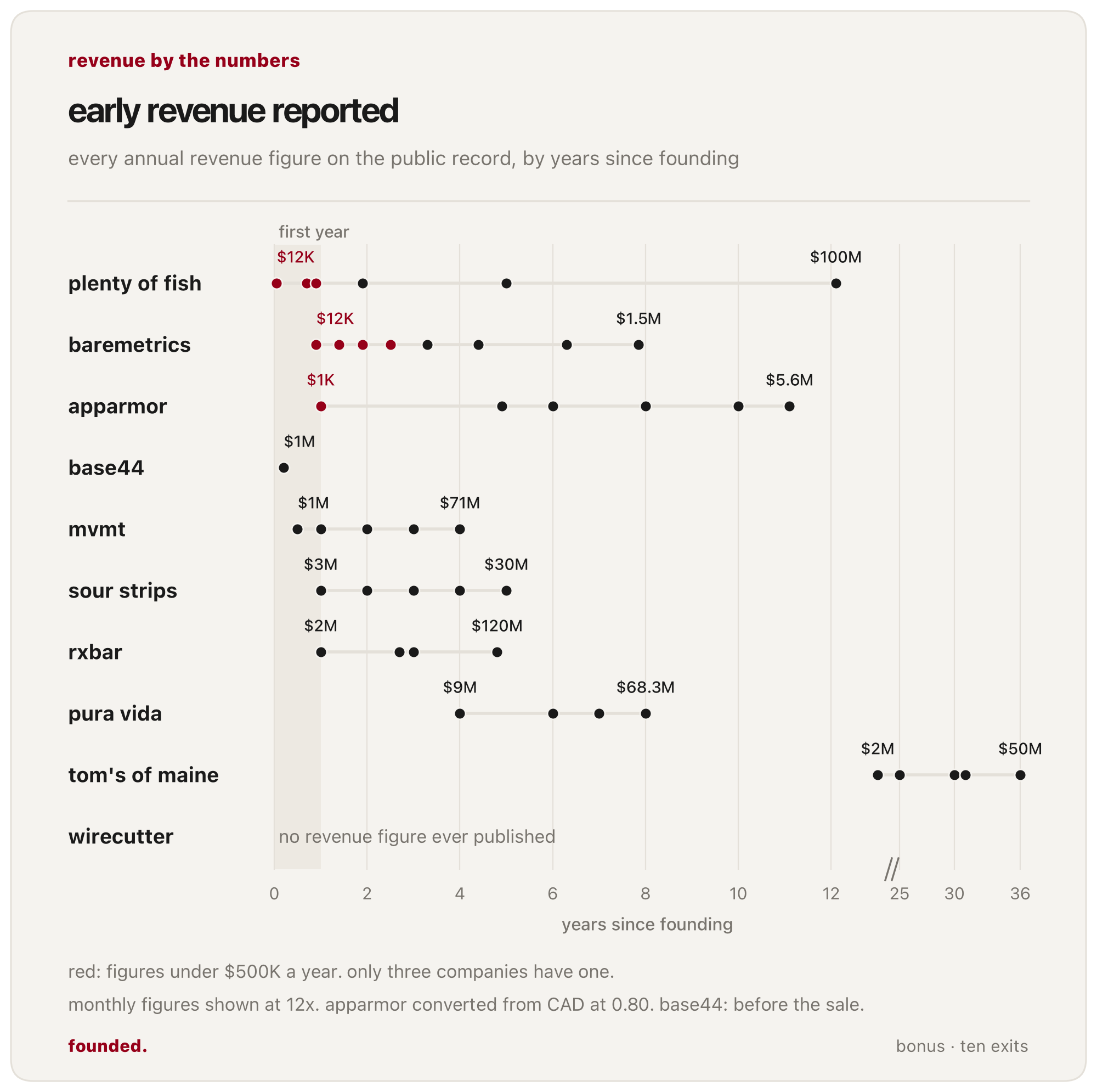
The most difficult data to find was early on. Across the ten companies only three had a public revenue figure under $500,000 per year.
Plenty of Fish made $1,000 in its first month and $4,000 per month just months later, enough for Markus to go all in. It then reached $10,000 per month 11 months after launch.
Baremetrics went from its first $1,000 month in December 2013 to $10,000 a month five months later. It then took until mid-2017 to reach $1 million per year.
AppArmor started with CAD $960 annual revenue from one client in 2012 , and it wasn’t until December 2015, after it changed its distribution channels, that it reached CAD $1 million ARR.
All of the other companies recorded revenue for the first time at or past the $1 million mark. MVMT posted $1 million in its first year on the back of pre-orders while Sour Strips grossed $3 million in its first year because of Maxx’s pre-existing following. Pura Vida didn’t report a revenue figure until the business had been in operation for more than four years.
The first $1 million of revenue tells a fascinating story. It was largely dependent on a cheap mechanism to reach thousands of potential customers. This was seen in the form of an existing audience, a crowdfunding campaign, or targeted advertising. Jake from MVMT described the moment it clicked for him:
Once I learned I can go and spend 20 bucks and sell a $100 watch, I’ll do that all day.
— Jake Kassan, MVMT
The two software companies founded before 2015, AppArmor and Baremetrics, had to find customers one at a time and took four to five years to reach the $1 million mark. This didn’t appear to hurt the ultimate sale price; AppArmor sold for the second-highest revenue multiple.
04: the channel that worked
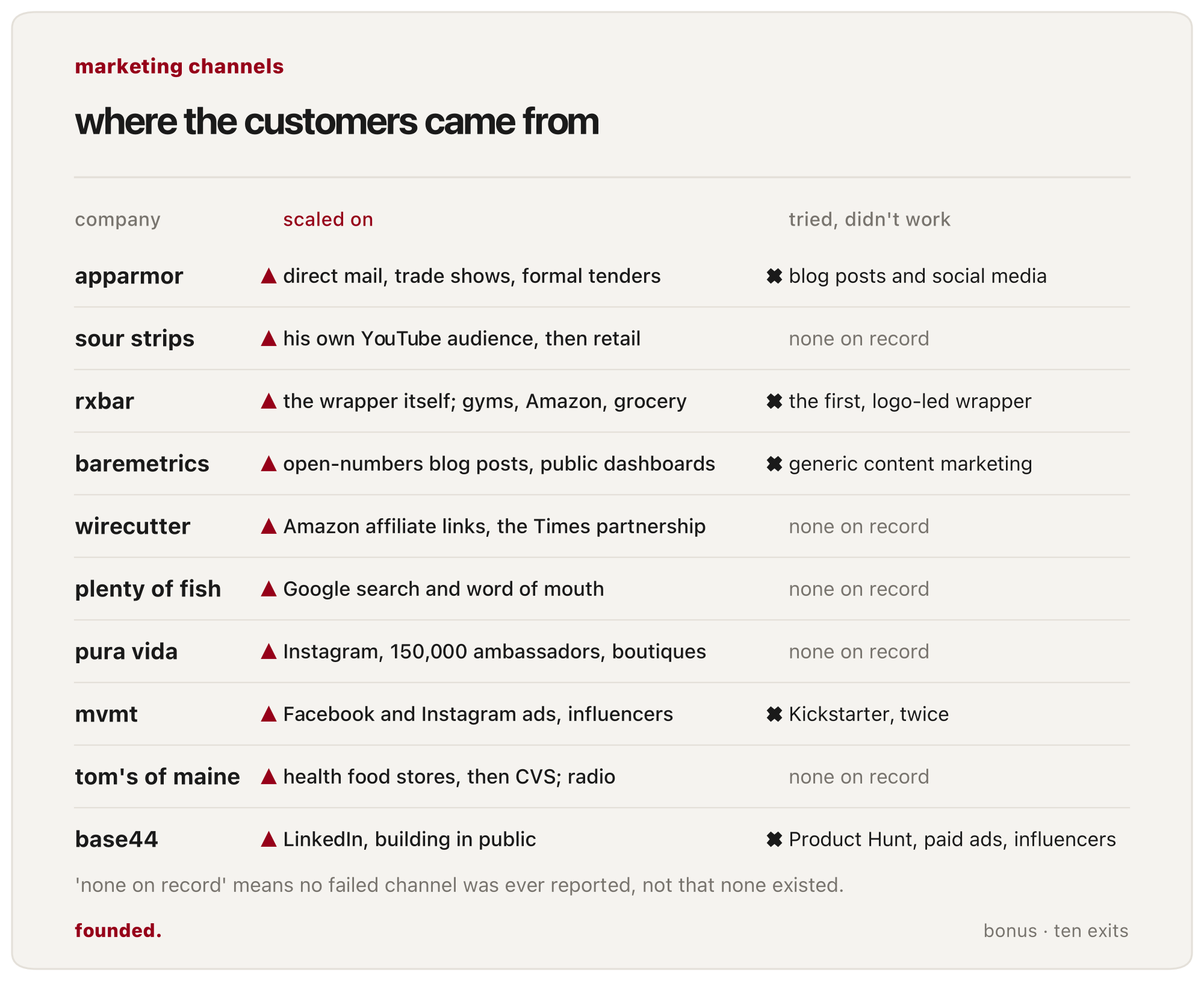
Three patterns emerged when comparing sales channels side-by-side:
one channel and consistency
Almost every company grew on one channel for years before it added a second. Plenty of Fish relied on Google search results. Tom’s of Maine sold through health food stores for 13 years before CVS stocked their products in 1983. MVMT placed their bets on Facebook and Instagram ads from year two and eventually added podcasts, Google Search and YouTube. Sour Strips were sold to Maxx’s audience first; brick-and-mortar stores like Walmart, Target and H-E-B were later chosen as a secondary channel.
second time’s the charm
The channel that ultimately worked was often the second one. The AppArmor brothers spent years on blog posts and social media before they realized the people buying campus safety systems were emergency managers who weren’t the people reading those posts.
We were selling to emergency managers who weren’t in that demographic.
— Chris Sinkinson, AppArmor
The choice to switch to direct mail, trade shows and formal tenders is what took the brand to CAD $1 million.
Baremetrics’ founder Josh Pigford discovered that generic content marketing provided no traction but blog posts that broke down its own revenue figures and failures converted well.
RXBAR’s first wrapper prioritized the logo and tagline; the second attempt placed the ingredient list on the front with a “No B.S.” label underneath. This simple change allowed revenue to increase more than fivefold from $6.5 million to $36 million in the year that followed.
Maor tried Product Hunt, paid ads, and influencer marketing before building in public on LinkedIn.
relying on a single channel
What intrigued me when studying ten different distribution strategies is how quickly a channel can change when it’s out of the founder’s control. Facebook ads got more expensive for MVMT in 2018, the year the founders sold it. In 2021, Apple’s change to its tracking rules across apps disintegrated the edge Pura Vida had in acquiring a new customer two years after Vera Bradley bought it.
The ones that held up were the ones that had direct relationships with customers, unencumbered by the control of a single platform. AppArmor had contracts with campuses directly, Wirecutter had its reputation with readers, and Maxx’s viewers followed him from YouTube to the candy aisle.
It works, but it isn’t a guarantee. Platform risk is real but also helped to increase reach without much legwork. Pura Vida had over 1 million email subscribers at the time it was sold but still struggled to remain profitable after Apple’s change in 2021.
The key was to prioritize off-platform migration as early as possible. Get customers onto an email list, contracted work, or even just diversify across social platforms.
05: who they were
When I realized how few founders were experts in what they sold, I questioned my own imposter syndrome. Pura Vida’s founders weren’t jewelers or marketers. MVMT’s founders weren’t watchmakers. Markus wasn’t an expert on dating. What they shared was the audacity to try and the development of specific habits. Here are the ones that I saw repeatedly:
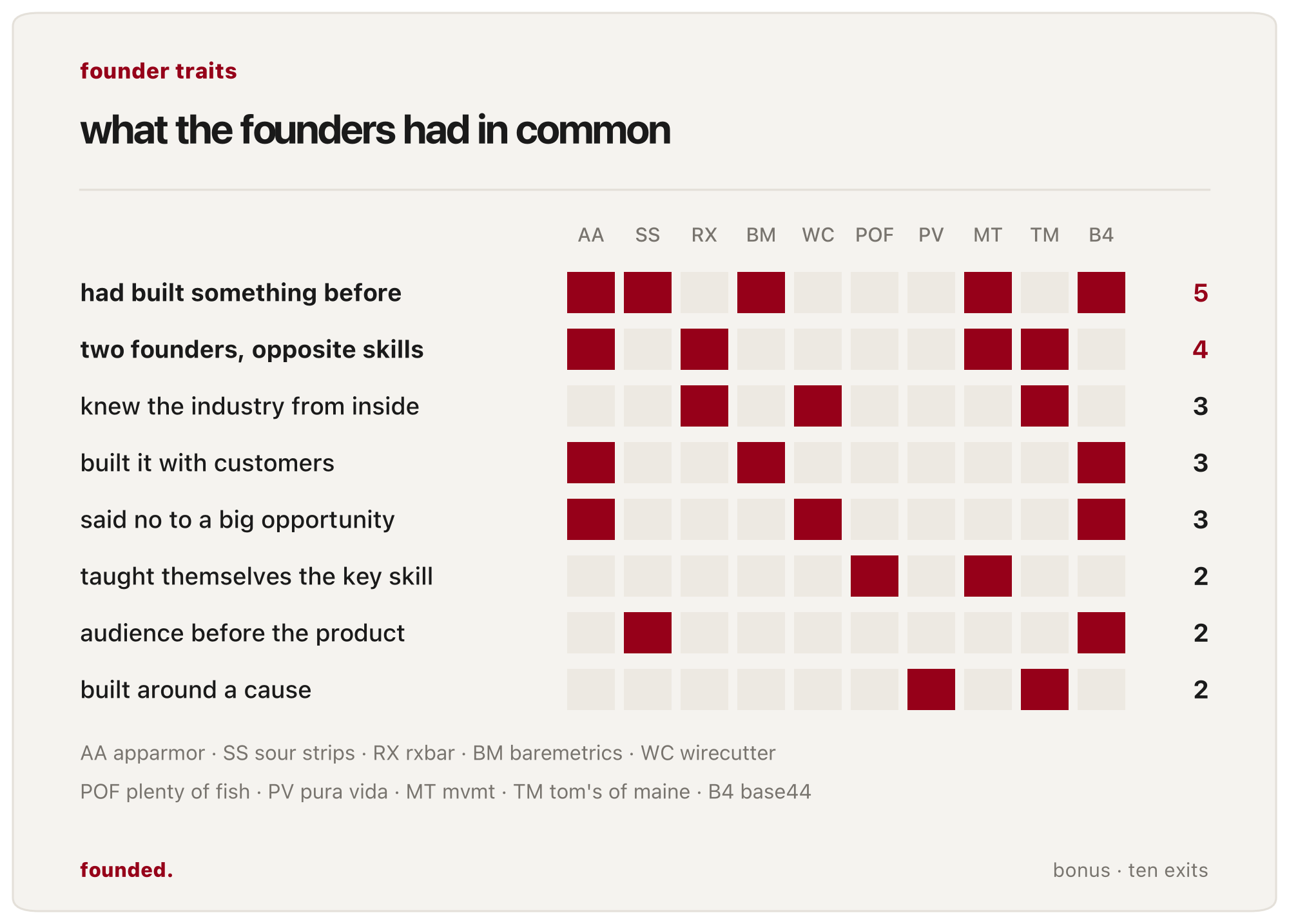
it wasn’t their first rodeo
As you might expect, half of the founders in the dataset had built something before their home run. Most of them failed but it provided a foundation for their success.
Josh Pigford said that Baremetrics was “probably my hundredth thing to build.” Maxx founded an apparel company, Ever Forward, before Sour Strips that taught him manufacturing and supply-chain skills.
Maor served as co-founder and CEO of Explorium for seven years before starting Base44. Jake from MVMT started a T-shirt company at 17, and has been open about his failures:
I had other businesses that had failed and I blamed myself. I wasn’t going to let that happen.
— Jake Kassan, MVMT
complementary skillsets
Four of the five two-founder companies split work based on skillset. One founder was responsible for selling while the other built and ran operations. At AppArmor, David Sinkinson ran sales and marketing while Chris built the software.
At RXBAR, Peter focused on product, branding and sales while Jared ran operations; both have stated that their differences turned out to be assets.
At MVMT, Jake learned Facebook ads while Kramer ran operations; at Tom’s of Maine, Tom was the salesman and Kate was the customer voice and designer.
working closely with customers
In a digital world, it’s easy to assume that people will just buy what saves them time or solves a problem they have. It’s only half the equation in most cases. Three founders worked more closely with early customers than you might think.
Josh got on the phone with every Baremetrics customer and booked follow-up calls at three, six, twelve and eighteen months. Chris sat in a campus dispatch room to learn how the app should be built, later calling that time “invaluable.” Maor recruited early testers from his LinkedIn community to test the product, report bugs and give feedback.
the ability to say ‘no’
This last habit is probably the hardest to use in practice.
Wirecutter was capped at 10 updates per month and turned down all requests for advertisements. The AppArmor brothers didn’t want to entertain venture capital and later turned down a CAD $20 million offer because they did not want an earnout component. Maor turned down every investor in favor of staying on as the only shareholder until Base44 was sold to Wix.
It stresses me out when other people’s money is in my company.
— Maor Shlomo, Base44
06: what went right
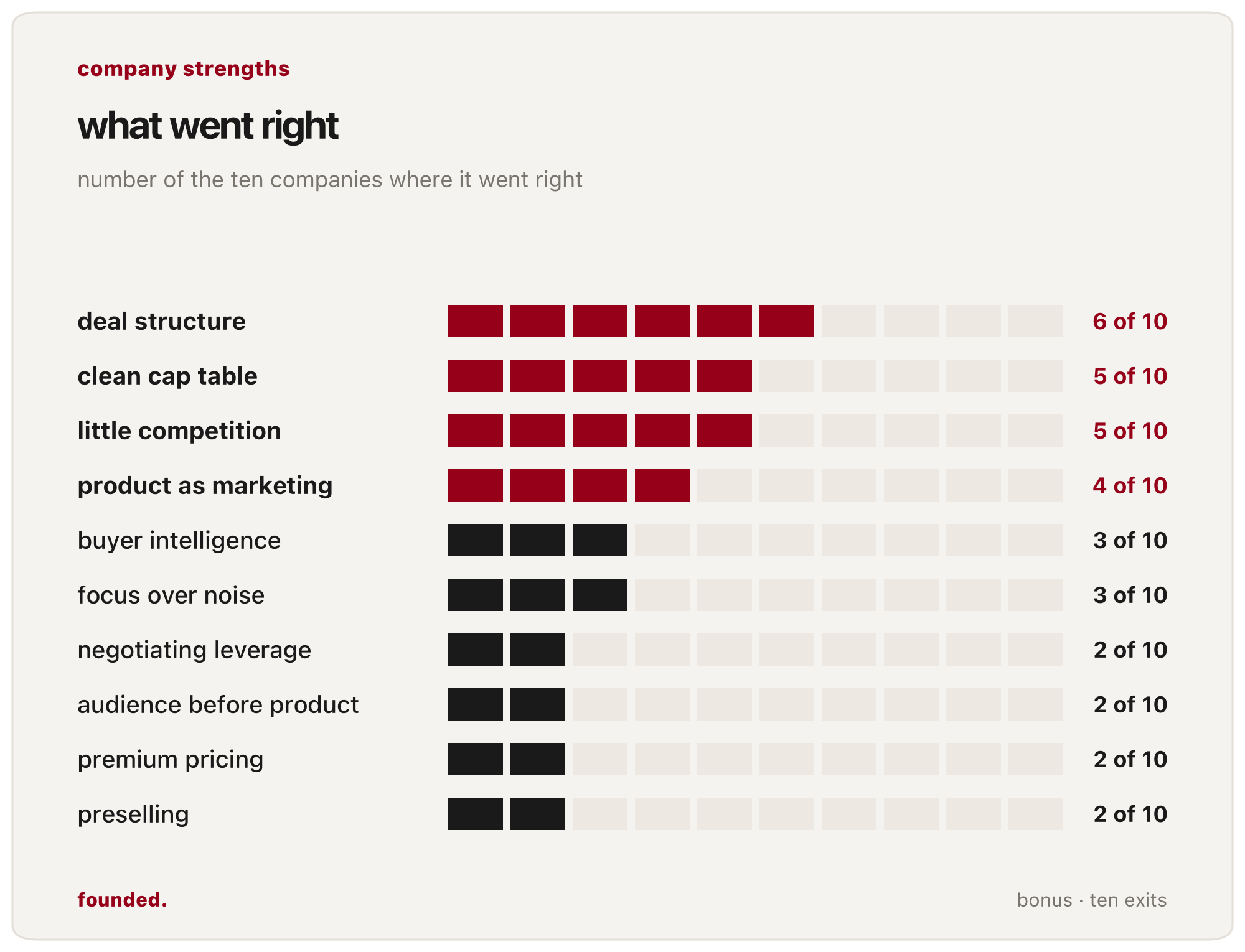
As helpful as it can be to look at failures, just as much is gleaned from things that worked well. Although these ten companies have inherent survivorship bias, they still share similarities that are worth investigating.
The terms of the sale and its structure were the most common part that went right for founders. Six of the ten chose specific terms such as no earnout, staying on to run the business or to keep values aligned with the brand instead of a higher cash price at closing. However, this does come with a caveat: The case studies were cherry-picked based on the story, which had to be interesting enough to write about at length.
The other thing that worked well was choosing a channel with little competition and using the product itself as marketing, which are really one and the same.
Seven of the ten founders found it the cheapest and most reliable way to reach potential customers and to ultimately keep their customer acquisition cost (CAC) low. There were two main ways this materialized in practice: through preselling a product or service, or by finding an underutilized distribution channel.
MVMT and Baremetrics both relied on preselling, giving early feedback on the business model and serving as a proof of concept.
The real takeaway, though, is how founders found uncontested distribution channels to kickstart growth. Five of the ten (RXBAR, Plenty of Fish, MVMT, Base44 and Tom’s of Maine) found channels where traffic was thin, customers weren’t yet buying their product or service through that channel, or competition was weak.
RXBAR sold door to door targeting CrossFit gyms in Chicago. Plenty of Fish was free when every other service was paid (and marketed on dating forums). MVMT paid Instagram influencers before it was common. Founders sniffed out the least utilized channels and used them to grow quickly and effectively at little or no cost.
Have you learned something new that’s worth applying to your business? Please let me know what you liked or didn’t like as much. I’d also appreciate it if you would share this post or restack if you found value here!
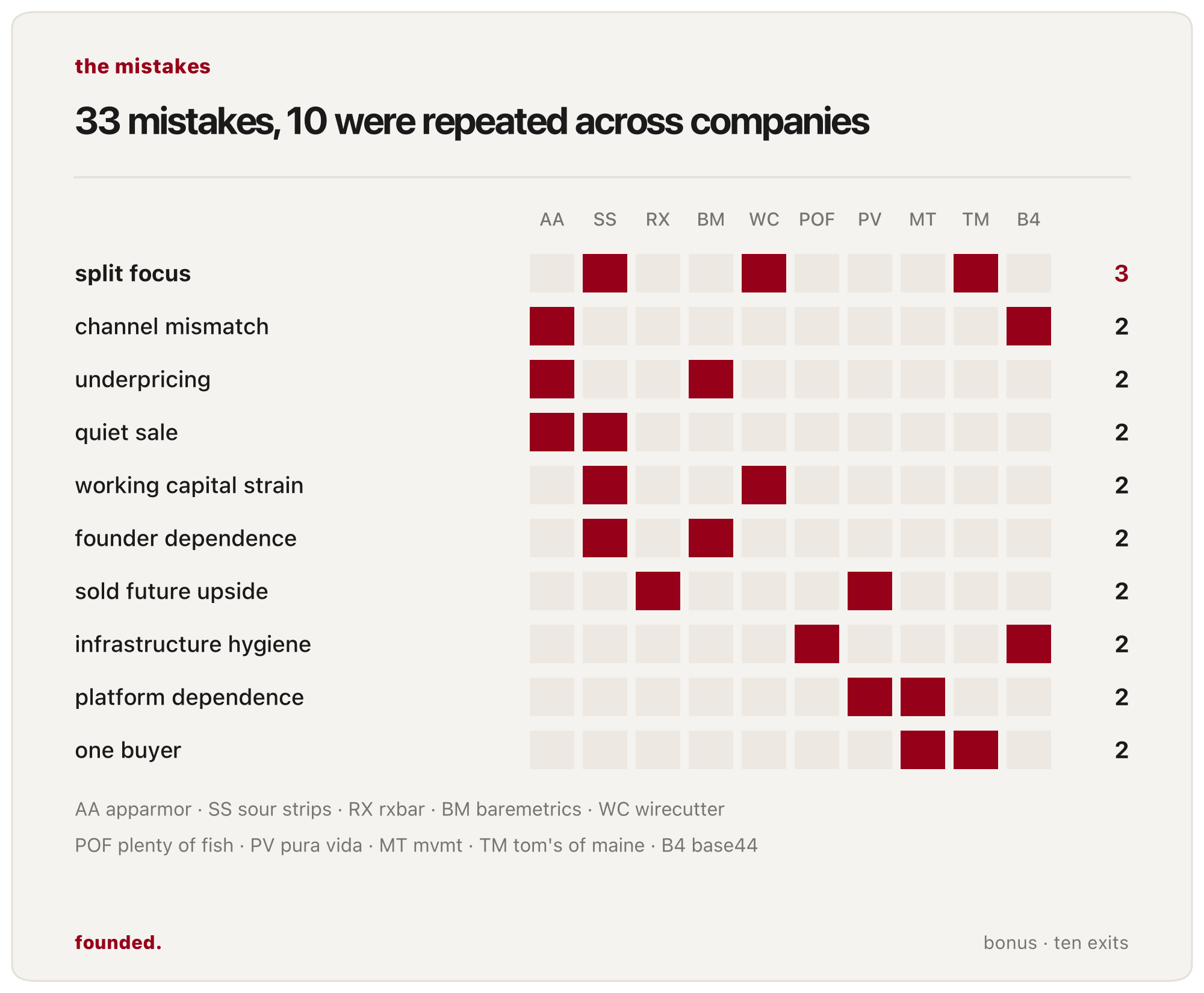
The mistakes provide the more valuable lessons as a founder primarily because several track across industries in the dataset. They are also clustered by each stage of growth:
Early on, mistakes are tied to pricing and where to market. Underpricing, specifically, cost two companies their growth potential: AppArmor for the price it charged for its first client (CAD $960 per year) and Baremetrics which failed to increase prices over eight years.
About halfway between idea and exit, a lack of attention became the problem. Three businesses suffered because of a founder’s split focus: Maxx ran Sour Strips and Ever Forward at the same time, Wirecutter operated two sites that did the same thing for four years, and Tom’s of Maine expanded into an herbal remedy product line that ultimately flopped.
At acquisition, mistakes were clustered around the approach in finding a buyer and relaying information to the team. MVMT and Tom’s of Maine negotiated with just one buyer. The AppArmor and Sour Strips founders told their respective teams about the sale at the very end (though this was not something the founder could control).
07: the price on paper
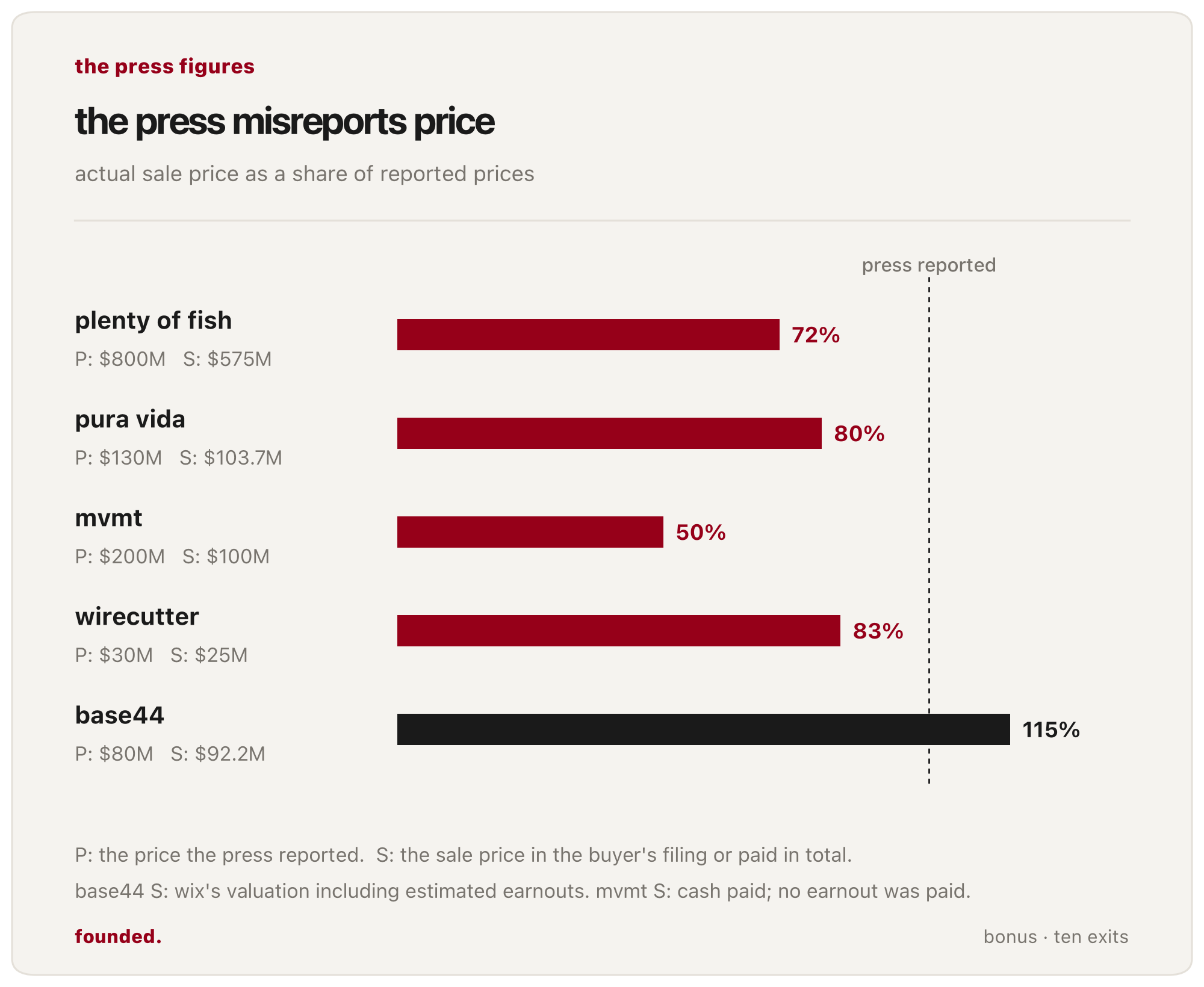
This part of each analysis is where things got slightly annoying, especially when relying solely on public information. It also matters if you plan to sell one day and want to find comparable businesses: the press misreports final sale numbers frequently. This can be seen from the graphic above. The dotted line represents the press reported figure and the bars are the actual sale price according to official filings.
For four of the acquisitions, the press reported a figure that was higher than the actual number:
Plenty of Fish: one headline put the sale at $800 million. IAC’s filing says $575 million.
Wirecutter: the press reported “more than $30 million.” The New York Times’ annual filing says $25.0 million.
Pura Vida: two business publications reported $130 million, the most the deal could ever have been worth. Vera Bradley paid $75 million for 75%, $18.7 million of a possible $22.5 million earnout, and $10 million for the last 25% in 2023, for $103.7 million in total.
MVMT: Movado paid $100 million in cash and promised up to $100 million more as an earnout. On closing day, the earnout was valued at $16.5 million, and none of it was ever paid.
Base44 was the outlier: Wix announced a figure of $80 million, paid $18.1 million in cash at closing and valued the whole acquisition at $92.2 million once it included the earnouts it expected to pay. Base44 has since passed $200 million in ARR and Calcalist reports that Maor is on course to receive more than $150 million in total.
This data is important: If you’re ever looking at what similar businesses sold for, treat the press-reported figure as an optimistic one, likely to be higher than the actual figure.
Then dig into official buyer filings to find the actual amount that was paid. If you’re negotiating a deal, it helps to know exactly what another business sold for as both leverage and a means of comparison.
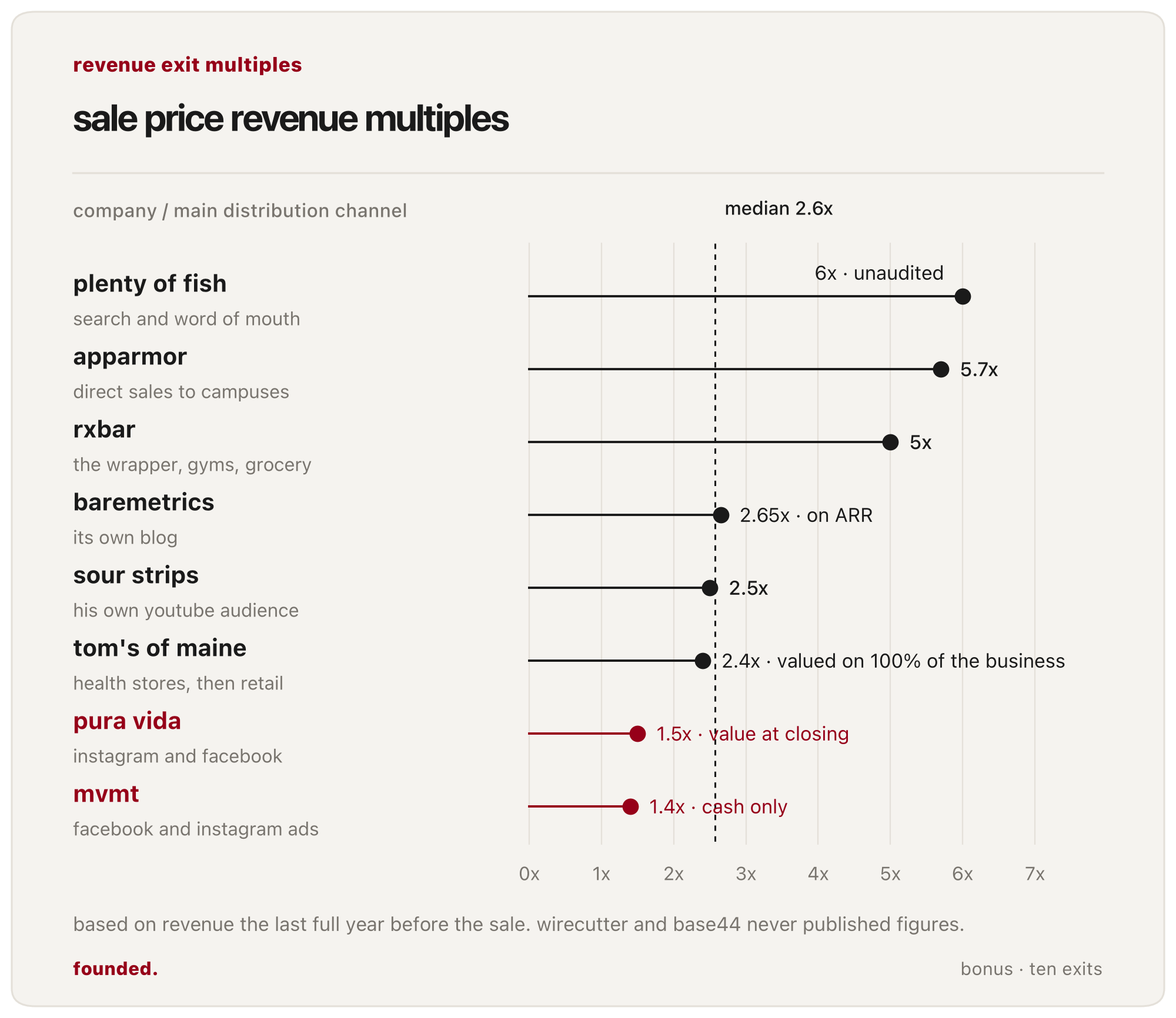
Founders are often obsessed with exit multiples. They show not only what growth was expected after the sale but the value of the underlying assets. Interestingly, the two businesses that didn’t own their audience and later had problems with an increasing CAC sold for the lowest multiples of revenue.
None of the top three depended on paid advertising for reach: Plenty of Fish grew through search and word of mouth, AppArmor through direct sales to campuses, and RXBAR through a new wrapper. Eight companies don’t exactly provide concrete proof, but it lines up with the distribution findings from section 04.
Although two of the ten (Wirecutter and Base44) never published a full-year revenue figure before the sale, the remaining eight had a median revenue exit multiple of 2.6x.
I first expected the multiple to reflect revenue growth in the year prior to the sale but that didn’t hold: Pura Vida more than doubled its revenue in its last full year, from $30 million to $68.3 million, and was valued at just 1.5x revenue at closing.
08: the numbers nobody shares
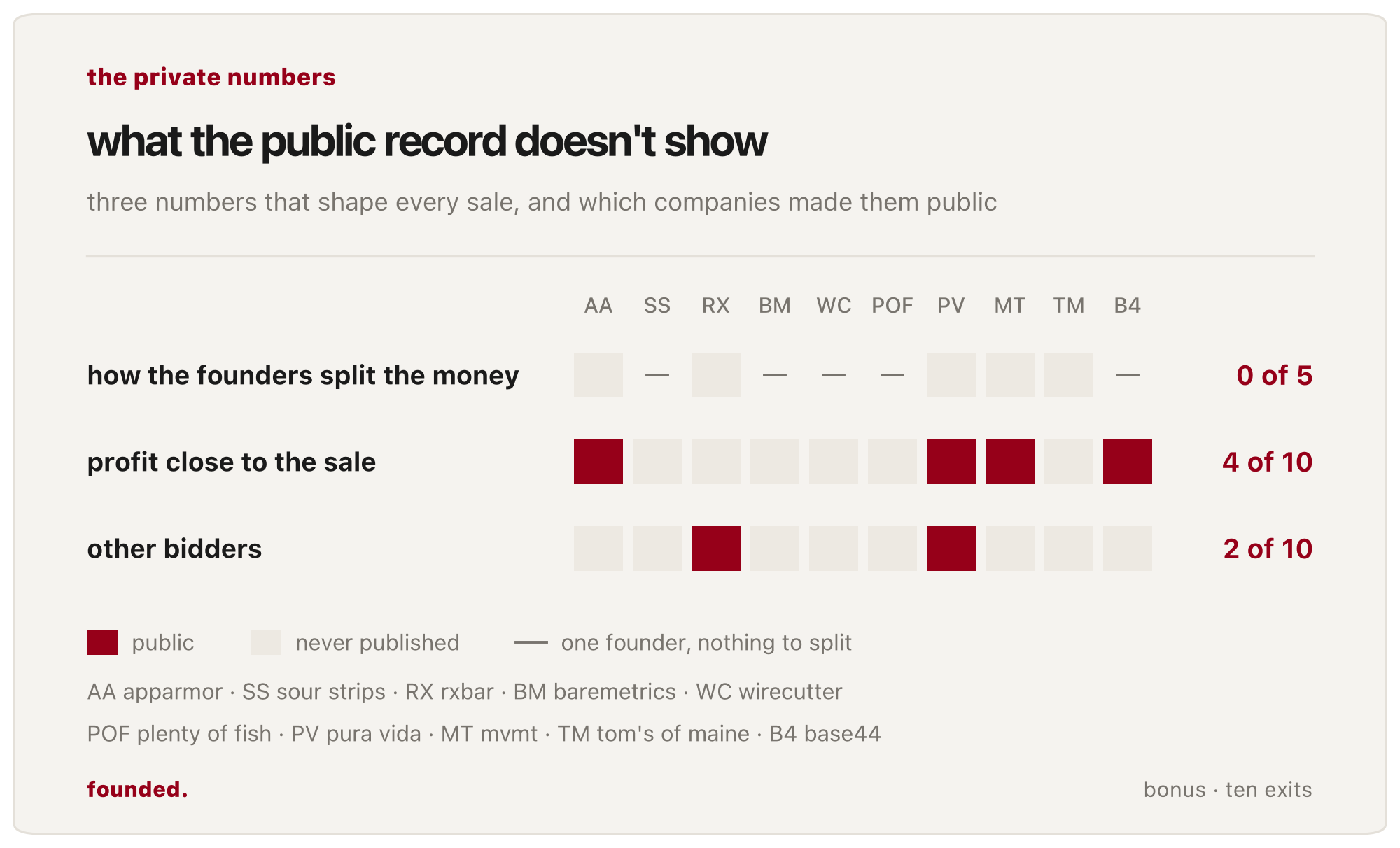
Several gaps exist in the public record, and many of them repeated across companies. While I was always able to find what the buyer paid, it’s almost completely undocumented how proceeds were split between cofounders.
I also found it inherently tricky to find a reliable profit figure close to acquisition, and was rarely able to find a record of other bidders prior to deal closing (only two companies, RXBAR and Pura Vida, even had a record of other buyers that were interested).
The most information was gleaned from Pura Vida: The public record describes an auction process with 25 interested buyers and seven formal offers.
With founded, my goal is to uncover all of these mysteries so you don’t have to. Future calls with founders, better documentation, or finding ones with better public data would be beneficial to understand the best mechanisms for getting the best terms and price when you sell.
09: ten questions from ten exits
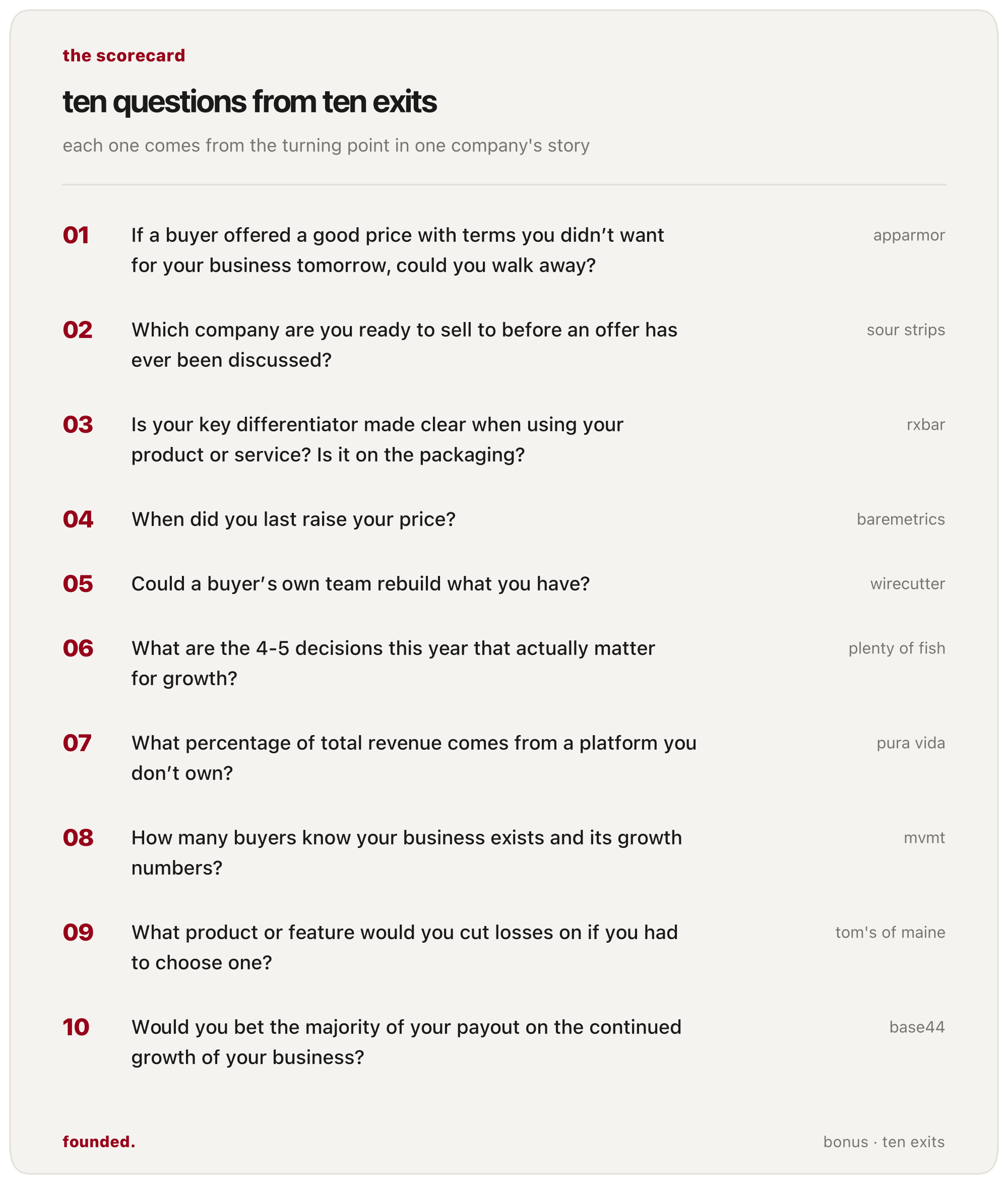
In every case study, there was one pivotal moment, decision or outcome that changed the entire course of the sale or growth of the business. Each of these was condensed into a single question for you to ask about your own business.
The graphic below poses all ten questions along with the case study from which it originated.
10: what I’ve learned
I started writing founded back in August 2026, unaware of how rewarding and interesting it would be to write in-depth case studies.
Between learning the terminology and the challenges faced by founders from idea to exit, I have started noticing the patterns and ideas I have laid out in this article. My goal is to build an extensive database that provides meaningful insights and lessons for founders so you can build and grow more easily and find transparency in the sale process when it’s time.
What’s led to a lot of growth for me has nothing to do with writing or researching: I decided from week 1 that I would reach out to each founder asking to review the article and provide additional information I couldn’t find publicly.
Although my reply rate wasn’t as high as I’d hoped (currently at 20%), two meaningful replies made it all worthwhile.
The first reply came from AppArmor’s cofounder David Sinkinson, the subject of the first case study I ever wrote. He responded with excitement that I had written about his business. He offered many useful nuggets that I added to the case study and I found out he lived just 10 minutes from me in Toronto. The next step is going for coffee…wish me luck.
The second was Jake Kassan from MVMT. I reached out on Instagram and he replied with a screenshot of my Substack page and that he had read it already.
Yep, he already read it BEFORE I SENT IT TO HIM.
That blew my mind a bit. He was very kind and although he didn’t provide additional details, he agreed the article was accurate and didn’t miss any critical information.
Let’s see what happens after 100 case studies. Twenty conversations with founders will almost surely provide further opportunities to grow.
Ten issues taught me things I never expected going in: Negotiating a sale is far more nuanced than the acquisition price suggests. From turning down offers to structuring deal terms with earnouts and tradeoffs between the structure and the price, to the depth and breadth of the due diligence process that often left founders exhausted and ready to tap out, I now better understand what it means to sell a business.
Most founders chose a bootstrapped approach rather than raising capital. Chris said they had “heard a lot of horror stories” about venture capital and never wanted it. Maor turned down every investor. More founders used outside capital as a ‘last resort’ rather than the status quo.
Lastly, I never expected that distribution would so rarely work on the first try, and that once a founder found the right channel, the business often grew faster than seemed reasonable: MVMT went from $1 million to $7 million the year Jake taught himself Facebook ads. RXBAR went from $6.5 million to $36 million after the new wrapper and the move into grocery. Base44 reached $1 million in ARR in just three weeks after a post took off on X and LinkedIn.
Let’s now tie it all back to the two founders we opened with: Markus sold Plenty of Fish in 2015 with more than 100 million registered users, three years after Tinder changed the game for online dating.
Maor sold Base44 four months after launch when the business was growing too quickly for him to handle alone. The conclusion is simple but something I hadn’t considered: both sold while the channel that built the company was still working. Sometimes, a founder knows exactly when it’s time to lock in a sale.