


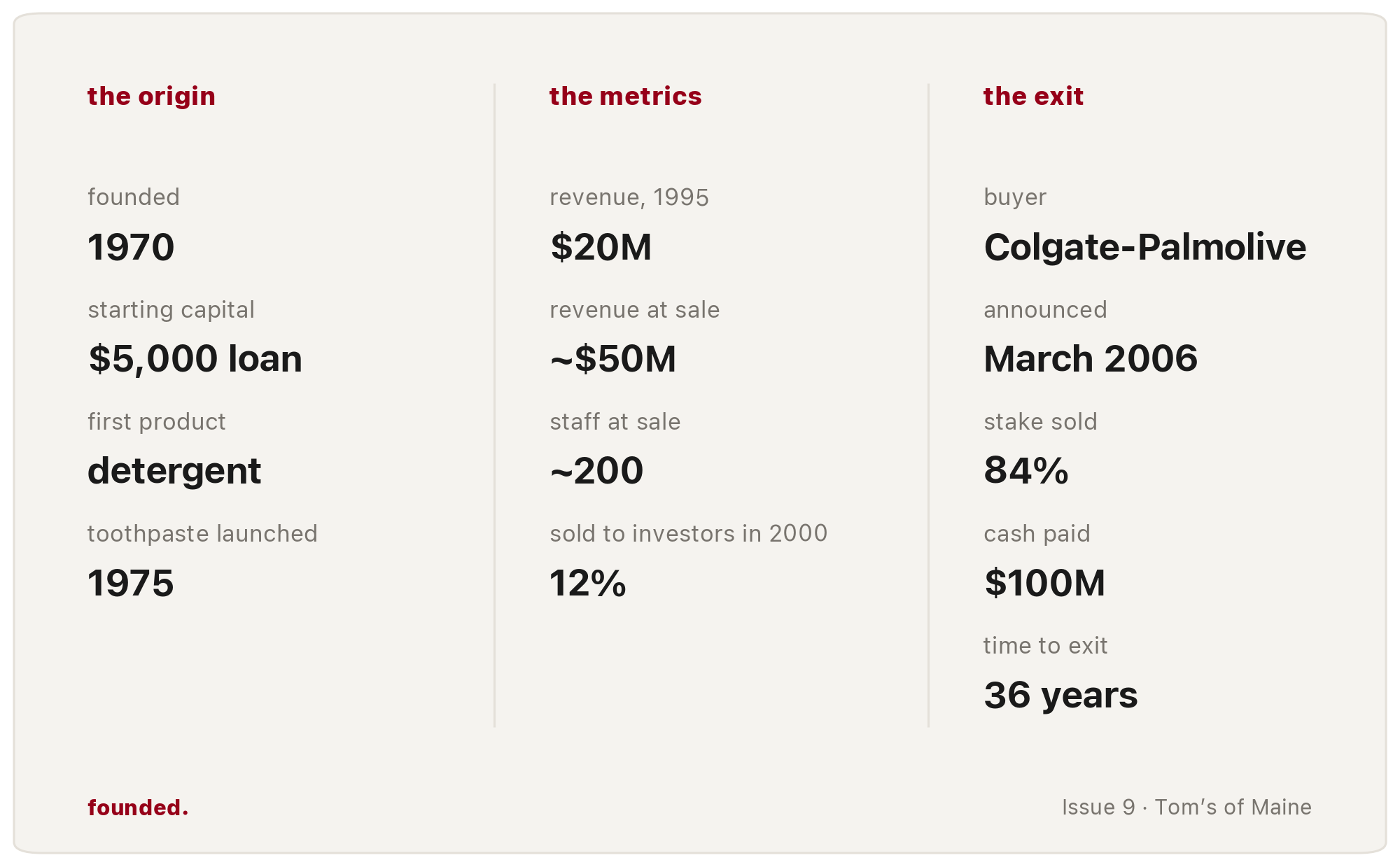
TLDR: In 1970, Tom and Kate Chappell borrowed $5,000 from a friend and started making a natural laundry detergent in a warehouse in Kennebunk, Maine. Five years later, they launched what the company calls the first natural toothpaste in the United States. By the mid-1980s the business was growing fast under managers Tom had hired from Booz Allen and McKinsey, but it had stopped innovating. In 1986, Tom enrolled part-time at Harvard Divinity School while running the company full-time, subsequently rewriting the company’s mission statement with his employees. In 1992, a deodorant formula failed and had to be recalled, and the company lost money that year. By 2006, 36 years after starting, 84% of Tom’s of Maine was sold to Colgate-Palmolive for $100 million cash when Tom was 62. After a short ‘retirement’, Tom got an itch (no pun intended) to start a wool clothing company, and bet $14.5 million of his own capital before it came close to failing. The following is a complete breakdown of what happened.
What we found out:
Define your mission statement early.
Negotiate terms based on your values, not just price.
Stay true to your vision and keep innovating.
Recalls should be handled quickly and to your customers’ benefit.
Raise capital when it supports growth, not exploration.
Allocate capital for your next venture carefully; don’t blow it all.
01: an insurance salesman and a $5,000 loan
Tom Chappell was born in 1943 and grew up in Pittsfield, Massachusetts. He studied English at Trinity College in Hartford, Connecticut, and at 22 he married Kate Cheney, an artist whose family had founded Cheney Brothers, at its peak the largest silk mill in the country.
His first job out of school was selling insurance for Aetna in Philadelphia, and he was successful. He ranked first out of 65 salespeople and got a $600 raise, while the lowest performer got a $300 raise. Tom was competitive, so a system that gave only slightly higher rewards to high achievers didn’t sit right with him:
I was not made for that kind of a culture.
— Tom Chappell
Most of the write-ups I read about Tom’s of Maine start with a loan made in 1970. His time selling insurance is usually left out, but it explains a lot of what was to come. Apart from two years working for his father’s business, Tom spent the rest of his career owning his own businesses. Even when he finally sold at 62, he negotiated to stay in charge.
the family business
In 1968, Tom and Kate moved to Maine to raise their children in the countryside. Tom went to work with his father, whose textile mill business had failed. His father had started a new business focused on pollution abatement for the textile industry, developing cleaning products without harmful nitrates and phosphates.
For me, it was about combining business and the environment. In the mid-’60s, you didn’t work for a business and be concerned about the environment. It was either-or.
— Tom Chappell
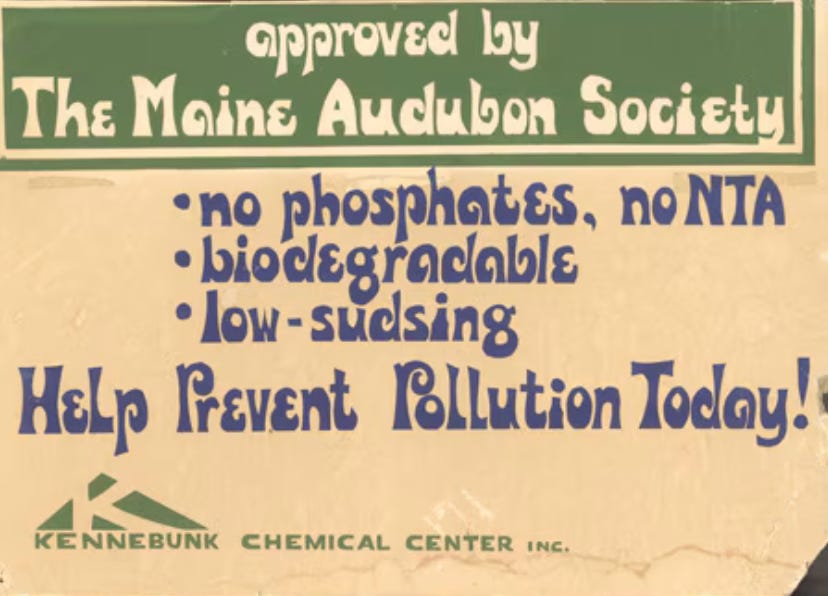
Laundry detergent seemed like an odd first product for a company later known for toothpaste. It made more sense once I learned about his father’s business; Tom spent two years there learning how to clean textiles without phosphates, compounds that help detergents clean but were causing algal blooms in lakes and rivers.
the loan
Tom had no money to start a business. A friend in Kennebunk who worked in alternative education offered to loan him $5,000 by posting his IBM stock as collateral at the bank. The same friend later contributed another $2,500. Further funds came from a second mortgage on the Chappell home and, later on, loans from the Small Business Administration (SBA).
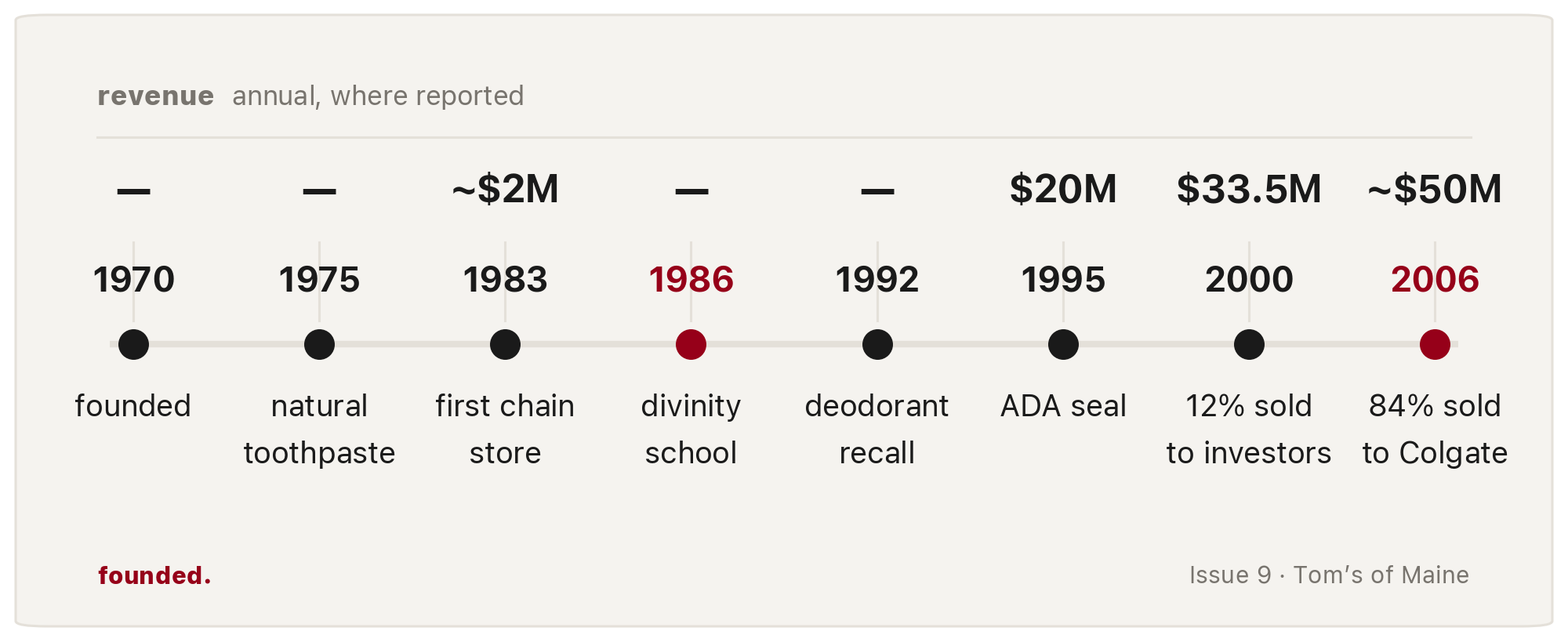
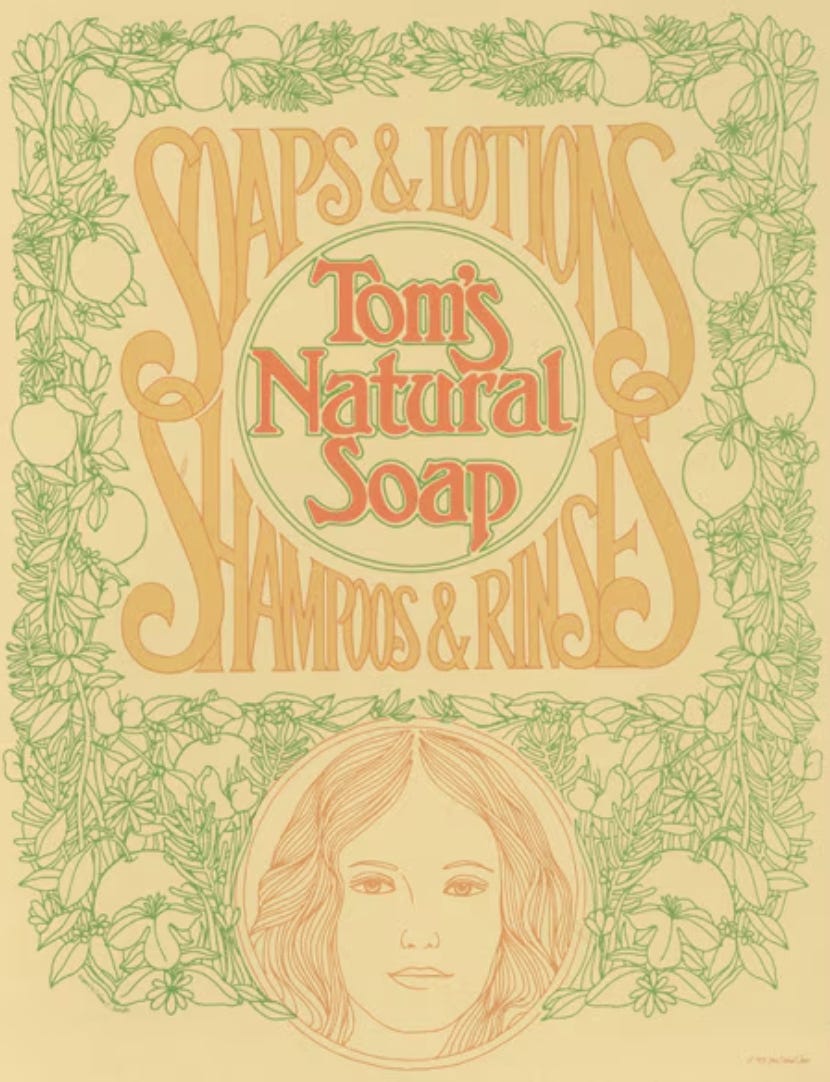
The first product was developed in 1970 and called Clearlake, which the company calls the first non-phosphate cleaner on the market. It came in a container with a prepaid return label so customers could mail it back for refills, and Kate drew the product label by hand. The manufacturing equipment was secondhand stainless steel from local dairy farms, which Tom bought about a hundred dollars at a time. In 1972, the company added soaps made with vegetable glycerin, and later shampoo, conditioner and lotion.
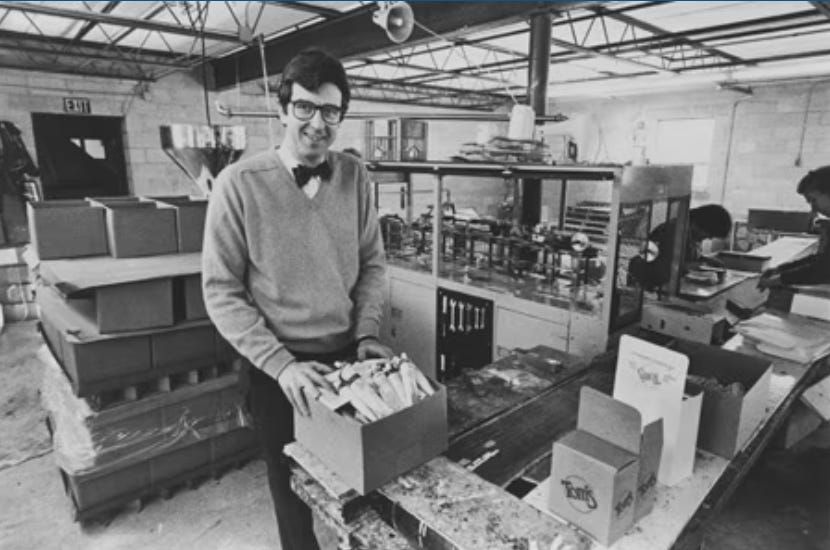
Kate raised three kids while doing the design work and was the voice of the customer, helping guide Tom’s decisions on product design and packaging.
the toothpaste
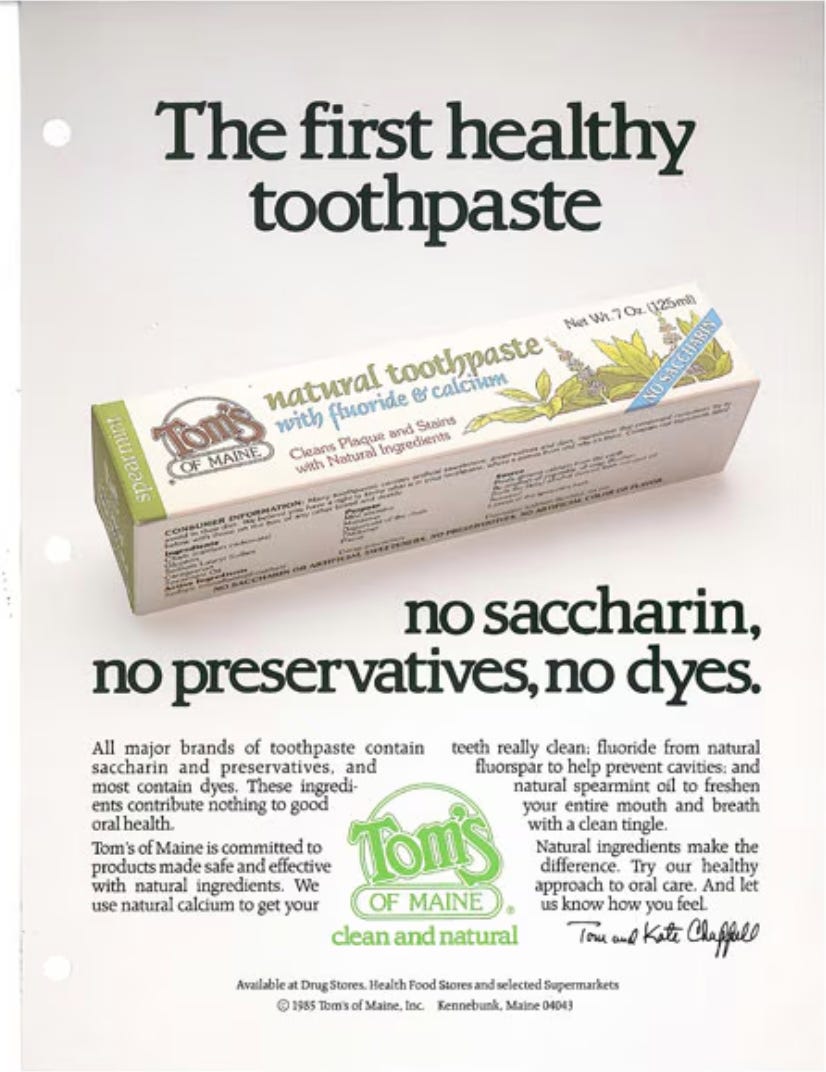
In 1975, Tom and a chemist friend made a toothpaste without saccharin or artificial additives. It was flavored with herbs and spices and used calcium carbonate, a natural mineral, to clean the teeth. The company stated that it was the first natural toothpaste sold in the United States. Tom had a hunch it would work: nobody else was making one.
We knew very well that we were serving a consumer that was discerning about what they would put in their bodies.
— Tom Chappell
Tom’s toothpaste quickly became the company’s biggest revenue driver and a staple in health food stores.
02: the growth-innovation tradeoff
The first test of the company’s values was fluoride. It was controversial in the natural foods world but was also what the American Dental Association (ADA) recommended to prevent cavities. Tom decided the company should offer both. Within two years the fluoride version was outselling the original version and total toothpaste sales had doubled. The company explained the decision: it is important to serve all of a customer’s health needs, and to give them the choice.
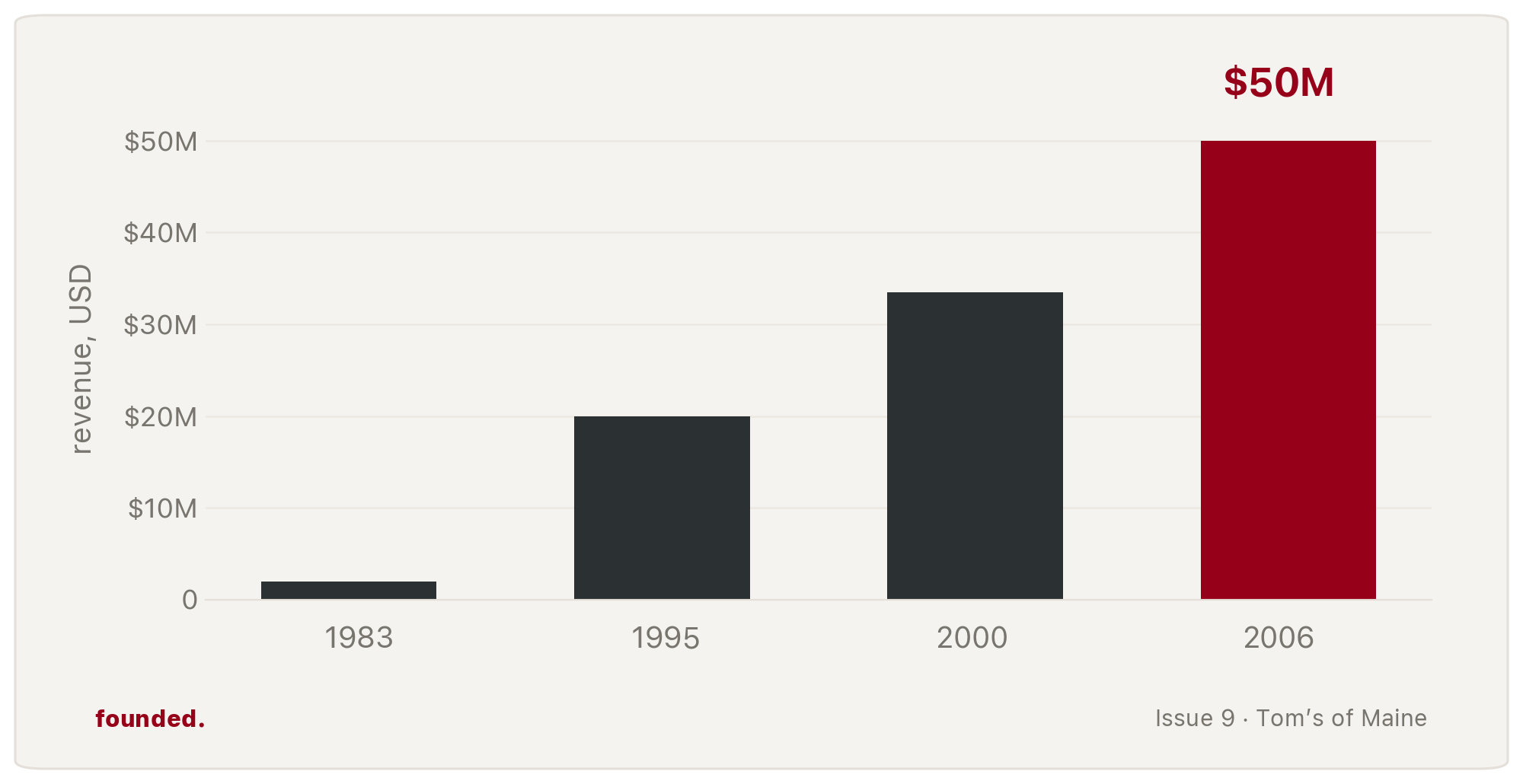
In 1981, the company changed its name to Tom’s of Maine. By 1983, annual sales were approaching $2 million, and further growth needed outlets beyond health food stores. That year, CVS became the first drugstore chain to stock Tom’s products, and the company started to position its toothpaste as a proper alternative to Crest and Colgate.
the consultants
To make that leap, Tom brought in professional managers. John Rockwell, a consultant from Booz Allen Hamilton in New York, joined as a director. Rockwell summarized the change in one sentence Tom recalled decades later:
We’ve got to help transition this company from serving the health committed to expanding it to the people that are health concerned.
— John Rockwell, as recalled by Tom Chappell
From 1981 to 1986 the company followed a strategic plan: changing the marketing and brand message so it appealed to mainstream shoppers, hiring the right people, raising prices and producing the product more efficiently. In short, it worked. The business was growing by about 25% per year in the early 1980s.
Tom later said the company had become “overcome with the numbers,” so I expected the consultants to be the villains of the story. Instead, he calls Rockwell a great mentor, and in the interview he never says the growth plan was wrong. The plan did what it was meant to do and the company grew. The tradeoff was innovation: no new products were introduced for four years, and new products were the reason the company existed in the first place.
the empty years
By 1986, Tom’s of Maine had hit its strategic targets and Tom was miserable:
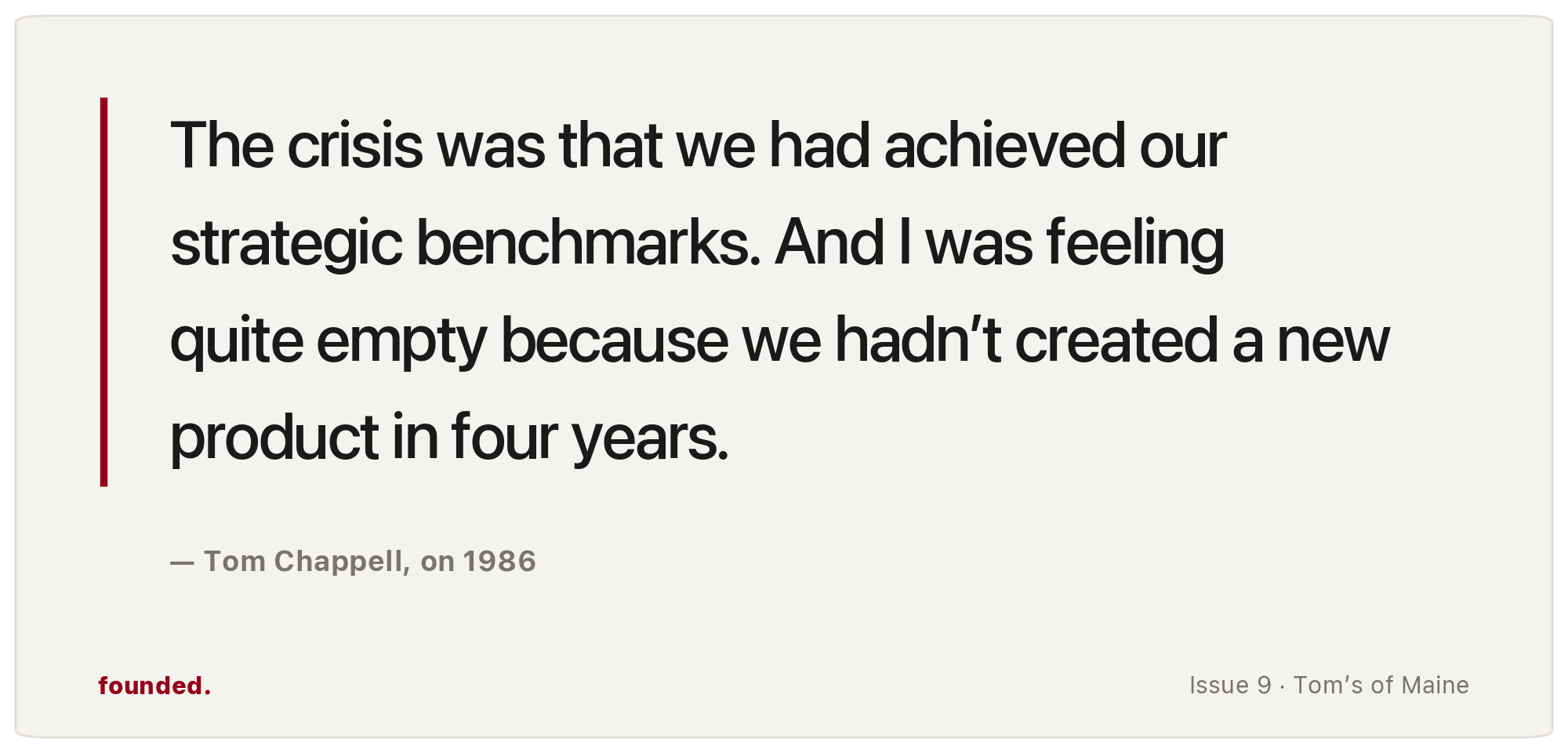
The company had started because Tom and Kate wanted products that didn’t exist. Now, in Tom’s words it was led by “the MBAs.” He said he could not find meaning in a business with the sole purpose of becoming bigger and more profitable.
03: a divinity degree and a failed deodorant
Tom’s answer to the disconnect was an unusual one: he enrolled part-time at Harvard Divinity School, 90 miles from Kennebunk, and commuted there twice per week while continuing to run the company. He got up at 4:30 a.m. to study and later called it an extremely difficult education. He read philosophers like Martin Buber, whose book ‘I and Thou’ is about how people relate to one another, and started to apply the lessons to the business. He finished with a master’s degree in theology in 1991.
On paper, a founder enrolling in divinity school looks like he is walking away from the business. The way I read it, it was the opposite: he kept running the company while gaining perspective through his studies. Some of the biggest changes made to the business came from that time: a revised mission statement, a giving program and paid volunteer time for employees.
the mission
In June 1989, while he was still studying, Tom started a year-long process to work out what the company stood for, asking employees to play an active role. The resulting mission statement declared that the company would make a profit and work toward the common good at the same time. Three main changes shifted the axis on which the company was built:
5% of profits were donated to environmental, arts and community causes. That later increased to 7% and then 10%.
5% of employees’ paid time could be spent volunteering in the community.
New benefits for employees, including profit sharing, child-care support and paid parental leave. Factory workers also rotated stations every hour to avoid fatigue.
The advertising budget was increased to $1.3 million in 1989, and the first national campaign went live in 1990: a radio spot with the voices of Tom and his mom, Virginia. Around the same time, new manufacturing equipment increased toothpaste output from 50 tubes per minute to 90.
the recall
The new set of values was put to the test almost immediately. Tom’s deodorant was a popular choice. In 1992 the recipe was changed to remove petroleum-based ingredients, replacing them with glycerin made from coconut, and lichen. The new version simply didn’t work for about half of the customers it served.
We hadn’t really thought this through carefully enough. It wasn’t an effective deodorant.
— Tom Chappell
In October 1992, Tom recalled the product at an estimated cost of $450,000. Oof. The solution included bringing back the old formula and sending every customer who complained a replacement product and a coupon for their money back with their next purchase. The recalled deodorants were donated to homeless shelters, in true Chappell fashion. Tom has said that the recall created an overall loss for the business that year, but that it recovered the following year and no employee was let go:
I think I took the hit for that.
— Tom Chappell
the ADA seal
The company’s values also meant that the biggest wins took a long time to materialize. Tom’s wanted the ADA’s seal of approval for its toothpaste line; the seal communicates that a product has been tested and approved by the dentists’ association. To most, an ADA seal seems trivial. For Tom’s it was a requirement that took seven years to obtain. The timeline seemed unusually long, so I dug a bit deeper. Turns out the ADA had no standard for natural products, and Tom’s would not allow animal testing. The Food and Drug Administration (FDA) required fluoride toothpaste to be registered through trials on rats. Tom refused and pushed for human trials instead. After meetings in Washington, the FDA agreed. It may have taken a while, but they never gave in.
In 1995, Tom’s of Maine became the first natural toothpaste to carry the ADA seal, for its spearmint, cinnamon and fennel flavors. That same year, sales reached a record high of $20 million. Tom wrote about the company in two books, one released in 1993 and the other in 1999.
04: the investors and the sale
going herbal
Tom’s of Maine made the biggest bet in its history in 1999: a line of herbal cough, cold and wellness remedies and liquid herbal extracts that effectively doubled its product offering. The products were developed with researchers at the University of Illinois at Chicago and the company acquired Green Mountain Herbs of Vermont to make the extracts. Approximately $4 million was set aside for marketing, the largest marketing budget in the company’s history.
At this point in time, much bigger companies, including Warner-Lambert and tea giant Celestial Seasonings, had already tried their hand at herbal remedies with little success. Tom’s rebuttal was that the business had often succeeded when others were doubtful.
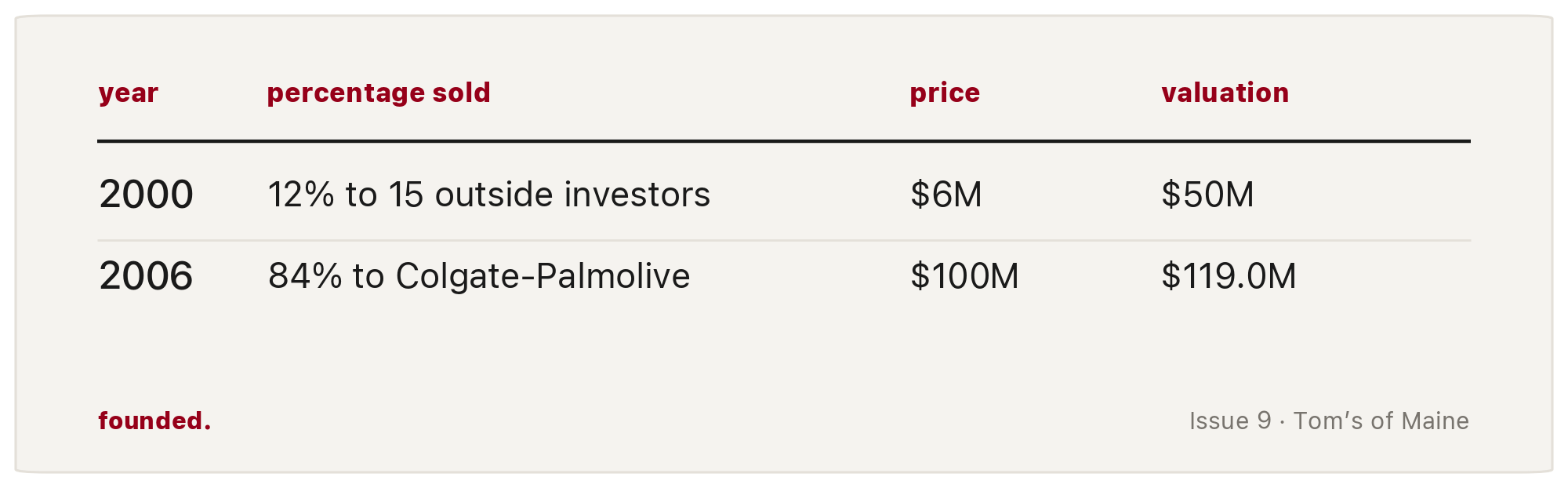
The capital outlay was substantial. So much so that in 2000, the Chappells sold 12% of the company to 15 outside investors for $6 million. One of them was John Whitehead, the former co-chairman of Goldman Sachs.
At first, the expansion provided false hope. Sales grew by 19% to $33.5 million in fiscal year 2000. The next year, growth slowed to just 7%, to $36 million, short of Tom’s $40 million target, and the company ended the year with a $1.5 million loss. It was only the second year in 25 that the company lost money. Tom’s explanation to Forbes says it all:
We tried to do too much.
— Tom Chappell
the recovery
The record between 2001 and 2006 is light because Tom’s of Maine was a private company. Most of the write-ups I read end around 2000, when the herbal products were introduced, so I assumed the Chappells sold because the business was struggling. Then I found the coverage of the sale in 2006, which said the opposite.
By the time of the sale, the company was generating about $50 million in revenue and growing 15% to 20% per year in its existing stores. Tom’s was responsible for 60% of natural toothpaste sales in health and specialty stores, with nearly 200 employees and a lineup of about 90 products. Colgate said at the time that Tom’s gross margins were ten percentage points higher than its own.
If you’re interested in getting a weekly deep-dive to adopt founder mindsets, skills, and lessons please subscribe. It’s great to have you in the family!
why sell?
Tom was 62 at the time of the sale and had been running the company for more than 35 years. His three reasons for selling are well documented:
The business lacked the distribution and research and development it needed to keep growing.
He was concerned that competitors would be bought by bigger companies and take market share away.
Kate had gone back to her art.
He summed it up simply:
We had run out of energy.
— Tom Chappell
The Chappells looked at going public and decided against it, because money alone would not get the products into more stores. So they decided to sell instead. Colgate topped their list of possible buyers because, according to Nutraceuticals World, it had treated Tom’s of Maine with trust and respect.
Funny enough, 2006 was a year of big moves in the industry. On March 17, 2006, L’Oréal agreed to buy The Body Shop, the other famous values-led personal care brand at the time. Tom’s of Maine announced its sale just four days later.
the deal
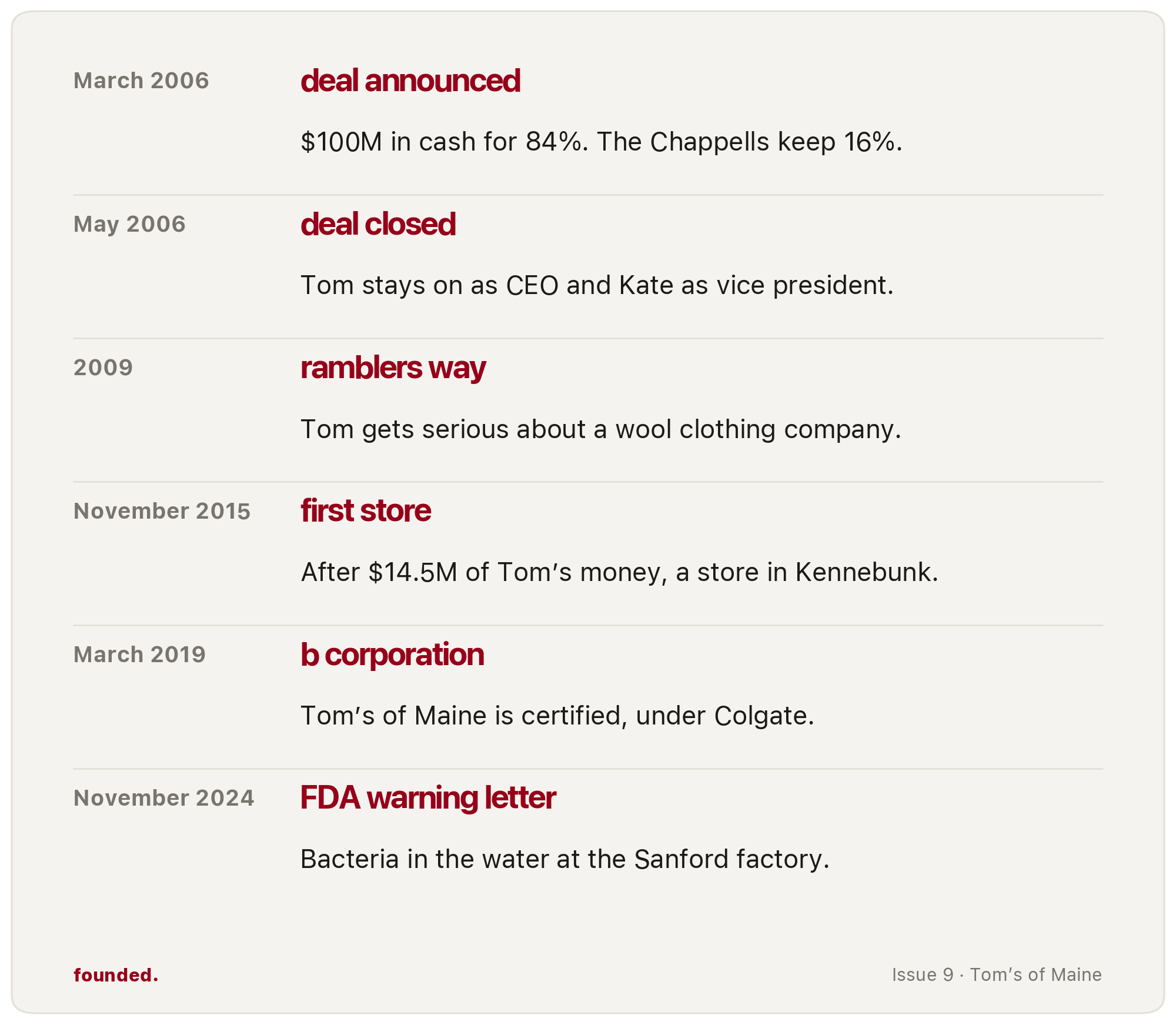
The deal was announced on March 21, 2006, and closed on May 1. The terms were as follows:
$100 million in cash for 84% of the company. Colgate described the price as approximate and never published an exact figure.
Tom and Kate were to keep the other 16%.
Tom was to stay on as CEO and Kate as vice president.
The company stayed headquartered in Kennebunk, Maine.
Tom said the product formulas, jobs and programs, including the giving program and paid volunteer time, would not change.
Tom and Kate’s joint statement explained the choice:
We chose Colgate as our partner because they have the global expertise to help take Tom’s of Maine to the next level.
— Tom and Kate Chappell
Colgate’s price valued the business at $119.0 million, approximately 2.4x annual sales.
The more interesting value is the one implied six years earlier. When 15 investors bought 12% of the company in 2000, they valued the business at just $50 million. Effectively, the value of their stake grew about 2.4x in six years, despite a losing year along the way.
Not every customer was happy about the sale. A customer in Portland told reporters her first thought was that Tom’s was “consorting with the devil.” The marketer Seth Godin titled his blog post on the deal “Tom Chappell sells out,” though he opened it by congratulating him.
05: after the sale
two weeks of retirement
Tom kept running Tom’s of Maine under Colgate for about two years. Once he retired, it didn’t last long. Kate put it best in a 2011 interview:
I think he stayed retired for two weeks.
— Kate Chappell
A lot of thought went into what came next. A mentor had told Tom that he was too young to retire and he agreed:
I didn’t feel like retiring. I felt I had a lot of energy.
— Tom Chappell
The two quotes about energy stood out to me because they sound like they contradict one another. The difference was who said it. “We had run out of energy” was about Tom and Kate together, after running a business for more than 35 years, with Kate ready to return to her art. “I felt I had a lot of energy” was Tom on his own, thinking about his next move.
The idea for his next company came on a hiking trip in Wales with his son Matt. Walking for up to eight hours each day, Tom struggled to find a layer that kept him warm and dry even after testing several different materials.
When he told Kate about his plan, she recalled thinking, “My goodness, all over again?” Inc. reported that Tom committed nearly $5 million to the idea within weeks of the sale, while he was still running Tom’s. The company, called Ramblers Way, was founded in 2009, when Tom decided to take it seriously.
ramblers way
Ramblers Way made clothing from American-grown wool that was sewn in the United States (and partly in Kennebunk, Maine). Pay started at $14 per hour plus benefits in 2016. Tom picked apparel because he thought the industry needed to change, calling it the second largest polluter on earth. He told the Portland Press Herald in 2017 that he expected Ramblers Way to be much bigger than Tom’s of Maine.
It didn’t exactly work out how he hoped. The company was launched exclusively online, had a “miserable” first four months, and then started selling through brick-and-mortar retailers. By 2011, it was in 115 stores and had 22 employees, two of whom were Tom’s kids. By 2015, Tom had personally ponied up $14.5 million to build the business, and by the end of that year the company was close to going out of business:
We didn’t have a winning proposition.
— Tom Chappell
It was Kate, along with their daughter, who pushed for the next move: opening their own stores. The first store opened in Kennebunk in November 2015, with plans for more in Portland and New Hampshire. His daughter Eliza handled the design work, his son Chris managed the e-commerce side, and his son-in-law managed supply chain. As of 2025, the company’s website states the brand is run by a new husband-and-wife team, David and Stacey Weinstein.
The comparison is stark. Tom’s of Maine took 13 years to get close to $2 million in sales, funded by a loan from a friend, a second mortgage and SBA loans. By 2017, bringing Ramblers Way to market had cost about $18 million, and it was close to failing six years after it was founded.
06: the tools
the product
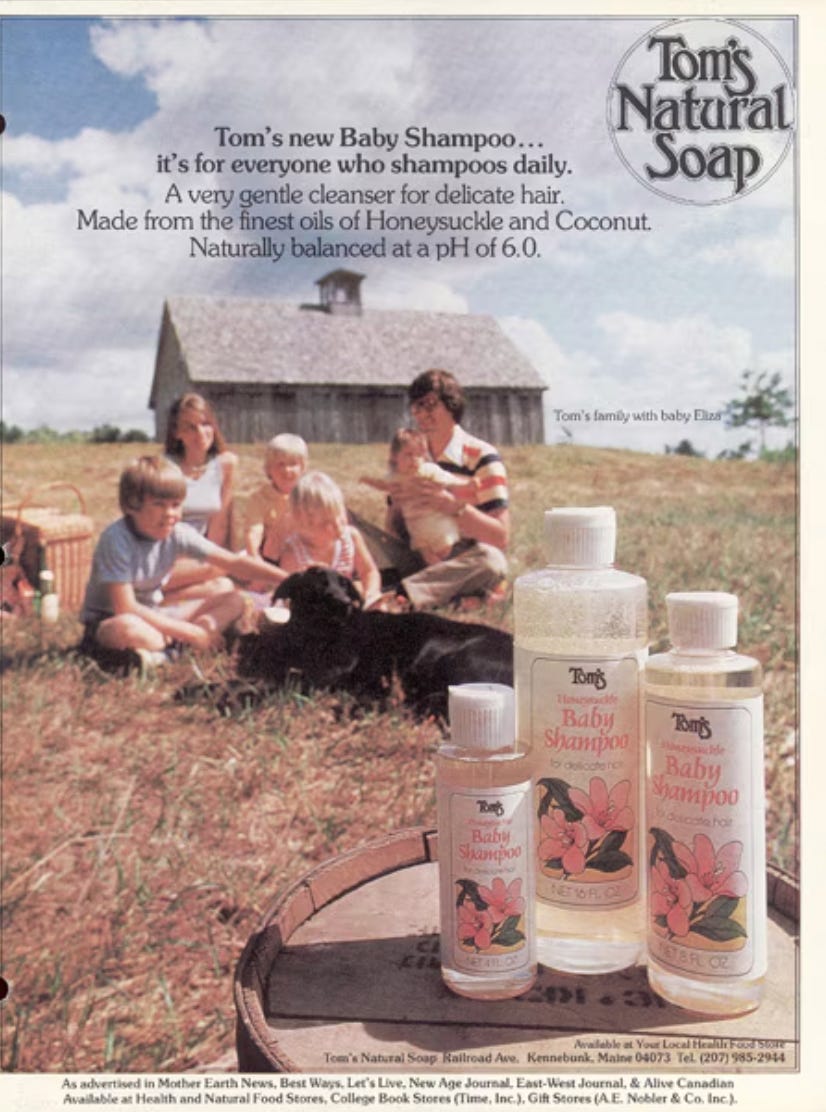
Tom’s sold only natural household and personal care products for health-conscious customers. Laundry detergent was the first, then soap, shampoo, lotion and eventually the star of the show, toothpaste. Deodorant, mouthwash, floss and shaving cream were introduced in later years. By 2006 the company offered about 90 products across health food stores, co-ops and mass-market chains such as CVS.
founder skillsets
Tom is a salesman by trade. He is competitive by nature and was top of his sales team at Aetna early in his career. He later said that the reason Tom’s of Maine succeeded was the market share it took from Colgate, Procter & Gamble and Unilever. Read: he beat the competition at their own game.
He learned how to make cleaning products without phosphates while working in his father’s business, and knew when to bring in outside managers. What he learned in the 1980s was that hiring did not mean handing over direction of the company.
Kate brought design and a customer’s perspective. She drew the first label, worked on packaging and advertising, and kept her own career as an artist along the way.
monetization
Tom’s made money by selling products on store shelves. It started in health food stores and co-ops, and moved into mass-market chains, starting with CVS in 1983. In the 1980s it raised prices as part of the move to the mass market, and by 2001 Forbes noted that a tube of Tom’s toothpaste cost 30% more than Colgate’s in some stores. Despite the long runway from idea to exit, Tom’s was the definition of “if it ain’t broke, don’t fix it.” Selling through retailers worked for a long time, and the company never moved away from it.
unique branding
The brand was the founders. The company took Tom’s name in 1981, Kate designed the packaging, and the first national ads used the voices of Tom and his mother. The giving program and volunteer time are at the core of the business and carried the legacy on after the company was sold.
The refusal to test on animals was another testament to the brand the Chappells had built, even when it cost the company years with the FDA and ADA.
Have you learned something new that’s worth applying to your business? Please let me know what you liked or didn’t like as much. I’d also appreciate it if you would share this post or restack if you found value here!
07: lessons to apply today
01: the mission statement
Tom’s of Maine didn’t start with a mission statement; in the early days it was run on a philosophy. When Tom was at school, he started writing one. It took a full year and the input of every employee but it went on to guide later decisions including the sale. It also shaped how much the company gave away, how people were treated and, years later, what kind of buyer it would accept.
In reality, you don’t need a full year. Set aside a quiet afternoon and write down what your business does for its customers and the community beyond making money. Put extra thought into the things your business will NOT do. Share it with anyone who works with you and use it to guide decisions, big or small. Review it once a year. A clear mission statement is the core pillar of your business.
02: stay true to your vision
The consultants that Tom hired in the early 1980s did exactly what they had to in order to grow the business. What got missed was innovation, something Tom had never delegated before. Four years passed without a new product. When hiring outside expertise, make sure there is a clear line for what they are improving and what stays with you. Innovation and vision should remain in your hands as the founder. Nobody can do it like you.
03: recall the right way
Product recalls happen all the time. What surprised me was how gracefully Tom’s handled the failed deodorant formula. Not only did it donate the batch to homeless shelters (in line with the mission statement), it brought the old formula back and sent every customer who complained a replacement and a coupon for their money back on their next purchase. Even though the company finished the year at a loss, it showed customers what the brand valued. Tom’s wanted to get the product right. If you’re faced with a recall for a physical product, go above and beyond to make sure customers are satisfied and not thinking of leaving. The respect you earn will be worth more than the money you lose.
04: raise capital sparingly
Raising money is easier to justify in situations where the capital would support further growth and expansion of the business. For Tom’s, it was to explore a new branch of the business where there was no expertise and competitors had already failed. The result was a $1.5 million loss for the year. Before making the decision to take on outside capital, ask if you’re paying to grow what you already know works or if you’re exploring. You’re better off testing small scale, perhaps even pre-selling to gauge demand and price elasticity before committing.
05: values or price?
There is no record of an auction or a competing offer. Nutraceuticals World reported that some analysts thought another buyer could have paid more, and the numbers suggest why: Colgate’s price valued the business at about 2.4 times revenue while it was growing 15% to 20% a year, with gross margins higher than Colgate’s own. Price was clearly not the Chappells’ main motive; the terms of the deal mattered more.
The announcement confirmed the things they cared about most: a 16% residual stake, Tom running the company and the headquarters in Kennebunk. Tom also said the giving programs would continue. If you’re selling your business and want a set of values to survive the sale, make a list of your non-negotiables before the first conversation. Conditions can lower the price a buyer is willing to pay, so decide which terms you can live without and what your price floor is.
06: preservation of capital
Tom’s of Maine was built on borrowed money and was forced to grow slowly; perhaps one of the reasons it succeeded as a brand. When he founded Ramblers Way in 2009 with money from the sale, he spent heavily from the start and came close to losing the company. When you sell your business, decide in advance how much of the proceeds you are willing to put into your next venture and decide on growth targets required before more capital is allocated.
08: what still isn’t clear from the research
How much of the sale proceeds the Chappells kept after paying out the 15 outside investors, and whether any employees owned shares.
Whether Colgate ever bought the Chappells’ remaining 16% stake.
Tom’s of Maine’s profit figure at the time of the sale.
The exact date Tom stepped down as CEO of Tom’s of Maine; the Portland Press Herald says he ran the company for about two years after the sale.
Annual revenue between 1983 and 1995, and between 2001 and the sale.
If there were any other interested buyers.
09: the brand today
Twenty years after the sale, Tom’s of Maine is still a Colgate-Palmolive brand headquartered in Kennebunk. The range now includes toothpaste, deodorant, mouthwash, body wash, bar soap, floss and toothbrushes. The company says it still gives away 10% of its profits and has maintained the B Corporation certification it first earned in March 2019, with a score of 86.5 in the 2024 assessment. The last two years have been harder. In November 2024, the FDA issued a warning letter after an inspection found bacteria in the water used to make toothpaste and clean equipment, and a black mold-like substance, at Tom’s plant in Sanford, Maine. The company said it tests finished products before they leave its control and that the water system was being upgraded. In 2026, Colgate agreed to pay $2.9 million to settle a class action over the contamination and its “natural” marketing, without admitting wrongdoing. Colgate does not report Tom’s sales separately, so whether the brand continued to grow post-sale cannot be confirmed. The details that mattered to the Chappells can: the brand kept its name, hometown headquarters and giving program, although Tom has since stepped down as CEO.
FOUNDED FACT
At the age of 10, Tom Chappell was the model for Norman Rockwell’s painting Choirboy, which was on the cover of The Saturday Evening Post on April 17, 1954. Decades later, the owners offered to sell it to him for $750,000. Kate said they would’ve had to give it to a museum, so he passed.
LEARN MORE
How I Built This with Guy Raz — Tom’s of Maine: Tom Chappell, NPR, December 2017. Tom on Aetna, his father’s business, the loan, the consultants, divinity school, the recall and Ramblers Way, in his own words.
Inc. — Andy Isaacson, “Why the Tom’s of Maine Founder Thinks He Can Create the Next Patagonia,” April 2017. Why he sold, and the near failure of Ramblers Way.
Tom Chappell — The Soul of a Business: Managing for Profit and the Common Good, Bantam, 1993. His own account of the 1980s and the mission statement.
SOURCES
Colgate-Palmolive Company — press release, March 21, 2006. The purchase of 84% for about $100 million in cash, the 16% retained by the Chappells, Kennebunk, Tom continuing to lead the company, the $3 billion natural care market growing 15% a year, the 60% share in the health and specialty channel, and Ian Cook on gross margins ten points above Colgate’s.
Colgate-Palmolive Company — press release, May 1, 2006. Completion of the purchase.
How I Built This with Guy Raz — Tom’s of Maine: Tom Chappell, NPR, December 2017. His father’s textile business in Massachusetts, the Aetna raises, his father’s pollution abatement business, the IBM stock and the $5,000 loan, the dairy equipment, Kate’s role, the toothpaste, John Rockwell and the consultants, Guy Raz on 25% growth, the 1986 crisis, divinity school, volunteer time, the deodorant recall, its $450,000 cost and the loss, animal testing and the FDA, the mentor after the sale and the Rockwell painting.
Encyclopedia.com and FundingUniverse — Tom’s of Maine, Inc. company history, compiled from contemporary press. Aetna, the move to Maine, Clearlake, fluoride in 1978, sales near $2 million in 1983 and CVS, the consultants, Harvard Divinity School from 1986 to 1991, the mission statement, the $1.3 million ad budget and the 1990 campaign, the recall and the replacements and coupons, the ADA seal and $20 million in 1995, the tithe, the 1999 herbal line and the 2000 investors.
Forbes — Ian Zack, “Out of the Tube,” November 26, 2001. The 30% premium on a tube of toothpaste in some stores, $6 million for 12%, John Whitehead, $33.5 million in fiscal 2000, 7% growth to $36 million in fiscal 2001, the $40 million target and the $1.5 million loss.
Inc. — Andy Isaacson, April 2017. The reasons for selling, “We had run out of energy,” the Wales trek, the nearly $5 million within weeks, the $14.5 million and the $18 million, and Kate and the retail stores.
New Hope Network — “Colgate to retain Tom’s values in acquisition,” March 2006. The $50 million in sales, nearly 200 employees, about 90 products, Tom on keeping the programs, including paid parental leave, and Tom and Kate’s roles.
Nutraceuticals World — “Word from Wall Street: The Colgate, Tom’s of Maine Deal,” 2006. The 15% to 20% growth, the decision not to go public, why Colgate topped the list, and the view that another buyer might have paid more.
The Motley Fool — “Tom’s Deal With the Devil,” March 22, 2006. About $50 million in sales, and Colgate’s margin comparison repeated as profit margins.
Deseret News (Associated Press) — March 22, 2006. Customer reactions and Tom on formulas, operations and jobs staying the same.
Seth Godin — “Tom Chappell sells out,” Seth’s Blog, March 2006.
Moodie Davitt Report — March 17, 2006. L’Oréal’s agreement to buy The Body Shop.
Tom’s of Maine — “Backstory” and “Who We Are,” company websites. Kate’s hand-drawn label, soaps in 1972, the toothpaste in 1975, fluoride in 1981, the ADA seal, and the giving and volunteer programs today.
Wikipedia — Tom Chappell, Kate Chappell and Tom’s of Maine. Birth years, schools, the Cheney family, the 1991 degree and the 2019 B Corporation certification.
Entrepreneur — “Toothpaste Magnate Finds an Eco-Friendly Encore,” March 2011. Kate on two weeks of retirement, the first four months of Ramblers Way, 115 stores and 22 employees.
Portland Press Herald — June 6, 2016, and February 19, 2017. Ramblers Way’s stores, wages and prices, 2009 as the year Tom got serious, his two years running Tom’s under Colgate, Chris Chappell as e-commerce director, and his expectation that it would be bigger than Tom’s of Maine.
Ramblers Way — “Our Company,” ramblersway.com, September 2026. The current owners.
Portland Press Herald — November 20, 2024, and CNN, November 19, 2024. The FDA warning letter, the Sanford inspection, the complaints and the company’s response.
Antiques and the Arts Weekly — December 2005. Tom Chappell as the model for Choirboy and the April 17, 1954 cover date.
B Lab — Tom’s of Maine company profile, bcorporation.net, read October 2026. Certified since March 2019, the 86.5 score on the 2024 assessment and the current product range.
Inc. — July 7, 2026, and Top Class Actions, 2026. The $2.9 million settlement in the Eastern District of New York, covering purchases from November 21, 2020 to March 6, 2026, and Colgate’s denial of wrongdoing.
Every figure in this issue is drawn from public statements, interviews and press coverage, and each one is listed with its source above. No interview was conducted with the founders. Tom’s of Maine was a private company and published no financial statements, so revenue and profit figures are as the founders, the buyer or the press stated them and have not been independently audited. The purchase price and stake are taken from Colgate-Palmolive’s own announcements. Amounts are US dollars.