

It’s 7:35am.
I’m at my usual table at a coffee shop five minutes from the office, with a little over an hour left before work. This case study still needs plenty of editing and I haven’t posted a single Note today.
I aim to post at least three each day because they bring in more of founded.’s subscribers than anything else I do, so skipping them isn’t really an option.
On a good morning I’ll get three written before I run out of time. On a bad one, I turn right to editing the case study and worry about Notes later on.
Now imagine a tool that showed me the best posts in my niche, drafted a first version in my voice and scheduled it for the right time. That is what Tweet Hunter sells, just for X instead of Substack. I’ve never used it, but I know exactly why someone would pay for it.
The bigger problem for me recently is getting seen at all. One of my Reddit posts received over 260,000 views. All of my Reddit posts combined have brought in two subscribers.
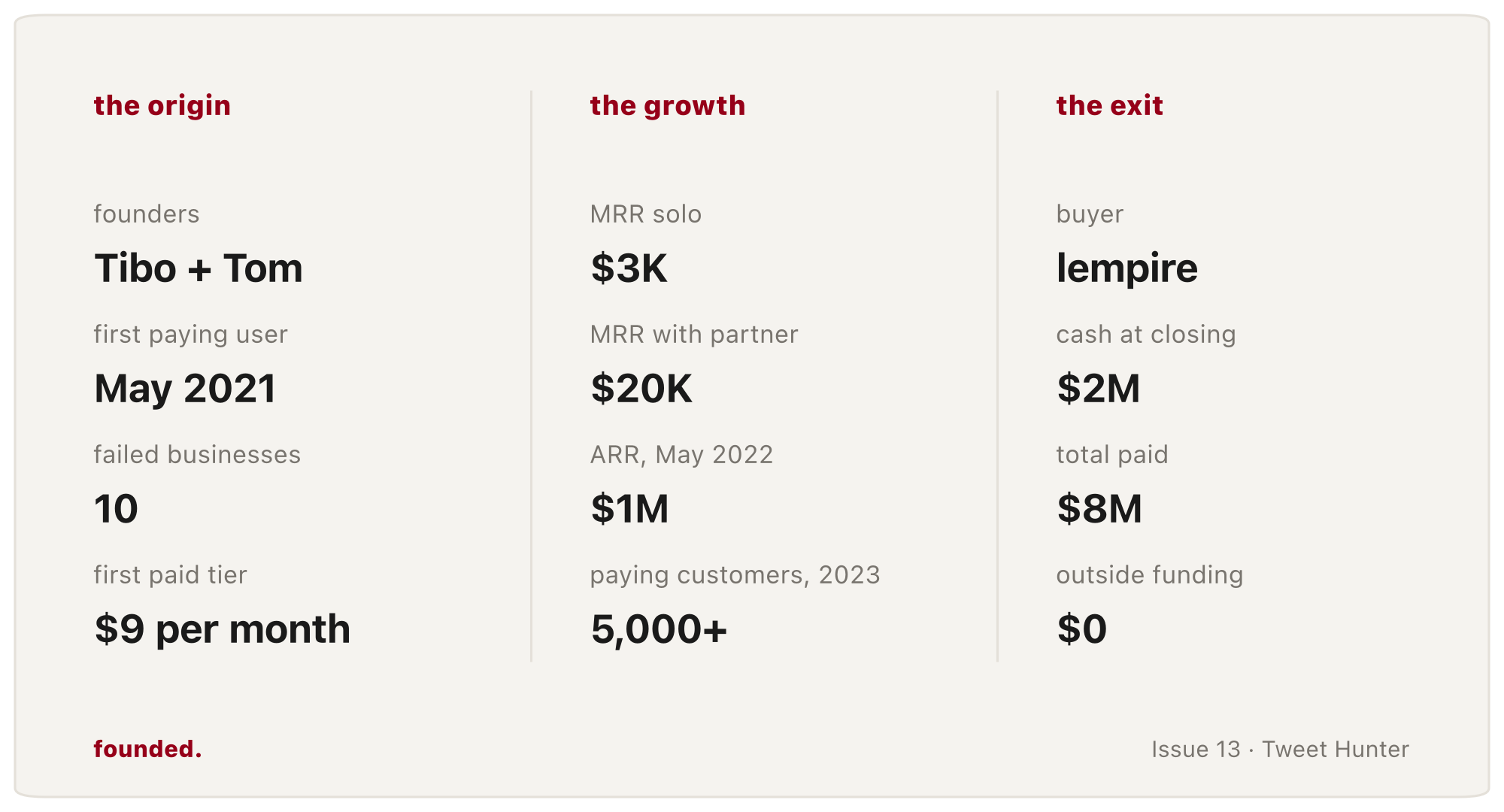
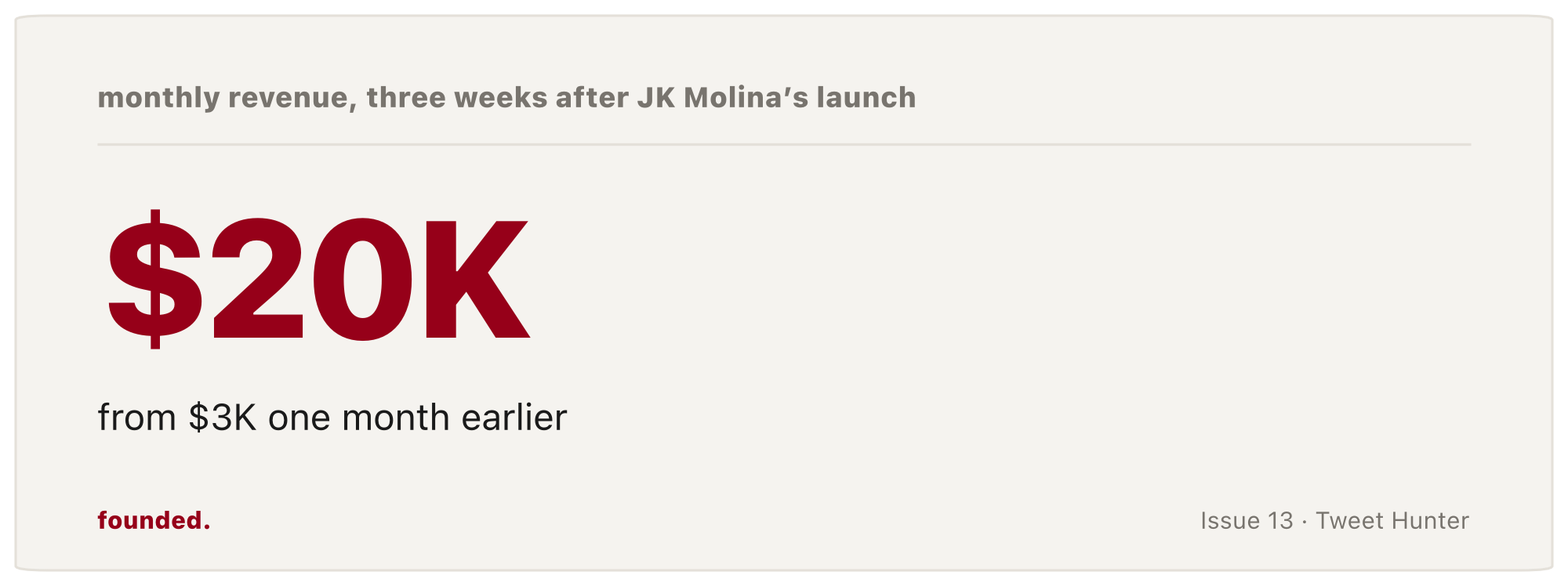
So when I read that Tweet Hunter went from $3,000 to $20,000 in monthly revenue in three weeks, and that it happened because the founders handed a quarter of their profits to someone else, I had to find out why.
before we dive in
Tweet Hunter is a subscription tool for people who use X to grow an audience and sell to them, primarily aimed at founders, coaches and consultants. It gives you a library of millions of popular tweets to learn from, writes drafts with AI, schedules posts and can automatically message people who engage with you. Plans start at $49 a month on their website.
Taplio is the same tool but for LinkedIn, built by the same founders from the same code.
The founders are Tibo Louis-Lucas, a French software engineer, and his friend Tom Jacquesson, a digital marketer. In 2022 they agreed to sell the business to lempire, a French software company best known for the cold email tool called lemlist.
If your side business depends on people finding you online, this one applies to you even if you never post on X. The overarching question that changed the business was this: would you give away 25% of your side business to someone with a bigger audience to reach target buyers? I laughed at the idea until I understood the whole story.
What we found out:
Measure recurring revenue, not signups. Tibo killed a product that was already making money because customers paid once and disappeared.
Rent an audience before you build your own. Tweet Hunter went from $3,000 to $20,000 in monthly recurring revenue (MRR) within three weeks of launching with a partner who already had the attention of their buyer.
Structure your deals to suit your needs. The launch partner, JK Molina, received 25% of profits and sale proceeds, which could be reversed if he stopped acting like a co-founder. A stop-loss in real life.
Reuse what’s already working. Tibo recycled one backend across 11 products in four months, then copied Tweet Hunter to LinkedIn under the new name Taplio with the same infrastructure.
An offer is only as good as the cash paid at closing. Tweet Hunter’s founders got $2 million upfront, a quarter of the $8 million they were paid in the end.
01: €250,000 in debt
In February 2020, Tibo Louis-Lucas and his wife quit their jobs to travel. A few weeks later COVID hit, and they were stuck in Paris with a sick baby, no income and no plan for the future.
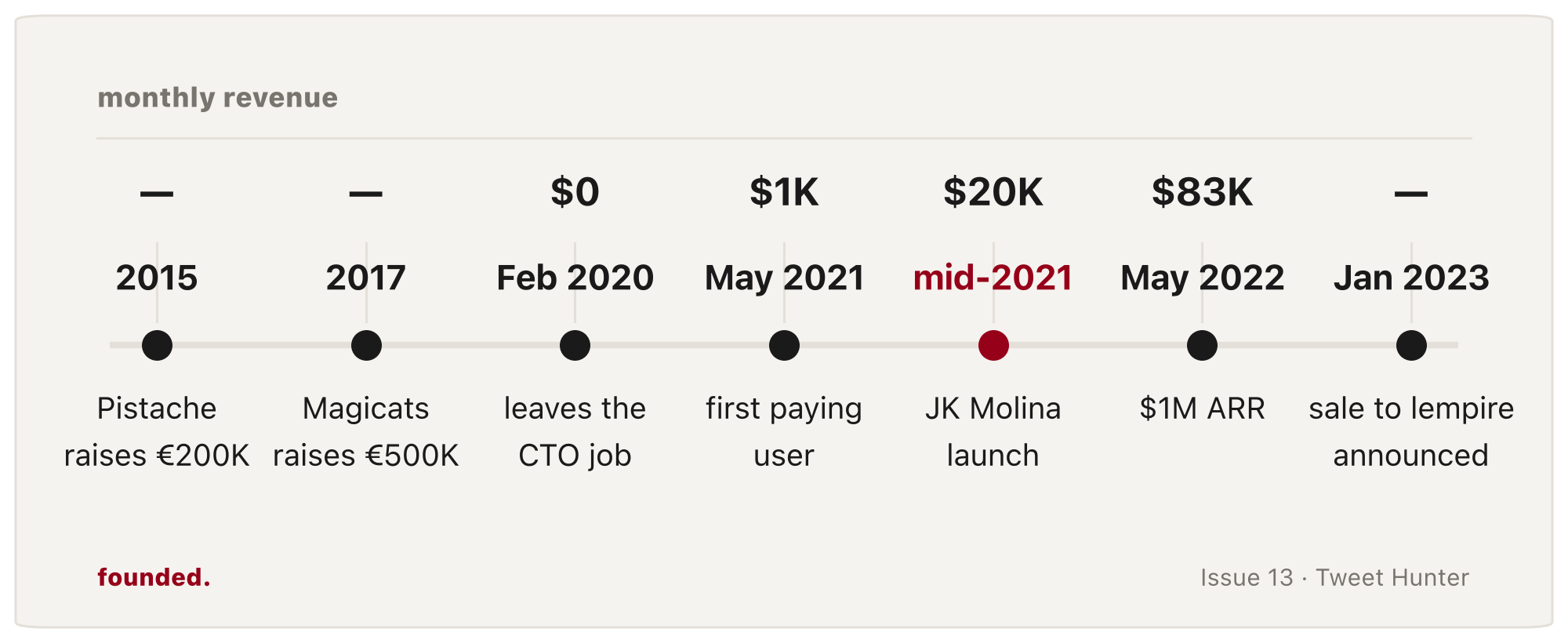
Tibo had already raised money twice. In 2015 he and Tom, who he met while studying for an MBA at ESCP Business School in Paris, started Pistache, an app to get kids to do their chores, and raised €200,000. Two years later Tibo raised €500,000 on his own for Magicats, a game that teaches kids to code.
Pistache never had recurring revenue, and both companies went to zero. The second left him with €250,000 of personal debt.
He is blunt about what went wrong:
I think I did the dumbest and the most classical mistake that a founder can do.
— Tibo Louis-Lucas, to SaaS Club
The mistake was “looking at average weekly active users or just downloads of our app as a signal for success.” Pistache reached 500,000 downloads and still couldn’t make the business model work.
To reach stability with the birth of his first child, he took a job as CTO of a large scale-up, managing 30 developers. He calls it “an awesome job” and stayed 18 months. That’s how long he lasted, saying he couldn’t stand having a boss (sounds familiar).
If you’re building a business alongside a day job, the situation here is the opposite end of the risk spectrum from Neal Taparia, who kept his job at Lehman Brothers until EasyBib made six figures in revenue. Tibo left his job with no business at all and €250,000 of debt.
The goal for me was to understand how he managed to get from that position to a sale just two and a half years later, worth $8 million in the end. Let’s dig in; it’s a juicy one.
02: one product per week
After quitting, Tibo called Tom and the two created a challenge for themselves: launch one product every week until something worked. They paid their bills from French unemployment benefits and shipped 11 products in four months.
When I first read that, I assumed they were throwing ideas at a wall to see what would stick. However, there was more structure to it. Every product went to the same buyer: founders and creators online.
Many weeks there was no real product at all, just a landing page with a “request access” form to gauge demand through email signups before building anything. When he did build, he didn’t start from scratch:
I was not bothering recreating project, I was recycling everything.
— Tibo Louis-Lucas, to SaaS Club
Every idea ran on the same backend, so a failed test cost very little. The rule for killing a product was the part I found most useful.
After two companies judged on the number of downloads, the only thing they cared about now was revenue. One of the 11 products, a search engine for online communities, made money. They killed it anyway because people would pay once, use it for a while and never return.
Tibo’s explanation was that “you basically only launch once.” He wanted customers that kept coming back, a wonderful SaaS term called ‘recurring revenue’.
the jealous co-founder
The 11th idea came from Tom noticing where customers came from: Tibo’s Twitter account. At the time, Tibo had 2,000 followers, so Tom started tweeting too, later describing the product as the result of “me being jealous of @tibo_maker.”
They already had a database of tweets from an earlier project, so the first version was a searchable library of top-performing tweets for $9 a month. It took a week to build and was initially launched on Twitter and Reddit.
In May 2021, they got their first paying user, and three weeks later they reached $1,000 MRR.
Tibo knew they had something good when demand started to outgrow what they could handle:
It’s when you get so much demands that it’s getting hard to serve.
— Tibo Louis-Lucas, to SaaS Club
03: the 25% bet
By the summer of 2021, Tweet Hunter was making $3,000 a month, a decent side income but nowhere near enough to pay back €250,000.
JK Molina was a Twitter account with 25,000 followers who ran a ghostwriting agency, writing tweets for people who wanted to grow on Twitter.
The key: his followers were exactly the people Tweet Hunter was built for.
The founders gave him access to the product in exchange for a mention. He used it, liked it, and asked to join the team.
The terms, according to Tibo: up to 25% of monthly profit plus 25% of the proceeds if the company was sold. The contract also let the founders revoke the terms if commitments weren’t upheld. That never happened.
JK launched it to his audience and within three weeks Tweet Hunter grew to $20,000 MRR.
As a financial analyst who assesses risk daily, I found those terms far too generous at first. A quarter of all profit every month with no end date and a quarter of sale proceeds is a lot to give for a simple product launch to 25,000 followers.
Here’s the reality about this business: even with JK taking 25 cents of every dollar of profit, the founders’ share of $10,000 (estimated profit on $20,000 MRR at a 50% margin) would still have been $7,500. That is five times the $1,500 profit on the $3,000 they made on their own.
The founders expected revenue growth to subside after the initial launch, but it was more like a kickstart. Users loved Tweet Hunter, and word of mouth allowed the brand to grow to $25,000 MRR by the end of the year. In December 2021 Tom was tweeting about the $25,000 MRR product built “from scratch in 6 months.”
The cost, however, was almost as real as the revenue. JK’s share became more of a concern as the business grew, and ultimately changed how the founders built.
Instead of expanding Tweet Hunter to LinkedIn directly, they forked the code into a separate product, Taplio, partly to keep it outside JK’s share.
If you’re interested in getting a weekly deep-dive to adopt founder mindsets, skills, and lessons please subscribe. It’s great to have you in the family!
the replicated product
The idea for a LinkedIn version came partly from Guillaume Moubeche, the founder of lempire, who would later acquire the brand. He asked Tibo why Tweet Hunter wasn’t on LinkedIn, and a week later he received a link to the Taplio beta.
Taplio got the same playbook: a LinkedIn creator as the launch partner and most of Tweet Hunter’s code. LinkedIn creator Alex Berman is listed as one of Taplio’s makers on Product Hunt. His terms have never been made public, so I can’t say whether the founders learned from the structure of the deal with JK.
Taplio soft-launched in April 2022 and reached #1 on Product Hunt on November 29, 2022, with more than 1,000 customers by then. According to the French podcast Soloquest, it grew even faster than Tweet Hunter. Taplio’s share of the revenue was never made public.
Tweet Hunter also added AI writing using a model from AI21 trained on its own data to write threads, hooks and tweets. Tibo said “our tool became 10 times faster with the AI integration.”
On May 25, 2022, Tom posted: “So… we just hit $1M ARR. A year ago we didn’t even have a product.”
the broken rules
Tweet Hunter went against how most SaaS founders grew at the time:
Most founders paid affiliates a commission for increased reach. Tibo and Tom gave one partner a share of the company’s profit and potential sale proceeds with a clause that revoked them if performance wasn’t adequate.
Most founders kept one product and added new features. Tibo and Tom copied their product onto a second platform under a different name.
Most founders celebrated early sales. Tibo killed products because he hated one-time payments.
04: selling to a school friend
The founders decided to sell in January 2022, four months before they hit $1 million ARR. I honestly didn’t expect them to want out so quickly with something that grew as quickly as Tweet Hunter did.
Tibo gives three reasons for the shift. The products depended on platforms they didn’t control, and Taplio was “even more platform dependent on LinkedIn.”
The second was Tom. In Tibo’s words: “my co founder wanted to sell a little bit more than I did.”
The final reason was a payday. Neither of the founders was paid much: “we were definitely not getting a big money from the SaaS.”
They looked at US buyers first, thinking “selling to a US buyer would make the price way higher.” In the end, the buyer was someone Tibo had known since he was a kid:
We started talking with lempire because their founder, Guillaume was basically in middle school with me.
— Tibo Louis-Lucas, to The Bootstrapped Founder
Guillaume Moubeche runs lempire, a French company that sells sales automation software. Its best-known product, lemlist, helps salespeople send personalized cold emails at scale. Tibo says they “fixed all the details about the acquisition over WhatsApp in two weeks.”
The deal was arranged in the summer of 2022 and announced in January 2023. Guillaume later wrote that the offer came with one condition: the founders had to stay for at least two years.
The terms:
$2 million in cash at closing
An earnout over two years, paid in six instalments and tied to growth and profit targets
Headlines at the time called it a $10 million exit
They hit five of the six earnout targets. Tibo has said the total was $8 million, meaning $6 million was paid through growth targets the founders achieved after the acquisition.
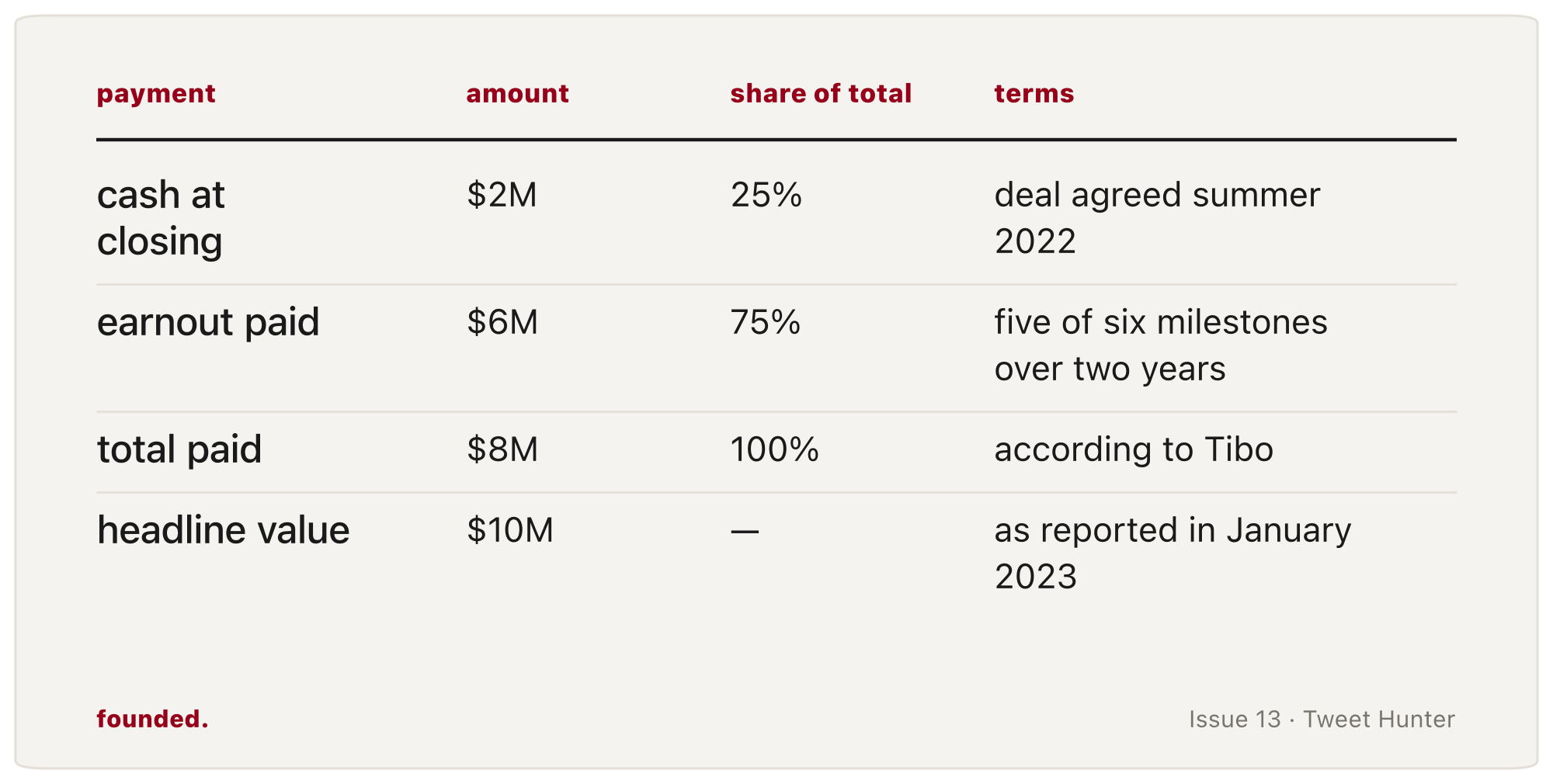
Payment risk was high. Only 25% of the final price was cash at closing, while the other 75% depended on a business that kept growing under Tibo and Tom’s guidance.
A shock came just two months after the announcement, in March 2023, when Twitter cut off Tweet Hunter’s access to its API:
We got our API access totally cut off, like no warning, nothing.
— Tibo Louis-Lucas, to The Bootstrapped Founder
Access was restored after 48 hours. To the founders’ surprise, customers stayed: Tibo said “less than 1% of the people churn.”
Revenue continued on a steep growth trajectory from $1.5 million ARR at the sale to $8 million by 2024.
That growth is why Tibo stated the sale was “not a great decision” financially:
We basically ended up selling an 8 million company for 8 million.
— Tibo Louis-Lucas, to SaaS Club
The $2 million at closing was 1.3x the revenue figure at the time of sale. The full $8 million was 5.3x, but only 1x the $8 million revenue figure that was achieved by the end of the earnout period.
In other words, the founders chose two years of growth risk that effectively reduced their multiple to just 1x ARR by the end of the earnout period.
They did, however, maintain control.
The deal allowed them to make product decisions and have their own Slack workspace, and spared them from reporting to a boss, something Tibo really enjoyed. Tibo has said that lempire’s team took credit for growth he figured they would otherwise have achieved on their own.
05: buying freedom
I write these case studies to study how founders built so we can follow in their footsteps. It’s also for seeing what’s possible through another lens: freedom. founded. is built on the premise that freedom of time, location and money while not answering to anybody is the best way to live. The only way.
The public record has a plethora of detail about Tibo, whereas Tom is mostly silent. I’ll focus on Tibo’s experience of freedom given this constraint.
money
Before the sale, the founders took little money out of the business. After the sale, however, Tibo had money for the first time since building Magicats:
thanks to the acquisition, I have some money around. So I hired a developer.
— Tibo Louis-Lucas, to The Bootstrapped Founder
While he was still working at lempire, he acquired Typeframes, a video tool, and turned it into Revid, which uses AI for video generation.
Since he left lempire, it has grown considerably, generating more than $600,000 per month in revenue. The business is part of TMAKER, Tibo’s holding company, which together with four other software products makes more than $1 million per month in revenue with a team of 10 and no outside funding.
no boss
As far as freedom goes, it’s pretty clear it’s what drove Tibo to become an entrepreneur.
Working as a CTO, he hated having a boss, so he left with no money to his name, a pile of debt, and no plan. Even during the earnout period with lempire, he requested a separate Slack workspace and full control over the product.
He has evolved into the role of distribution lead for TMAKER, working with cofounders building products to help them grow. It’s the role JK played that kickstarted Tweet Hunter at the beginning of their journey.
location
Tibo spent six months living in Thailand, where he met indie hacker Pieter Levels. He also spent time in Bali, where he met up with a weekly group of 10 to 30 indie hackers. He finally left to be closer to home:
We went back in France because our kid is growing and we wanted to be close to family.
— Tibo Louis-Lucas, to The Bootstrapped Founder
time
Time freedom was never high on Tibo’s list of priorities. He continues to run five SaaS products at once, switches tasks often and has said that he is “completely burned out” by the end of the day.
After the exit he describes a void: the loss of being recognized as a successful founder and an urge to get back to building. The free time he does have goes into learning to fly; he is seven hours short of the 45 hours needed for a private pilot license.
The story started with Tibo stuck in Paris having recently quit his CTO role. It ends with him back in France by choice, with a portfolio business that makes more in a year than Tweet Hunter sold for.
He didn’t have the money to build an audience, so he borrowed one and used the resulting profit to pay for it.
06: the growth channels
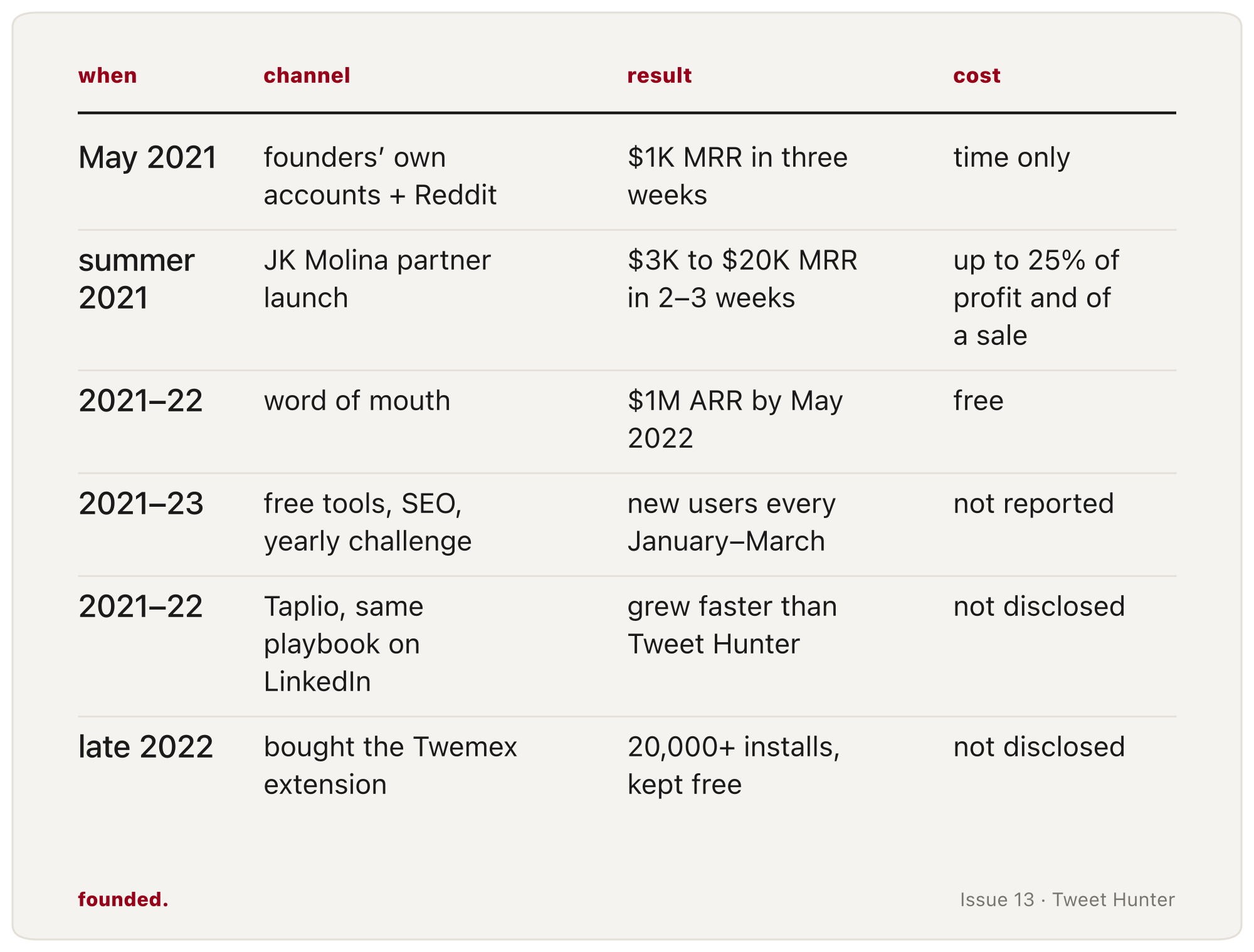
The table below describes the main distribution channels that allowed Tweet Hunter to grow, with the results and costs if they were publicly available.
growth on Twitter
The first channel was the founders’ Twitter accounts and Reddit posts. It was enough to prove people would pay but not to grow with an audience of 2,000.
Twitter (now X) was used as a proof of concept; Tibo used Tweet Hunter to grow his account. The result was growth to almost 60,000 followers in two years, surpassing 100,000 in early 2024.
the partner launch
JK Molina’s launch was the shift that changed the business. It worked for two reasons.
The positioning of JK’s messaging and audience was perfectly aligned with Tweet Hunter: people paying a ghostwriting agency to grow on Twitter are the ones who would pay for a tool that speed runs it.
The second reason was that JK had tried the product and enjoyed using it, so it was more of a recommendation than a true advertisement. Organic content, if you will.
Tom summarized their success:
Every major thing that happened to us happened by building relationships.
— Tom Jacquesson, to Pete Codes
word of mouth
After the launch, the founders expected that growth would stall. Instead, word of mouth allowed revenue to continue climbing and a drop-off in demand never came.
free tools and the yearly challenge
The founders built free tools around Tweet Hunter, including a “best time to tweet” add-on and an AI tweet generator, while writing articles about Twitter with SEO built in.
Every January through March they hosted a Twitter and LinkedIn growth challenge that brought in new users each year.
buying a Chrome extension
In late 2022, Tweet Hunter bought Twemex, a free Chrome extension built by graduate student Geoffrey Litt. It’s a sidebar next to your Twitter feed with additional tools. It started as a way for Litt to search his old tweets and grew into a tool for finding the most popular tweets for any account.
The extension was installed more than 20,000 times and Litt sold it because “a dedicated team could do a better job maintaining and growing the extension than I could with my spare time.” Tweet Hunter kept it free and used it to introduce users to their paid product. A sale price was not disclosed.
the revenue takeaway
Before you spend another year growing an audience from zero, find the one person who has already rounded up your ideal buyers and consider an ask to partner with them.
If your product is good and demand has been proven, this might be an effective way to grow. Tweet Hunter went from $3,000 to $20,000 a month within three weeks of doing exactly that. Think carefully about the terms you agree to.
I’ll repeat this because I think it’s easily missed: Tweet Hunter already had paying users who stuck around before JK touched it. If your product isn’t converting yet, a bigger audience just means more people seeing something they won’t use.
When one of my Reddit posts got 260,000 views and brought in two total subscribers, I knew something had to change in how I packaged my offer. It’s a perfect example of refining the offer before searching for a larger audience. After all, 0 x 1,000,000 is still 0.
07: the tools
the product
Tweet Hunter was built to help users grow and sell to an audience on X. Its homepage today reads: “Build & Monetize your 𝕏 audience FAST.” Funny enough, Tweet Hunter has become exactly what the founders needed from JK when they first started: a way to grow an audience that actually brings in sales.
The product started out as a searchable library of top-performing tweets and migrated into a place to schedule them, along with features such as automatic DMs, AI-written tweets, threads and hooks. In February 2023, there were more than 5,000 paying users.
founder skillsets
Tibo was the engineer who built the product and scaled the brand. His Twitter account was proof for the product and everything that came afterwards. Tom is a digital marketer and helped build the product while taking the lead on marketing it. JK brought an engaged audience and a ghostwriter’s intuition for good tweet writing.
monetization
Tweet Hunter only ever sold monthly subscriptions because of Tibo’s obsession with recurring revenue. The first price was $9 a month. Today, plans start at $49 a month, with a $99 tier.
unique branding
Tibo’s own Twitter account was the brand. He said it himself: “Twitter is me, or at least it was me.” He still strives to answer every DM.
His advice for founders starting out is that “when you have zero audience, you have this unique advantage is that you are reachable.”
08: the founder’s decision: renting an audience
the signal
Tweet Hunter had paying users, but growth was slow with only 2,000 followers.
the options
Keep growing slowly as they had been, building an audience.
Bring JK on as a co-founder, lending his niche audience to Tweet Hunter for 25% of profits and of any sale.
Pay JK a standard affiliate commission on each sale.
Raise money to pay for growth directly through paid advertising.
the decision
The founders chose the second option.
JK received up to 25% of monthly profit and 25% of the sale. The genius part was structuring it in a way that allowed them to revoke the co-founder role if JK didn’t uphold his end.
the cost
The cost has been covered a few times so I won’t keep beating a dead horse. Essentially, a quarter of the business for growth. But more than that, it also shaped how the founders built: Taplio became a separate product to keep it out from under the Tweet Hunter umbrella.
the evidence
MRR grew more than sixfold to $20,000 in a matter of weeks and continued growing to $25,000 by December 2021 and $83,000 by May 2022. The initial launch wasn’t just a promotion, it was a kickstart. The number of people using Tweet Hunter allowed word of mouth to become one of the largest growth levers, something the founders didn’t expect.
The product already had paying users and new features were added regularly. Product Hunt, Black Friday deals and free tools also played a big role.
There is also survivorship bias. Many founders give influencers a share and see nothing back. You’re reading about this one because it worked.
the application
Before writing this case study, I probably would have opted for the affiliate route: ask JK to recommend Tweet Hunter and pay him for each customer who stayed. Looking at it now, I’m not convinced the two deals are that different. The big difference is the 25% of sale proceeds. Let’s break it down.
Affiliate commission: say Tibo had asked JK to try the product, then offered him 30% of the revenue from each customer he brought in. That’s conservative; Tweet Hunter’s own affiliate program pays 40% for the first 12 months today.
JK’s launch took MRR from $3,000 to $20,000, and no other channel was growing at the time, so let’s give him credit for the $17,000 difference: $17,000 x 30% = $5,100 a month, for as long as those customers stayed.
The key is that commission is paid on revenue, not profit.
Profit sharing: Tibo told Starter Story in 2023 that Tweet Hunter’s gross margin was above 50%, so I’ll use 50% as a stand-in for profit. With the same growth, JK would have made ($20,000 x 50%) x 25% = $2,500 a month. Less than the commission at first, but his share applied to all profit, including growth he had nothing to do with.
By May 2022, less than a year later, that was ($83,000 x 50%) x 25% = $10,375 a month for little added effort. The real number is likely lower because Taplio’s revenue may be included in that figure. Let’s call it $8,000 a month. Still a lot.
The sale proceeds are the second big difference. Of the $8 million paid, setting aside $4 million for Taplio to be conservative, JK’s 25% comes to another $1 million before tax.
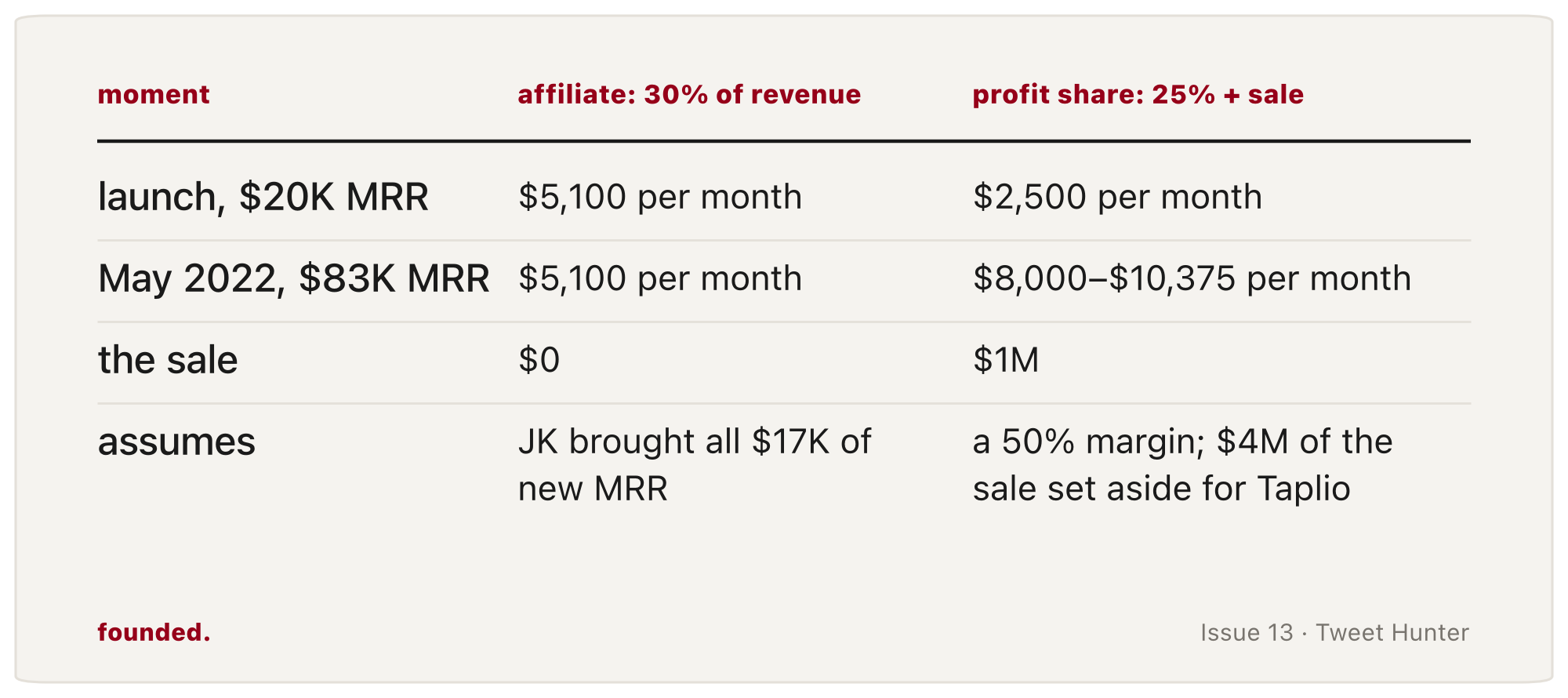
Month to month, there’s minimal difference in the year before the sale. The founders took the big hit on the acquisition. In return, the co-founder title likely kept JK more invested in growing the business than a commission would have, and made him less likely to walk away early. It’s hard to say from the outside, but he seems proud of it: he lists the role in his X bio.
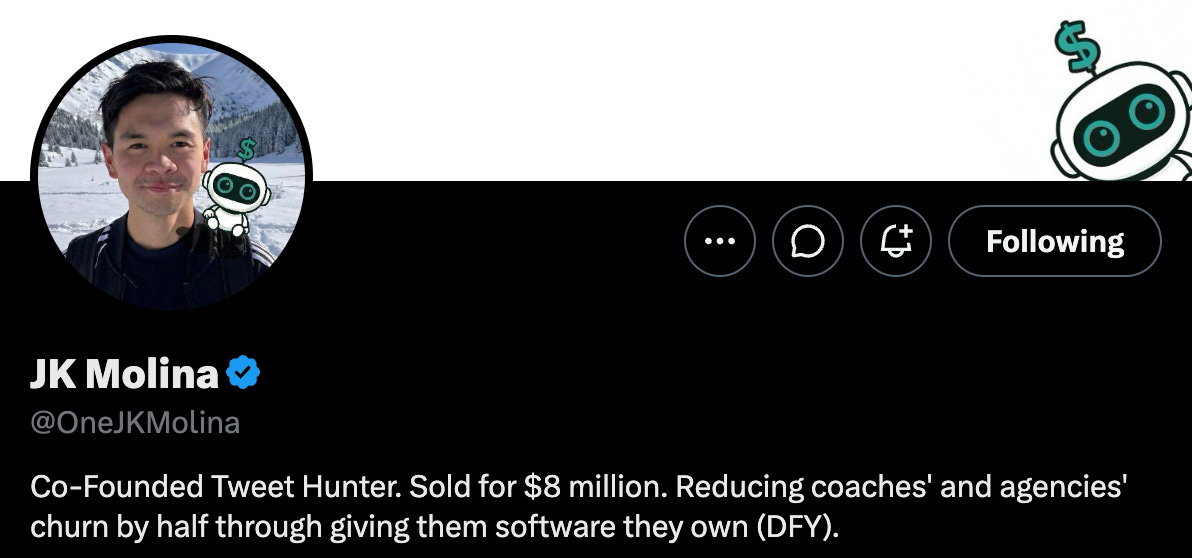
Either way, bringing JK on paid off in a big way. It provided scale they otherwise wouldn’t have reached with Tibo’s Twitter following alone.
Three things made it work well and are worth paying attention to:
JK’s followers were the exact buyers they wanted.
JK used the product himself and liked it before promoting it.
The product already had paying users who stayed, proving it was functional and useful.
An example: imagine earning $1,000 a month doing bookkeeping for freelancers. Your JK is a coach or a newsletter with 5,000 freelancers who trust them. Instead of an affiliate link that gives them a 20% kickback, offer them a share of the profit from the customers they refer, for as long as they keep bringing home the bacon, with the right to end the agreement if things take a turn.
Make the first test a small one. Ask the partner for one post or email with a link and run it for 30 days before signing an agreement. If revenue doesn’t grow, no harm done.
What I would argue against is giving away a share of sale proceeds. It aligns the partner’s interests with yours, but profit sharing already does that.
Needless to say, your margins matter too. I’m assuming a SaaS or digital product with margins above 50%. If yours are lower, the math changes.
09: the quit number
Going forward, I will be tracking the revenue figure the month a founder quits their job. I call it the Quit Number.
Over time it should show what people like us actually need to make the jump, adjusted for risk tolerance.
Neal Taparia’s Quit Number at EasyBib was more than $8,000 a month. Tibo’s was $0. Tweet Hunter’s first paying user signed up 15 months after he quit. Certainly not for the faint of heart.
What made a Quit Number of $0 reasonable was a backup. French unemployment benefits paid the bills during the rapid building phase so they could focus on launching products.
10: what still isn’t clear from the research
JK Molina’s exact terms for the deal. Tibo has stated up to 25% of profit and of a sale; another write-up describes equity in steps of 10%, 15% and 25% at revenue milestones.
How much of the sale proceeds were paid out to JK.
Alex Berman’s terms for the Taplio launch.
The maximum earnout. Reports put the total possible price between $10 million and $11 million.
The revenue split between Tweet Hunter and Taplio.
Which founder made each decision. Everything public is from Tibo’s point of view.
The growth attributed to the free tools, yearly challenge and the Twemex purchase.
11: the brand today
Tweet Hunter still operates under the lempire umbrella. On October 24, 2026, the homepage states: “Build & Monetize your 𝕏 audience FAST,” with plans starting at $49 a month, and claims that it is “Trusted by 5644+ 𝕏 creators,” with no mention of lempire as a parent company.
Together with Taplio it passed $8 million in ARR in 2024. lempire as a whole reported $22.4 million in revenue for 2023 with 85 employees by March 2024. Neither lempire nor the founders have published figures for Tweet Hunter since the earnout, so there isn’t a great way to measure how X’s changes have affected the brand.
FOUNDED FACT
A single tweet once sold for $2.9 million. In March 2021, two months before Tweet Hunter’s first paying user, Jack Dorsey’s first tweet “just setting up my twttr,” sold as an NFT for $2.9 million. In April 2022, the buyer put it back up for sale. The highest bid was $280.
NEXT ISSUE
Next week’s case study: Baby Einstein. Julie Aigner-Clark was a teacher who put $15,000 into a video for babies. Five years later it made $20 million a year, and she sold it to Disney for $25 million. Was that too early?
LEARN MORE
SaaS Club — Tibo Louis-Lucas, episode 482. The whole story in his words, from the €250,000 debt to the earnout and TMAKER.
The Bootstrapped Founder — episode 288, January 24, 2024. The sale, platform risk and life after the exit.
SOURCES
SaaS Club — Tibo Louis-Lucas, episode 482, and its playbook “Validate by Revenue, Not Feedback,” May 7, 2026. Pistache and Magicats raises, the €250,000 debt, “the dumbest” quote, the CTO job, quitting in February 2020, COVID in Paris, unemployment benefits, 11 products, the kill rule, the recycled backend, the community search engine, the PMF quote, the JK Molina terms and the $3,000 to $20,000 jump, Taplio’s fork, $2 million upfront, six milestones, five hit, $8 million, the “8 million company” quote, control and Slack, the void, Revid, TMAKER, team of 10, the pilot license.
The Bootstrapped Founder — episode 288 and transcript, January 24, 2024. CTO of 30 developers, the reasons for selling, US buyers, Guillaume in middle school, the WhatsApp deal, the API cut-off, churn, “Twitter is me,” the DMs, Thailand, Bali, back to France, the developer hire, 100,000+ followers.
Soloquest — “Comment vendre sa boîte +10M€,” August 27, 2024. Deciding to sell in January 2022, the deal in summer 2022, the seven-figure upfront and two-year earnout, $1.5 million to $8 million ARR, Taplio growing faster.
Indie Hackers — Pete Codes, January 19, 2023. lempire as buyer, $2 million cash plus earnouts, $1 million revenue in 12 months, and the Tom Jacquesson interview.
Unicorn Growth — Brian Bourque, January 21, 2023. JK Molina’s following and agency, the staged equity version, no paid ads, free tools, Twemex, SEO, Tom’s quotes from his Pete Codes interview.
The Successful Projects — April 23, 2024. ESCP, the tweet database, the $9 price, the one-week build, the Twitter and Reddit launch, the free account for JK, Tom’s tweets of December 15, 2021 and May 25, 2022, Product Hunt and Black Friday.
AI21 — Tweet Hunter case study, February 20, 2023. 2,000 starting followers, 60,000 followers, 5,000+ paying customers, the fine-tuned model and the “10 times faster” quote.
Starter Story — Pony Express Studio, May 18, 2023. Tweet Hunter’s gross margin above 50%.
Tweet Hunter affiliate program (Rewardful), October 28, 2026. 40% commission for 12 months.
Product Hunt — Taplio, November 29, 2022. Alex Berman as a maker, the April 2022 soft launch, 1,000+ customers, #1 of the day.
lempire blog — Guillaume Moubeche, “How I turn my middle school mate into a multi-millionaire.” The LinkedIn question, the Taplio beta, the two-year condition, lempire as a sales automation company.
Scale Nuggets — May 25, 2024. Pistache’s 500,000 downloads and Magicats.
Geoffrey Litt — “For your next side project, make a browser extension,” January 8, 2023. Twemex’s 20,000+ installs and the sale to Tweet Hunter.
Chrome Web Store — Tweet Hunter X: Sidebar for Twitter, October 24, 2026. The listing name and store ID.
Tweethunter.io — home page, October 24, 2026. The headline, the $49 and $99 plans, 5,644+ creators.
GetLatka — lempire, updated October 13, 2026. $22.4 million revenue in 2023 (via Indie Hackers) and 85 employees in March 2024.
NBC News — March 22, 2021, and PYMNTS — April 2022. The FOUNDED FACT.
Alejandro Cremades — Julie Clark interview; Inspired Insider — Julie Clark interview; Publishers Weekly — November 19, 2001. The next issue.
Every figure in this issue is drawn from public statements, interviews and press coverage, and each one is listed with its source above. No interview was conducted with the founders. Tweet Hunter was a private company and published no financial statements, so revenue, customer and deal figures are as the founders and the press reported them and have not been independently audited.
It's so interesting to hear about how all of the founders from these case studies are so different.
What intrigued me most was the one-product-a-week challenge. I wonder: did they interview anyone before testing an idea, or were the “request access” signups enough?
I ask because I’ve been thinking about making something to help builders talk to the people they're building for, before they invest a lot of time creating based on their assumptions. But, maybe it’s better to put something out there first and get feedback fast.
Do you think it’s worthwhile to build a product every week now that AI makes it so easy? Just to see what sticks?