

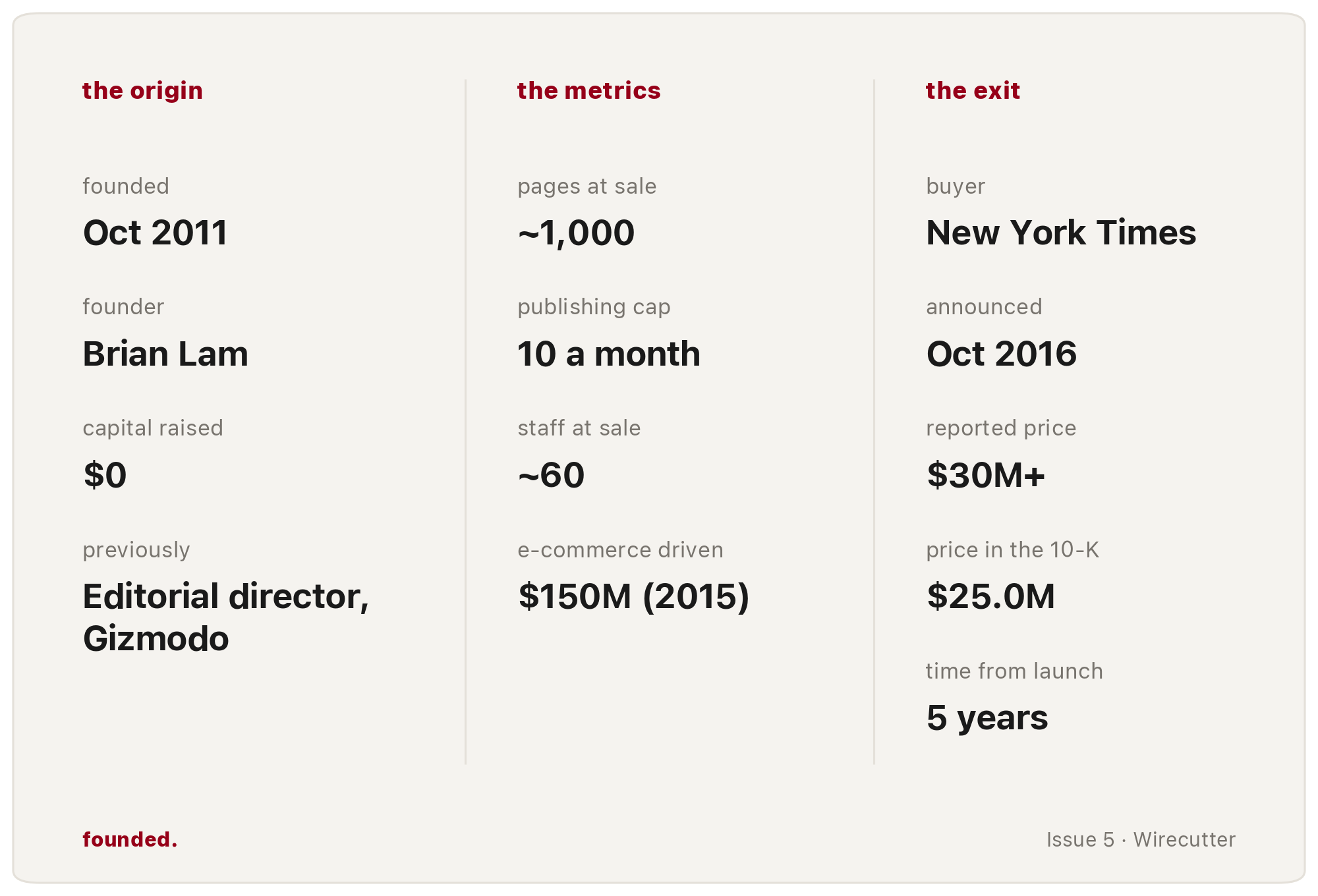
TL;DR: Brian Lam ran a large San Francisco blog for five years and quit in 2011 to start a product review site that published just 10 articles per month. He didn’t raise any money, never advertised and didn’t sell subscriptions. Five years later, The New York Times acquired the business for what the press reported as “more than $30 million”, however, the Times’ annual filing confirmed a purchase price of $25.0 million a few months later.
Biggest lessons:
Pick your buyer before you build the business. Brian built the site to be sold to the New York Times, and spent a year publishing alongside them before an offer was made.
Quality beats quantity every time. Towards the latter half of Brian’s time at the Wirecutter, articles were revised more often than new ones were written showing the deep commitment to providing the most relevant recommendations.
01: the real sale price
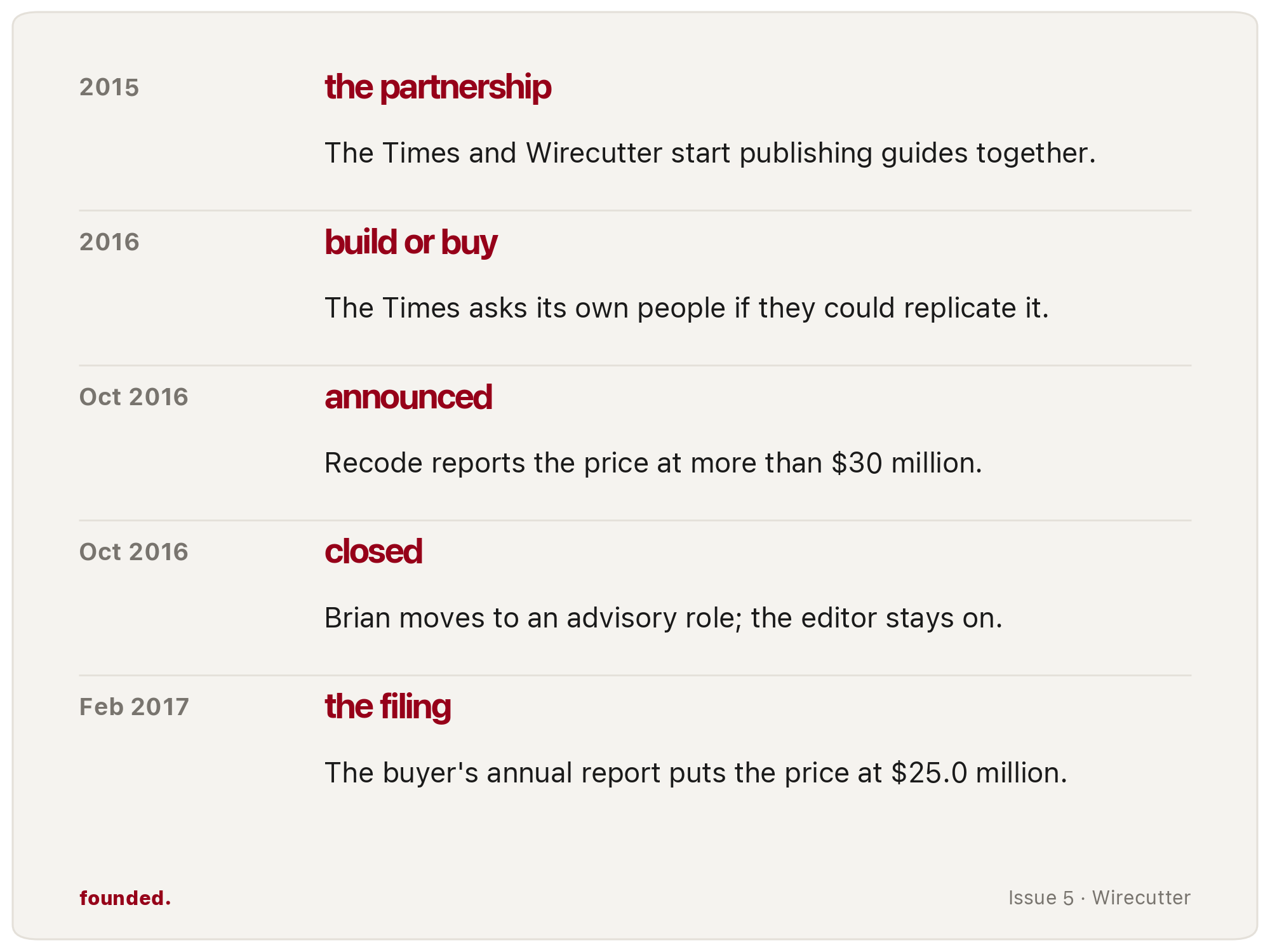
On the morning of October 24, 2016, Recode reported that The New York Times was buying two websites: The Wirecutter and The Sweethome (the two sites Brian had spent the five prior years building). The price was quoted as “more than $30 million”. Within hours, the vague number was everywhere from news outlets to competitor blogs.
In late February 2017, about four months after the sale the Times filed its annual report that read: “In October 2016, we acquired product review and recommendation websites The Wirecutter and The Sweethome for $25.0 million.” Funny enough, I actually found the number still misquoted on Brian’s Wikipedia page:

Nobody (including Brian) has seemingly cared enough to go back and update the record.
Here’s the full story of how a man running one of the biggest blogs on the internet went on to build a product review site that used all of the opposite rules the industry swore by.
02: how it started
Brian Lam was born in New York City in May 1977. His mother grew up in Queens while his father immigrated to the United States from Hong Kong and worked as a computer engineer at Hewlett Packard. The family moved to suburban New Jersey while Brian was young. He recalls hating it there:
“I think it was like subtly racist in a way that it just is… New Jersey was just kind of very racist, very classist. It was just like not where I belonged.”
— Brian Lam
Brian had a peculiar upbringing with parents that had zero expectations for their children. He described it as very frustrating at the time but became useful later in life.
“My dad had a really overbearing dad and overbearing older brother, so he never wanted to tell us what to do, as a matter of principle. My mom was just really into being a free spirit.”
— Brian Lam
He built his first remote-controlled car at the age of seven. By the time he was 11 or 12 he spent summers in Hong Kong, where gadgets were “a lot smaller, cheaper, and better” than anything in America.
He attended Boston University and managed to switch majors six times: philosophy, English, journalism, photojournalism, computer science, and business, taking summer school every year and graduating with about 150 credits. The final degree of choice? Business. During his time at school, a journalist from the Boston Globe had come to speak to his class explaining that 80% of students wouldn’t get a job after graduation. Those that would were threatened with 80-hour work weeks for a measly $20,000 a year.
In 2000, he moved to San Francisco for a web development job and was laid off within two months when the dot-com bubble burst. His next job was rather unique, settling for a job at a kickboxing gym owned by professional fighter Alex Gong answering phones, cleaning, and helping out with customer service. After three or four years, he started giving lessons.
One day while working, a driver backed into Alex’s Jeep, parked on the street outside the gym. In a desperate attempt to catch the madman, Alex chased him down the street in nothing but boxing shorts. He caught up to the driver when he was stopped at the next set of lights:
“The light turns green, and I hear, ‘Pop,’ and I see Alex fall down. Alex was shot in the chest by this totally yuppie looking guy.”
— Brian Lam
A witness told the San Francisco Chronicle that Alex put his arm out to stop the driver, that the driver pushed him back, and that he then shot him point blank. Brian, an instructor at the gym, was quoted in the paper the next day: “the guy popped him. He definitely waited for the light to turn green.” He gave Alex CPR on the pavement using his own t-shirt and could not save him. The biggest lesson he learned from the whole ordeal was to always avoid conflict in life. It took him eight years to fully internalize what that meant for him.
A restack or subscribe from you helps founded grow and reach more ambitious entrepreneurs like you :)
the call
Eventually, all roads led back to writing. Internships at Maximum PC and Wired turned into a contributor slot and then an assistant editor job at Wired, where he lasted a couple of years and got nowhere: “it was like me and sixteen senior editors who never really listened to me.”
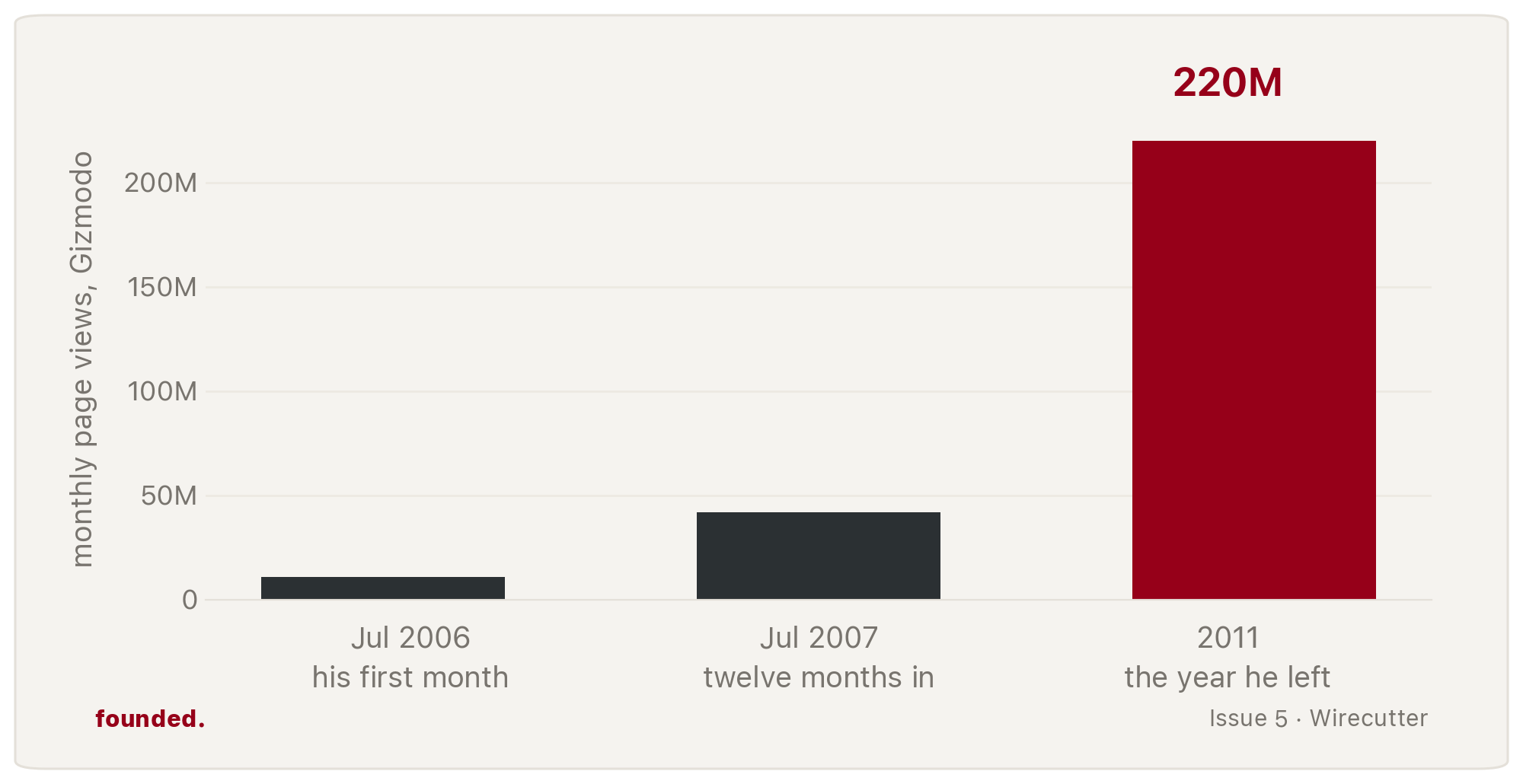
In July 2006 he left the magazine for a blog, which was not something many people did back then, called Gizmodo which he ran from his San Francisco apartment. He worked long hours, day and night, ultimately growing monthly page views from 11 million to 42 million in his first year. He was promoted to editorial director less than two years in. By the time he left the company in 2011, the site had more than 220 million page views a month.
“At Gawker, I was thirty-five pounds heavier than I am now, because I was so unhealthy, and so unhappy, and so stressed all the time.”
— Brian Lam
“For five years it was not that different from boxing; being punched in the face every day was actually easier than working at Gawker. It was like so combative internally, so combative externally.”
— Brian Lam
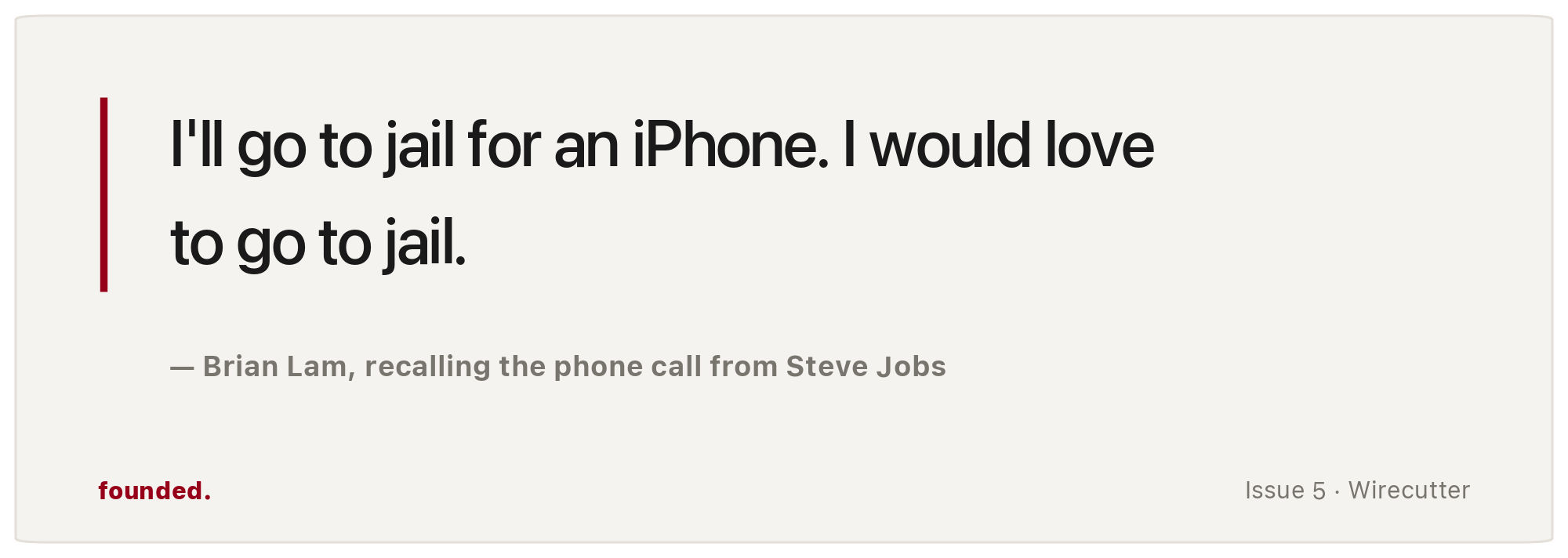
In April 2010 Gizmodo put out the biggest article of Brian’s career. An Apple engineer had left an iPhone 4 prototype in a bar in Redwood City. It ended up being sold to Gizmodo, for which it was taken apart, photographed and published. Steve Jobs called soon after, asking for the phone back. With a bold tone, he told Steve that he would return it if he confirmed it was Apple’s phone.
Police raided the home of Jason Chen, the editor who had written the article, and seized his laptop and gear. Prosecutors spent 18 months on the case and charged no journalist. In October 2011 the two men who had found the phone and sold it to Gizmodo pleaded no contest and were each given a year’s probation, 40 hours of community service and $250 to repay Apple for the prototype.
Read the original Gizmodo article here: https://gizmodo.com/this-is-apples-next-iphone-5520164
After leaving Gizmodo that same year, Brian wrote a piece titled “Steve Jobs Was a Kind Man: My Regrets About Burning Him”.
03: lowering the (quantity) bar
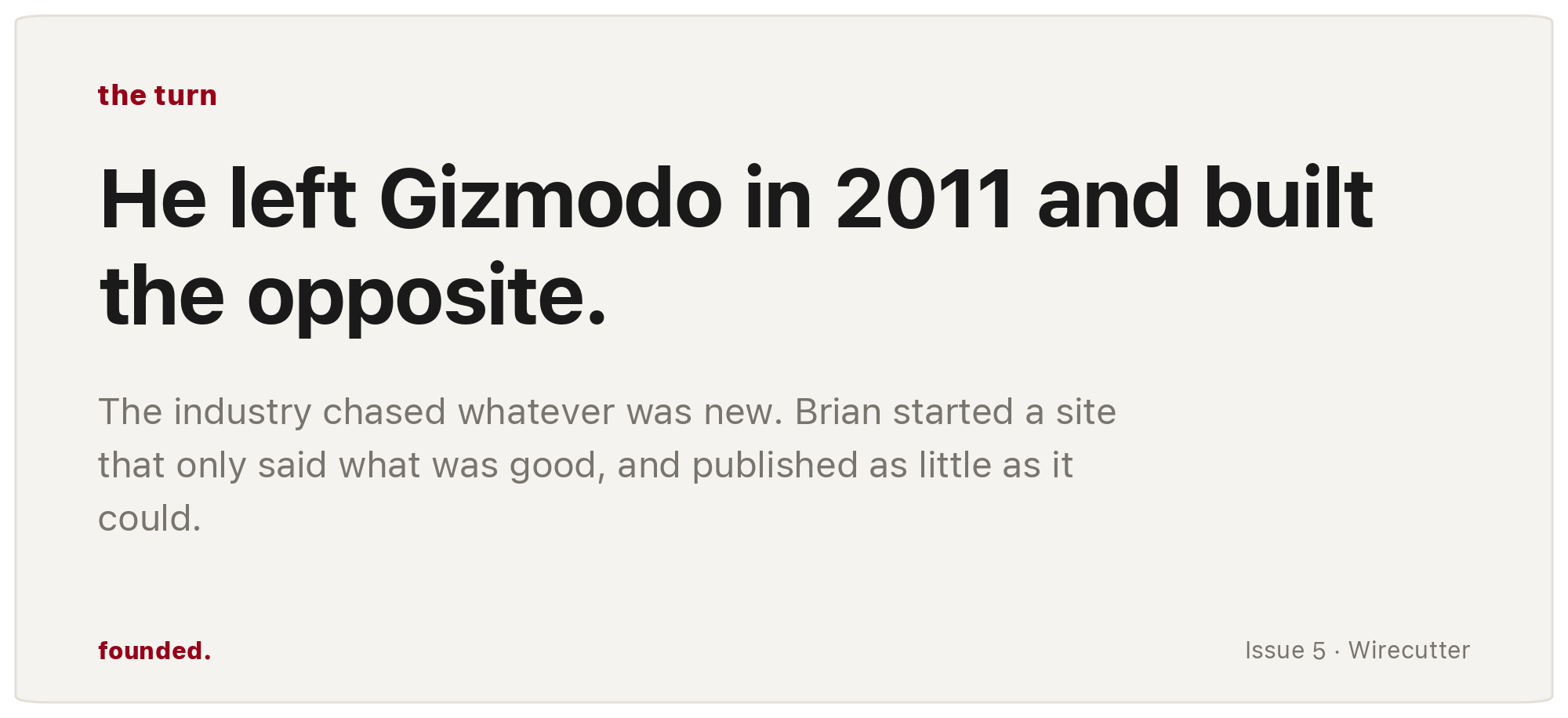
The idea for what came next didn’t come from research. It was the accumulation, over several years, of people asking for advice on what tech to buy.
The entire industry was obsessed with what was new and hot. There was no market to write about what was good. Just like that, he had found one of the most underrated niches in the industry at that time.
The Wirecutter went live in October 2011, announced in a short post on The Awl. The post described the purpose of the website: to give advice for the best product in a given category at all times. It was a constraint rather than a promise, which didn’t sit well with investors at the time.
“My pitch was we are going to ignore a lot of noise and only be updated 10 times a month at most.”
— Brian Lam
Because of the hard sell, Brian didn’t raise any money at all. In fact, he asked for a simple sponsorship from Intel for the launch and covered the rest himself by renting out his house on Airbnb, selling his car and replacing it with a cheaper model. It took him two whole years to pay himself more than just enough to survive but he certainly learned how to live on a tight budget.
how it made money
The only revenue the website generated came from affiliate links. An article would recommend a product, the link to buy it redirected to a retailer (primarily Amazon) and the retailer paid Wirecutter a fraction of each sale, typically between 4% and 8% at this point. Fortune tried to estimate Wirecutter’s revenue in 2016 assuming 6%, which put revenue at roughly $10 million a year.
Two major differentiating factors made Wirecutter scalable and sellable:
There were no advertisers, so there was no reason to chase traffic. The edge came from genuine care put into recommending products rather than maximizing page views.
Neither the writers nor editors knew which products yielded the highest affiliate commissions. It was intentionally kept under wraps to keep incentives aligned with customers (recommending the best products).
Most copycat sites failed because they did not enforce the latter.
the work
Matthew Haughey, founder of MetaFilter, was asked to write for Wirecutter and turned it down: a single article took dozens to hundreds of hours of research, far more than he had expected. By the time the company was sold, there were roughly 1,000 active pages. Most of the backend work was not putting out new articles, it was keeping the ones they had updated and relevant. An analysis by Ahrefs in 2022 found that for every new article, five were updated.
For a website funded by advertisements, the incentive is to keep publishing something new. When funded by affiliate links like Wirecutter was, what pays is having a meaningful recommendation that holds its weight, especially over time. Keeping old articles updated was worth more than publishing new ones, especially once most of the major tech category recommendations had been written.
A downstream effect of this was years later:
“After people trust our work, they only read the first like 30 seconds, and then they stop, and they buy what we recommend.”
— Brian Lam
The trust had been built, one loyal customer at a time.
In 2013, Brian launched The Sweethome, a sister site for household goods. In December that year Brian hired Jacqui Cheng, previously an editor at Ars Technica. There were fewer than 10 people at the company at the time but by 2016 there were about 60, not counting freelancers. Matt Haughey, who had turned the work down, later described the writers as well paid and under no pressure to publish often.
Handing the editing job over to others was not one of Brian’s strengths. He had run Gizmodo from his own apartment and made most of the calls himself. At Wirecutter he hired Jacqui and then stayed out of her way. This progression meant that by the time of the sale, the company did not need Brian running the day to day.
04: the Times
In 2015 the Times and Wirecutter agreed to publish together. One of the collaborations, a guide to wireless routers, became the most-shared story on the Times site the day it ran. The Times’ version carried no affiliate links; Wirecutter’s did.
“I built The Wirecutter to be sold to the Times, basically. It’s the one thing they weren’t good at that I was good at… we just made a point of doing work good enough that it was the best that ever existed.”
— Brian Lam, 2025
The potential buyer of any business runs through the same set of questions. One of them is whether the internal team could build the same product or service in house for the same money. If they are able to, which they usually are, they cut the bid price or cancel the deal altogether. What keeps a number strong is unique positioning or a competitive advantage the company can’t quite replicate on their own.
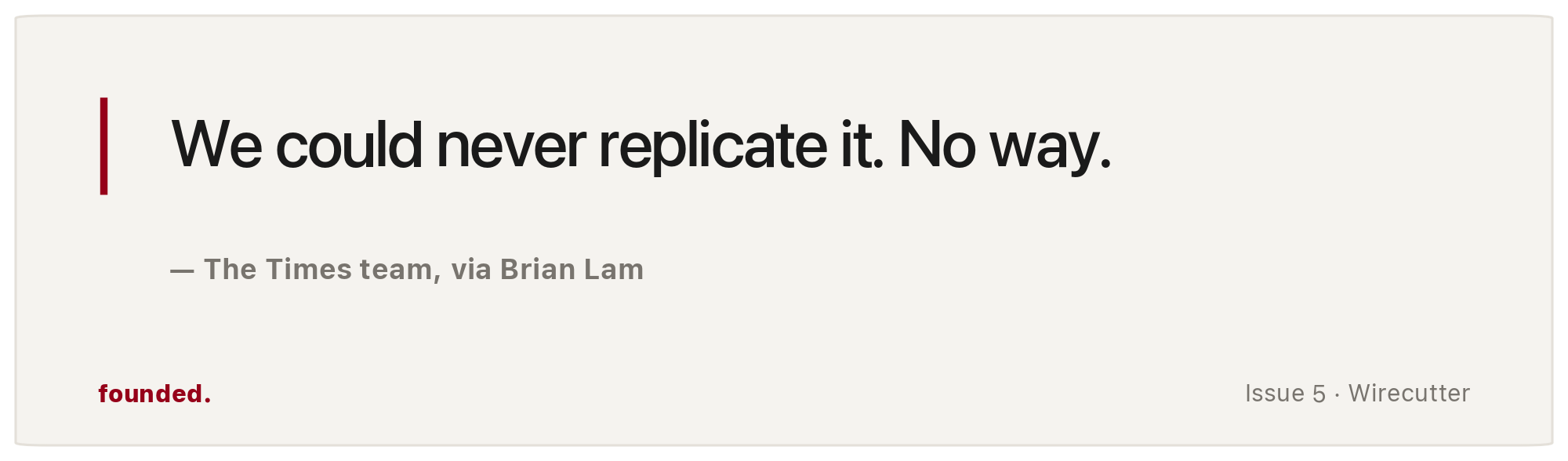
The interesting part about Wirecutter was that the Times had asked its employees to do just that and they had responded with a resounding ‘no’. They could never accurately and efficiently replicate what Brian had done.
It wasn’t just the gruelling amount of time spent writing and re-writing the 1,000 articles, it was the customer trust and conversion through affiliate links that would have been almost impossible to do properly, especially a company as large as the Times.
The sale was ultimately announced in October 2016. Brian moved into an advisory role. Jacqui stayed on as editor-in-chief. In January 2017, the Times named David Perpich to run the business, and the two sites merged into one under the Wirecutter name later that year.
Brian was 39 when Wirecutter sold. He has described himself as semi-retired ever since.
05: the tools
the product
The product was simple: one webpage per category. Each individual page featured a dedicated winner in that category, a cheaper pick and a runner-up. There weren’t any scoring metrics, no endless options to choose from and no news or advertisement noise. When the winner was no longer relevant or a newer and better version came out, the page updated. The Sweethome had the same format but for mattresses, mops and kitchen knives, showcasing a horizontal market move that cost next to nothing.
founder skillsets
At this point you’re probably thinking that Brian was a talented writer, or marketer or just a generally savvy businessman in being able to scale Wirecutter to an eight-figure exit. Although he did have many talents, the real gold mine was knowing the industry inside and out. From the experience Brian had in the blog and magazine space, he understood what the big boys were after (attention) and what he could do to bridge the gap (build trust). The corporations were after speed, volume and covering everything that was new. Brian removed all three and focused on quality and answers. Exactly, as it turns out, what customers wanted.
The second skill Brian learned throughout his time at Wirecutter was restraint. Between hiring an editor, limiting publishing volume, and turning down advertising money, it quickly became clear that it didn’t come naturally to him. Part of what made it work was physically distancing himself from the industry by moving to Hawaii.
monetization
Affiliate commissions were, until the day of sale, the only monetization channel for Wirecutter. In 2015 the site drove $150 million of e-commerce sales, and the commission on that is what the company lived on. No annual revenue figure has ever been published, so what that commission actually came to is not known.
The best part? No funding rounds, no subscriptions, no advertisers to chase down and nobody to answer to.
unique branding
The brand was a promise that built trust over time. No BS. Only what customers really wanted from a product recommendation site. Wirecutter managed to do what others grimaced at: removing everything until the only thing left was what truly mattered for driving growth.
06: by the numbers
The only frustrating part of the story is the lack of publicly available revenue information. Brian was always very private around money. He even declined to give revenue figures to Digiday in 2014. To make matters worse, the Times has also never published revenue figures, either. Dead end. So apart from the $150 million e-commerce sales number from 2015, the incorrectly reported sale price of ‘more than $30 million’ and the actual reported sale price, there isn’t really much to work with.
07: the sale process
The thing I find interesting here is the difference in the attitude towards selling a business. In previous issues, we looked at founders that were dumbfounded when a buyer approached them. They would, in a hurry, hire lawyers and bankers and attempt to gain some leverage by collecting offers from several buyers.
This could not have been further from Brian’s intentions. He had planned for a sale from day one. There was never another buyer; it was always the Times. He knew it from the start of the journey. Working together was strategic to showcase what he had built, do some due diligence work for him, and strengthen relationships with those that would help facilitate the eventual sale. He never even so much as thought about another buyer, meaning he saw it coming all along.
Let me know what you think about this issue of founded. it helps me tailor content to your needs. Thank you :)
08: what went wrong
01: no outside funding
This went wrong from Brian’s perspective in early years. It took two years before he could pay himself more than poverty wages. Although this was a tough time in the journey, some entrepreneurs yearn for this kind of grind. One where there is nothing to lose and everything to gain.
02: the revenue nobody published
Brian’s refusal to publish figures was deliberate and defensible for most of the company’s life. The discrepancies arrived when the sale price was misreported. It also doesn’t allow us to paint a detailed picture of how revenue growth looked throughout the journey.
03: two brands doing one job
The Wirecutter and The Sweethome were separate sites for years. The Times merged them within a year of acquisition which is probably what should have happened a long time ago.
09: what went right
01: the asset nobody could rebuild
It was the sheer dedication to giving the right recommendation every time that earned trust. People came back and bought the recommended products. Over time, customers didn’t even read the articles anymore and skipped right to the affiliate links. They trusted Wirecutter with their buying needs at a deeper level. It was something not even the New York Times could replicate in the end.
02: money left on the table
It takes a lot to leave money on the table in any given situation. But leaving subscription and advertisement revenue AND getting no outside investment because of it required Brian’s vision for Wirecutter to be strong.
03: one buyer
Brian built Wirecutter to be sold to the Times, meaning he had structurally positioned the business to be enticing to executives. The unique positioning, strong trust that he built over years and dedication to quality articles spoke to all he had learned and hoped to sell to his target buyer one day.
10: take it with you
01: pick your buyer early
Knowing who you want to sell to can give you an edge. Like creating a customer avatar, it allows you to create the business for the buyer rather than seeking one after it’s already built. It will also increase the perceived value of what you’re selling. What kind of buyer would rather buy what you’re building than build it themselves? Keep a short list and revisit it often.
02: sell what takes years
The Times could have hired 60 writers and replicated the Wirecutter website. It could not, however, create five years of trust readers had for the recommendations. If you work out which part of your business can’t easily be copied within six months, you have determined your unique advantage that puts you in a good place to sell.
03: fix before you add
Wirecutter revised far more than it published because a useful and accurate recommendation kept earning more while new ones did not. A reminder that your five best-selling products or pages are probably worth more attention than the one you haven’t shipped yet.
04: the double-blind
Wirecutter’s reviewers were not told which of the links paid the most, which meant there was no conflict of interest. The recommendations were truthful and not skewed based on revenue figures. What are you selling because it gives you more cashflow? Is it the highest value item you could be selling if money wasn’t in the picture?
05: go public
Get ahead of the press. Let the public know before any news outlet of the details when you sell your business. A correct but uncomfortable message from you is worth way more than a misconstrued estimate from an illegitimate source.
11: what still isn’t clear from the research
Why the reported and filed prices disagree. Was it retention pay for staff, an earnout, some liability, or just a wrong figure that stuck?
The Wirecutter’s annual revenue figures.
The site’s exact traffic in any year before the sale.
What Brian personally earned from the sale. Was there anyone else in the picture?
How the $25 million sale price was split between both Wirecutter and The Sweethome.
Whether any other buyer ever approached Brian or made an offer.
FOUNDED FACT
Gawker Media, the company that owned Gizmodo, did not last as long as Wirecutter did. Gawker Media was sued by Hulk Hogan, lost, and filed for bankruptcy; in August 2016 a court approved a sale to Univision for $135 million. That was two months before the Times announced it was buying Wirecutter.
LEARN MORE
How I Built This with Guy Raz — “Wirecutter: Brian Lam”, 2022. Brian’s own long-form account of the whole arc. https://wondery.com/shows/how-i-built-this/episode/10386-wirecutter-brian-lam/
Techies Project — Brian Lam, 2016. The longest first-person interview about his upbringing, the gym, Gawker and the launch. https://techiesproject.com/brian-lam/
The Awl — “Please Welcome The Wirecutter”, October 3, 2011. The launch announcement. https://www.theawl.com/2011/10/please-welcome-the-wirecutter/
SOURCES
1. The New York Times Company — Form 10-K for fiscal 2016, filed February 22, 2017, SEC EDGAR accession 0000071691-17-000003 (the $25.0 million purchase price, the October 2016 acquisition date, and the description of affiliate referral revenue)
2. Recode — Peter Kafka, “The New York Times is buying The Wirecutter for more than $30 million”, October 24, 2016 (the reported price, attributed to unnamed sources)
3. Nieman Journalism Lab, CNN Money, Poynter and Fortune — acquisition coverage, October 24, 2016 (the ~60 staff, the $150 million of e-commerce sales in 2015, the 4–8% range of affiliate referral fees, and Fortune’s 6% assumption and its resulting ~$10 million revenue estimate)
4. Techies Project — interview with Brian Lam, 2016 (the upbringing, New Jersey, Boston University, the dot-com layoff, Alex Gong and the CPR, Wired, the Gawker years, the 10-updates-a-month pitch, Intel, the Airbnb and the car, the two years below poverty pay, roughly 60 staff, and the 30-seconds reading behaviour)
5. Hawaii Bulletin — interview with Brian Lam, November 16, 2025 (“I built The Wirecutter to be sold to the Times, basically”, the build-or-buy exchange, the Steve Jobs call and the jail line, and semi-retirement)
6. The Awl — “Please Welcome The Wirecutter”, October 3, 2011, and Laughing Squid’s write-up the same day (the launch date and the one-sentence description of the site)
7. A Whole Lotta Nothing — Matt Haughey, “The NYT buying Wirecutter and Sweethome is so much more amazing than you think”, October 24, 2016 (roughly 1,000 pages, dozens-to-hundreds of hours per guide, the pay and volume policy, and his own decision to turn down the work)
8. Digiday — “These publishers blend e-commerce with content — and make it work”, August 2014 (Brian declining to say what affiliate links earned)
9. Ahrefs — Wirecutter SEO case study, 2022 (the roughly 5:1 ratio of updated to newly published reviews)
10. AppleInsider, October 12, 2011, and TechCrunch, October 11, 2011 (the San Mateo County outcome, the no-contest pleas, the probation, community service and $250 restitution, and District Attorney Steve Wagstaffe’s remark)
11. Wikipedia — Brian Lam and Wirecutter (website) (the Gizmodo pageview figures, the title of the Steve Jobs essay, the December 2013 hire of Jacqui Cheng, the 2013 launch of The Sweethome, and the 2017 merger of the two sites)
12. The Business of Content — Simon Owens, “Inside The New York Times’s post-acquisition strategy for Wirecutter”, March 2018 (the 2015 editorial partnership, and post-acquisition growth)
13. Bloomberg Law and Fortune — Gawker Media’s $135 million sale to Univision, court-approved August 2016 (the FOUNDED FACT)
14. San Francisco Chronicle — “Fender-bender hit-run turns fatal in S.F.”, August 2003 (the parked Jeep, the chase down Fifth Street, the witness account of the shooting, and Brian Lam quoted as an instructor at the gym)
15. The Atlantic — Brian Lam, “Steve Jobs Was a Kind Man: My Regrets About Burning Him”, October 6, 2011 (the essay, published the day after Jobs died)
Built entirely from public interviews, podcasts, press coverage and SEC filings. No interview was conducted with the founder. All figures are as the founder, the buyer or the press stated them and have not been independently audited, with the exception of the purchase price, which is taken from the buyer’s own annual report. Amounts are US dollars.
This was a great and informative read, thank you! Brian’s story shows that there is tons of value to creating high-quality products (recommendations in this case), even if it takes time to get the ball truly rolling. Trust takes a long time to build, but it’s completely worth it in the end