


I had never heard of BuzzBallz until March 2026, when I was on a boys trip to Las Vegas with three of my best friends.
Kevin in particular loves trying the most random foreign treats and snacks he can get his hands on, so the rest of us didn’t bat an eye when he wanted to stop at random gas stations to find a round plastic drink.
It was harder to find one in Nevada than we thought. It wasn’t until our road trip took us to California that we finally found a chili mango ball in a run-down rural gas station just outside Joshua Tree.
Kevin took a swig and didn’t like it, and the rest of us agreed. The flavor wasn’t my favorite, but I was amused by the packaging and marketing. They sat next to beers and energy drinks but stood out because of their shape and bright colors.
I spent some time googling and found out just how popular they were. We didn’t have them in Canada, so this was all new to me. That interest stuck around, but it wasn’t until recently that Phillip Lagoc, a friend I met here on Substack, mentioned on a 1:1 video call that the founder’s story was a good one and that I should write about the brand, since it was acquired just a few years ago.
It was a fun eight-hour rabbit hole to dive down, so I hope you enjoy it :)
I’d also urge you to take a look at Phillip’s work. He is building a game, working with early-stage founders to help test their products, and developing productivity tools he uses himself and shares for free. He’s also just a great guy, so subscribing can’t hurt either way.
before we dive in
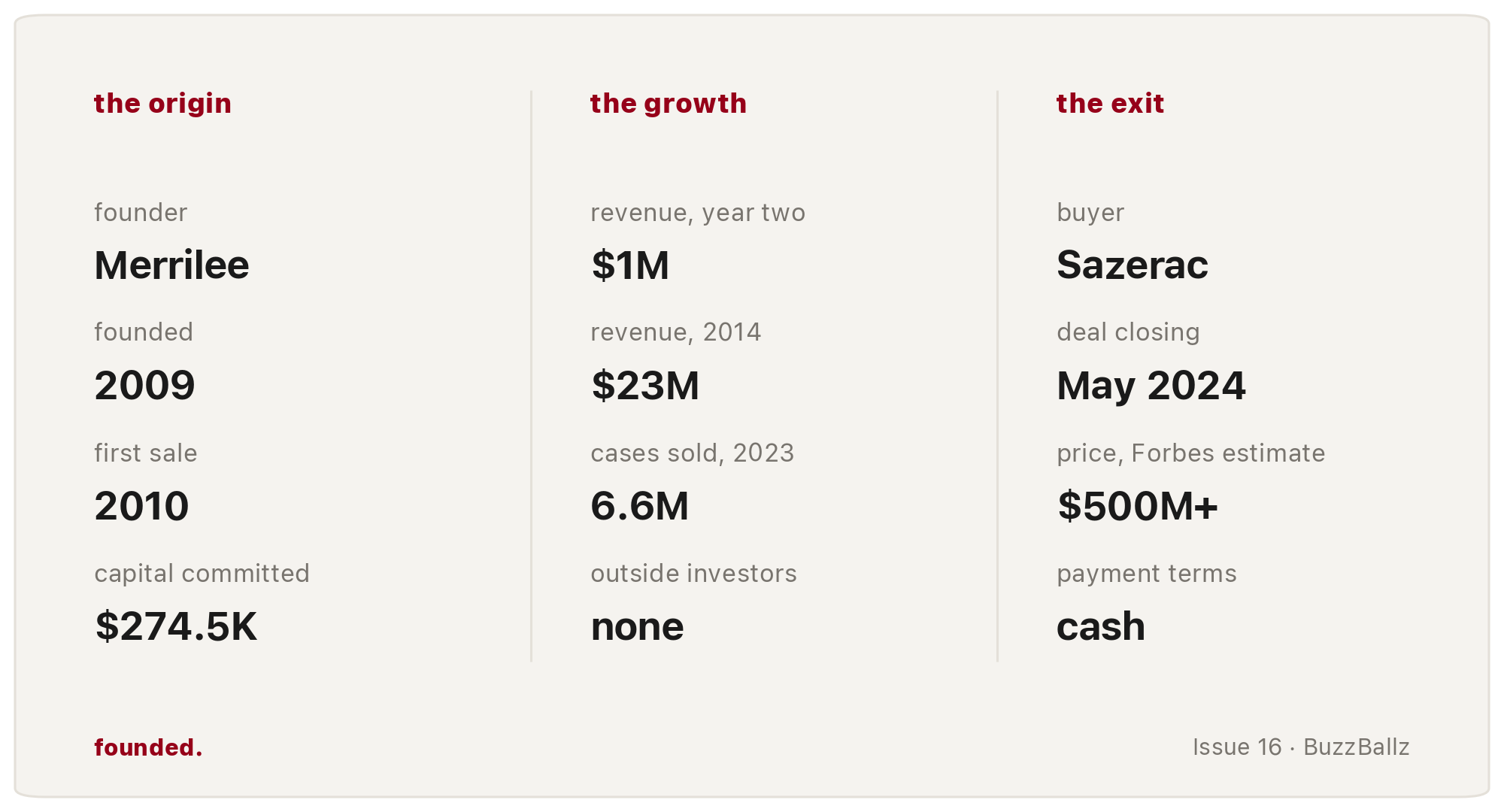
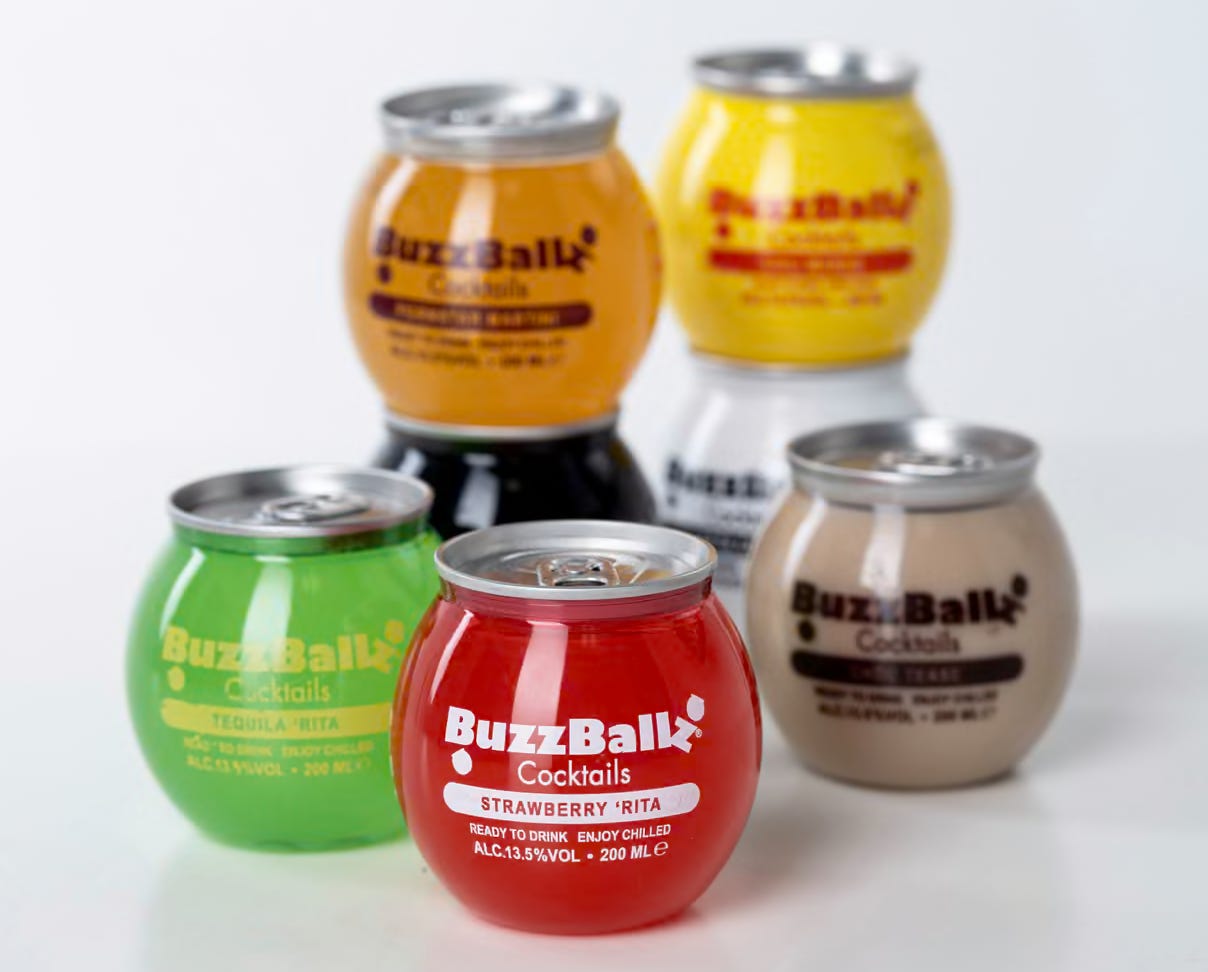
BuzzBallz is an American brand that makes ready-to-drink cocktails in plastic containers shaped like Christmas ornaments and about the size of a tennis ball. They sell for $2.99 at liquor stores, grocery stores and gas stations, and each ball is 15% alcohol by volume. The company also makes its own containers and spirits at a plant in Carrollton, Texas.
Merrilee Kick started the brand in 2009 as her MBA project while teaching high school in Plano. Over the next 15 years she never accepted a dime of outside capital, and in May 2024 Sazerac, the private spirits company behind Fireball and Buffalo Trace, bought the business in an all-cash deal that Forbes estimates at $500 million or more.
If you sell a physical product in stores or on a platform you don’t own while you work a day job, this one’s for you.
What we found out:
Adapt the product to the stores you can reach. The convenience and grocery stores Merrilee could visit couldn’t sell spirits, so she made a wine-based version they could carry.
Don’t expect a distributor to sell for you. Hers only delivered to stores that ordered, so Merrilee visited 20 stores a day and mailed letters to 17,000 more.
Keep your job until you’re debt free. Merrilee stopped teaching after year three, once the bank loan was repaid and the business made more than six figures a month.
Bring production in-house when suppliers won’t work with you. When her only container supplier kept raising prices, she moved production to Texas and cut the cost of each container in half.
Sell where your buyers already are. A $2,000 booth at a Las Vegas trade show for alcohol wholesalers led to signing up with distributors for 15 states in one day.
Be patient with the right buyer. Sazerac passed on her asking price about three years before the sale, then came back in 2024 and agreed to a deal within weeks.
01: grading papers by the pool
In 2009 Merrilee was 46 and grading papers by her pool in Plano, Texas, with a cocktail beside her. She didn’t like having glass by the pool and found herself wondering why cocktails weren’t sold in a less breakable container.
She taught entrepreneurship and marketing classes at Plano West Senior High School. The school was paying for her to get an MBA at Texas Woman’s University. For her final project, she wrote a business plan for single-serve cocktails in round containers, called PartyBallz, and got an A.
Teaching wasn’t her first career. Merrilee grew up in Helena, Montana, where both parents taught high school science. The family didn’t have much money: her mother sewed their clothes, and they often grew and hunted their own food.
She studied business, economics and computer science at the University of Montana and then worked as a computer engineer at Electronic Data Systems (EDS).
EDS moved her to South Africa in 1995. She later lived in Stockholm, and in 2003 she moved back to the US to work as a news anchor at CBS radio in Dallas.
By 2009 she and her husband, Tim, were considering a divorce. She had no savings and two sons to raise. (They later reconciled, and Tim became the company’s CFO in 2018.)
Merrilee has been open about why she started the business. She wanted to earn about $100,000 a year and she was worried about money. In her words:
I started my company out of fear and need.
— Merrilee Kick, to KTVH, December 2020
I think a few of us can relate to this.
I assess risk in my 9-5, so it’s hard not to look at what happened next the way a lender would. Merrilee was a teacher with no savings and no experience in the alcohol industry, and she wanted to sell a container that no factory had made before. Every bank she went to turned her down.
Fifteen years later, one of the largest spirits companies in the world bought the business. What exactly was Sazerac paying for, and how did a teacher build a business valuable enough to sell?
02: $27,000 hidden in a clock
Merrilee needed $300,000 to get the ball rolling. She applied to the big banks in Dallas and to every credit union in town, and every one said no. In her words, they said she was “just a teacher.”
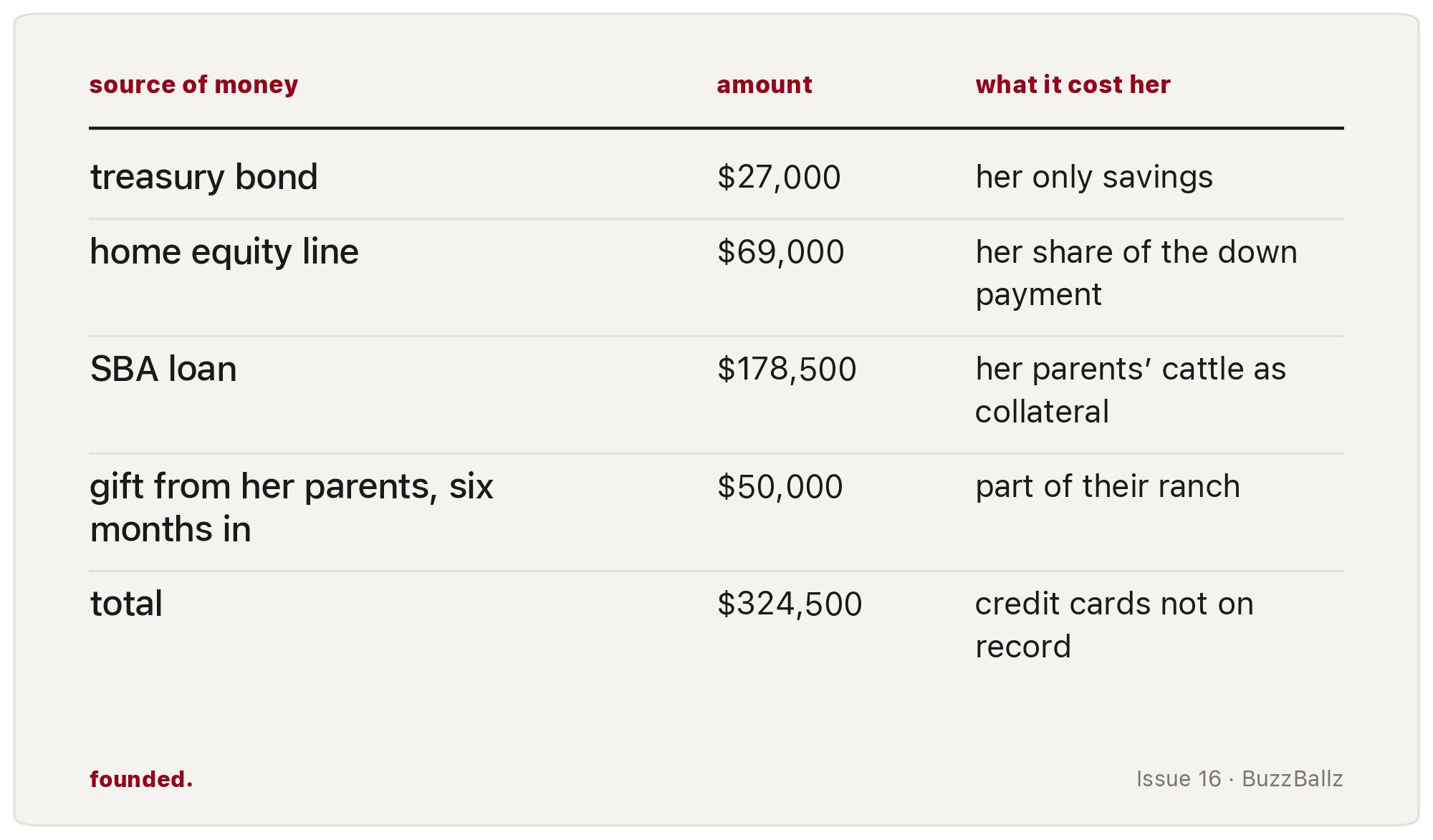
The capital was therefore her own. Her grandfather had left her a Treasury bond worth $27,000, which she hid inside a clock in the living room without telling her husband. She also took out a $69,000 home equity line of credit (HELOC), her share of the down payment on the family home. The one that pains me: she also maxed out her credit cards.
Once her own money was on the line, a local community bank agreed to lend her $178,500 through the US Small Business Administration (SBA), a government program that guarantees part of a loan so the bank takes on less risk. Her parents put up their cattle as collateral. Six months later they sold part of their ranch and gave her another $50,000.
Without the credit card debt, which isn’t public, the bond, the home equity line and the bank loan added up to $274,500. With the $50,000 from her parents, the total capital used to start the business was $324,500.
If this had come across my desk at work, I would have pushed it aside as well. Most of the money was debt, some of it was secured against her home, and there wasn’t a single order or even a prototype.
the first prototype
Merrilee made the first prototype in her garage. It was a screwdriver drink, made with vodka and real juice, and she sealed the container with a hand crank. The idea for the lid came from a trip to Walmart to buy tennis balls. She noticed the metal pull-top on the can and realized the same kind of lid could seal a round container.
She didn’t know how to make plastic containers or shelf-stable drinks, so she asked people who did.
She hired a CAD designer to draw the container, got help from polymer experts at the University of North Texas and food scientists at Texas A&M, and visited a packaging company to understand how filling lines worked.
The next problem was finding someone to make the container. American plastics companies weren’t interested in a small order; one told her it wouldn’t make fewer than 5 million pieces. She found a manufacturer in China through Alibaba.
Most new drink brands pay a co-packer, a company that mixes and fills drinks for other brands. Merrilee refused because of how much margin she would lose, and decided to make the drinks herself. That meant she needed her own alcohol permits, and the government wouldn’t issue them until she had leased a warehouse.
She rented a 7,000 square foot industrial space and hired her first worker from Craigslist at $13 an hour. Her entire teaching salary went to paying rent.
She was still teaching and working at the radio station during the day while building her empire at night.
03: twenty stores a day
In Texas, a company that makes alcohol can’t sell it directly to stores. It has to sell to a wholesaler (also called a distributor), and the wholesaler sells to the stores; before Merrilee could sell a single drink, she needed a distributor to work with.
She pitched Blair Casey at Glazer’s, which is now called Southern Glazer’s Wine & Spirits. Blair said no. Merrilee went back with new pricing, and this time Blair agreed to a test run.
In 2010 Blair ordered five pallets for Dallas, followed by more for San Antonio, Houston, Austin and El Paso. The first order was worth $75,000, more than her annual salary as a teacher. Each ball sold for $2.99 in stores. Merrilee sold it to the distributor for $1.30.
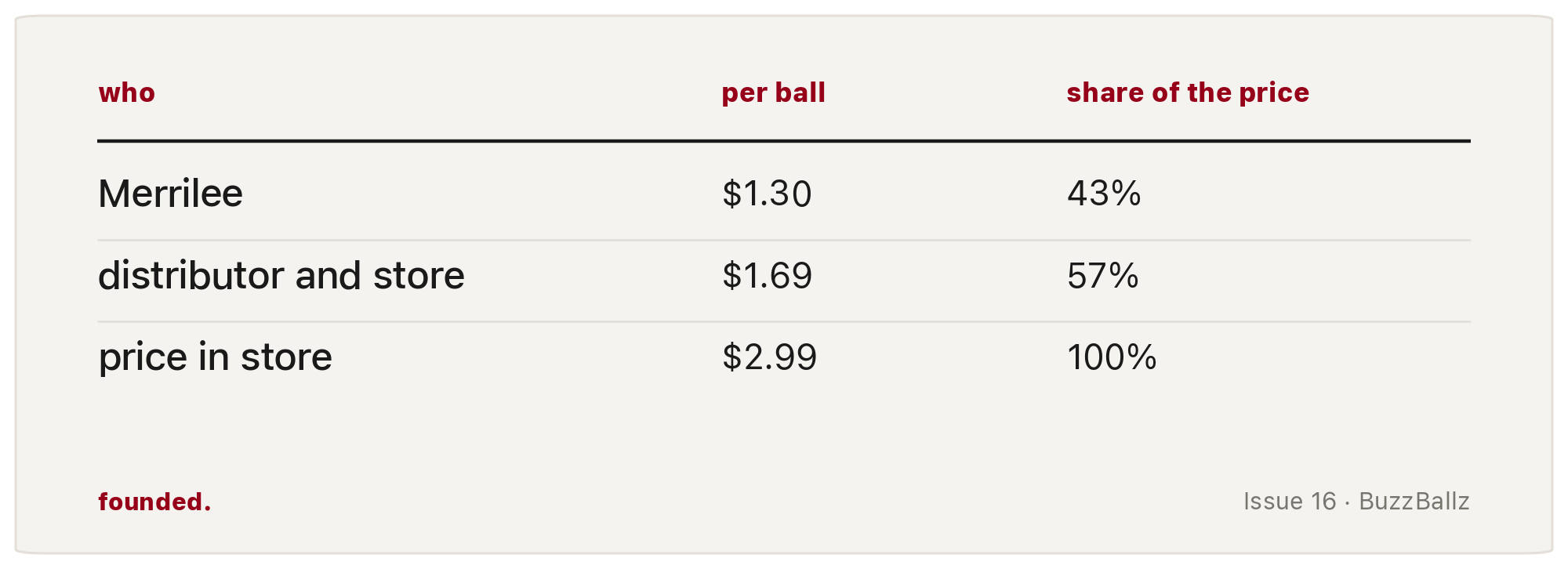
This part was confusing to me. I assumed that once a distributor like Glazer’s agreed to carry the product, the hard part was over. It turns out the distributor didn’t get the product into stores. It only delivered to stores that ordered, and Merrilee learned that “you had to build it yourself.”
She started selling to stores on her own, one by one. She pitched 20 independent convenience stores a day in Dallas, then moved on to Austin.
She couldn’t reach all 17,000 convenience stores in Texas in person, so she mailed them a letter with photos of the product and handed out samples until customers started asking for BuzzBallz. Over time she built up about 300 retailers in Texas.
a second recipe
Early on, a problem limited reach. BuzzBallz were made with spirits (vodka, tequila, rum), and convenience and grocery stores weren’t legally allowed to sell them. Only liquor stores could.
Instead of looking for another way in, Merrilee changed the product. She made a second line called Chillers that used wine as the base instead of spirits.
Chillers came in the same round container so the stores she had already visited could now sell them. The original spirit-based line, called Cocktails, stayed in liquor stores.
She did this in the first year. The company has sold the same flavors on different bases ever since.
I’ll come back to this decision in section 11 because I think it’s the most important one Merrilee made.
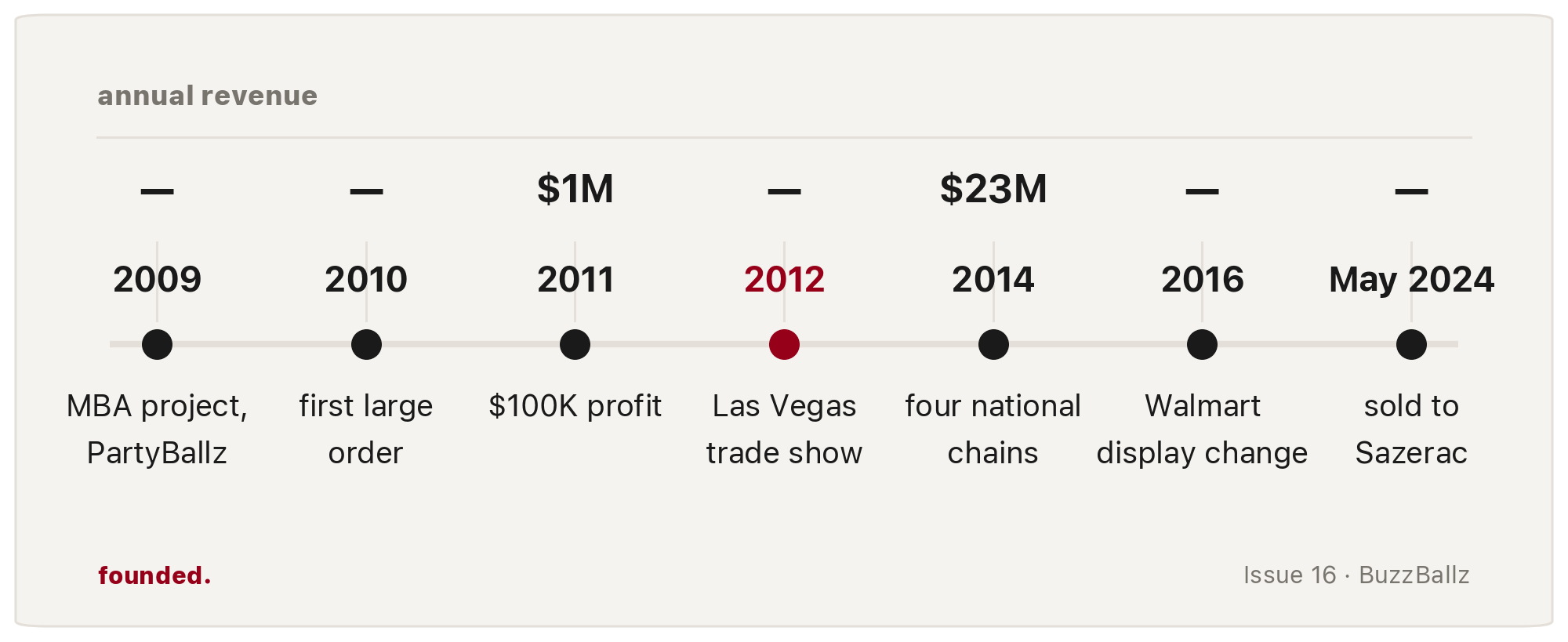
BuzzBallz sold 20,000 cases in its first year and lost $100,000. In its second year, 2011, the business made about $1 million in revenue with $100,000 in profit. Merrilee didn’t pay herself for the first two years.
04: a $2,000 booth
In 2012 Merrilee and her son Alex drove from Texas to Las Vegas to attend the convention of the Wine & Spirits Wholesalers of America.
They paid $2,000 for a 10x10 booth. A contact in distribution had suggested the show, and Merrilee bought the last booth available. The company had 15 employees.
By the end of the first day, distributors for 15 states had signed up to carry BuzzBallz. Merrilee also left with an agreement for Southern Glazer’s to distribute BuzzBallz in 26 states, and her Tequila ’Rita won the show’s top prize, a double gold from all 50 judges.
That same year, Merrilee stopped buying her containers from China. Her supplier there was the only one making them and kept raising prices. In her words, the supplier was “holding me hostage.” She flew to China to learn how the containers were made and then had custom machinery built, moved it to Texas and started making the containers herself. That cut the cost of each container in half.
After year three the bank loan was paid off, and that’s when Merrilee stopped teaching. She was terrified of debt, and tied the decision to BuzzBallz reaching Arkansas, Missouri and Kansas.
Revenue in year three was $2 million.
I would have guessed that she quit right after the trade show, but she kept teaching until the loan was repaid later that year.
05: getting into national chains
I wanted to understand this part more than any other. If the distributor only delivers, how does a teacher from Plano end up in Walmart and 7-Eleven? Four things had to happen.
First, the independent stores in Dallas and Austin gave BuzzBallz a sales history Merrilee could show bigger buyers. Second, a chain like 7-Eleven buys alcohol through the distributor in each state, and the Las Vegas show put distributors in place in at least 26 states in two days. Third, Chillers could go on the beer and wine shelves of convenience stores, grocery stores and drugstores. Lastly, customers were asking for it; a chain is far more likely to give shelf space to a product customers already buy.
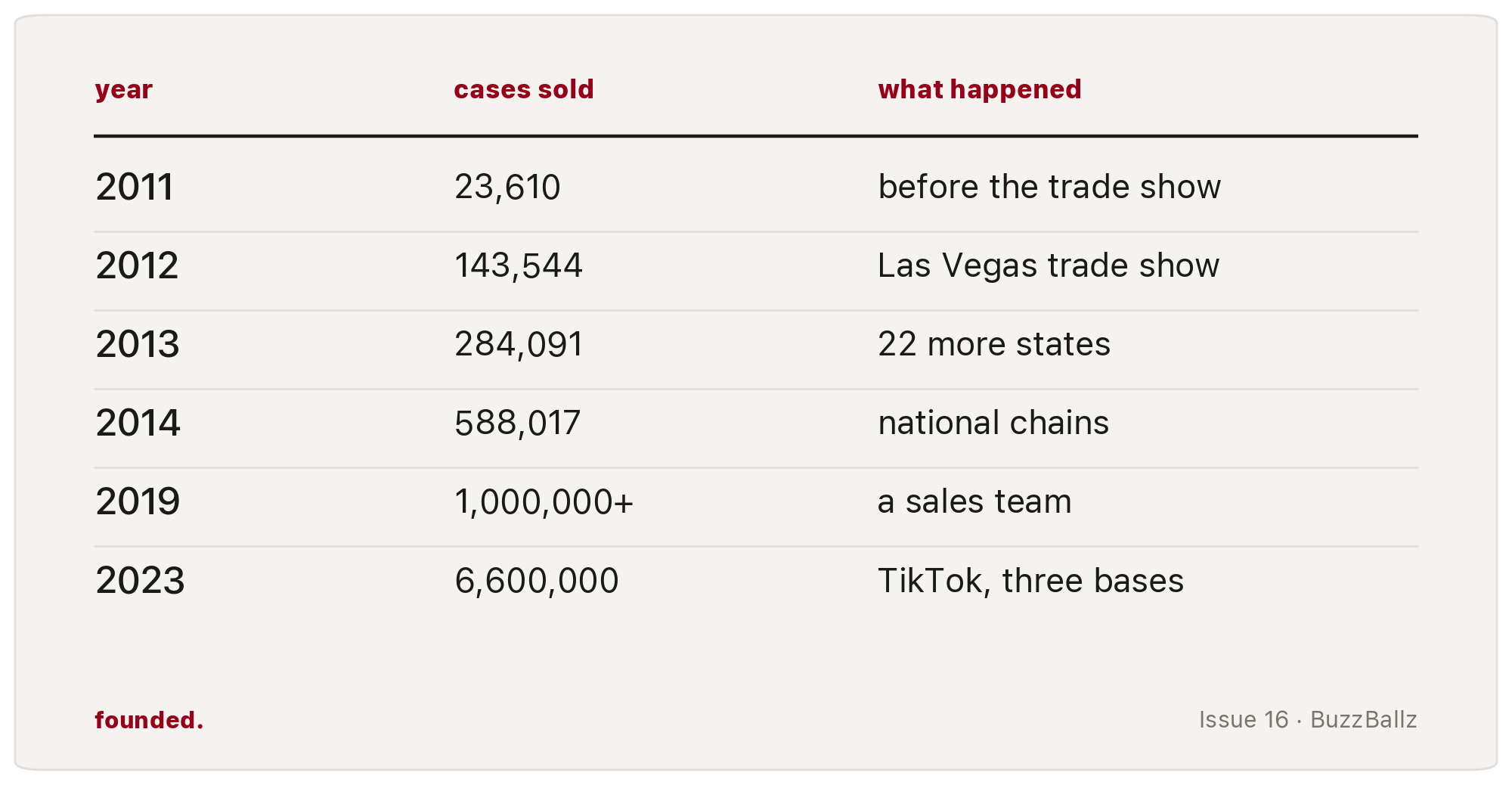
BuzzBallz sold 23,610 cases in 2011 and 143,544 in 2012, the year of the trade show. In 2013 it added distribution in 22 states, and revenue grew 176%. Cases doubled again, from 284,091 in 2013 to 588,017 in 2014.
By 2014 revenue was $23 million, with double-digit growth at Walmart, 7-Eleven, Circle K and Walgreens. By 2016 BuzzBallz was a top seller at 7-Eleven and QuikTrip, and in 2017 it became the official premixed cocktail of Spirit Airlines.
It wasn’t all growth from there. Walmart changed how it displayed BuzzBallz, which cut sales by about $5 million. The drinks had been sold from a large bin in a main aisle, and Walmart moved them to a rack to clear floor space.
That tells me how people bought BuzzBallz: most didn’t plan to but did because the product was easily accessible within the store.
Merrilee later said she learned to plan how a product would be displayed before working with a retailer.
Merrilee’s family joined the business along the way. Alex, her oldest son, became president and her younger son, Andrew, became vice president.
In 2020 Merrilee owned 90% of the company and each son owned 5%. By the sale, each son owned 24.5%, so most of that equity changed hands in the last few years before the deal.
The coolest part? Remember Blair, the buyer at Glazer’s who first told her no? Blair left the distributor in 2017 to run sales and marketing at BuzzBallz.
06: from 1 million cases to 6.6 million
In 2019 BuzzBallz sold more than 1 million cases in a year for the first time with revenue approaching $50 million. Four years later it sold 6.6 million cases. Here’s what changed in between.
a sales team
Until 2017, Merrilee and her sons were the entire sales team. Blair changed that: in the three years after Blair joined, sales grew 121%. The company hired its first head of marketing in 2018, launched BuzzTallz, a wine-based cocktail in a tall can for grocery stores and drugstores, and launched its loyalty program, Buzz Club, in 2019.
more bases, more stores
In early 2020 the company got a brewery license, which made one plant a distillery, a winery and a brewery. A malt-based version followed, in part to get into Pennsylvania, and did $595,883 in its first year. The flavors tasted the same whatever the base.
the plant
None of this works if you can’t make enough product. The warehouse went from 7,000 square feet to 500,000, and by 2019 the plant was filling 1,200 balls a minute and making 30 million containers a year for BuzzBallz and other brands.
I think owning the plant mattered more than anything else. When demand jumped during the pandemic, BuzzBallz didn’t have to wait for a supplier or a co-packer to catch up.
TikTok
Social media came next. Other companies I’ve written about started there and grew with paid ads; for BuzzBallz it was an extra channel once the main ones were already working.
The company has said going viral “was never part of the plan.” It never advertised on TikTok, and it couldn’t: alcohol advertising rules require at least 71.6% of an audience to be of legal drinking age.
Instead, customers made and posted the videos. By May 2021 the hashtag #BuzzBallz had 14 million views. One video of a drinking game, where whoever caught a thrown ball had to drink it, reached 1.6 million views.
Revenue went from $50 million in 2019 to $68.8 million in 2020, and sales grew 292% between 2019 and 2022.
BuzzBallz only started advertising once it knew what customers liked.
In 2023 the first national ad campaign aired with Blake Anderson, an actor from the show Workaholics, who had already been talking about BuzzBallz on his podcast. The ads were viewed 15.2 million times, and online searches for the brand rose 38%.
what went wrong
An early version with 20% alcohol turned out to be illegal in some states, which caused problems with the Spirit Airlines deal. She changed the formula back to 15%, which keeps BuzzBallz under the 16% line above which US alcohol taxes are higher.
There were problems on site too: employees drank on the job, and one copied company files and went to work for a competitor. Merrilee sued and won.
The people who helped her start the business weren’t the right people to grow it. Many of them hated structure, so she hired managers to build processes. The edgy marketing of the early days was also toned down.
the broken rules
BuzzBallz differed from most new drink brands in four ways:
Most new brands pay a co-packer. Merrilee made the drinks, the containers and the spirits herself.
Most brands rely on a distributor to get into stores. Merrilee sold to stores herself and ran the orders through the distributor.
Most spirits brands are sold only in liquor stores. Merrilee made a wine-based version for the stores that couldn’t sell spirits.
Most founders at this size sell part of the company to investors. Apart from the stakes she gave her sons, Merrilee never did. Despite being terrified of debt, she chose a loan over selling equity.
07: the second offer
Merrilee turned down investors for years. Private equity was never part of the plan. What she eventually wanted was a buyer that had what she didn’t: wider distribution, legal support and more influence with retailers.
About three years before the acquisition, Merrilee tried to sell to Sazerac, her buyer of choice. After a closer look, Sazerac decided the price was too high and walked away.
In 2024 Sazerac came back, and the two sides agreed to a deal in a few weeks. The acquisition was announced on March 20, 2024, and closed on May 1. Here’s what she had to say:
Sazerac matched our innovative culture and spirit best.
— Merrilee Kick, March 20, 2024
Jake Wenz, the CEO of Sazerac, later explained what made BuzzBallz attractive. Merrilee had built up distribution slowly and steadily, and the volume each store sold was going up every year.
Jake also admitted that waiting those three years had cost him. In his words, Sazerac “probably ended up paying a little bit more” than it would have four or five years earlier.
To answer the question from earlier: Sazerac was paying for the 15 years Merrilee spent getting BuzzBallz into stores one at a time and making sure they kept selling on the same shelves. The company already owned more than 400 brands, but this was something it couldn’t build quickly or efficiently.
the (estimated) acquisition price
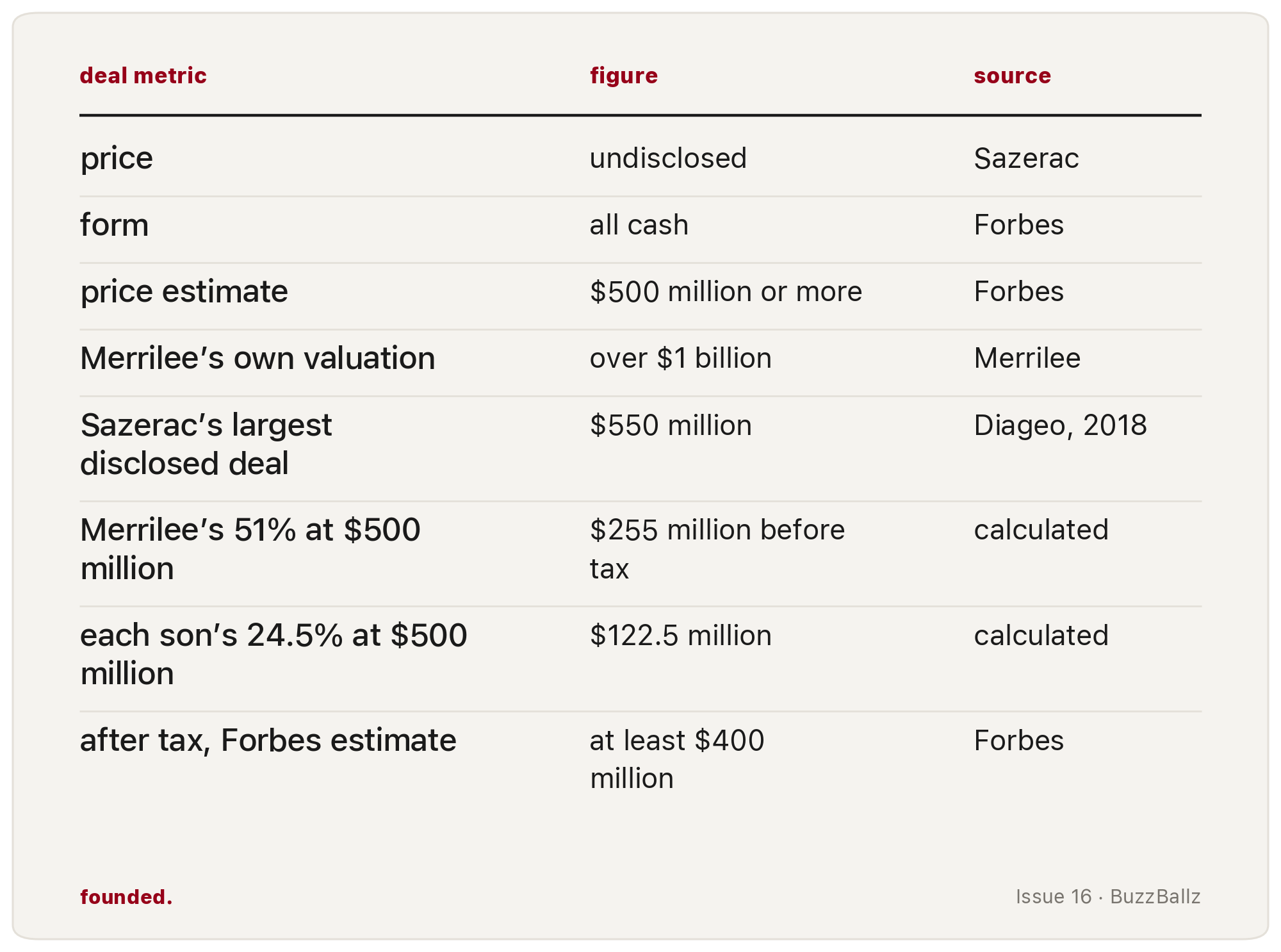
Neither side has disclosed the price. Both companies are private, so there are no public filings, and Merrilee signed a non-disclosure agreement. All that is known is that it was an all-cash deal.
Forbes estimates the price was at least $500 million and that Merrilee kept at least $400 million after tax. When she was asked about the estimate, she said: “Forbes missed the mark” and that the real number is much higher.
The two estimates don’t line up. At the sale Merrilee owned 51% and each son owned 24.5%. If the price was $500 million, her 51% would be worth $255 million before tax and each son’s share $122.5 million.
For Merrilee alone to keep $400 million after tax, the price would have to be well above $500 million. So either the $400 million includes her sons’ shares, or the price was much higher. The Forbes piece was titled “Merrilee Kick & family,” which points to the first.
Forbes also estimated revenue at $500 million a year, meaning Sazerac paid at least 1x revenue. Profit was never made public.
I found three other hints through my research:
When the deal was announced, Merrilee told a trade newsletter: “The value of our company is over a billion dollars.”
Jake has said the deal was close to the largest Sazerac had ever done. The largest one it has disclosed is the $550 million it paid Diageo in 2018.
Trade reports at the time put BuzzBallz’s retail sales at about $200 million a year, well below Forbes’s $500 million revenue estimate.
Jake was closest to the deal, and his comment fits a price of about $500 million to $600 million. Merrilee’s $1 billion seems to be what she believed the company was worth.
08: buying freedom
founded. is about what the sale bought the founder: time, money and no boss. Here’s what the record shows for Merrilee.
time
She planned to retire at 60. Instead, at 61, she signed a four-year employment contract with Sazerac as part of the sale, which was not the retirement she had in mind. It didn’t last a year: Merrilee and her family stepped away from running BuzzBallz in January 2025, eight months after the deal closed.
money
Merrilee started with no savings and a $27,000 bond. After the sale, Forbes ranked her 84th on its list of the richest self-made women in America.
In August 2024 she gave $30 million to Texas Woman’s University, where she got her MBA. The university named its business college after her. She also funds a science scholarship for students in Helena, Montana, where she grew up.
no boss
For 15 years Merrilee had no investor to answer to. The sale changed that: she, Tim and both sons signed four-year contracts that would have run until 2028, and she stayed on as CEO. I couldn’t find why or on what terms they left early.
Her current bio lists her as founder and strategic advisor to BuzzBallz. She also serves as CEO of GourmetLand, a food and beverage start-up in Addison, Texas.
09: the growth channels
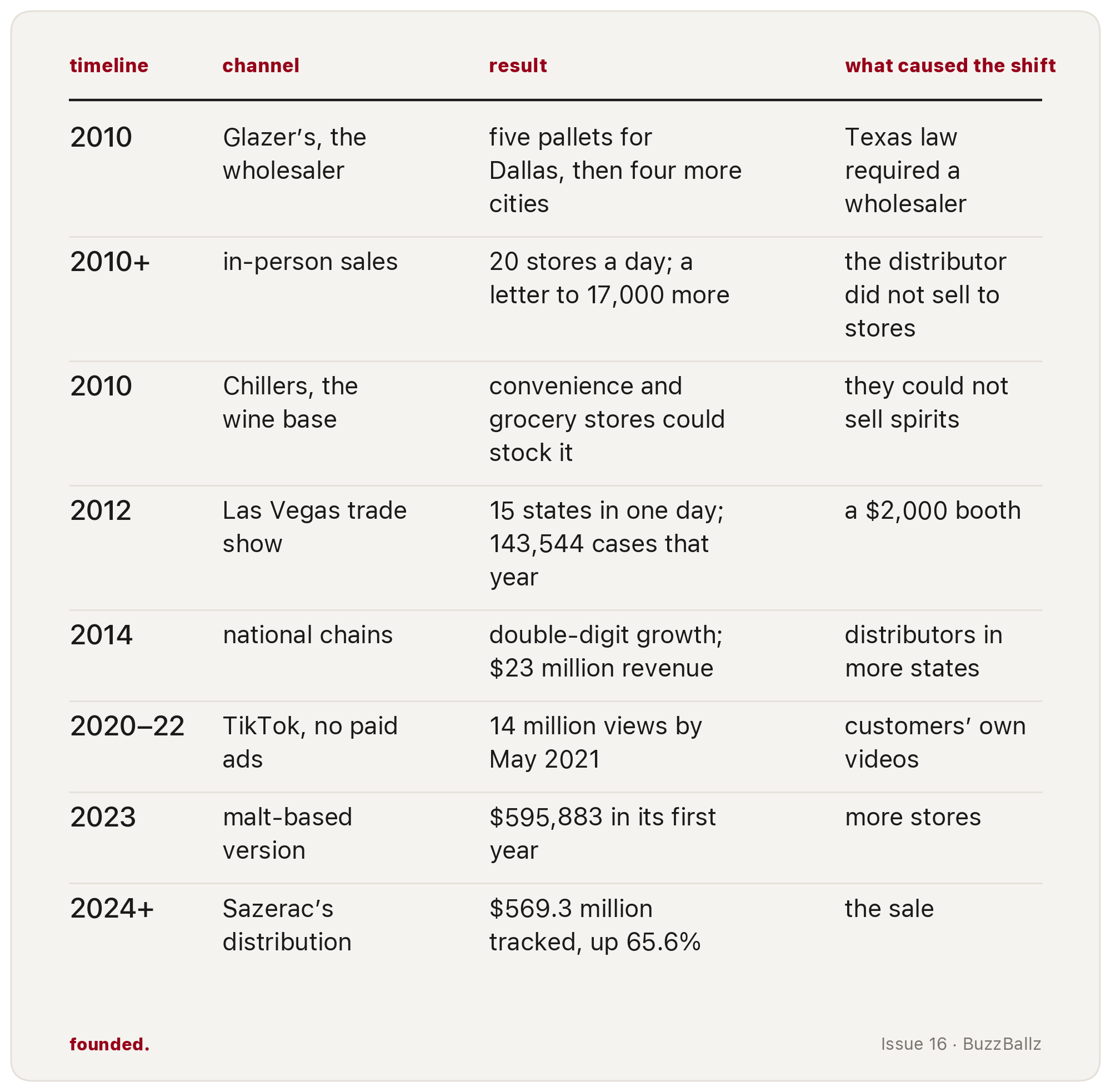
The table below breaks out the channels that contributed to the growth of BuzzBallz, with the result and what caused each shift.
store by store
Visiting stores worked because every store Merrilee signed placed its order with Glazer’s. More orders meant more sales for the distributor and a reason to keep carrying BuzzBallz. The only cost was her time.
the wine base
Chillers got BuzzBallz into stores that could sell beer and wine but not spirits. A sales breakdown between Chillers and the spirit-based line isn’t public, although I wish it was.
10: the tools
the product
BuzzBallz sold a strong cocktail in a round plastic container for $2.99. Merrilee said she wanted a drink that wouldn’t make people “feel fat and bloated the way a beer would.”
Merrilee got $1.30 of the $2.99 shelf price, and everything it cost her to make a ball, plus any profit, had to come out of that $1.30. That’s why the cheaper containers made such a difference.
founder skillsets
Merrilee was a computer engineer, a news anchor and a business teacher, and she had no mentor: “there really wasn’t anyone guiding me or holding my hand.” The funniest part: she taught business long before she had ever built one. If she ever goes back to teaching, I’d like to be in the front row.
monetization
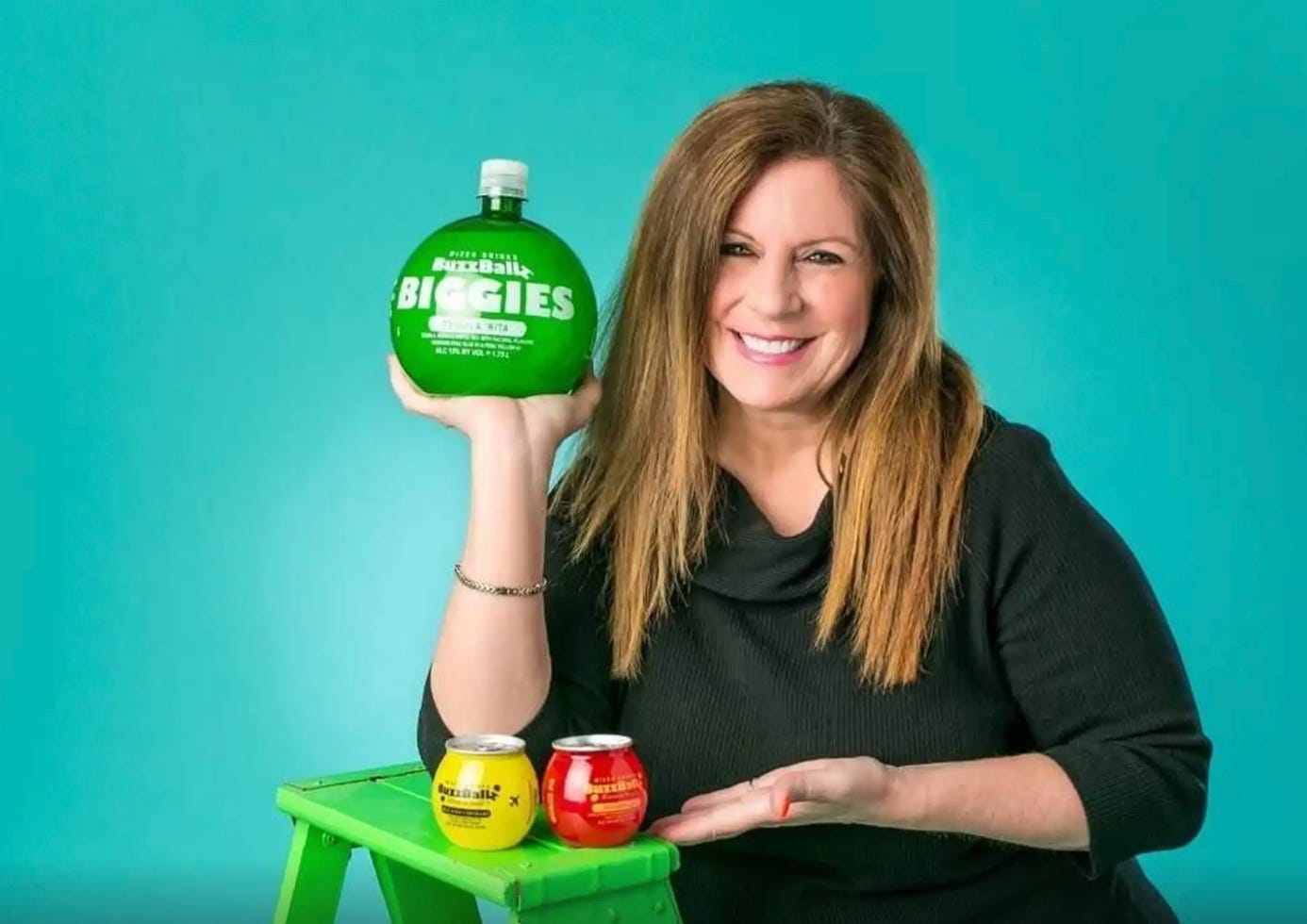
BuzzBallz made money by selling cases to distributors. Over time the company added a 1.75-liter version called Biggies, other cocktail brands, its own spirits and private-label drinks for 7-Eleven and H-E-B. Spirit Airlines also sold BuzzBallz on certain flights for $8.
unique branding
The round container is what makes BuzzBallz recognizable, and the company holds a patent on it. The flavor names are part of the joke too: Choc Tease, Lotta Colada, Cran Blaster. A billboard from 2015 read “TASTE OUR BALLZ.”
The headline on the website now reads “Grab life by the ballz.”
Not everyone likes the branding. Alcohol Justice and Ohio’s Drug Free Action Alliance have both said the containers look like toys and appeal to people who are under the legal drinking age. A complaint in the UK in 2022 was dismissed, although the panel said the design was “close to the line of acceptability.”
11: the founder’s decision: changing the base
the signal
In 2010 Merrilee had a distributor and six flavors, but stores weren’t placing orders, and the stores she could visit in person were mostly convenience and grocery stores that weren’t allowed to sell spirits.
the options
Keep BuzzBallz spirit-based and sell only through liquor stores. Cutwater Spirits, which started selling canned cocktails in 2016, did exactly this.
Make a malt-based version for stores that sell beer. Sazerac did this with Fireball.
Make a wine-based version for convenience and grocery stores.
Merrilee never said which options she considered. The first two are based on what competitors had done.
the decision
Option 3, and later option 2. Merrilee created Chillers, a wine-based line in the same round container and kept selling the original Cocktails through liquor stores. The malt-based version came later.
the cost
Merrilee now had two recipes and two product lines that looked the same but were sold in different stores, and the company had to become a winery as well as a distillery.
the evidence
Chillers launched in 2010. Revenue grew to $1 million in year two and $23 million by 2014.
BuzzBallz never published sales by product line, but several data points confirm the success of the Chillers line:
In 2021 the company said Chillers was the best-selling product line.
In 2023 a marketing director said the wine-based version outsold the spirits version because more stores could carry it.
In 2024 Chillers alone sold nearly 1.5 million cases.
Other things were happening at the same time, which makes the results hard to isolate: the Las Vegas trade show, the cheaper containers and Merrilee visiting stores herself.
There is also survivorship bias. You’re reading about BuzzBallz because the second recipe worked. Brands that changed their recipe to get into new stores and still failed don’t make the cut for founded.
the application
The idea that you can change your product to fit a shelf rather than finding a shelf that fits your product is what I would take away from this case study.
A good example might be a course you want to offer your followers. You want it up and running as fast as possible, which means you don’t have time to build your own website for it.
What do you do? You sign up for a course platform such as Udemy or Coursera, which lets you start easily, but you give up part of each sale in platform fees.
You also need to make sure the course follows the platform’s rules.
Many people would build a website or landing page and host their course somewhere half-built just to avoid these sites. I think a platform can be a great starting point.
Not only does it increase your reach, it gets you live instead of spending time building yet another part of the process.
Merrilee had an important decision to make with her spirits line: stay niche and focus only on spirits, or go wide and aim for mass distribution in the US by offering wine and malt versions.
Here’s why I think it made sense to expand reach:
Alcohol is alcohol. Whether you like it or not, people who buy alcohol tend to buy it in the same places. Many of my friends are too lazy to go to a liquor store and pick up coolers at the grocery store while they’re there. That’s a missed opportunity if there’s no wine or malt version on the shelf when they want it.
The brand didn’t change. Merrilee kept the same packaging and logo with a different base, making sure the flavors tasted the same across drinks.
Distributor connections. Proving sales in grocery and convenience stores showed distributors there was demand outside liquor stores, which is likely also why she had a shot at Walmart and other national chains.
The decision to expand laterally is well supported, even without product-line sales figures. If it had required a different container, less colorful packaging or an alcohol-free version, I would be more skeptical.
That being said, plenty of other alcohol brands have tried a lateral move and created a recipe that few people liked.
12: the quit number
The Quit Number is the revenue a business made the month the founder quit their job.
Merrilee’s was $166,667. She stopped teaching after year three, when the business made $2 million in annual revenue.
It’s the highest Quit Number in this series. Pat’s at Starter Story was $1,737.84 and Neal’s at EasyBib was more than $8,000, while Tibo’s at Tweet Hunter and Julie’s at Baby Einstein were both $0.
What stands out to me is that Merrilee didn’t quit based on revenue at all. The business was already making far more than her teaching salary of $3,000 a month by year two. She stayed until the bank loan was repaid.
13: what still isn’t clear from the research
The acquisition price. Forbes estimates at least $500 million and Merrilee has said it was much higher.
Whether the $400 million Forbes estimates Merrilee kept after tax is her 51% alone or includes her sons’ shares.
The exact month she stopped teaching. The Quit Number is year three’s revenue broken out monthly.
Revenue at the time of the sale. Forbes estimated about $500 million; a trade report stated retail sales around $200 million.
Why Merrilee and her family left in January 2025, three years before their contracts ended.
The price discussed in the first sale attempt with Sazerac.
14: the brand today
In May 2026, Circana data showed BuzzBallz sales of $569.3 million, up 65.6% from the year before. That is more than a fifth of all premixed cocktail sales in the US. The next biggest brand, BeatBox, had sales of $312.5 million over the same period.
BuzzBallz launched in the UK in the summer of 2022. In the 52 weeks to September 6, 2025, sales in UK stores reached £24.6 million, with volumes up almost 800%.
The criticism has grown with the brand: in August 2026 a UK industry panel upheld a complaint about an arcade-style BuzzBallz promotion in London.
From what I can see, the sale has been good for the brand. The products, the round container and the plant are the same ones Merrilee built, and Sazerac has said there is still a lot of room to grow distribution.
FOUNDED FACT
The mini bottles of Fireball Cinnamon that are sold at gas stations for 99 cents don’t contain any whisky. They’re a malt-based drink with whisky flavoring. In January 2023 a customer filed a class action lawsuit against Sazerac over the label.
NEXT ISSUE
Next week: Sarah Michelle NP Reviews. Sarah Michelle Boes kept her job until her exam-prep business for nurse practitioners made $1 million, which took seven months, and all of it came from referrals in her Facebook group. Two years later she sold a business built on her own name. If you’re building a business around a personal brand, this one’s for you.
LEARN MORE
Forbes — “How A High School Teacher Turned BuzzBallz, A Single-Serve Cocktail, Into A $20 Million Business,” December 5, 2016. Merrilee’s own account of the first six years.
Good Beer Hunting — profile of BuzzBallz, August 29, 2023. The container, the distributors and the critics.
SOURCES
Forbes (Chloe Sorvino) — June 1, 2024, read in Forbes Argentina’s translation, June 13, 2024. Age 46 in 2009, the banks, the $178,500 SBA loan, the home equity line as her share of the down payment, credit cards, the 7,000-square-foot warehouse and $13 an hour, year two revenue and profit, the loan repaid and teaching ended after year three, terrified of debt, the Las Vegas booth, the 2014 chains, nearly 7 million cases, the failed sale about three years earlier, all cash, the price and after-tax estimates, the 24.5% stakes, the four-year contracts, 84th on the list, more than 400 brands, the patent.
Forbes (Susan Adams) — December 5, 2016. EDS, South Africa, Stockholm, CBS radio, Plano West, the $300,000 ask and the credit unions, the $27,000 inheritance, the Walmart lid, the CAD designer and the universities, Alibaba, John Sheets, $2.99 and $1.30, the letter to 17,000 stores, Arkansas, Missouri and Kansas, the $100,000 loss, no pay for two years, $23 million in 2014, the Walmart display, $20 million expected for 2016, 60 employees, 40 states, the container cost cut by half, the beer quote.
Good Beer Hunting — August 29, 2023. The $100,000 goal, the garage screwdriver and hand crank, no co-packer, Blair Casey’s five pallets and the five cities, 20,000 cases in year one, 20 stores a day, the Chillers line and where it could be sold, machinery in Texas by 2012, Blair’s move in 2017, TikTok, tracked sales 2018 to 2022, 650 employees and 500,000 square feet, Spirit Airlines, the billboard, Cutwater, the critics and the UK complaint.
Valuetainment — “Beer and Business,” April 13, 2018. The bond in the clock, the salary paying for the warehouse, the $50,000 from her parents, “just a teacher,” the 5 million piece minimum, Blair’s first no, about 300 Texas retailers, teaching and radio by day, retiring at about 60.
KTVH (Helena) — December 3, 2020. Helena, her parents, the cattle as collateral, the “fear and need” quote, the scholarship.
The Shelby Report — May 25, 2023. “You had to build it yourself,” more than 1 million cases in 2019.
Texas Woman’s University — 2019 news releases. The MBA capstone and the A. D Magazine — August 2024. PartyBallz, the $30 million gift, the non-disclosure agreement, “Forbes missed the mark.”
Sazerac — press releases, March 20 and May 1, 2024 (PR Newswire). The announcement, the closing, terms not disclosed, Merrilee’s statement. BevNet — March 2024. The malt-based version and its $595,883.
Brewbound — interview with Jake Wenz after the sale. The distribution, the rate of sale, “paying a little bit more,” the room to grow.
Women Business Collaborative — Merrilee Kick biography, read November 14, 2026. Strategic advisor, GourmetLand, private label for 7-Eleven and H-E-B, the university degrees.
The Daily Pour — May 20, 2026 (Circana). $569.3 million, 65.6%, BeatBox at $312.5 million. The Grocer (NIQ, 52 weeks to September 6, 2025). UK sales and volumes. Drinks Intel — August 12, 2026. The UK panel ruling. FoodNavigator — January 21, 2026. Retail sales near $200 million before the sale.
buzzballz.com — homepage, November 14, 2026. The headline, 18 flavors, 15% alcohol, the footer.
NPR and NBC — January 2023. Fireball Cinnamon, 99 cents, about 170,000 stores, the class action. The FOUNDED FACT.
D CEO — “Merrilee Kick is Creating a Big Buzz,” December 2020. Revenue of $2 million by year three, the 90% and 5% stakes, the packing robot, 121% growth since Blair joined, no mentor. D CEO — June/July 2024. The four-year search for a buyer, the 50% growth plan.
WSWA — case study, December 9, 2020. Cases in 2011, 2012, 2013 and 2014, the 22 states and 176% revenue growth in 2013.
GuruFocus — December 30, 2019. The last booth and the double gold, 15 employees at the show, 1,200 balls a minute, 30 million containers, $50 million revenue, the $3,000 salary, the 20% product, the employee problems and the lawsuit, Harvard.
Drinks Intel — “My story: how BuzzBallz became a near-7m-case brand,” January 17, 2024. The 26 states, the trip to China, 6.6 million cases, 855 employees, beer distributors, 15% and the 16% tax line, “really hate structure.”
VICE — May 4, 2021. The TikTok videos and view counts, “never part of the plan,” the 71.6% rule, $3.49, revenue of $68.8 million in 2020, Chillers as the best-selling line.
BevNet — “How BuzzBallz Has Kept The Party Rolling,” 2023. Independent stores first, Walmart, the wine base outselling spirits, Pennsylvania, 292% growth, Buzz Club, Blake Anderson. Shorty Awards — campaign entry. 15.2 million views and the 38% rise in searches.
Forbes — profile of Merrilee Kick & family, June 3, 2025. The family leaving in January 2025. Beer Marketer’s Insights — March 2024. “Over a billion dollars.” UPI — November 12, 2018. Sazerac’s $550 million deal with Diageo.
The Rider (UTRGV) — November 25, 2024. The $75,000 first order and the 17,000 stores in Texas. Impact Databank, via Market Watch. Chillers’ 1.5 million cases in 2024.
Every figure in this issue is drawn from public statements, interviews, press releases and press coverage, and each one is listed with its source above. No interview was conducted with the founder. BuzzBallz and Sazerac are private companies and published no financial statements, so revenue figures are as the founder and the press reported them, the price was not disclosed, and the price and after-tax figures are Forbes’s estimates. None of it has been independently audited.
Thanks for the shout out!
My wife and I really enjoyed reading this one, and she and I both remember how viral BuzzBallz on TikTok! I distinctly remember the videos and how she and I would try looking for them everywhere because they were sold out haha
Great analysis as always!