


This case study is important for two reasons.
First, it’s what inspired me to start writing founded. I adapted the idea that Pat Walls had for Starter Story to founder exits and understanding when founders could afford to quit their jobs.
The second is that it provided me with a morning routine working at a cafe for 2-3 hours each morning to get the most important work done before my day job.
I’m deeply inspired by what the founder has built and I am hopeful it is reflected in this article. The entire process and revenue timeline was posted publicly on X, which makes it even more exciting.
If you’re building a business right now and need inspiration, use AI to find you a business that sold that is very similar to the one you’re building. Send it over to me and I’ll write about it if there’s enough information on it.
I’ve found it to be the best way to learn because most aspects are almost directly applicable.
before we dive in
Starter Story publishes interviews with founders about how they built their businesses: what they sell, the metrics and how they found first customers. It started as a blog and later added a newsletter, paid courses, a database of more than 4,000 case studies and, since 2023, a YouTube channel that went on to have more than 800,000 subscribers.
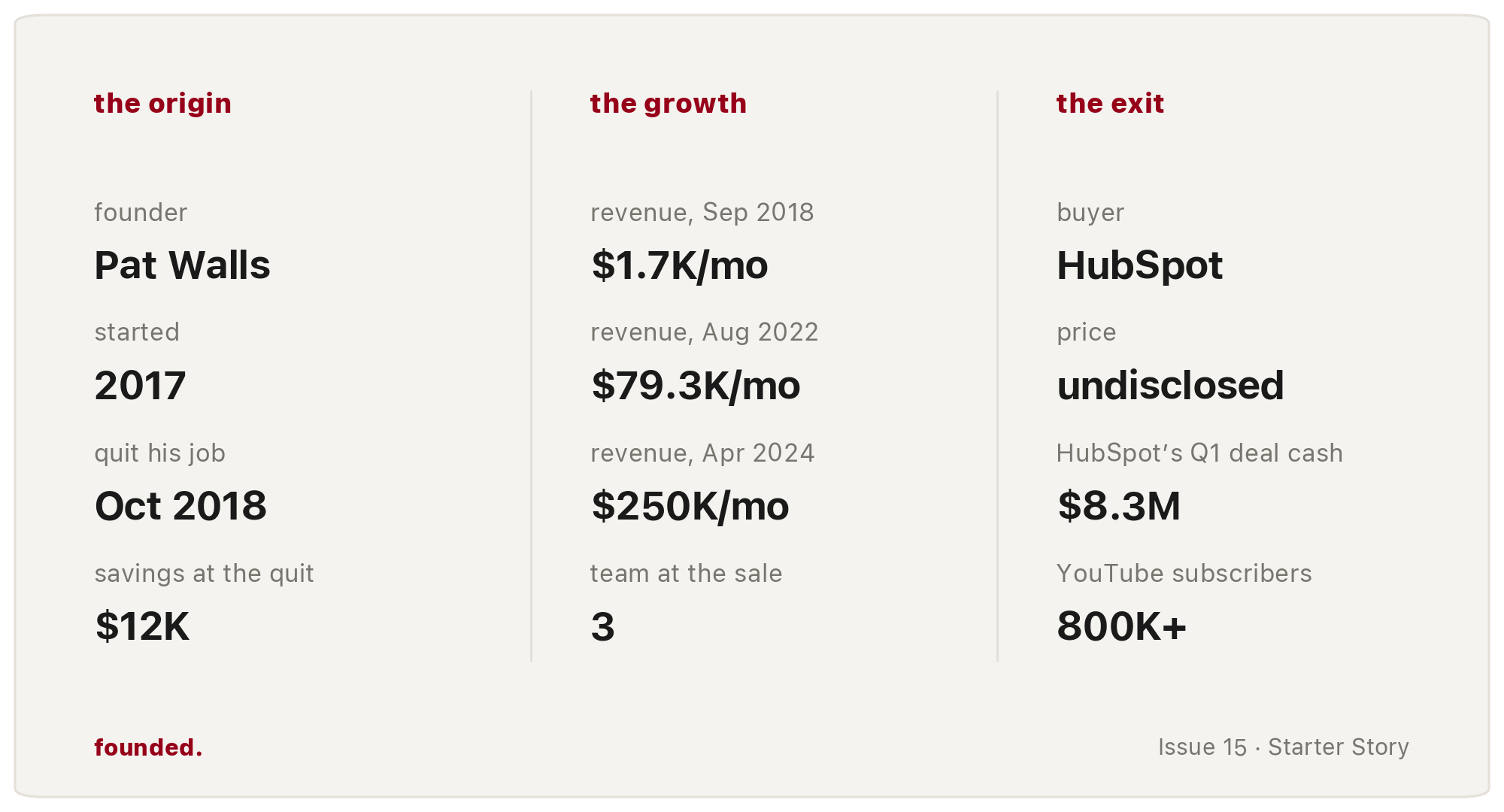
Pat Walls started Starter Story in New York in 2017 as a side project next to a six-figure software job at a startup. Nine years later, in February 2026, HubSpot, a public marketing software company, acquired the brand.

If you run a creative business alongside your 9-5 and are figuring out how to grow cash flow to the point you can go full-time, this one’s for you (and me).
What we found out:
Give away all of the value where your readers spend time. Reddit removed Pat’s first link to an interview and marked it as spam, so he pasted the full interview instead. It was featured on the front page of r/Entrepreneur with more than 400 upvotes and 50,000 views. He repeated this hundreds of times over the years, which brought in more than 1 million site visits.
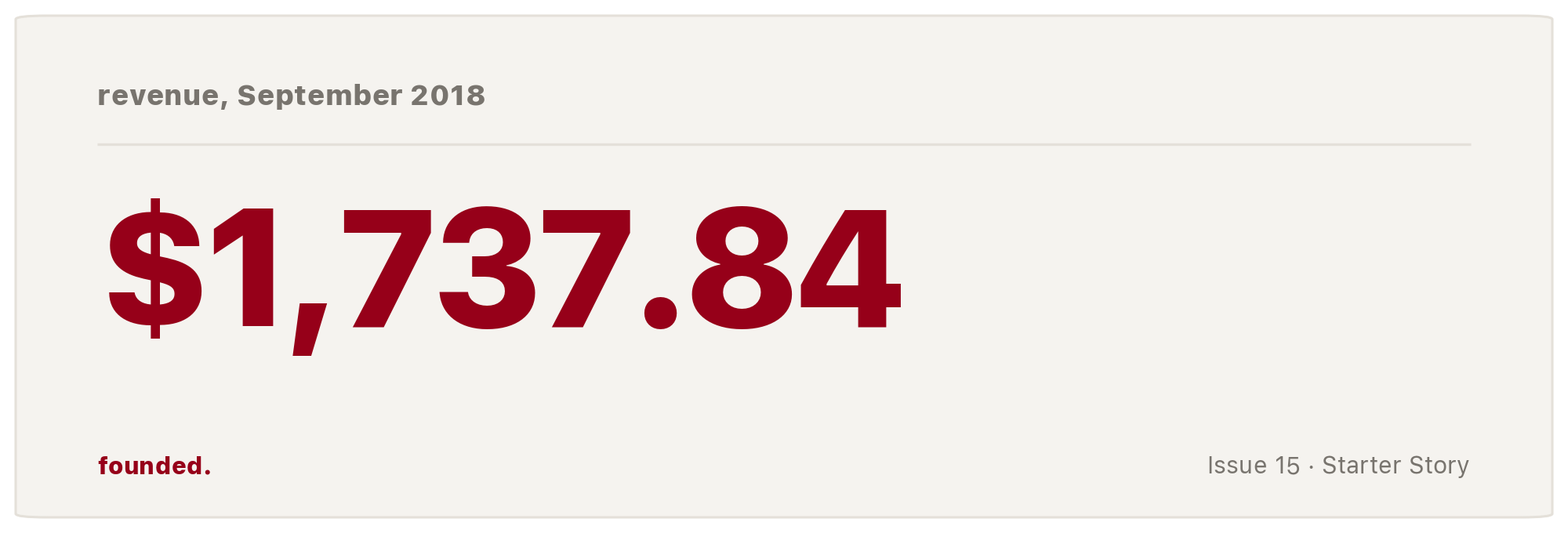
Quit when the business can pay the bills where you live. Pat quit in October 2018 with $1,737.84 of monthly revenue (September 2018) and $12,000 saved, and moved to Chiang Mai, where the cost of living was at most $1,500 a month.
Pick one venture at a time. Pat spent 2019 unfocused with his attention split between Starter Story and another business. In May 2020, he took a week off and returned with a sole commitment to Starter Story. Revenue doubled the next month.
Be open to shifts in distribution. Reddit accounted for the first million visitors until users started to push back. Search engine optimization (SEO) took over from that point and reached 1.4 million visitors per month by March 2022. Pat started a YouTube channel in 2023, just two years before he said “the SEO ship is sinking.”
Use sponsorships and advertising as a crutch. Starter Story was making more than $50,000 a month from this channel at its peak. Pat dropped all advertisers in early 2023 and charged a one-time price for the database of case studies instead. By August of that year, annual revenue reached $1.5 million.
Pitch your buyer in public. On September 23, 2025, Pat posted “hubspot should acquire starter story” on X. Five months later, they did.
01: two hours at a Starbucks
In the summer of 2017, Pat Walls was 26, living in New York and working as a software developer at a startup. He has said the work left him feeling empty.
He had already tried to build something of his own before Starter Story: With two co-founders who also worked a 9-5, they spent four months building an app to help small brands sell to retailers. They struggled to find customers, applied to Y Combinator, were rejected and shut it down.
Pat’s next idea was an Amazon affiliate blog about pets. He lost interest within two weeks.

What he wanted was a guide to how other people had started a business, written for people who didn’t code. He couldn’t find one, so he decided to write it himself by interviewing founders. In his words:
Starter Story was the result of a failed business.
— Pat Walls, to HackerNoon
After reading Cal Newport’s Deep Work, he signed a contract with himself to work two hours a day at the Starbucks he walked past on his way home. Before he quit his job in October 2018, he was getting up at 5:30am to get three hours of work in before the office.
He kept it quiet: “I was so worried that my coworkers would find out about my side project.” I think a few of us can relate to this. He also spent that year paying off his credit card debt.
Two months in, he made his first money on the internet, $3 from Amazon’s affiliate program.
It was only $3, but Pat cared more about what it proved: “It was more about the fact I had made my first dollar that wasn’t from a salary.”
He has also said that he would never sell Starter Story. So why did he?
02: the Reddit interview
Pat planned to launch with ten interviews ready but jumped the gun with just three.
His first month brought around 300 unique website visitors. When he posted a link to one of the interviews on r/Entrepreneur, the moderators removed the post and marked it as spam. So he tried something else:
Instead of linking to the article, I would take the full interview and put it into the Reddit post.
— Pat Walls, to Simon Owens
That post hit the front page of the subreddit with more than 400 upvotes and over 50,000 views, sending a few hundred people to the site.
Here’s how the conversions worked. Most people read the whole interview on Reddit and never clicked through. The ones who wanted more landed on a site with a newsletter signup on every page and every article. A good post sent about 1,000 people to the site, and about 10% of them joined the newsletter. So for every 1,000 visitors from Reddit, Pat got about 100 subscribers.
By 2019 he had automated the whole thing. Each interview was stored in a format Reddit could read, with the title, intro and outro written ahead of time. A program posted one story a day to four subreddits, 15 minutes apart, so Reddit’s spam filters wouldn’t catch it. It stripped out links that got posts shadow-banned and tagged the founder in the interview so they’d get a notification. That added up to around 120 posts each month.
He kept this pace for more than two years. Pat has said that it led to tens of millions of impressions and more than 1 million visitors until Reddit users started pushing back. By August 2019, though, Reddit was only about 3% of Starter Story’s traffic. Most of it was already coming from Google.
Hacker News came next. A Starter Story interview sat at number one for a full day and resulted in around 40,000 visitors. The founder in that interview made $5,000 in sales from the publicity.
A Product Hunt launch, after months of preparation, finished fifth for the day.
The money came from sponsors. Klaviyo, an email marketing company, was the first. Its CEO sent Pat a $12,000 check for a one-year newsletter sponsorship. Banner ads ran at the top of every page and in every newsletter. As a result, monthly revenue went from a few hundred dollars to $1,000. Pat has said the deal is “probably a big reason that starter story exists now.”
The site cost about $85 a month to run: around $60 for servers and $25 for tools.
The entire time, the business was being built in public on X.
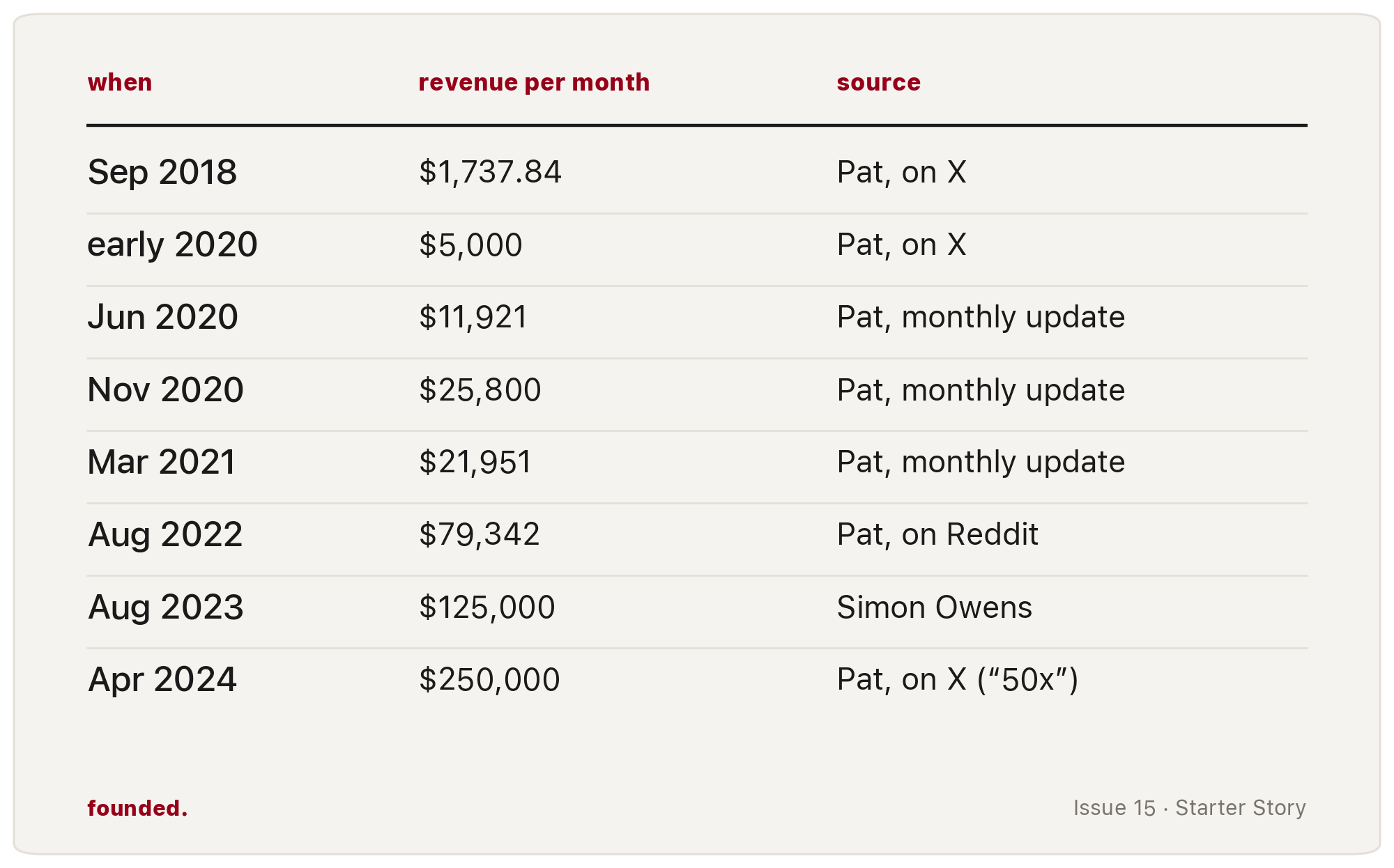
On October 2, 2018, Pat posted his numbers for September: $1,737.84 in revenue, 20,205 unique visitors and 2,956 email subscribers.
the startup challenge
That month, Pat organized a 24 Hour Startup Challenge that required a full sequence from idea to launch in one day. 96 startups were launched and $4,000 in prizes were awarded with no budget. Two days later he quit his job.
I went to my manager and quit my job.
— Pat Walls, December 2018
When he quit, Pat had around $12,000 to his name. His reason is one I think you can relate to: “All the work I had done in my career was for other companies, other bosses - trading money for my time.”
I assess risk in my 9-5, so it’s hard not to overanalyze the decision: September’s revenue works out to $20,854 a year, a fraction of the six-figure salary he walked away from. Looking back in his post announcing the sale in 2026, Pat agreed: “it was too early.”
By then he remembered the business making $3,000 to $4,000 a month when he quit. The numbers he posted at the time say $1,737.84.
03: Chiang Mai
Weeks after quitting his job, Pat flew to Thailand. He started 2019 in Chiang Mai, where he spent at most $1,500 a month, renting an apartment for $150. He later moved on to Bali and Vietnam.
This is what made quitting possible. With monthly revenue of $1,700 and spending at most $1,500, the business covered his costs before tax. The margins were still slim and one email from Klaviyo could have ended the game of musical chairs, but that was a risk he was willing to take.
He also didn’t bet everything on Starter Story, which was smart at first but turned into a mistake. 2019 was spent building Pigeon, a software tool for interviews and content, which grew to 10 paying customers by July. He interviewed with Y Combinator that fall and was rejected a second time.
This part was confusing to me. Why would Pat start another business when one was already working? The answer came to me as I dug a bit deeper: Pat never saw Starter Story as the business. He saw it as a way to learn more so he could build a ‘real’ one. It took some deep reflection to finally understand that Starter Story was the business.
Starter Story kept growing in the background. Pat hired freelancers in June 2019, published more than 500 interviews that year and had nearly 140,000 visitors in November. More than 6,000 cold emails to founders brought in about 80% of the interviews.
Sponsors made up 80% of revenue, premium memberships were 10% and affiliate links the remaining 10%. Klaviyo was still the main sponsor, on six- to twelve-month deals at a time. By March 2019 the brand was paying $4,000 a month to advertise across the site and newsletter.
Pat was open in his Indie Hackers AMA that August:
I have a lot more stress. I feel that it could all fall apart tomorrow.
— Pat Walls, to Indie Hackers
His solution was to keep publishing: “I never stopped posting new interviews. That’s what always got me out of those funks.” He ended 2019 back in the US, with $100,000 of annual revenue across both businesses.
04: hiring family
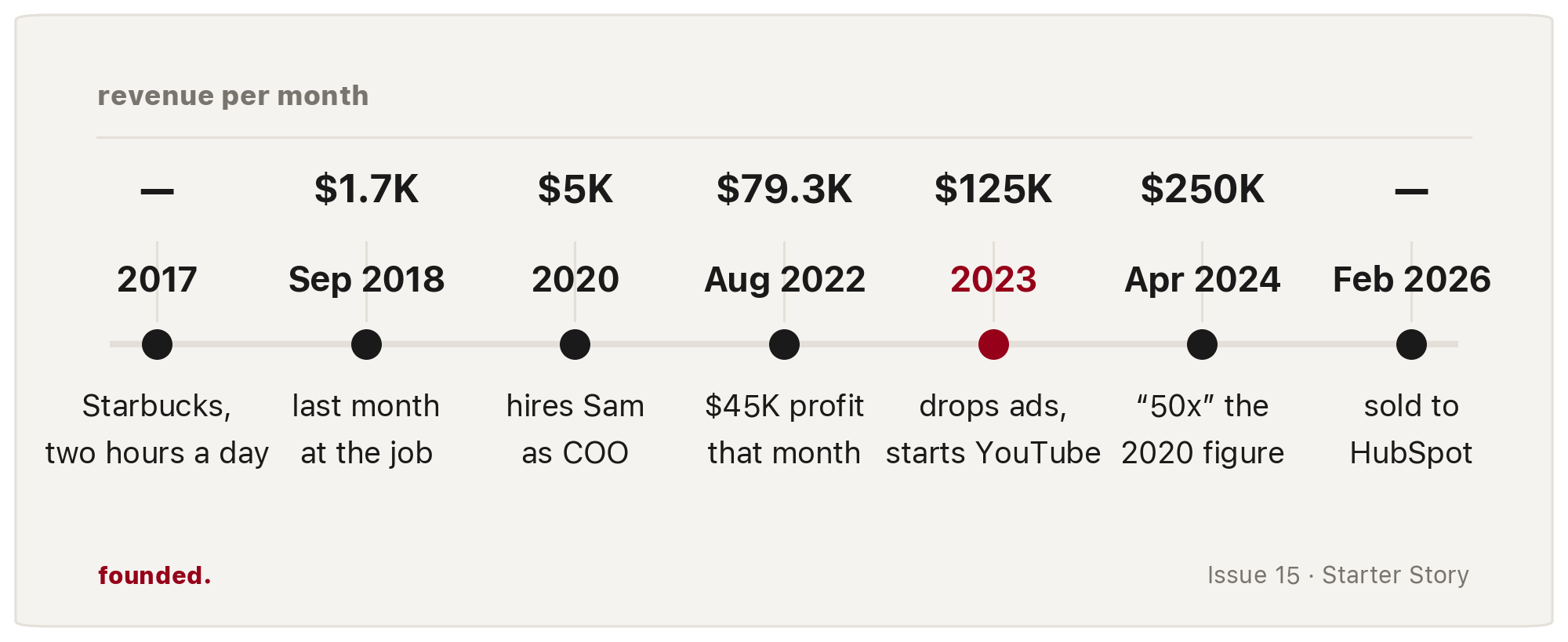
In early 2020, Starter Story was making $5,000 a month. Pat made a hiring decision he later called “the smartest decision of my life”: taking on his sister Sam as COO.
I decided to stop being a solopreneur.
— Pat Walls, on X, April 2024
That added an extra $60,000 a year to the expense load, before Pat paid himself. I don’t know if I could have been comfortable with that decision. I would have opted for a freelancer to keep costs to a minimum.
In May 2020, Pat took a week off to decide what to focus his attention on. He drove around the western United States, primarily through California, visiting old friends along the way.


When he returned, he had made the decision to put all of his energy into Starter Story. It turns out that driving provided the perfect lull where he couldn’t look at screens to really think hard about what was next.
Revenue doubled the month after he committed. He posted figures every month. June 2020 was $11,921, with premium memberships accounting for more than $8,000, and by September 2020, Google was responsible for more than 250,000 site visits each month.
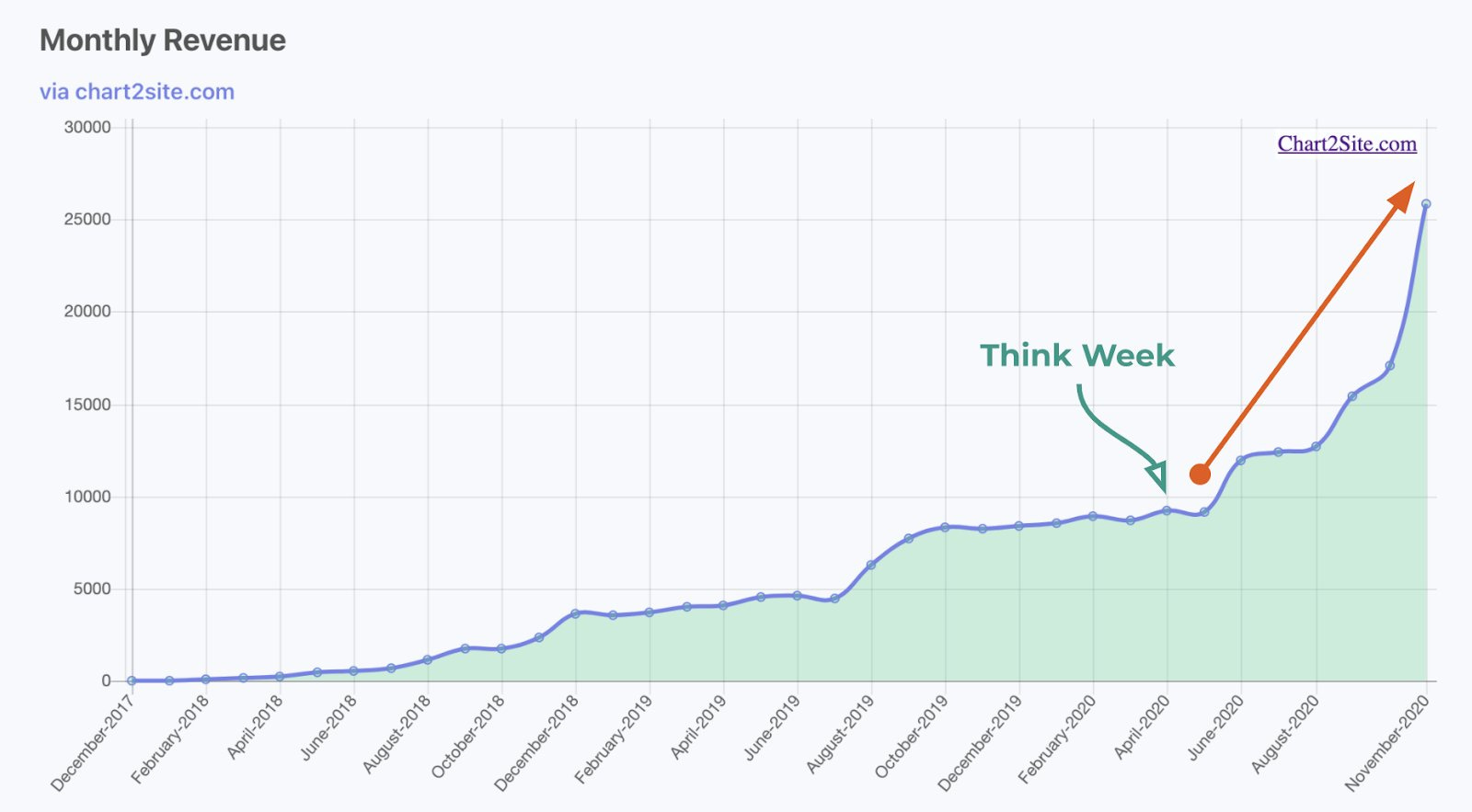
In late 2020 the first course, Lean SEO, was launched, which taught how to grow organic search traffic. Pat offered preorders and collected $10,000 and made $28,226 in the first week from a total of 104 hours of work: 85.5 hours building and 18.5 to promote it.
$271 an hour in case you’re wondering.
The course and nearly 200 new membership signups over Black Friday took revenue for November 2020 to $25,800. March 2021 revenue was logged at $21,951 and Pat commented that new signups had started to slow.
By the following March, the site had 1.4 million monthly visitors generating more than $500,000 in annual revenue.
05: walking away from $50,000 a month
In May 2022, Pat pushed harder with advertising. He had three large advertisers paying a combined $23,000 a month. The goal was to get to $50,000 in monthly ad revenue by the end of September and hire a salesperson to manage it all.
In August 2022, Starter Story made $79,342, with $45,000 in profits and a team of eight. The next month, about 57% of revenue came from ads and sponsors, 38% from premium memberships and 5% from affiliates.
Sponsors had paid the bills since the first Klaviyo deal. At its peak, Starter Story was generating more than $50,000 a month from sponsorships alone.
In early 2023, Pat decided to cancel all sponsorships and replace the monthly membership with a one-time payment that gave permanent access to the archive. By August 2023 Starter Story was making $125,000 a month from memberships and information products.
Pat explained why in an X thread in June 2023:
I used to rely 100% on ad revenue. As a bootstrapped company, I knew this wasn’t reliable and I needed to diversify.
— Pat Walls, on X
He added that the paid product was “still our biggest source of revenue.”
Demand held up. Starter Story sold lifetime access in short sales that were time sensitive. Its 2023 Black Friday deal sold out in two hours. I love this because a digital product technically can’t sell out.
In 2024, the case studies sold for $695, one time, or $1,095 with the courses and the community. In November 2024, Pat offered lifetime access at 55% off for 24 hours, “for less than we usually charge for one year of Starter Story access.” By the sale, more than 10,000 people had paid for archive access.
Pat has never publicly mentioned the costs of choosing a lifetime membership over a recurring business model. I have contacted the founder and hope to find out.
The numbers show why the switch made sense: the sponsorship peak was $600,000 a year that required a lot of selling and a potential hire. Within months of the switch from sponsorships, revenue was 2.5x that figure. Advertising eventually hit a cap whereas Starter Story’s own products and services could scale infinitely.
That year Pat also moved to YouTube and started posting video interviews. He posted the first one and relied on Twitter for feedback. After 12 videos the channel had 85,000 subscribers and within a year there were 200,000.
Newsletter signups went from 200 a day to 2,000 within a few months, ultimately crossing 250,000 subscribers on April 16, 2024.
At the start of 2024, Pat set a goal of $6 million in revenue at a 75% profit margin. That April, he wrote that the business was generating 50 times the $5,000 a month it made when Sam joined, around $3 million a year. It’s unclear whether the goal was ever achieved under his control.
the broken rules
Starter Story differed from most online media businesses in four ways:
Most content sites hold back full articles to get readers to their site. Pat posted whole interviews on Reddit for free.
Most media businesses are primarily monetized through advertising. Pat dropped his advertisers in favor of selling access to the archive.
Most subscription businesses chase MRR. Pat switched to a one-time price.
Most founders wait for a buyer to call. Pat raised the question publicly.
06: the tweet
On September 23, 2025, Pat posted on X:

HubSpot already owned The Hustle newsletter, the My First Million podcast and Mindstream, an AI newsletter.
“Then, a tweet turned into a conversation. That conversation turned into an offer,” Pat explained.
In December 2025, he posted: “YouTube threatening to deplatform us is actually a silver lining.”
He had said he would never sell and he meant it. What changed was how much of his life the business had taken over: “I wasn’t just Pat anymore. I was the starter story guy.”
If I really want this thing to grow beyond me, then I have to let it go.
— Pat Walls, “I sold my company”
He wasn’t sure why he sold either: “Am I selling because it’s the right thing to do on paper, or am I just doing this because I’m tired...”
The deal was announced on February 23, 2026. The whole team—Pat, Sam and YouTube producer Gus Tiffer—joined HubSpot Media. Starter Story was profitable at that point with seven-figure annual revenue, more than 800,000 YouTube subscribers, 275,000 newsletter subscribers and 10,000 paid members.
the (assumed) acquisition price
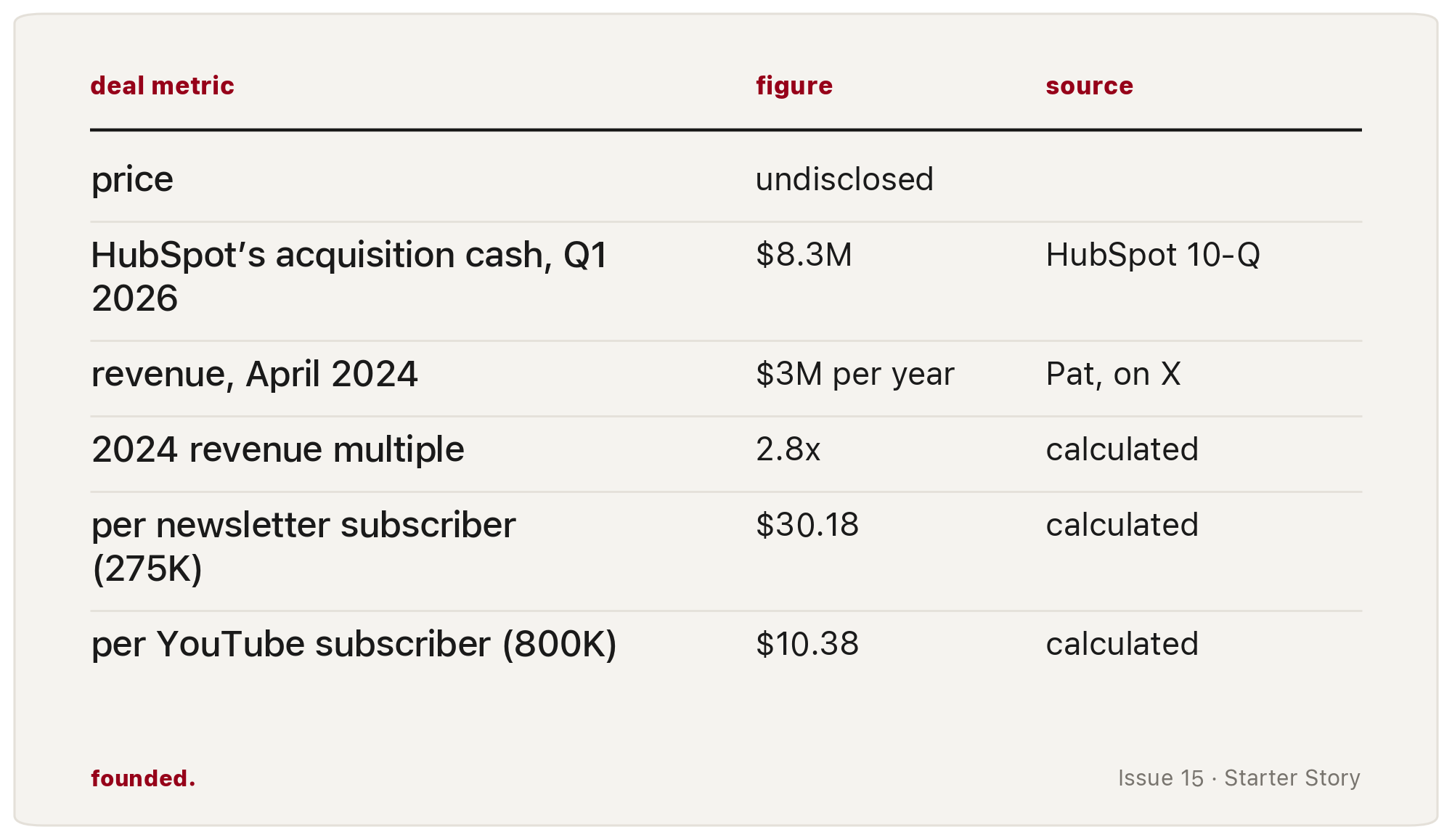
Neither party has disclosed the actual acquisition price, but Pat has called the amount “life-changing.”
HubSpot is a public company, so its quarterly filing is the closest thing to a deal document. In the first quarter of 2026, HubSpot spent $8.3 million on business acquisitions, net of cash. On the earnings call, CFO Kathryn Bueker named two acquisitions: “Starter Story and Futurepedia.”
The deal with Futurepedia, an AI media platform, didn’t close until April 3, after quarter end.
Starter Story was therefore the only acquisition in Q1, and it’s my assumption that the $8.3 million is the amount HubSpot paid in cash for Starter Story less cash the business held. That amount does not include deferred payments, earnouts, or shares.
If Starter Story’s deal was set up like Futurepedia’s, where 31% of the total payout was tied to keeping staff on board, the full package would be closer to $12 million.
Here are the numbers, based on my analysis:
Based on the $3 million 2024 revenue figure, HubSpot paid a 2.8x revenue multiple.
Put another way, $30.18 per newsletter subscriber and $10.38 per YouTube subscriber.
07: buying freedom
founded. is about more than how founders built and sold. It’s also about what the acquisition bought them: the freedom to spend their time as they want, live where they want, and have enough money to not answer to a boss. Here’s what the record shows for Pat.
time
Starter Story started as two hours a day around a job. By 2026 it had taken over Pat’s life.
Something I built for freedom slowly took it away.
— Pat Walls, “I sold my company”
location
In 2019 the business let him work from Chiang Mai, Bali and Vietnam. After the sale he moved back home to Florida. He started the business from a Starbucks in New York, working before and after his 9-5.
money
In 2018 Pat quit his day job with about $12,000 in the bank and by 2026 had sold Starter Story for a cash price likely in the high seven figures. Enough to never have to worry about money again.
I always start to daydream when I see these numbers. The $8.3 million in HubSpot’s filing would yield $581,000 of annual income if invested at an average return of 7%.
no boss
What started as a means to find freedom became a second 9-5 after the sale. He and his former team now work for HubSpot Media. He has said that he might “potentially go back to a job.”
So why did a founder who swore he would never sell end up doing just that?
From a financial and growth perspective, the timing makes sense. Google search, the channel that built Starter Story, was declining, something that Pat said publicly before he had an offer on the table. He sold while the YouTube channel was growing, to a buyer that needed video content for its portfolio.
From a freedom perspective, the writing was on the wall. The business had started to consume him and Pat wanted it to continue to grow.
When I took a week off to ‘live like a founder,’ I found it was inherently difficult to draw the line and finish working. As an entrepreneur you’re never truly finished. If you’re having fun and more inputs can yield more outputs, it’s hard to stop. It’s important to realize that eventually it can burn you out, so a fixed work schedule is needed.
I like to take Sundays fully off from the business. I know I could probably make more progress, but taking this time serves as a reset and room to breathe.
The story started with two hours a day at a Starbucks and $3 in affiliate revenue from Amazon. It ends with a life-changing sale and Pat back home in Florida eight years later.
08: the growth channels
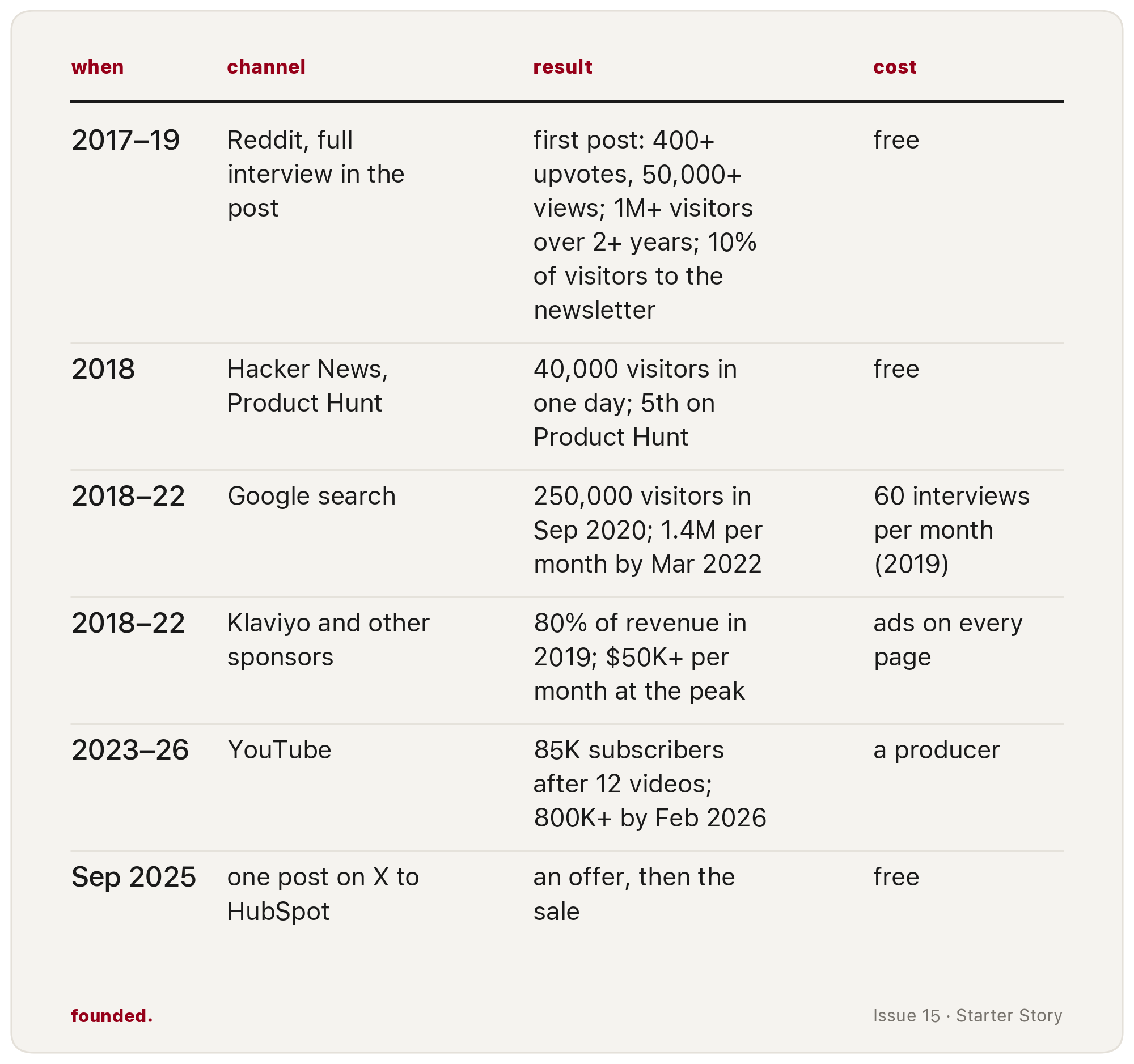
The table below lays out the channels that grew Starter Story, with the result and cost where available.
Google search
Every interview that was published to the Starter Story website was a new page Google could send visitors to. By August 2019, there were 60 interviews published each month, a record for the team. When Reddit started losing steam, Pat moved his focus to SEO, which brought in far more traffic than Reddit ever had.
YouTube
Pat started posting on YouTube in 2023, and by 2025 he said “the SEO ship is sinking.” The interview archive provided years of stories to film for the channel. The videos were also repurposed for the newsletter; signups increased tenfold as a result.
09: the tools
the product
Starter Story sold case studies of real businesses with their revenue, tools and growth tactics. The homepage reads: “Find the business ideas that actually make money.”
Readers (including myself) were reading to find proof and inspiration that someone like them had already made an idea work.
founder skillsets
Pat was a software engineer and coded the Starter Story website himself, automated the Reddit posting and built Pigeon. He also learned SEO well enough to sell a course. Sam ran operations as COO, and Gus Tiffer was hired for video production.
monetization
Sponsors and affiliate links were the first path to monetization, followed by a monthly membership that morphed into an archive accessed through a one-time payment. Later on, there were courses, bootcamps such as the AI Build Accelerator, and a private community.
Email did most of the selling. Starter Story sent its newsletter and sales emails through Klaviyo, the same email marketing company that had been its first sponsor. In a testimonial for Klaviyo, Pat said more than half of Starter Story’s revenue could be traced directly to those emails.
In late 2024, he said they brought in $80,000 to $120,000 a month. Klaviyo’s fee for sending to a list of 250,000 to 300,000 people was around $4,000 a month.
unique branding
The brand was built on sharing numbers publicly: the ones that interested people that wanted to start a business. Titles like this one: “I Built a $10K/Month App from My Mom’s Basement” caught my eye. The primary target was revenue figures because builders are after it from day one. It also makes them curious how the founder was able to create a business around the idea and monetize it.
The number-first branding was also reflected in Pat’s own journey. He shared revenue, traffic and subscriber numbers along with what he had learned on X every month since he started back in 2018. It also makes writing this case study a lot more interesting!
10: the founder’s decision: dropping the sponsors
the signal
In 2019, sponsors accounted for 80% of revenue. Klaviyo, the largest sponsor, routinely signed six- to twelve-month renewals that required selling the deal all over again. Getting to $50,000 a month solely through advertising meant hiring a salesperson. Pat grew tired of chasing advertisers because of the amount of manual work involved.
the options
Keep selling sponsorships and follow the revenue model from 2018.
Drop advertisers and sell permanent access to the archive for a lifetime price.
Keep the monthly membership and continue with advertising.
the decision
Option two. The switch from sponsorships to one-time payments was a risky move from a revenue standpoint.
the cost
At the time of the switch, sponsorships generated more than $600,000 in annual revenue. Every member now paid once to access the entire archive, which meant there was not a need to find new leads consistently.
Another question to consider (which I have sent over to Pat as well): why the full switch rather than a gradual migration away from sponsorships?
the evidence
Before the switch, Starter Story earned $79,342 (August 2022). A year later in August 2023, after the switch, the business generated $125,000 a month on average ($1.5 million a year). By April 2024 it had grown to $250,000 a month.
The switch in revenue ultimately allowed the brand to scale (similar to the switch from Reddit to SEO), and positioned the business for the HubSpot acquisition. I will mention that the YouTube channel was created that same year so there is no clear way to break out the growth sources.
There is also survivorship bias. You’re reading about Starter Story because the switch worked. Creators whose paid products didn’t sell rarely post their numbers.
the application
What caught my eye is what Tibo (from Tweet Hunter, Case Study #13) avoided like the plague: offering a product through a one-time payment.
At the price point where Starter Story sold lifetime access to the case study archive ($695) and the option that included courses and a community ($1,095), revenue was scalable and replicable as long as new leads kept coming in.
The key is that a one-time payment for a large archive like this can be much higher than for a SaaS product or a template because there is significant value associated with the purchase (more than 4,000 case studies to figure out what worked and to get ideas for starting a business).
The price point increased customer lifetime value (LTV) significantly. If you have a monthly subscription option at $30/month and the customer cancels after month three, that customer’s LTV is $90. Probably not that profitable after accounting for costs and customer acquisition costs.
Just for fun, I found this breakdown of operating costs when Starter Story was making more than $1 million a year:

With a one-time payment of $695, the customer’s value is nearly 8x higher than the monthly subscription in this example, which allowed for a higher spend on customer acquisition.
Starter Story’s archive appealed to an audience that was desperate to figure out why their business wasn’t growing or what business they should start.
The pain point meant they were willing to pay more.
The downside here is obvious: if new customers aren’t coming in as quickly as they once were or price sensitivity increases (such as in a recession), revenue takes the hit directly. A $30 a month subscription is less likely to be canceled by existing users in times of economic struggle. A one-time payment for new customers, however, is harder to sell.
The switch to access rather than sponsorships meant that revenue was fully in Starter Story’s control rather than in the hands of advertisers. That was the entire premise.
11: the quit number
The Quit Number is the revenue a business made the month the founder quit their job.
Pat’s was $1,737.84 in September 2018, the month before he quit. Neal Taparia’s at EasyBib was more than $8,000, while Tibo’s at Tweet Hunter and Julie Aigner-Clark’s at Baby Einstein both had a Quit Number of $0.
What made it sufficient was a move that adjusted Pat’s cost of living.
Living in New York, there was no chance he could have quit with that revenue (which is also pretax). Instead, Pat moved to Chiang Mai and set a budget of $1,500 a month. That meant that Starter Story paid for his expenses and he could build full time while growing revenue.
If you’re eager to quit your 9-5, this might be something to consider. Do you like Vietnam or Thailand?
12: what still isn’t clear from the research
The acquisition price and the breakdown: cash, shares, deferred payments or earnouts.
Whether the $8.3 million in HubSpot’s first-quarter filing covers everything paid for Starter Story.
Revenue and profit figures for 2024 and 2025.
Whether Starter Story maintained one-time payments after 2024.
Why Pat dropped the sponsors completely instead of keeping some alongside the paid product.
The share of 2019 ARR attributed to Pigeon and what happened to it after he switched to focus on Starter Story.
Pat’s current role at HubSpot Media.
13: the brand today
In November 2026, starterstory.com offers its database of “3,848+ real, revenue-generating projects” for free: “Free to explore, filter, and export straight to ChatGPT.” The archive that sold for $695 in 2024 now costs nothing.
The biggest button on the page reads “Get started with HubSpot for free.” When the deal was announced, HubSpot Media said its YouTube-driven leads had grown 68% year over year. The case studies still come out every week, and the paid product, “Build a business that changes your life, in less than 5 weeks,” is still offered for sale.
To answer the question of what HubSpot was buying: HubSpot was indeed paying for the audience. The archive serves as a lead magnet to funnel customers into paid courses and other tools offered by HubSpot.
FOUNDED FACT
Klaviyo paid 12 months upfront to be featured in Starter Story’s newsletter and became the first big sponsor. On September 20, 2023, Klaviyo listed on the New York Stock Exchange at $30 a share, valued at just over $9 billion.
NEXT ISSUE
Next week’s case study: BuzzBallz. Merrilee Kick came up with the idea in 2009 while grading papers by her pool, and kept teaching while she built it. In 2012 she spent $2,000 on a trade show booth in Las Vegas, and 15 states signed up in one day. In 2024 Sazerac acquired it in an all-cash deal that Forbes puts at more than $500 million. Don’t miss it.
LEARN MORE
Starter Story — “I sold my company,” February 23, 2026. Why Pat sold, the tweet and the identity question, in his words.
Pat Walls — “Dear Reddit, I’m sorry for stealing your users,” thread on X, July 20, 2023. The Reddit method, start to finish.
SOURCES
HackerNoon — Founder Interviews: Pat Walls, November 2, 2018. The failed B2B app and Y Combinator, the pet blog, three interviews at launch, about $1,700 a month, the quit “about a month ago,” running costs.
Pat Walls — “The best year of my life in 35 tweets,” December 30, 2018. $3 from Amazon, Reddit, Product Hunt, Hacker News and its 40,000 visitors, Klaviyo paid upfront and revenue to $1,000, 5:30am, the 24 Hour Startup Challenge, the quit, coworkers, credit card debt.
Pat Walls — “2019: going full time as a founder.” Chiang Mai, Bali and Vietnam, $1,500 a month and the $150 apartment, Pigeon, the second Y Combinator rejection, freelancers, 500+ interviews, 140,000 visitors, $100,000 in annual recurring revenue.
Pat Walls — threads on X: Reddit automation, August 22, 2019; the think week, “I used to rely 100% on ad revenue” and $1.5 million, June 6, 2023; “Dear Reddit,” July 20, 2023 (300 visitors in month one, the spam removal, 400+ upvotes and 50,000+ views, 1 million+ visitors, the backlash); the YouTube post, December 23, 2025.
Pat Walls — monthly updates, 2020–2022: June 2020, September 2020, November 2020, March 2021, “Updates” (May 4, 2022) and “Half A Decade” (October 5, 2022). Monthly revenue, the revenue mix, the $23,000 in ad revenue and the $50,000 goal. r/Entrepreneur, September 2022: $79,342 in August, about $45,000 profit, a team of eight. LinkedIn, January 9, 2024: the $6 million goal.
Indie Hackers — Pat Walls AMA, August 20, 2019. The 80/10/10 revenue split, Klaviyo’s deal length, Reddit at 3% of traffic, 6,000+ cold emails, 60 interviews a month, the stress quote.
Founder Stories — “How Pat Walls makes $250k/month,” May 10, 2024, quoting Pat’s posts on X. $1,737.84, 20,205 visitors and 2,956 subscribers in September 2018; the October 2018 quit; Sam’s hire at $5,000 a month and “50x”; 250,000 visitors in September 2020; Lean SEO; YouTube and newsletter milestones; the $695 and $1,095 prices.
Simon Owens — March 14, 2022 (1.4 million visitors, $500,000+, the Reddit quotes, the Klaviyo placements) and The Business of Content, August 2023 (more than $50,000 a month in sponsorships, the one-time payment, $1.5 million a year).
Growth In Reverse — February 19, 2023. Klaviyo at $4,000 a month in March 2019.
Pat Walls — “Revelations and switching it up a bit,” January 4, 2020. “I should leverage Starter Story to grow Pigeon.”
Startup Spells — November 26, 2024. The 2024 Black Friday lifetime deal (55% off, 24 hours, Pat’s quote) and the 2023 deal selling out in two hours.
Klaviyo — customer testimonial by Pat Walls (undated). More than half of revenue attributed to Klaviyo emails.
Starter Story — “How I Built A $1M Business From This Starbucks,” “9 Things That Make Me $1.8M/Year” (October 2024: the $12,000 Klaviyo check, email revenue and cost) and “I sold my company,” February 23, 2026. Age 26, the six-figure job, the Deep Work contract, the $12 domain, $12,000 at the quit, the sale quotes, Florida.
Adweek and Tech Startups — February 23, 2026. The deal, seven-figure revenue, the team, 800,000+ YouTube and 275,000 newsletter subscribers, 10,000+ paid members, the September 23, 2025 post, “too early,” HubSpot Media’s lead growth.
HubSpot — Forms 10-Q for the quarters ended March 31 and June 30, 2026 (SEC), and the Q1 2026 earnings call, May 7, 2026. $8.3 million in business acquisitions, Futurepedia’s April 3 close for about $27.5 million, the CFO naming both deals, Futurepedia’s $19.1 million in cash plus $8.6 million in pay tied to its staff staying.
starterstory.com — homepage, November 6, 2026. The free database, the HubSpot button, the sprint.
NBC New York — September 20, 2023. Klaviyo’s IPO. The FOUNDED FACT.
Every figure in this issue is drawn from public statements, interviews, filings and press coverage, and each one is listed with its source above. No interview was conducted with the founder. Starter Story was a private company and published no financial statements, so revenue figures are as the founder and the press reported them, the price was not disclosed, and the deal figure is our reading of HubSpot’s filing. None of it has been independently audited.