


Most tools I use for founded. are free. My budget is $0 until something proves it’s worth paying for, and even then I’ve capped it at $50 a month. The only subscriptions I willingly pay for are Claude and X Premium.
My philosophy is that I use the best tools available that really move the business forward but don’t use ones that only provide a slight edge. I want the leanest business I can possibly build.
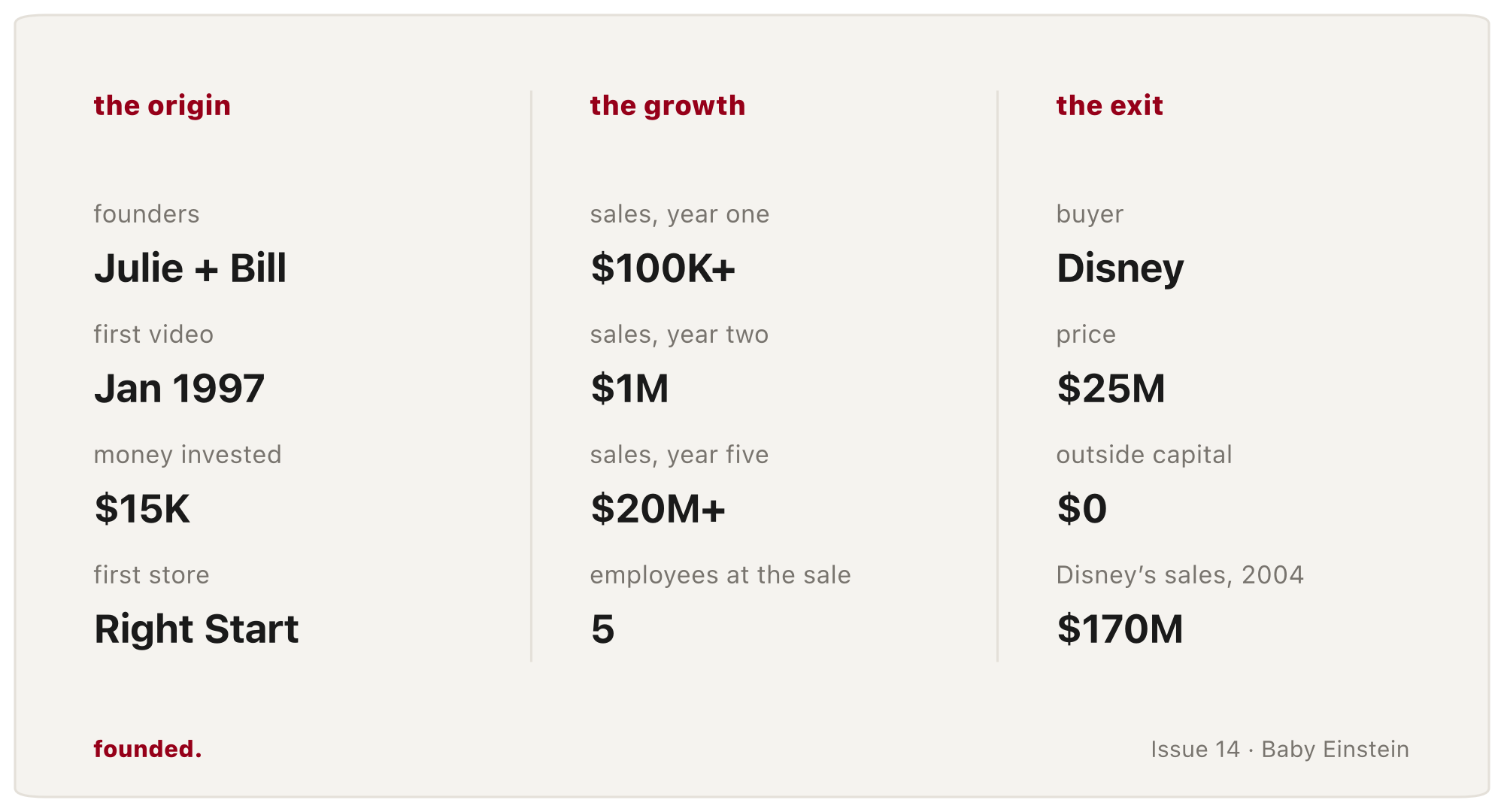
So when I learned that Julie Aigner-Clark put $15,000 into one video for babies before she had a single customer, I did what I do at work every day: I looked at the risk, which was alarmingly asymmetric. That $15,000 was half of her salary as a teacher and she had no distribution or plan.
Would I put half of my salary into founded. before it earned a dollar? Not unless there was a clear reason to.
The crazy thing is that the risk paid off, which unsurprisingly is likely also why you’re reading this.
Five years later, that video had morphed into a company doing more than $20 million a year in sales with five employees.
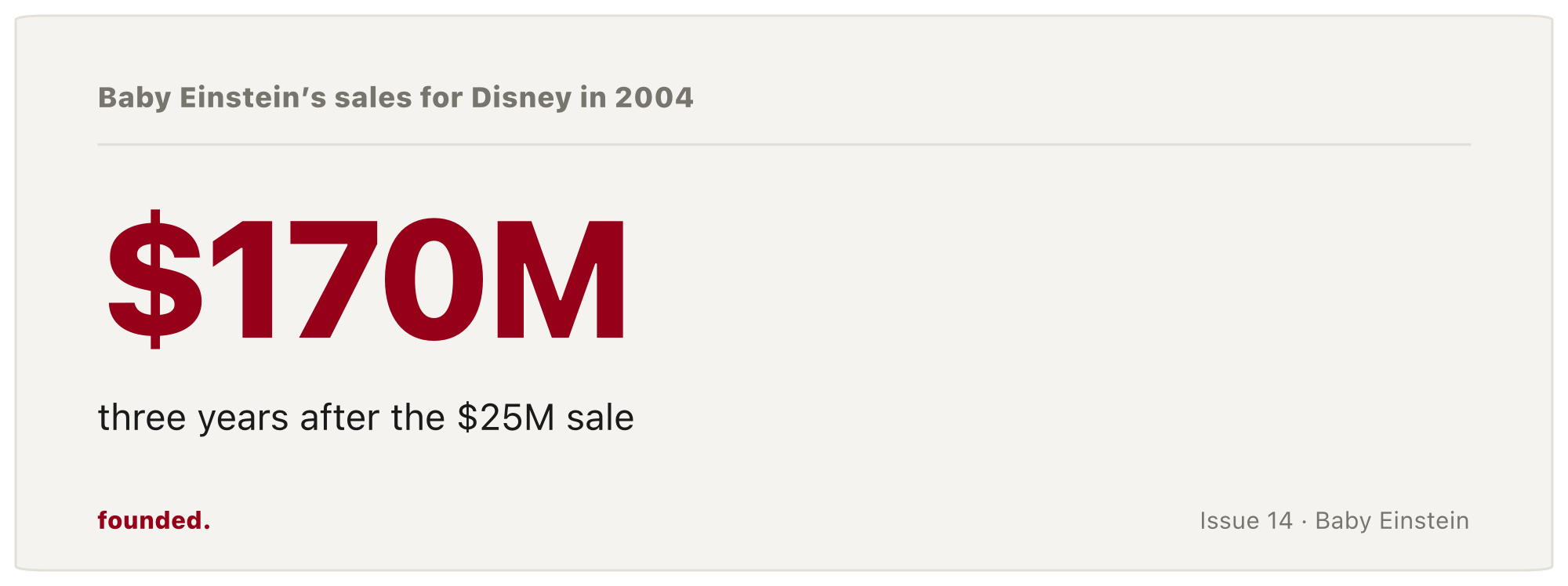
Julie sold it to Disney for $25 million and three years later Disney was generating $170 million annually from Baby Einstein.
I had a lot of questions, but two big ones stuck with me while I researched:
How does a teacher with a camcorder in her basement get to $20 million in revenue?
Was the business sold too early?
before we dive in
Baby Einstein made videos for babies and toddlers. Each one set classical music, nursery rhymes, toys and simple images against plain, high-contrast backgrounds. The titles say it all: Baby Mozart, Baby Bach, Baby Shakespeare and Baby Van Gogh. Later the content was turned into DVDs, CDs, board books and flashcards.
The founders are Julie Aigner-Clark, a former high school English teacher, and her husband Bill Clark, who had a physics background and later became the company’s CFO. They started in their basement in Alpharetta, Georgia.
If you have a product you make once and sell many times, like a course, a template or a digital download, this one applies to you.
The hardest question to answer: should you sell when the business is still small enough to run solo or should you hold out for the bigger number?
What we found out:
Sell a piece of the business to a company that can distribute it. Baby Einstein never raised money, but in February 2000 the Clarks sold Artisan Entertainment 20% for $2.3 million, and Artisan got three years of video distribution in the US and Canada. Sales went from $4.5 million to $12 million that year. (Similar to the story for Tweet Hunter).
Your licensee is a likely buyer. Disney signed an exclusive deal to make Baby Einstein books in March 2001 and owned 100% of the business eight months later.
Go where your buyer already shops. Julie had no booth at Toy Fair in New York. On the second day she found buyers from The Right Start, the store she shopped at for her own baby, and left with an opportunity.
Ask for attention before you have traction. Julie called CNN before she had sold a single video. The interview brought in her first orders.
Name your price first. The Clarks asked Disney for $25 million and Disney accepted without negotiating. No bankers were involved. It does, however, make you question what Disney was willing to pay.
01: six months of salary
Julie grew up in Michigan and was the first person in her family to go to college. She studied English at Michigan State University and moved to New Jersey to teach middle and high school English.
She left her job to be a stay-at-home mom after her first daughter, Aspen, was born. As a new mom she went looking for ways to share the things she had loved teaching, such as art, poetry and classical music, with her baby.
At the time, there wasn’t much available, so she decided to make them herself.
The new parents took $15,000 from a savings account to fund Julie’s idea.
She borrowed video equipment from a friend, found a producer in the Yellow Pages and filmed the first video in their basement. I love how she describes the early days:
It was literally me pushing ‘play’ on the Beta Cam and dragging a cat across a table with fishing line.
— Julie Aigner-Clark, to the Associated Press
It wasn’t a fancy studio creating these videos, it was a mother in a basement with a camcorder. It doesn’t get more wholesome than that.
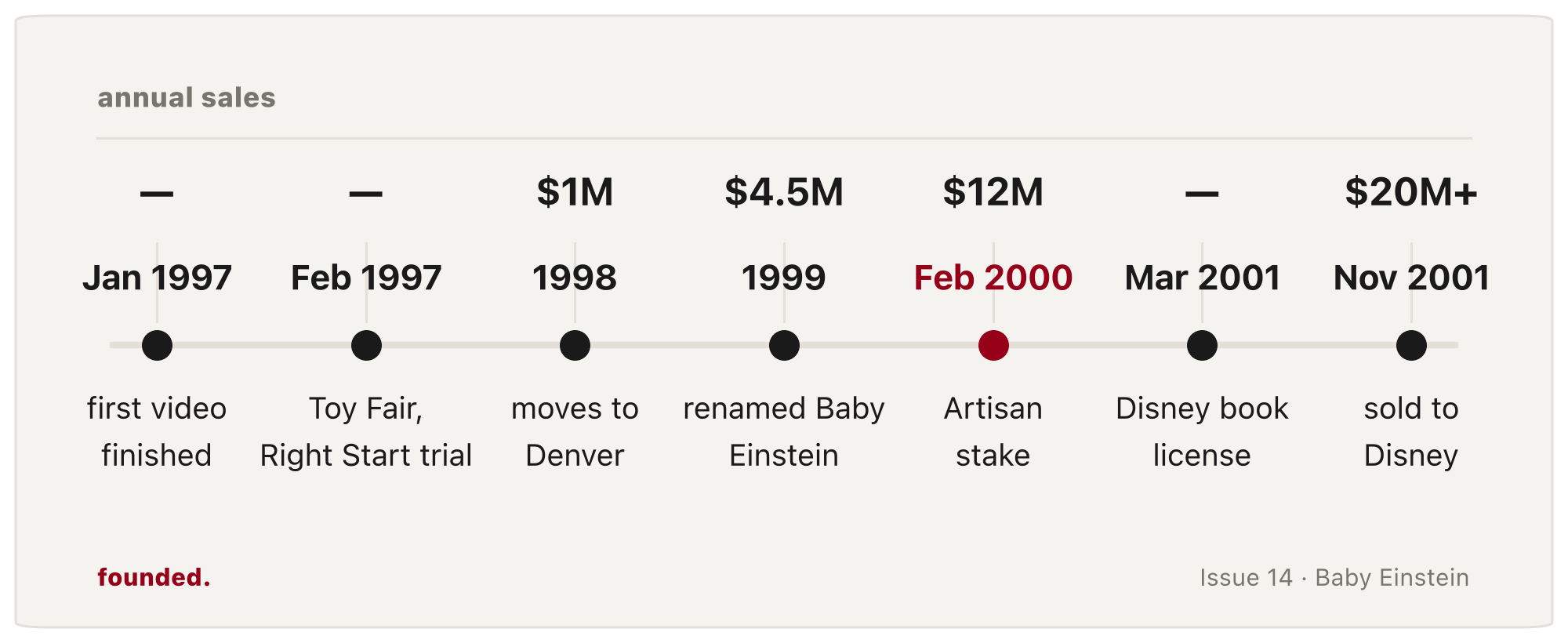
She finished the first video in January 1997 and called it ‘Baby Einstein’. It featured nursery rhymes in several languages and the toys Aspen liked most.
At that time, Bill was working for a company that designed science lessons for elementary schools.
02: no booth at Toy Fair
Before selling anything at all, Julie called CNN in Atlanta. She told the parenting producer the truth:
I have not sold one product.
— Julie Aigner-Clark, to Inspired Insider
The producer arranged an interview anyway and it kickstarted the brand. Whether this was luck or determination, I’ll leave to your discretion. Julie seems to think it was both: “I would not have been lucky if I hadn’t made that phone call.”
The first orders came through CNN’s website and came from as far as Japan.
At the time, online orders were new. Parents primarily bought baby products in stores. In February 1997, Julie went to Toy Fair in New York, the toy industry’s trade show, and brought copies of the video on VHS.
She didn’t have a booth because it was her first time at a trade show; she didn’t know she needed one and she couldn’t afford it.
Her goal was clear: she wanted to get into The Right Start, a small chain of baby stores where she had bought baby supplies for Aspen. She knew its customers because she was one.
On the second day, I found a group of women from Right Start, and I attacked them because I was so excited.
— Julie Aigner-Clark, to Kiplinger
The Right Start agreed to test the video in its stores, but it didn’t take long: “They tested it in stores, but the truth is it sold so instantly.”
new parents and word of mouth
Baby Einstein practically sold itself, primarily because parents share what works for their kids. In Julie’s words: “Parents would take it home, babies loved it, and there was amazing word of mouth.”
The press pushed it even further. Parenting Magazine called Baby Einstein its Best Video of the Year in 1997 and People was the first major magazine to feature it. Julie handled it all herself.
Sales passed $100,000 in the first year, more than three times her teaching salary. In the second year sales grew to $1 million.
The key was that none of the growth required capital. As Julie put it, “Duplicating videos is not very expensive,” so sales paid for the next batch of tapes. Bill handled the purchase orders, the billing, and the shipping, all of which was done from the Clark garage.
03: the Artisan trade
In 1998 the family moved to Denver. The company was renamed twice, first Aigner-Clark Productions and then, in 1999, The Baby Einstein Company. Bill eventually quit his job and became CFO.
Videos that followed were all made with the same style. Each new title could be sold to parents who had already loved the first video, which helped sales grow to $4.5 million in year three.
The next move allowed the brand to be taken to mass market.
In February 2000, Artisan Entertainment, a film and home video company, bought 20% of Baby Einstein for $2.3 million cash. As part of the deal, Artisan acquired the rights to distribute Baby Einstein videos in the US and Canada for three years, with an option to buy the rest of the company.
That valued the whole company at $11.4 million. The cash went to the founders, not the business, and the stake went to a company that specialized in getting videos like Baby Einstein into retail stores.
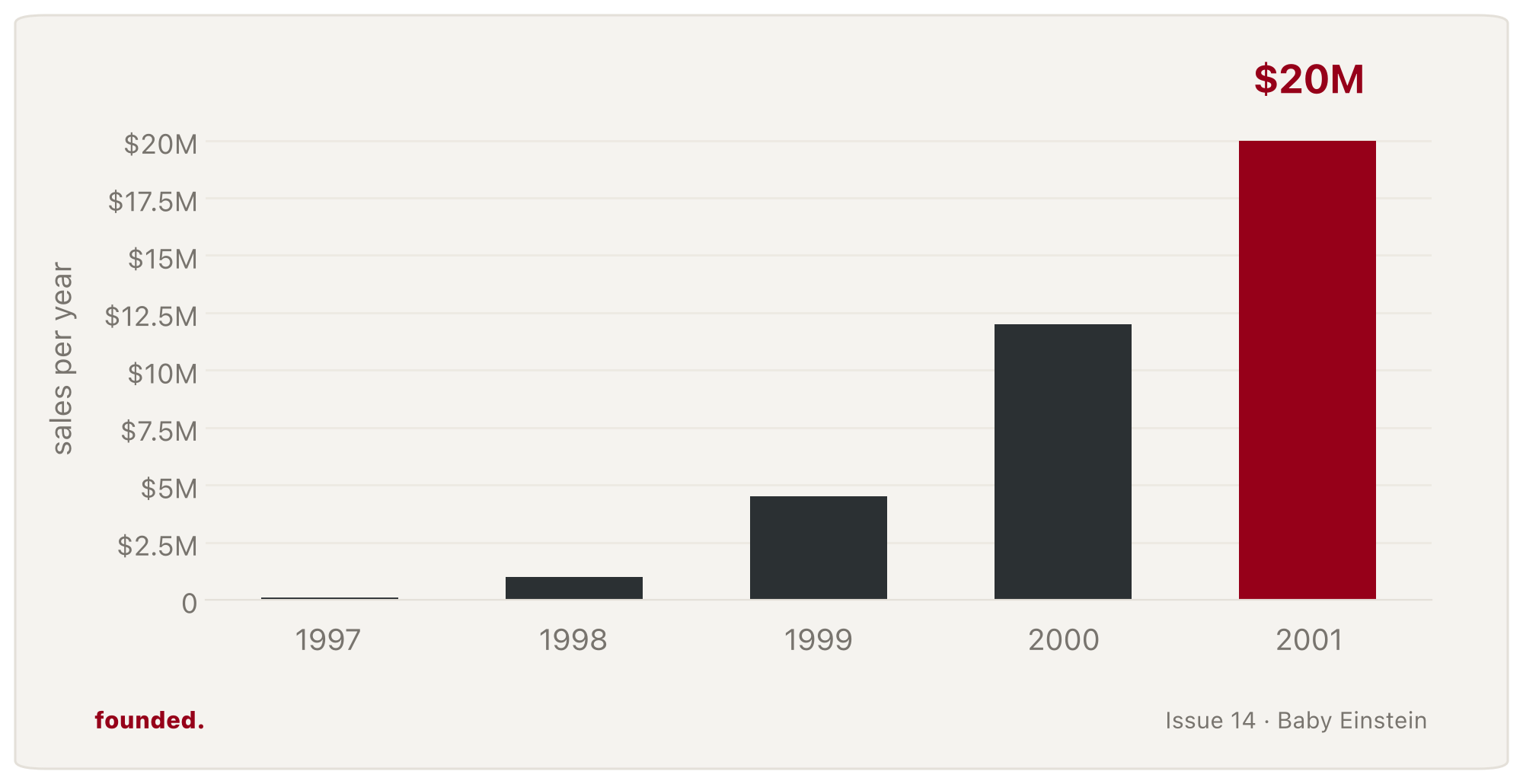
In the first year of the deal, sales nearly tripled to $12 million.
As someone who is at the front lines of evaluating risk in my day job, selling a stake to a distributor was a little concerning. Distributors typically get a portion of sales they generate, not a piece of the company.
But for a brand with no sales team, it was the biggest and best shot Julie had. Building a network like Artisan’s from scratch would have cost far more than a 20% stake. The Clarks were paid personally and incentives were aligned; Artisan now owned a piece of the brand so if it grew it was good for them as well.
The second deal was with a bigger partner: Disney. Around year three, Disney Publishing approached the Clarks about Baby Einstein. By March of 2001, an exclusive, multi-year licensing agreement had been signed. Baby Einstein books and toys hit retail that fall.
By year five, more than 50 Baby Einstein books had been published and Costco and Walmart had shown interest in carrying the brand.
the broken rules
Baby Einstein differed from traditional children’s media in three ways:
Most children’s videos came from studios with big budgets. Julie made hers in a basement, and the company never raised capital.
Most children’s videos were made for kids old enough to follow a proper show. Baby Einstein was made for babies as young as one month.
Most companies paid distributors a cut of every sale. Julie and Bill sold one of them a minority stake and put them to work.
04: naming her price
By 2001, Baby Einstein was generating more than $20 million a year in revenue with five employees ($4 million per employee).
This also caused some problems.
Julie worked out that to keep up with demand, she would need to hire 50 more people. Neither she nor Bill wanted to run a company of that size.
As she put it to Mixergy: “I didn’t want work to take over my life, and it was beginning to do that.”
The second problem was competition. She worried that bigger players, and she named Disney and Viacom, would move in and overtake them. “I can either try to compete with them... or I can sell.”
So they decided to sell. And they knew who to call first:
We knew Disney would be interested because they were already licencing the name for books from us.
— Julie Aigner-Clark, to Inspired Insider
The Clarks named their price: $25 million. Disney accepted with no counter or negotiation. There were no bankers or advisors involved and the deal closed six months after the offer, just weeks after the 9/11 attacks.
Julie credits a boring habit for how smoothly the sale went: an outside accounting firm kept the company’s books in order every month so there was nothing to clean up when Disney did their due diligence.
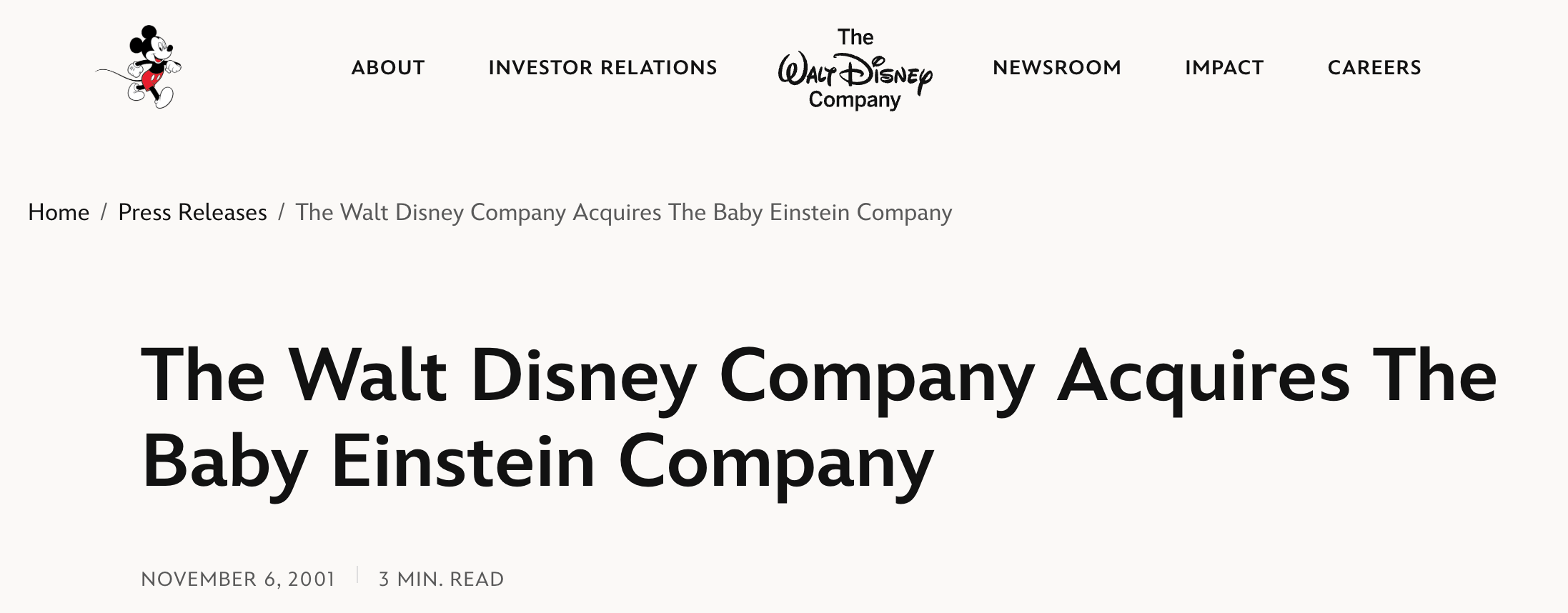
The deal was announced on November 6, 2001. Disney president Bob Iger called Baby Einstein “another high quality brand franchise.”
When the company was sold, the founders gave a substantial amount of money to key employees.
too early?
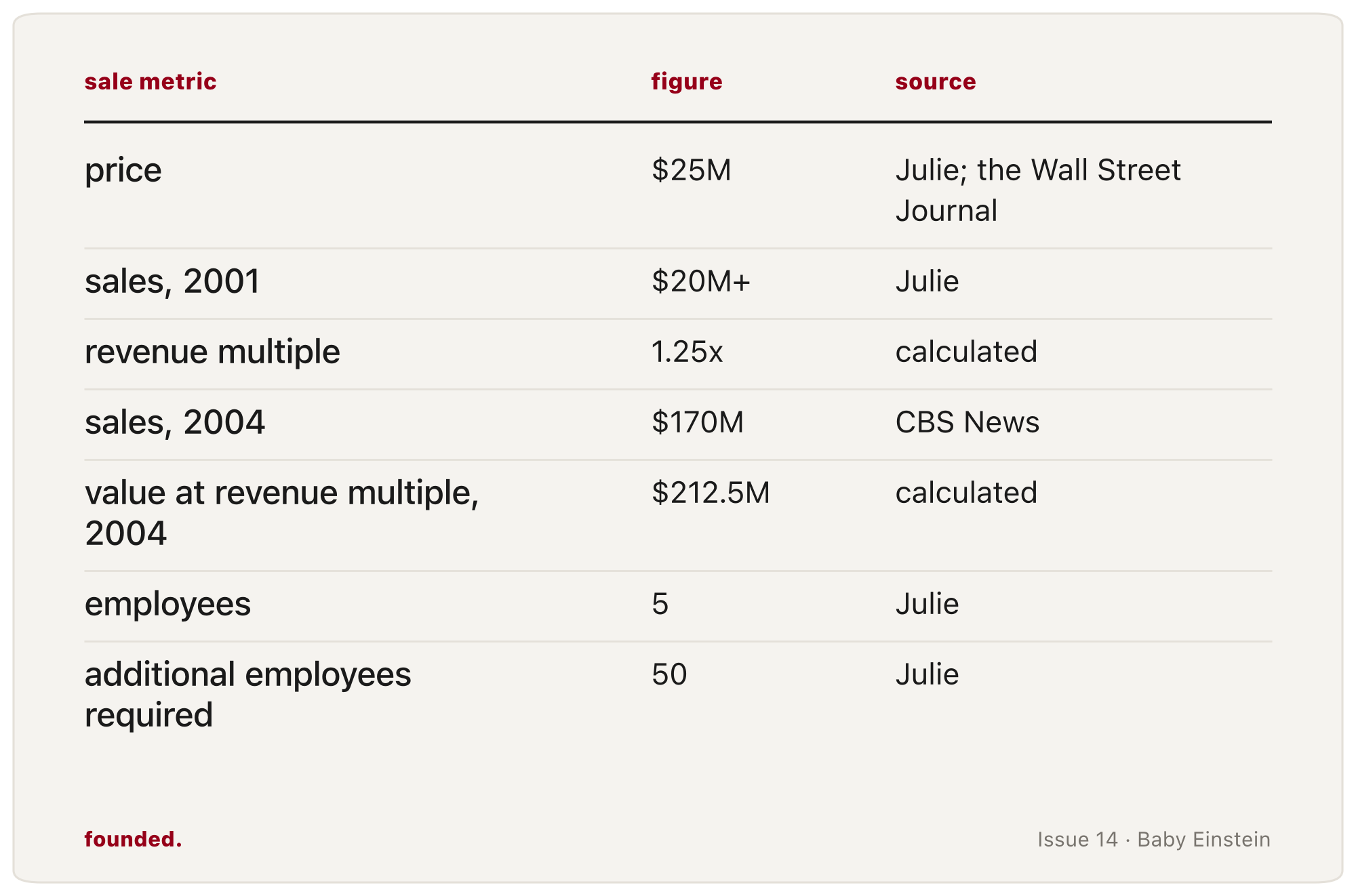
A big question for me was if the price the Clarks asked for was too low. Disney paid just 1.25x revenue, based on what Baby Einstein made that year.
Three years after the deal closed, sales had grown to $170 million on Disney’s books, more than 8x annual sales at deal closing.
At the same revenue multiple valuation of 1.25x, a business with that much in sales would have been worth $212.5 million, 8.5x the price paid to the Clarks.
05: buying freedom
founded. is about more than how founders built and sold. It’s about what building bought them: freedom of time, location and money while not having to answer to anyone. Julie sold to get back one specific type of freedom.
time
Time freedom was the reason for the sale. Baby Einstein was “taking a lot of time away from family.”
After the sale, she spent “a good year and a half or so” retired, traveling and with her daughters. She said the sale gave her “the freedom to do those things.”
location
The family had already moved from Atlanta to Denver before the sale, so the business had already given them location freedom. What the sale changed was how far they could travel with the newfound financial freedom.
Julie has been to every continent, including Antarctica, and in 2008 the Clark family was planning a year-long trip around the world with Aspen and her younger sister, Sierra.
money
The sale meant Julie could fund whatever came next. Travel, another business, or whatever else she chose to do.
What she did do was mostly for kids. She made The Safe Side, a series of child safety videos with John Walsh, the host of America’s Most Wanted, with proceeds going to the National Center for Missing and Exploited Children. Later came WeeSchool, a free parenting app for families with children up to age three.
no boss
This is where the sale cost her the most. For five years while building Baby Einstein, Julie had full creative control. After the sale she was a consultant to Disney, on an eight-year consulting and non-compete agreement. She had a boss again:
Now suddenly I had to explain myself.
— Julie Aigner-Clark, to Alejandro Cremades
She also found that “the big company wasn’t so interested anymore in hearing what the little guy had to say.” In her view, the consulting part “was more non-compete than a consulting.” She directed her last Baby Einstein video, Baby Beethoven, in 2002.
She explained that she has “no regrets” and that selling “was a hard decision.”
Was the sale too early? From a financial perspective, absolutely. On paper, a lot of money was left on the table, though it’s unclear whether the Clarks could have reached $170 million even with 50 new hires. Disney had distribution advantages in retail, online and brand recognition that they didn’t.
From a freedom perspective, it was perfect timing. The business was growing too quickly and required significantly more work and hours to get to the next level. Julie wanted time to spend with her family, not to run a large corporation. She was paid for the business she had built up until that point, not what it could be.
The story started with a teacher making videos in her basement, dragging a toy cat across a table with fishing line. It ends with her selling to Disney and walking away with life-changing money to spend a year and a half with her kids.
06: the growth channels
The table below lays out the channels that grew Baby Einstein, with the result and cost where available.
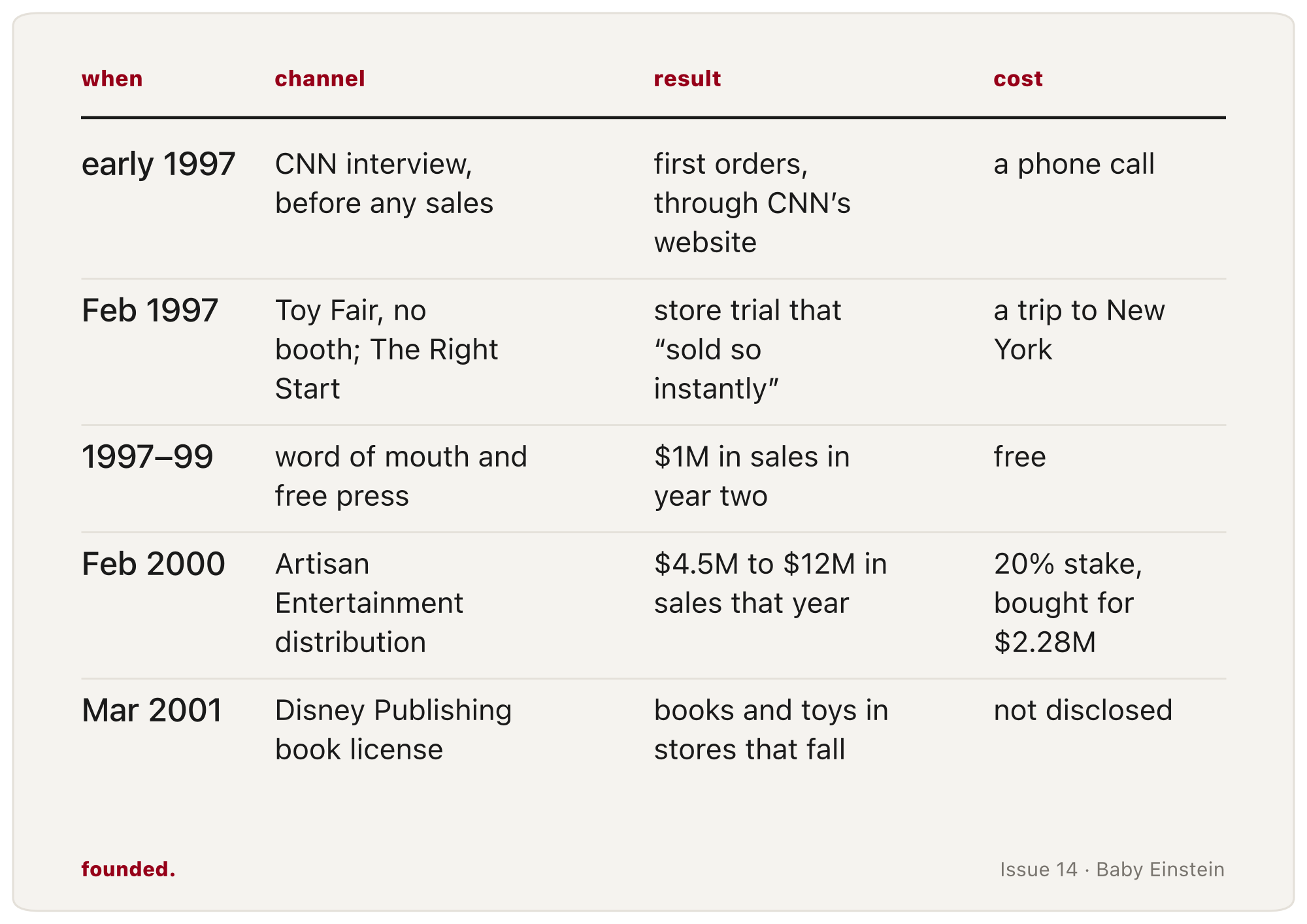
the CNN call
There was nothing to report on, but CNN had an audience of parents. Julie offered a story it couldn’t get anywhere else: a teacher who had made a video for babies in her basement. The interview put her in front of buyers before retail had even been considered.
the first store
She didn’t need to convince a big retailer that babies wanted to listen to classical music. She only needed one store whose shoppers were an exact match for her customers to put her tapes on the shelf.
It also gave her proof. A tape that sold that quickly in a specialty chain was an easy pitch to the next retail chain.
07: the tools
the product
Baby Einstein sold videos that included music, toys and images for babies from one month to three years old.
My thought is that parents were buying the feeling that they were giving their baby a head start.
The name supports this as well. “Einstein” promised a smarter baby.
founder skillsets
Julie was a teacher and a creative mind. Her teaching background qualified her to create educational content in a way that engaged babies. She created and directed early videos.
Bill had the business brains and later ran the finances as CFO.
monetization
Baby Einstein sold physical products in retail stores.
Licensing brought in revenue from books and toys without Baby Einstein having to make and sell them directly.
unique branding
The video titles were the brand: every one paired a baby with a genius, so parents knew exactly what they were buying.
Julie’s own advice on the product side: “you should always find out what people expect. And then give them more.”
08: the founder’s decision: selling at $25 million
the signal
Five employees could no longer keep up with demand, Julie wanted her time back, and bigger companies were moving into the market.
the options
Hire 50 people and keep trying to grow with increased stress and time commitment.
Grow through additional licensing deals, like the one with Disney Publishing.
Sell to Disney at a price the Clarks decide on.
Pursue Artisan to buy the rest of the company under its purchase option.
the decision
Option three was the way to go.
They called Disney, asked for $25 million and got the deal done without negotiation.
the cost
Sales growth was the biggest cost. From $20 million at the sale to $170 million three years later. Julie also gave up the creative control she valued most when consulting for Disney, exacerbated by an additional eight-year non-compete clause.
the evidence
Under Disney’s direction, Baby Einstein added toys and toothpaste product lines in addition to the TV series Little Einsteins in 2005.
The brand also came into some trouble. In 2006, a children’s advocacy group filed a complaint with the US Federal Trade Commission over the educational claims of the videos. In 2009 Disney offered refunds to parents, something that was on Disney’s watch and not the Clarks’.
There is also survivorship bias. Plenty of small companies sell to a big buyer and disappear. You’re reading about this one because the brand exploded after the sale. Pura Vida (Issue #7) lost most of its value under Vera Bradley after Apple’s app-tracking changes and was sold a few years after acquisition at a 99% discount.
the application
The interesting takeaway from this story is the licensing agreement and distribution with Artisan.
The brand had been established in a way that parents trusted the content that was being sold and were under the impression that the videos made their babies young ‘Einsteins’. This marketing was scooped up first by Artisan, which saw the brand potential and brought it into many retail outlets. Disney followed that with a licensing deal. The media giant saw an opportunity to use existing distribution channels to grow the brand exponentially, seeing how parents adored the videos.
If you’re on a mission to create a meaningful brand, licensing can be a useful tool. It gives another company creative control to use your brand while not giving you additional work. It can also contribute significant revenue (depending on the size of business you choose to license to).
For personal brands and creators, this becomes a bit trickier. Companies are more likely to work with you on a brand deal or as an affiliate rather than seeking a licensing deal. It is most effective if there is a strong trust and brand affiliation already and the company can leverage that with their existing channels to drive growth.
The one way a well-known creator or personal brand can use licensing is with other creators. Say you are a well-known personal finance or productivity creator such as Ali Abdaal for example.
If you sell a personal finance course, you might consider licensing or an affiliate program. The brands or creators that want to license your course are likely leaning on your brand affiliation and the trust you’ve built.
The structure can be rather simple: a 12-month licensing agreement to sell the course through their network with your branding, with a share of course sales paid directly to you. It pays you well, and the other creator leans on the trust you have built for your brand.
The other consideration here is the final amount that ended up in the Clarks’ pockets.
The sale price was $25 million. However, there are several costs that likely reduced the final amount significantly.
Artisan’s share. The company acquired 20% of Baby Einstein in February 2000 for $2.3 million. That share became worth $5 million on the $25 million sale price, assuming Artisan still held it at the sale. The Clarks’ share of the sale was $20 million.
The generous amounts paid to employees. Again this isn’t public so I am making an assumption. $100,000 paid to each employee means that $500,000 was paid out and the total is reduced to $19.5 million.
Finally, taxes. Married joint-filing taxes on the $19.5 million would be approximately 24.6% or $4.8 million, assuming it was structured as an asset sale: the 20% federal long-term capital gains rate in 2001 plus Colorado’s 4.63% income tax.
This means the Clarks’ net payment was approximately $14.7 million. Enough to earn an average of $1 million per year if invested at a 7% return. Not bad from a teacher’s salary of $30,000 five years earlier. This leaves out the $2.3 million Artisan paid the Clarks in 2000, roughly $1.7 million after tax.
09: the quit number
The Quit Number is the revenue a business made the month the founder quit their job.
Neal Taparia’s Quit Number at EasyBib was more than $8,000 a month. Tibo’s at Tweet Hunter was $0. Julie’s was also $0. She left teaching before Baby Einstein ever existed.
What made a $0 Quit Number possible was the same reason as last week: a backup. For Tibo it was French unemployment benefits. For Julie it was Bill’s paycheck and $15,000 in savings. When Bill finally quit his job isn’t documented publicly.
That’s two $0 Quit Numbers in a row, and both had something paying the bills in the background. Something to keep in mind for your own venture.
10: what still isn’t clear from the research
Whether there was any component of the sale that was not cash.
Exact sales each year. Kiplinger gives $12 million for 2000; an Associated Press report from 2001 gives more than $11 million and a forecast of $17 million for 2001.
Whether the Clarks weighed licensing or Artisan’s purchase option as alternatives to selling. Julie has only described growing or selling.
What share of each sale Artisan kept as distributor.
Whether Artisan still had a 20% stake at the acquisition.
Profit figures at any point in the journey.
11: the brand today
Disney owned Baby Einstein until October 2013, then sold it to Kids II, a toy maker in Atlanta that had made Baby Einstein toys under license. The price was not disclosed. Kids II, now Kids2, still sells Baby Einstein toys and digital content and describes it as a “curiosity-led” early learning brand.
The later years under Disney were rough. A 2007 University of Washington study linked baby videos to weaker language scores. The Clarks disputed the study and sued, and in 2010 the university paid $175,000 toward their legal fees and released its data. Kids2 doesn’t publish sales for the brand, so there is no telling how the brand is performing.
FOUNDED FACT
In January 1998, Georgia’s governor Zell Miller asked for $105,000 in the state budget to give every newborn in Georgia a classical music CD or cassette. The idea came from the “Mozart effect,” a 1993 study in Nature. The people in that study weren’t babies. They were 36 college students, and they listened to 10 minutes of Mozart.
NEXT ISSUE
Next week’s case study: Starter Story. Pat Walls started it in 2017 as a side project next to his full-time engineering job and quit once it was profitable. In 2026, HubSpot bought it. What changed when he stopped relying on ads?
LEARN MORE
Mixergy — Julie Clark interview, November 22, 2013. Toy Fair, the Right Start test, why she sold and the non-compete, in her words.
Alejandro Cremades — Julie Clark on investing $15,000 in her startup and selling it for $25 million. The price, the six-month deal and life as a Disney consultant.
SOURCES
Alejandro Cremades — Julie Clark interview. Half her teaching salary, borrowed equipment, the basement shoot, Bill’s orders and shipping from the garage, People and Parenting, no PR firm, no outside money, Disney Publishing approaching in year three, 50 more books, Costco and Walmart, 50 more people needed, Disney and Viacom, the $25 million price accepted without negotiation, no bankers, six months, after 9/11, the accounting firm, “explain myself,” WeeSchool.
Mixergy — Julie Clark, November 22, 2013. Michigan, January and February 1997, the Right Start test and “sold so instantly,” over $20 million with five employees, “take over my life,” “compete with them... or I can sell,” the eight-year non-compete and consulting, “freedom to do those things,” “no regrets,” The Safe Side proceeds.
Inspired Insider — Julie Clark interview, May 27, 2014. First in her family to go to college, the CNN call and “I have not sold one product,” Toy Fair with no booth, the Right Start as her own store, “already licencing the name,” gifts to key employees, a year and a half retired, “the little guy,” “a hard decision,” “give them more,” every continent.
Kiplinger — “Baby Einstein: The Video That Took on a Life of Its Own,” May 13, 2008. $15,000, Aspen, the Right Start quote, word of mouth, sales by year ($100,000+, $1 million, $4.5 million, $12 million, $20 million+), Bill’s physics background and CFO role, “time away from family,” more than $22 million, Centennial, the trip around the world, Sierra.
Associated Press via AccessNorthGa, 2001. Michigan State, teaching in New Jersey, Atlanta, the Yellow Pages producer, the Beta Cam quote, CNN’s website and Japan, Bill’s curriculum job, $11 million+ and the 2001 forecast, Lone Tree office.
Artisan Entertainment — Form S-1, February 18, 2000 (SEC). The minority interest in February 2000, the option on the remaining equity, three years of US and Canadian home entertainment distribution, infants 1 to 36 months.
Artisan Entertainment — Purchase Agreement for The Baby Einstein Company, LLC, February 4, 2000, filed as an exhibit to its Form S-1/A (SEC). 20% for $2,275,981, paid to Julie and William Clark; the purchase and call options; tag-along and drag-along rights. founded. Issue 7 (Pura Vida) — the 2025 sale for $1 million.
The Walt Disney Company via Writers Write, November 7, 2001, and Publishers Weekly, November 19, 2001. Iger quote, the titles, consultants, the March 2001 exclusive license, the Wall Street Journal’s $25 million.
CBS News — June 24, 2005. $170 million for Disney in 2004, The Safe Side and John Walsh.
Wikipedia — Baby Einstein. Alpharetta, 1996 founding, renames in 1998 and 1999, the Denver move, Baby Beethoven in 2002, Little Einsteins in 2005, the 2006 FTC complaint, the 2007 study, the refunds, the 2010 settlement, the 2013 sale to Kids II.
Kids2 newsroom — Baby Einstein brand. The “curiosity-led” positioning and Hello Einstein.
NPR — January 13, 1998, and Scientific American — “Fact or Fiction?: Babies Exposed to Classical Music End Up Smarter.” The FOUNDED FACT.
Indie Hackers — Pat Walls AMA, August 20, 2019, and Simon Owens’s Media Newsletter — March 10, 2026. The next issue.
Every figure in this issue is drawn from public statements, interviews, filings and press coverage, and each one is listed with its source above. No interview was conducted with the founders. Baby Einstein was a private company and published no financial statements, so revenue and deal figures are as the founders and the press reported them and have not been independently audited.
Incredible breakdown! This was a gamble that paid off, but I don't think I would be willing to take that risk if I was her.
Great read!
And yes, one could argue they sold too low, but I like your point that they were really buying freedom, peace of mind, and a comfortable life for their family. That’s hard to put a price on.
Also, the reminder to always give customers more than they expect is great advice. I’ll be keeping that one in mind.